Loading cart…
No products in the cart.

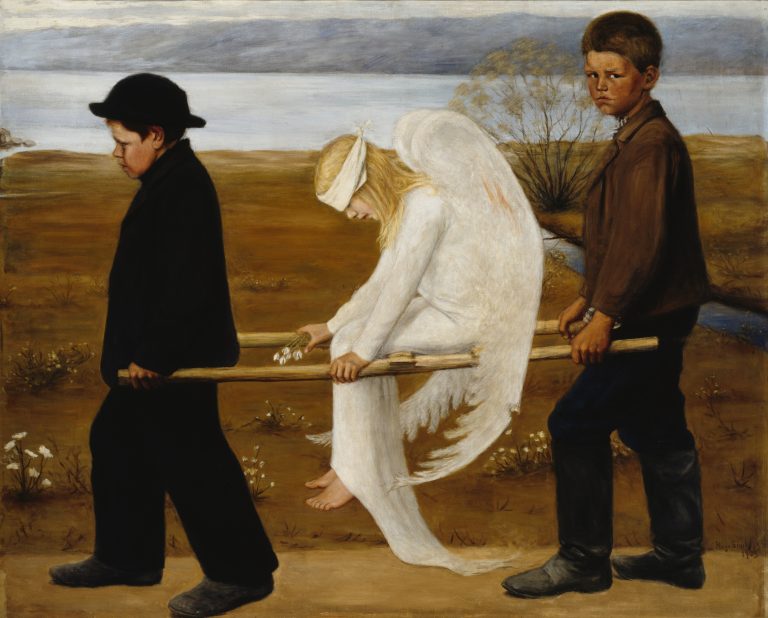
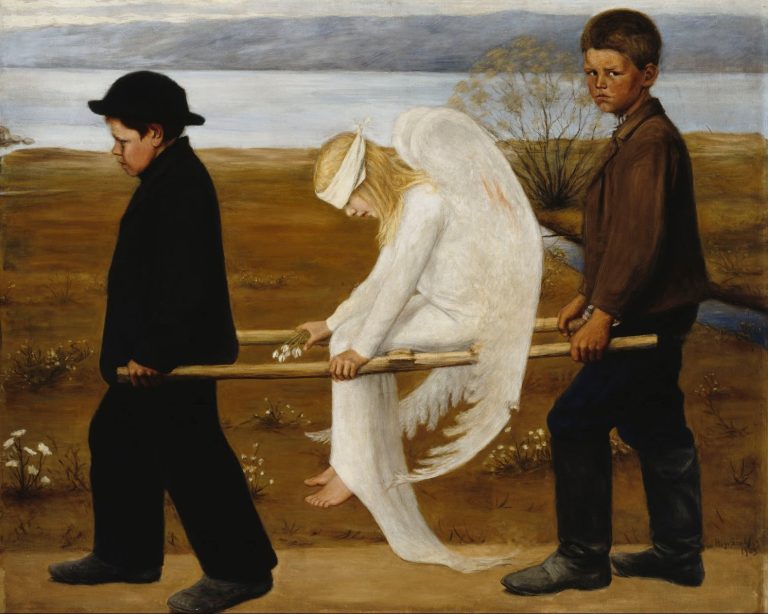
1903 · Oil on canvas · Finnish National Gallery / Ateneum Art Museum, Ahlström Collection
Save articles to your collection
Log in or create a free account, and this article will be waiting in your Private Collection.
Log in or sign up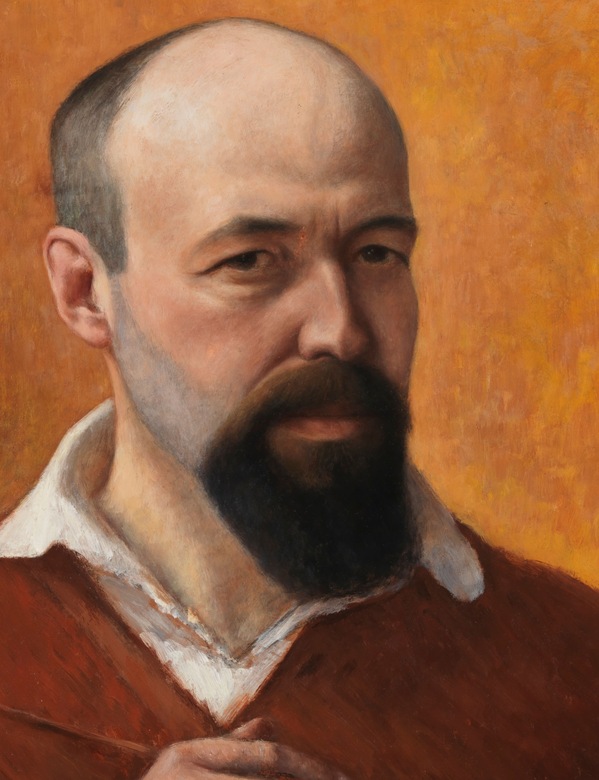 Explore the artistHugo Simberg →
The wings are still there. They simply cannot carry their owner.
In Hugo Simberg’s The Wounded Angel, two boys walk along a lakeside path with a stretcher between them. A small angel sits on it, head lowered, eyes covered by a white cloth. One hand grips the wood. The other holds a few white flowers. The boys’ boots move across the earth while the angel’s bare feet hang above it.
There is no visible attacker, no fall from the sky and no miraculous recovery. Simberg gives us the difficult interval after an injury, when someone has to carry the person who cannot walk. Making that person an angel turns an ordinary act of assistance into something harder to explain.
Painted in 1903, this Finnish Symbolist work is often read through compassion, wounded innocence or spiritual suffering. Those are ways into the image. The scene leaves room for disagreement about what has happened and what will follow.
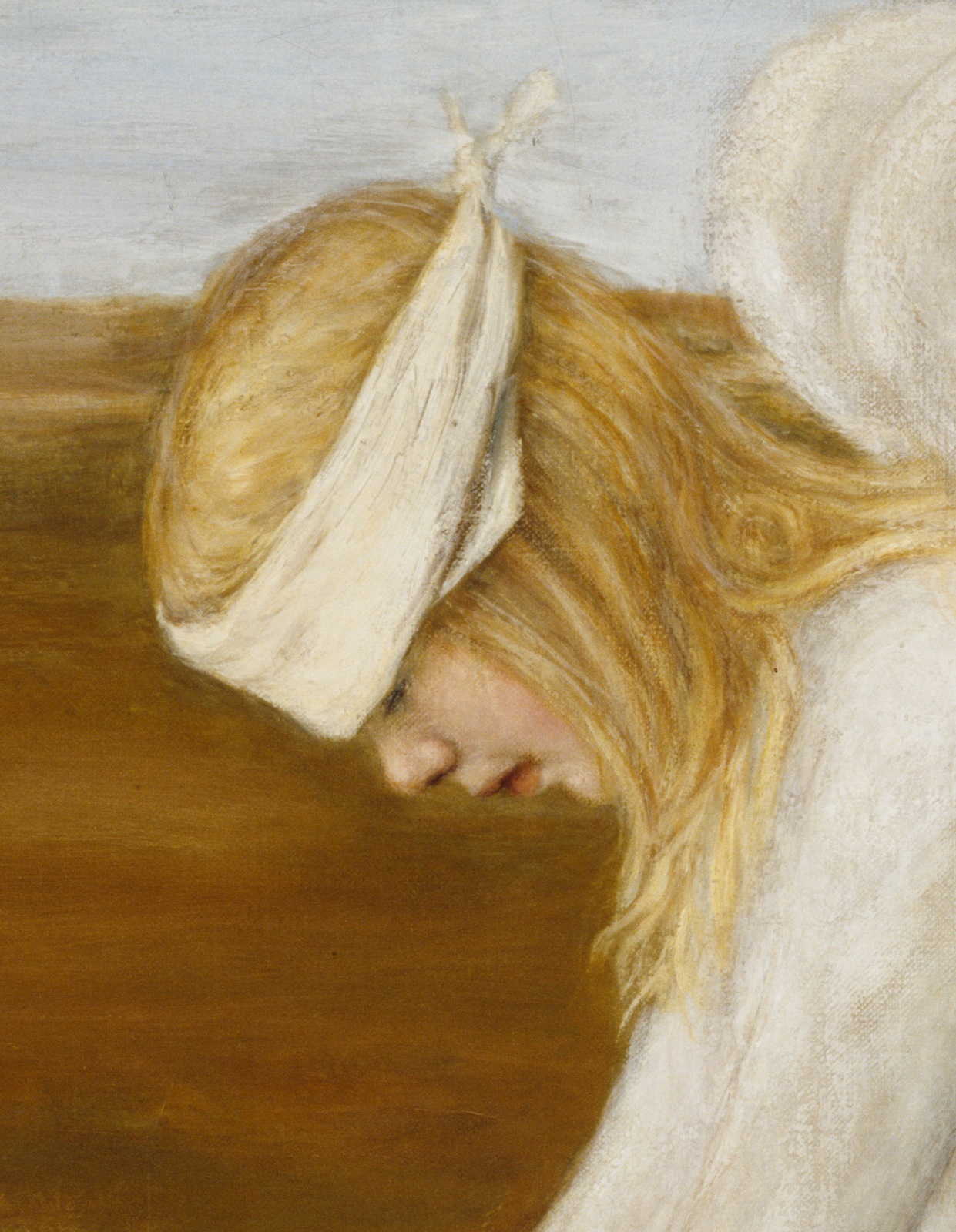
The white bandage passes across the angel’s eyes and rises above the blond hair. The nose, mouth and chin remain visible in profile. With the whole head bowed forward, the cloth becomes more than a small medical detail: it closes the part of the face through which we usually look for an answer.
The angel cannot return our gaze as the boy at the rear does. We have to read the lowered head, the grip on the stretcher and the weight of the seated body instead. The posture suggests exhaustion, but it does not tell us whether the angel feels pain, resignation or something we cannot name.
That uncertainty matters. The figure appears vulnerable enough to recognise as a hurt child, while the wings keep the encounter outside ordinary experience.
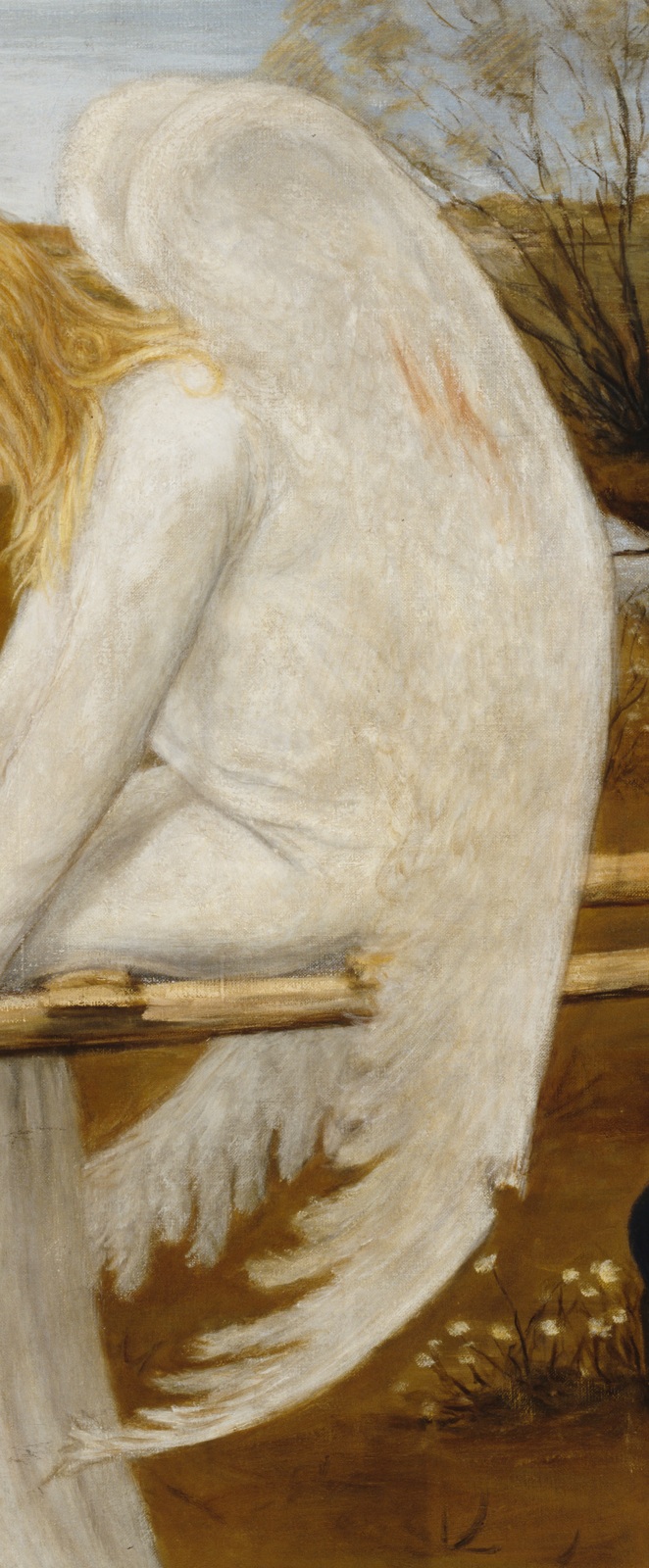
Reddish marks interrupt the pale upper wing. Farther down, long feathers separate and curve toward the ground beside the stretcher. The wing remains conspicuous and beautiful, but its downward movement makes flight feel remote.
The surrounding whites also differ. The garment falls in folds; the wing has a soft, feathered surface; the bandage wraps firmly across the face. Simberg lets the same pale colour describe clothing, injury and the feature that identifies the figure as an angel.
It is tempting to supply a dramatic cause for the wound. The painting supplies none. Nothing visible establishes punishment, a battle or expulsion from Heaven. Its subject is the injured being before us, rather than an illustrated explanation of the injury.
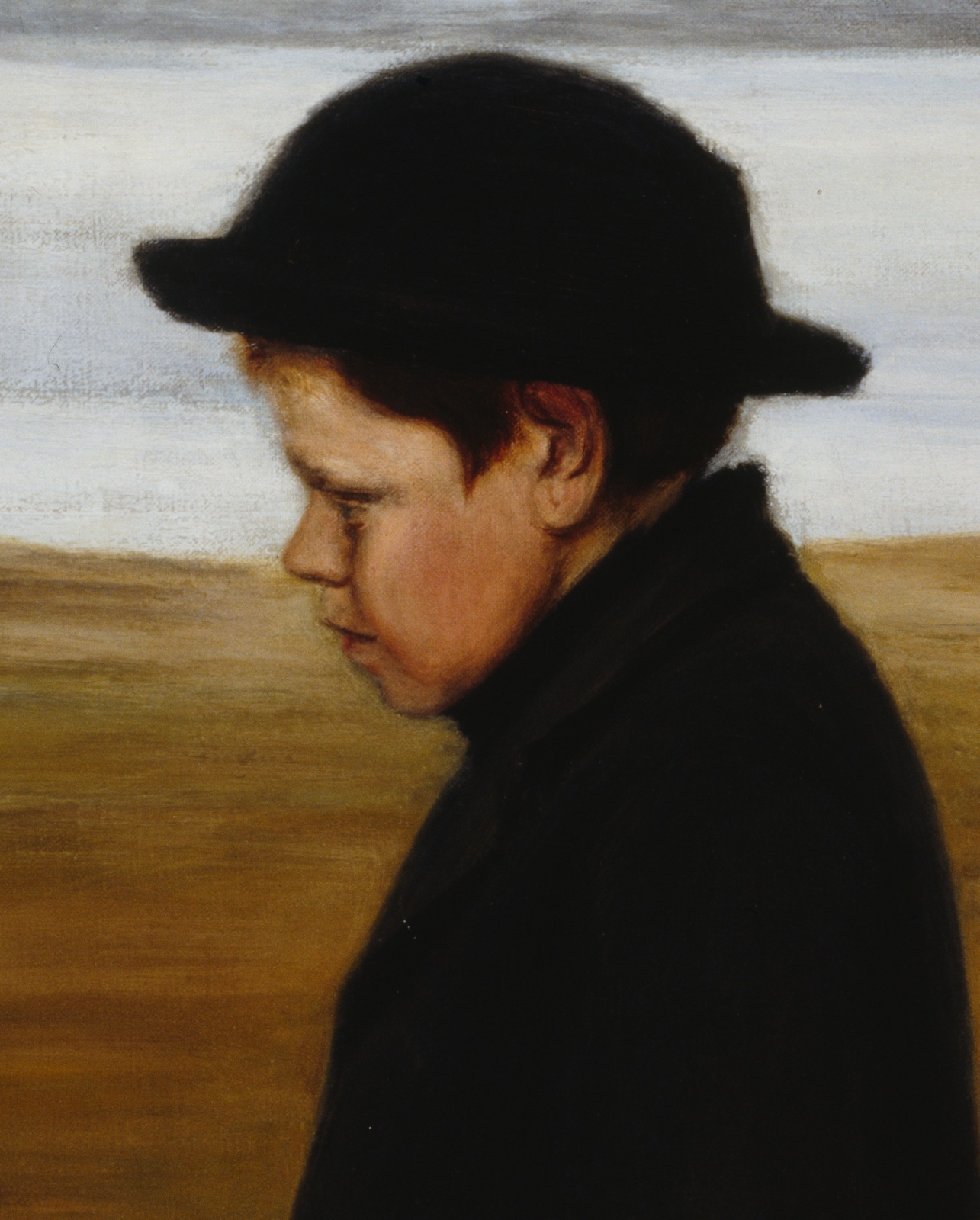
The boy in front wears a black hat and coat. His face is turned left, toward the direction of travel, with his eyes lowered. The hat, dark clothing and long step give him a closed outline. He seems occupied with getting the stretcher somewhere.
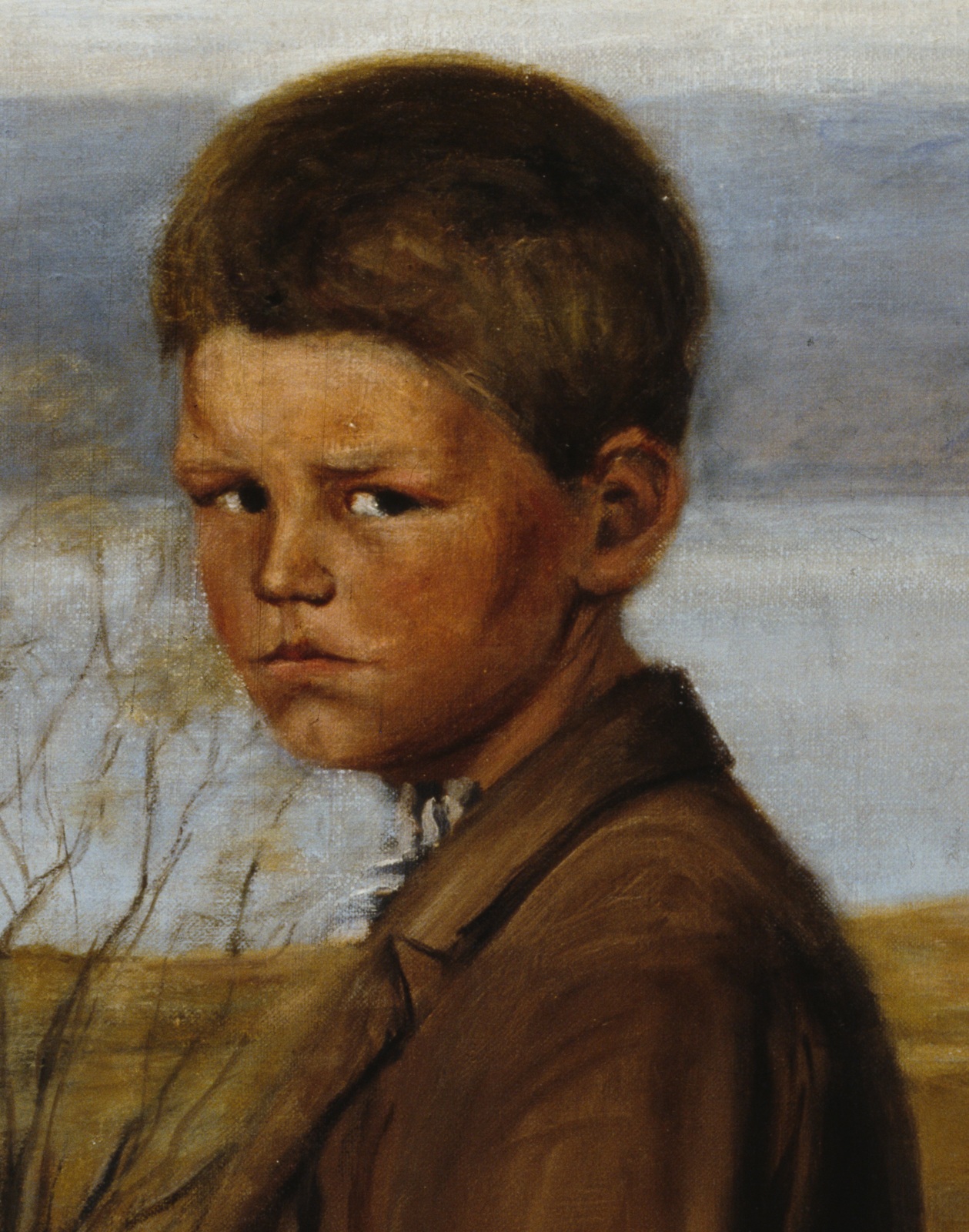
The boy behind the angel has no hat. His brown jacket and flushed face distinguish him from his companion, and his eyes turn toward the viewer. His mouth is set, but the expression resists an easy label.
He can seem angry, suspicious or burdened. Some viewers feel accused by that look. Yet the image does not prove that he blames us, knows the cause of the injury or caused it himself. His gaze makes us aware of watching a vulnerable figure being carried.
The boys continue the same task while looking in different directions. One attends to the journey; the other opens the scene toward the space where we stand. That small disagreement prevents the procession from becoming a single, untroubled gesture of kindness.
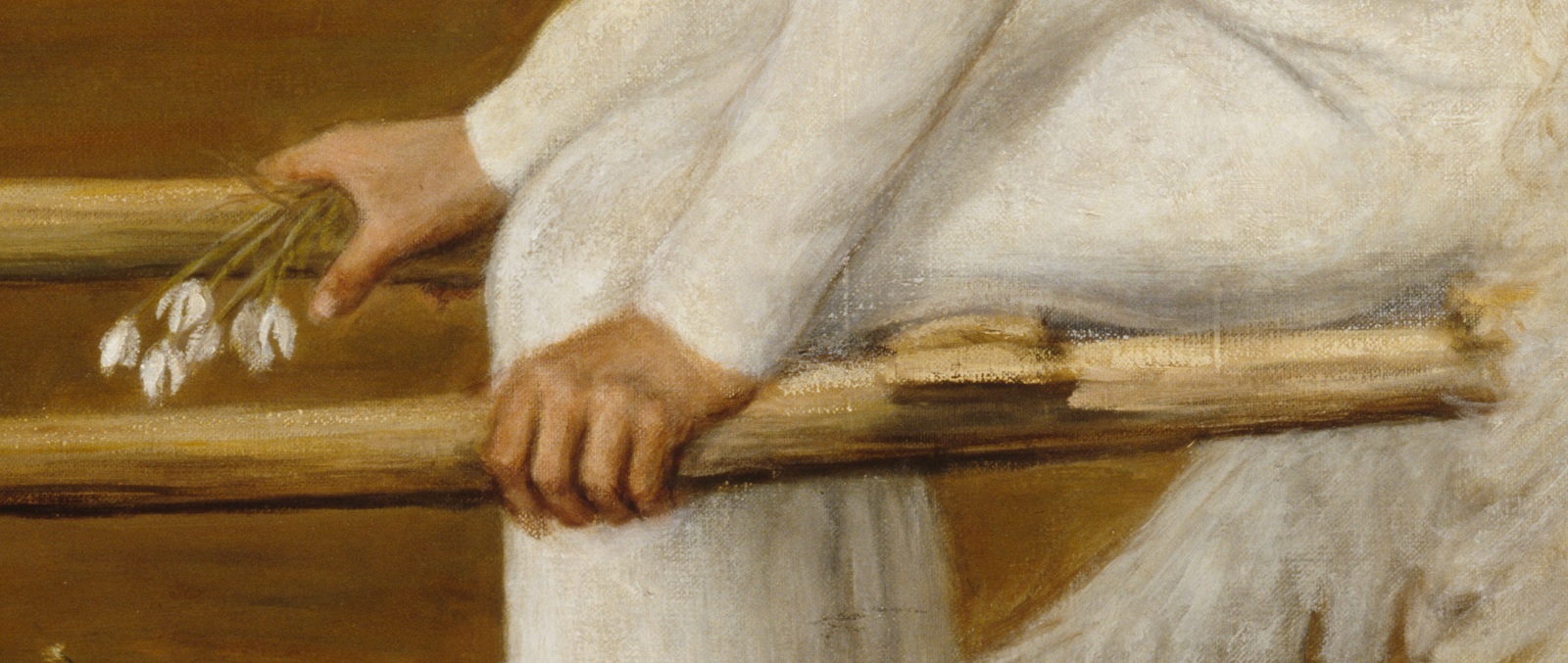
Look at the angel’s two hands together. One holds thin stems with small, drooping white flowers. The other curls tightly around the rough stretcher pole. The flowers hang loosely; the fingers around the wood have a practical job.
The contrast gives the angel some agency within this helpless-looking pose. The figure is being carried, but still holds on. The bouquet is something retained along the way, even while the other hand helps steady the body.
The flowers may suggest fragility or the possibility of renewal. That remains a reading rather than a fixed key supplied by Simberg. Their most immediate connection is visual: small white heads hang from their stems near the much larger white figure whose own head has fallen forward.
Below them, the stretcher is visibly made of wood. Its uneven surface grounds the encounter in ordinary materials. Whatever the angel means, the boys must carry its weight with their hands.
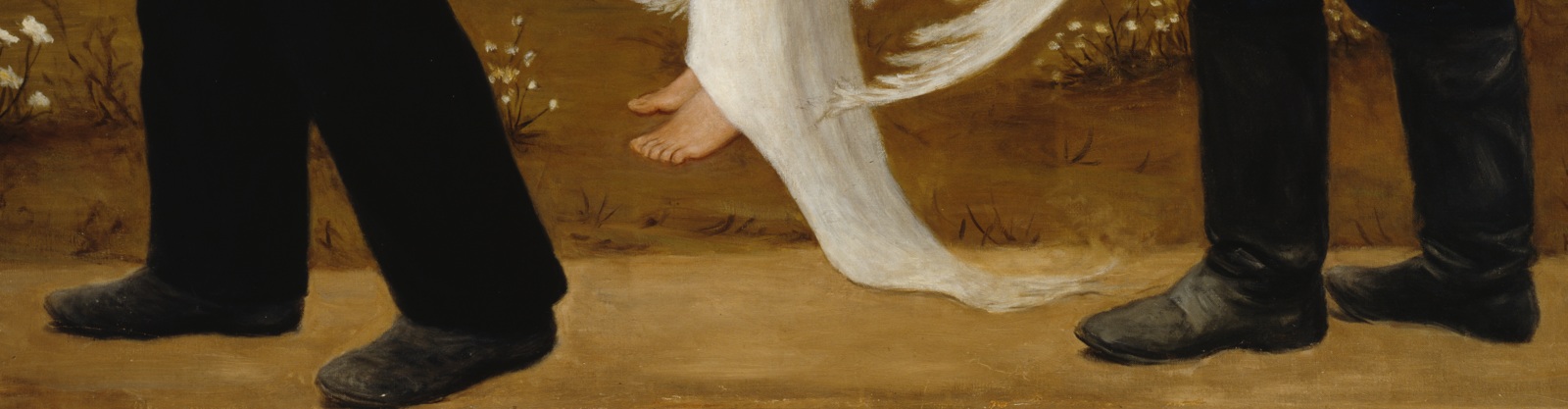
The boys wear heavy, dark footwear. The angel’s feet are bare, close together and suspended above the path. This difference is easy to miss when the wing and bandage attract most of our attention.
At ground level, the scene becomes a contrast between movement and dependence. The boots take the steps. The bare feet travel without touching the earth. The long white garment trails beside them, almost reaching the path.
There is no cloud beneath this angel. Support comes from the stretcher and the two boys carrying it. The composition makes care tangible before it makes it symbolic.
Ateneum identifies the setting with the shore of Töölönlahti Bay in Helsinki. The water, distant land, pale path and sparse vegetation give the encounter a recognisable earthly setting. There is little shelter in the open landscape.
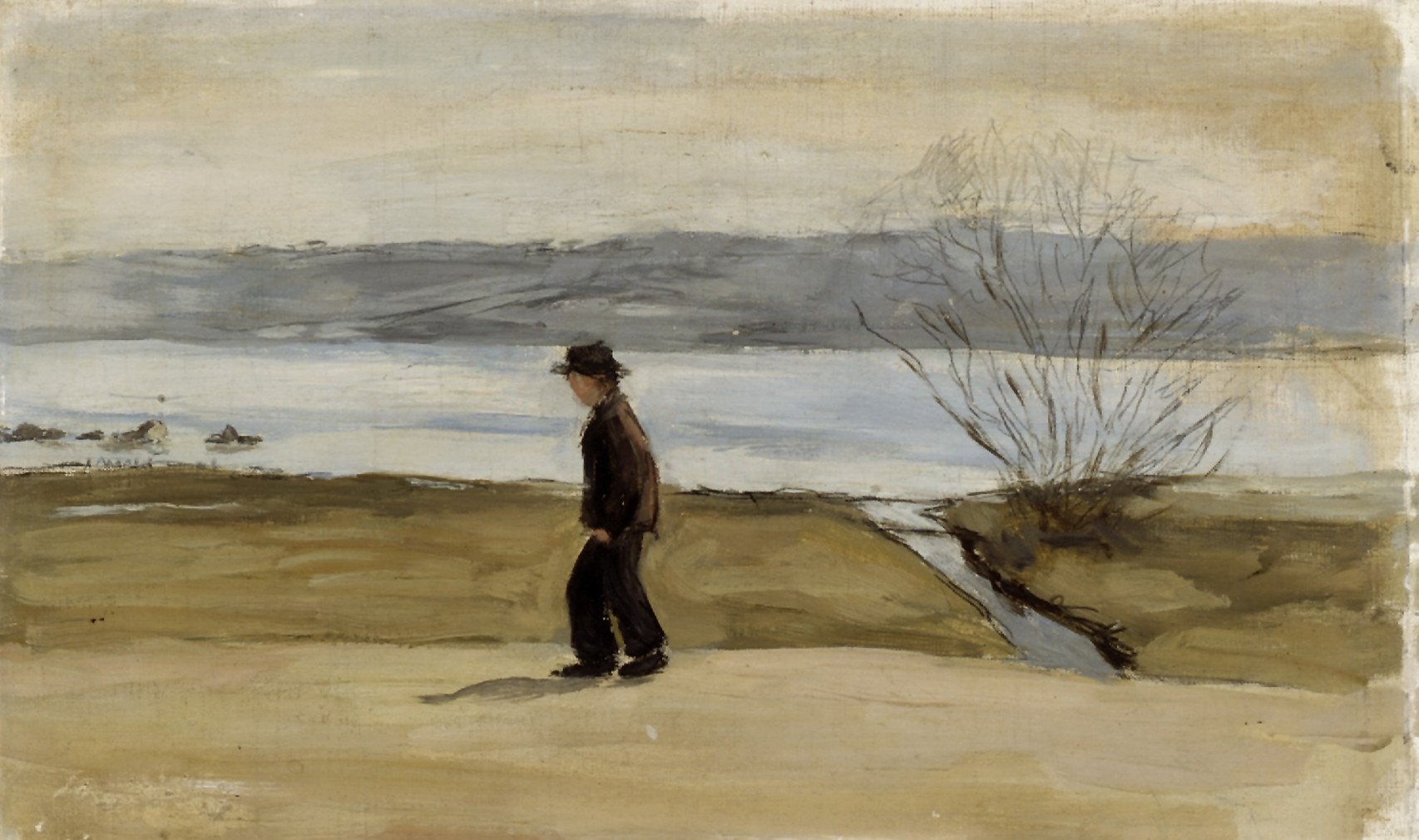
Simberg’s 1902 landscape study lets us see that setting before the completed group occupies it. A boy walks along the path. The lake lies behind him, and a bare shrub rises beside a narrow channel. In the finished painting, the angel and second boy change the emotional weight of this familiar-looking ground.
The comparison is revealing because the strangeness does not require a fantastic location. Simberg places an impossible visitor in a landscape with water, mud, plants and a route people can walk. The ordinary surroundings make the need for help feel immediate.
According to Ateneum, the earliest elements of the composition appear in a sketchbook from 1898. Further sketches and photographs record its development before the finished oil painting of 1903. The quiet, direct arrangement was the result of sustained work.
The museum also notes that Simberg experienced illness and periods in hospital. That background can make the bandage, transport and dependence on other people feel especially resonant. It does not establish a one-to-one autobiography in which every figure stands for a named person or event.
The landscape study offers firmer evidence of a painter’s decisions: a setting and walking figure were worked through separately, then became part of a more complex encounter. The painting’s stillness was constructed, rather than simply recorded.
When the painting was first exhibited, a long dash occupied the place where a title would normally appear. Ateneum connects that choice with the work’s openness to different responses. The familiar title identifies the wound, but it does not identify its cause.
A reading centred on compassion begins with what the boys do. A reading centred on lost innocence begins with the childlike angel and damaged wing. A spiritual reading may ask what it means for a heavenly being to need earthly assistance. Each draws on something visible; none resolves every detail.
This is also a useful way to approach Symbolism in painting. An image can give physical form to an inward experience without becoming a puzzle with one authorised solution. Turku Art Museum places Simberg’s work at the meeting of everyday life and fantasy, where sympathetic supernatural figures make familiar emotions strange.
The strongest reading may begin with the action that survives all those possibilities: two children keep carrying someone who cannot make the journey alone.
Hugo Simberg (1873 to 1917) was a Finnish painter whose Symbolist imagery brought angels, devils and personifications of death into human settings. Turku Art Museum identifies his time as a pupil of Akseli Gallen-Kallela as an important stage in that development.
The Wounded Angel is an oil painting on canvas, 127 cm high and 154 cm wide. It belongs to the Finnish National Gallery’s Ahlström Collection at Ateneum Art Museum, with inventory number A II 1703. Collection ownership does not guarantee that a work is on display at a particular moment; consult the museum’s current programme before visiting.
To explore the composition as a painting for your own space, see the hand-painted reproduction of The Wounded Angel or browse the Hugo Simberg collection.
Compassion, vulnerability and wounded innocence are plausible interpretations. Simberg left the scene open: the painting shows an injured angel receiving human help without explaining how the injury occurred.
The cause is not shown. The bandage and marked wing establish vulnerability, but no attacker or preceding event appears in the painting.
No. Hugo Simberg painted The Wounded Angel in 1903. Alexandre Cabanel’s The Fallen Angel dates from 1847 and has a different composition and subject. Simberg’s image does not identify its angel as Lucifer.
The boy at the rear, on the right of the painting, looks toward us. The boy in the black hat at the front faces the direction of travel.
The 1903 oil painting belongs to the Finnish National Gallery / Ateneum Art Museum, Ahlström Collection. It measures 127 × 154 cm, height by width. Check current display information with the museum.
Enjoyed this story?
Save articles to your collection
Log in or create a free account, and this article will be waiting in your Private Collection.
Log in or sign up
Man Writing a Letter
Gabriel Metsu, c. 1664
The gallery list
Every painting is already 50% off. Join the list and we will send you an extra $15 code, plus first access to new collections.
No spam. Unsubscribe anytime. · Privacy Policy
Welcome
Your $15 code is on its way. Explore the gallery while you wait.