Loading cart…
No products in the cart.

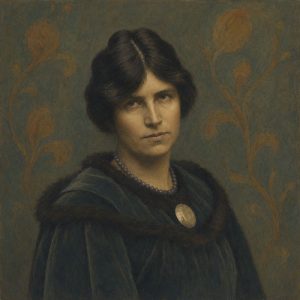
Agnes Slott-Møller occupies a distinctive and undervalued position in the history of European Symbolism. At a time when Danish painting was dominated by male voices and by the naturalist traditions of the Skagen school, she carved out an independent path…
Save articles to your collection
Log in or create a free account, and this article will be waiting in your Private Collection.
Log in or sign upAgnes Slott-Møller occupies a distinctive and undervalued position in the history of European Symbolism. At a time when Danish painting was dominated by male voices and by the naturalist traditions of the Skagen school, she carved out an independent path that drew on medieval Nordic legend, feminine interiority, and a deeply felt engagement with spiritual themes. Her decision to embrace Symbolism rather than follow the fashionable plein-air naturalism of her contemporaries was not a retreat from the world but an assertion that interior life, myth, and the emotional landscape of women deserved rigorous artistic attention. Her paintings speak with a gravity and compositional intelligence that place her among the most thoughtful painters of the Nordic Symbolist generation, and the relative neglect she has suffered in international art history is a gap that scholarship is only now beginning to address.
Born on June 6, 1862, in Copenhagen, Slott-Møller trained at the Royal Danish Academy of Fine Arts and later studied under Peder Severin Krøyer, one of the leading figures of Danish naturalism. Her early work showed strong technical facility in the academic tradition, but by the late 1880s she was moving decisively toward a more visionary and symbolic mode of expression. Together with her husband, the painter Harald Slott-Møller, she became a central figure in Danish efforts to develop a national Symbolist aesthetic rooted in Old Norse literature and medieval Scandinavian history. Her canvases frequently feature women as primary figures of agency and feeling, rendered with a refinement of line and a luminous palette that distinguishes her work from the darker tonalities of many European Symbolists. She exhibited widely throughout her career, participated in significant national exhibitions, and contributed to debates about the direction of Danish art. She died in Copenhagen on February 3, 1937, leaving behind a body of work that continues to reward close looking.
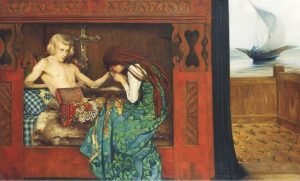
The visual language of Agnes Slott-Møller is grounded in a synthesis of meticulous draughtsmanship and a poetic sensitivity to color that sets her apart from both the academic realists and the more dissolving, atmospheric Symbolists of her era. Her technique reflects thorough academic training, evident in the precise rendering of drapery, the careful articulation of hands and faces, and the structured spatial organization of her compositions. Yet these classical foundations are consistently transformed by a decorative impulse that favors flattened planes, sinuous contours, and a heightened attention to surface pattern that aligns her work with the broader currents of Art Nouveau and the Northern European Symbolist movement. Fabrics fold in rhythmic, almost musical ways, and backgrounds are compressed into tapestry-like arrangements of foliage, sky, and architectural detail that reinforce the otherworldly atmosphere she sought.
Color in her paintings functions less as a tool of naturalistic description and more as an emotional register. She favored cool silvers, muted golds, deep greens, and the pale luminosity of Scandinavian light, deploying these tones to evoke states of longing, grief, spiritual aspiration, and quiet tenderness. Her figures, predominantly women, are painted with a stillness and psychological depth that invite sustained contemplation. The influence of Pre-Raphaelite painting is discernible in her elongated forms and her attention to literary and legendary subject matter, but her palette and her compositional restraint are distinctly Nordic in character. The overall effect is of paintings that exist slightly outside of ordinary time, suspended in a meditative space between the historical past of Norse and medieval legend and the emotional present of late nineteenth and early twentieth century experience.
Each card links to its own article with full analysis and reproduction details.
 #1
#1
 #2
#2
A print can reproduce colors. What it cannot reproduce is texture, depth, and the physical presence of oil paint on canvas. Agnes Slott-Møller technique depends on these.
At ByMuseum, every reproduction is painted by hand using oil on canvas. There is no inkjet, no digital print. The brushwork is real. The result looks like a painting because it is one.
Enjoyed this story?
Save articles to your collection
Log in or create a free account, and this article will be waiting in your Private Collection.
Log in or sign up