Loading cart…
No products in the cart.

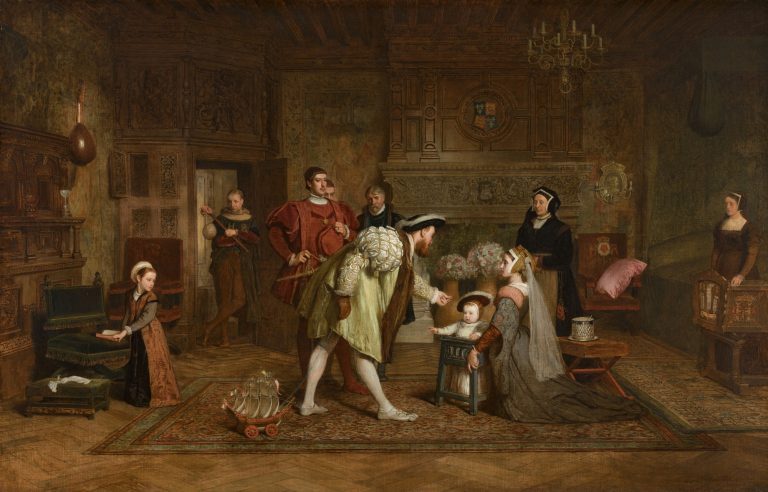
1871 · Oil on canvas · Private collection
Save articles to your collection
Log in or create a free account, and this article will be waiting in your Private Collection.
Log in or sign up Explore the artistMarcus Stone →
Henry VIII bends toward his infant son. The child reaches out, a woman holds him steady, and the people behind the king watch the encounter. At the left, a small red-haired girl stands beside a chair. Her body remains at the edge of the room, but her face turns toward her father.
The girl is Elizabeth, the future Elizabeth I. Marcus Stone painted The Royal Nursery in 1538 in 1871, imagining a Tudor family moment more than three centuries earlier. Edward receives the attention. Elizabeth, who will eventually reign for forty-four years, waits outside the central group.
That unequal attention was part of the picture’s original subject. The text accompanying its 1871 Royal Academy appearance said that Henry “took but little note of her.” The phrase gives us a way into the painting, but Elizabeth’s distant position already makes the point.
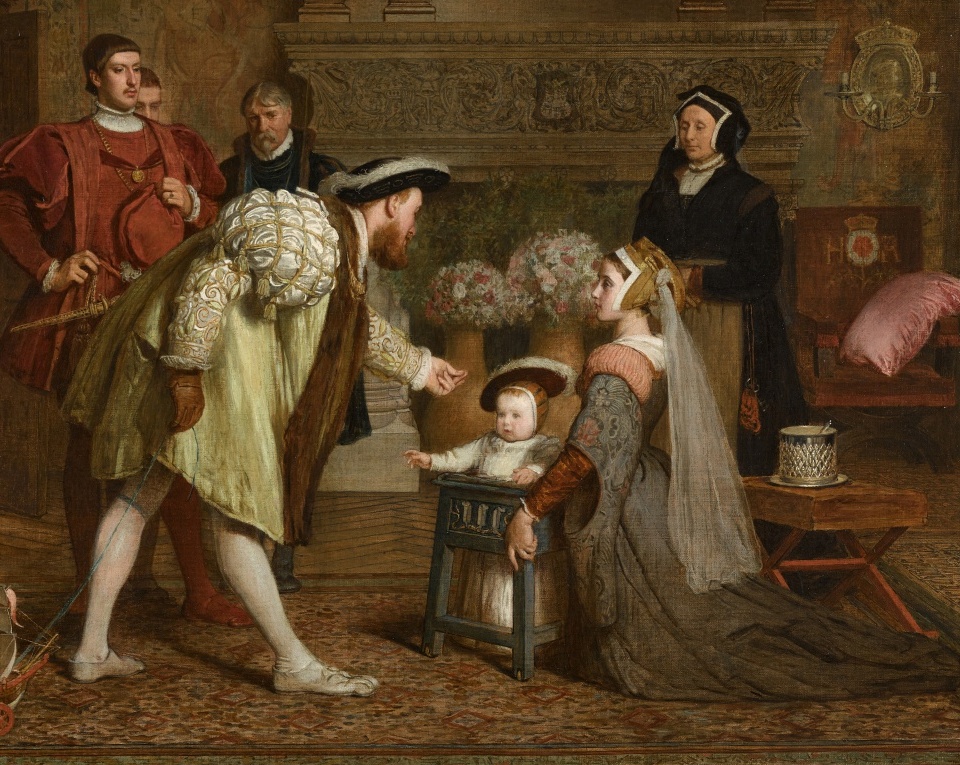
Stone makes Henry’s change of posture conspicuous. His feet are set wide apart, his knees bend and his heavy coat falls forward as he brings his face closer to the baby. The broad embroidered shoulders and fur still give him the largest presence in the group. Even while bending, he occupies more space than anyone else.
The open hand between father and son is easy to overlook in the full painting. Sotheby’s catalogue identifies the small offering as a biscuit. Edward stretches an arm toward it from his wooden walking frame. The exchange gives the king a familiar parental gesture, with the attendants and formal clothing making clear how many people are watching it.
The painting’s date within the story matters. Edward was born to Jane Seymour at Hampton Court in October 1537. In the nursery of 1538, he is Henry’s surviving legitimate male heir. Jane died shortly after the birth, leaving the baby’s mother absent from the scene.
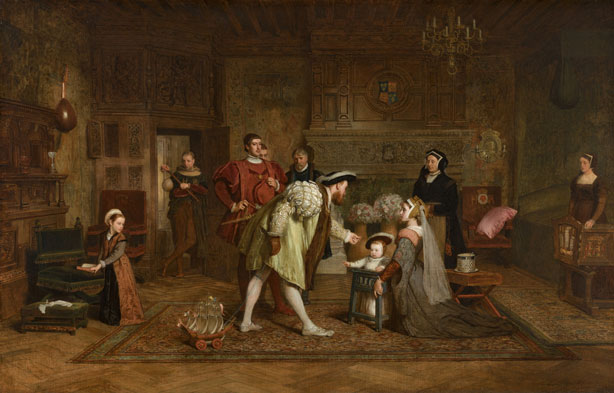
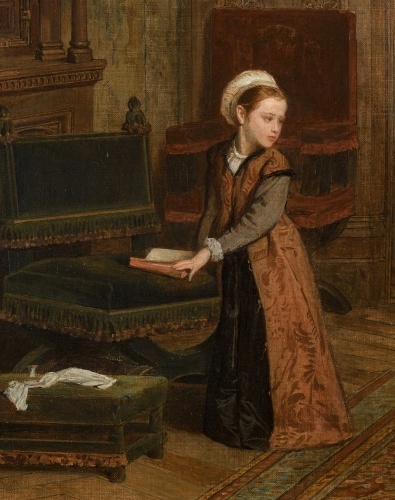
Elizabeth stands beside an open upholstered chair with a small book beneath her hands. She turns away from what is immediately in front of her to watch the family gathering. The gap between her and Henry is occupied by floorboards, carpet and the toy ship. Stone gives that distance enough room to register.
Her long dress and light cap identify her as a child in a formal household. Her expression can be read as sadness, curiosity or a wish to join in. The clearest evidence is her placement. Henry’s body, his face and his extended hand all point toward Edward.
Elizabeth was born in 1533 to Anne Boleyn. She would have been four or five in 1538, while her older half-sister Mary was in her twenties. Stone’s Victorian audience knew that the apparently overlooked child would become queen. That knowledge changes a small nursery incident into a story about how uncertain a dynasty’s future can be.
The young woman in the patterned sleeves kneels close to Edward. One hand rests on the walking frame, and her face turns up toward Henry. She belongs to the exchange between father and son in a way that Elizabeth, across the room, does not.
The auction catalogue identifies her as probably Princess Mary, Henry’s daughter by Katherine of Aragon. The qualification matters. Stone’s preparatory study, recorded by the British Museum, includes both Mary and Elizabeth, but the kneeling woman’s identification in the finished painting remains less explicit than Elizabeth’s.
If this is Mary, Stone has gathered three future monarchs around their father. Edward would succeed Henry in 1547. Mary would become queen in 1553, followed by Elizabeth in 1558. Those later reigns are present as historical hindsight whenever we look around the nursery.
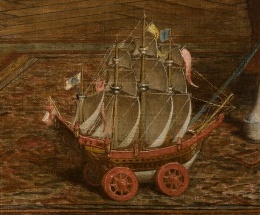
The miniature vessel has sails, rigging and bright red wheels. Its tall masts make it more elaborate than a simple block toy. A cord runs from the ship toward Henry’s lowered hand, linking the object on the floor to the family encounter above it.
A ship can suggest the wider world of royal power, but its wheels also keep it firmly within a child’s play. Stone places it near Henry’s feet, below the embroidered coat and the offered biscuit. The king’s imposing figure, a domestic gesture and a miniature vessel share the same part of the canvas.
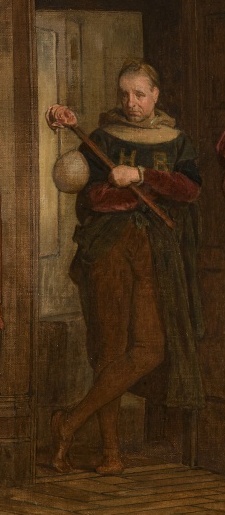
At the back of the room, a man in contrasting colours stands with one knee bent. He holds a stick and a small hanging object. His position and equipment suggest an entertainer, ready to contribute to the child’s amusement.
For the moment, he watches. The man in red beside him also holds back, while the older man behind Henry looks toward the encounter. Their differing postures create a ring of attention around Edward. Elizabeth sees that gathering from its far side.
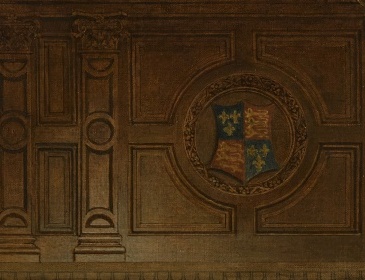
A heraldic shield sits above the fireplace. Carved panelling, patterned textiles, a chandelier and richly upholstered seats surround the figures. The room has been furnished to make royal status visible even during a moment of play.
The women behind and beside Edward remain in formal dress. Another attendant stands at the far right, close to a large wooden cradle. These details make the nursery feel occupied by a household with duties, positions and access to maintain.
Stone arranges the room so that the central action stays readable amid that decoration. Henry’s pale coat catches the light, Edward’s face appears against the dark frame, and Elizabeth’s lighter face draws the eye back to the left. The furniture tells us where we are. The figures tell us what to notice.
The picture was exhibited at the Royal Academy in 1871 as number 104. The historical setting is 1538, so the year in the title describes the imagined event rather than the date of painting.
A study in the British Museum records Stone working out the chamber and its family grouping in gouache on brown paper. It is useful evidence of a composition being planned. The arrangement offers a nineteenth-century interpretation of the Tudor family, with every glance and gap contributing to its effect.
In the full painting, return to the empty chair beside Elizabeth and the crowded space around Edward. The room allows both children to be present while making the difference in attention unmistakable. The scene’s irony depends on what happened after this imagined afternoon, when each of Henry’s three children eventually wore the crown.
Another Victorian painter looked at the consequences of the Tudor succession in a very different scene. Paul Delaroche’s The Execution of Lady Jane Grey follows the brief reign that came between Edward VI and Mary I.
Marcus Stone painted the oil on canvas in 1871 and exhibited it at the Royal Academy that year.
She is Princess Elizabeth, later Elizabeth I. The text associated with the 1871 exhibition names her and describes Henry paying her little attention.
The infant is Prince Edward, Henry VIII’s son by Jane Seymour and the future Edward VI.
She is identified as probably Princess Mary in the auction catalogue. Stone’s study includes Mary and Elizabeth, but the finished figure’s identification is qualified.
It is recorded in private ownership. The canvas catalogued by Sotheby’s in 2024 measures 83 × 128.5 cm without its frame.
Painting by Marcus Stone (1840–1921), first exhibited in 1871. The full image is a photographic reproduction of the public-domain painting from the Sotheby’s catalogue. The details are faithful crops of that image.
Enjoyed this story?
Save articles to your collection
Log in or create a free account, and this article will be waiting in your Private Collection.
Log in or sign up
Man Writing a Letter
Gabriel Metsu, c. 1664
The gallery list
Every painting is already 50% off. Join the list and we will send you an extra $15 code, plus first access to new collections.
No spam. Unsubscribe anytime. · Privacy Policy
Welcome
Your $15 code is on its way. Explore the gallery while you wait.