Loading cart…
No products in the cart.

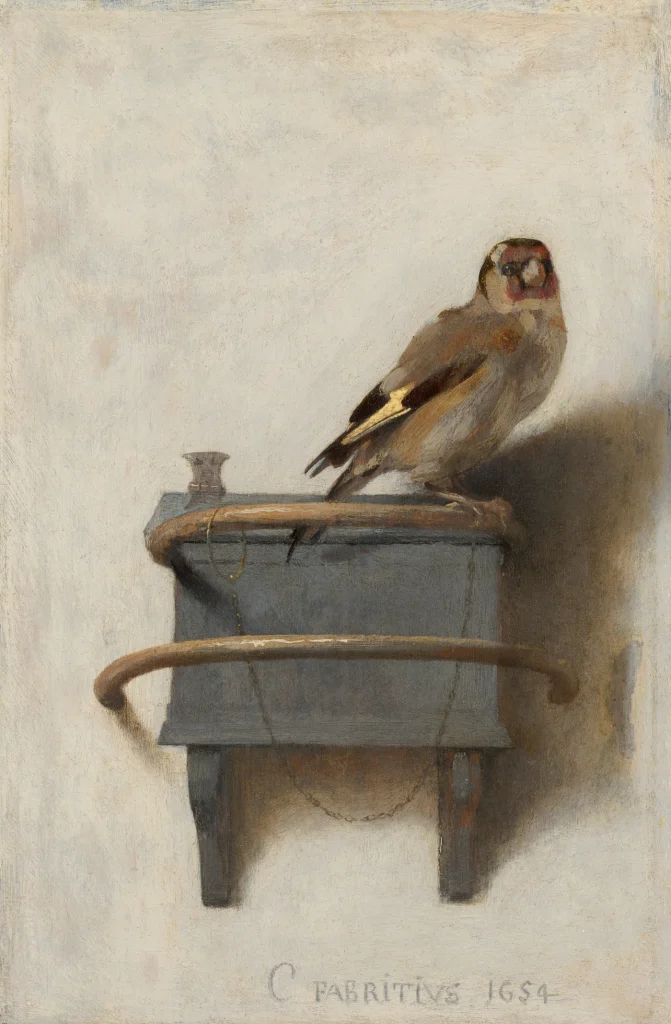
1654 · Oil on panel · Mauritshuis, The Hague
Save articles to your collection
Log in or create a free account, and this article will be waiting in your Private Collection.
Log in or sign upThe painting is the size of a sheet of paper. On a whitewashed wall a small blue feeding box is fixed with two curved perches, and on the top perch sits a goldfinch, chained by one leg, looking at you. That is all. No window, no room, no story. A bird, a chain, a wall, and the painter's name and the year written on the plaster underneath.
It is one of the most loved paintings in the world, and for most of its life almost nobody knew it existed.
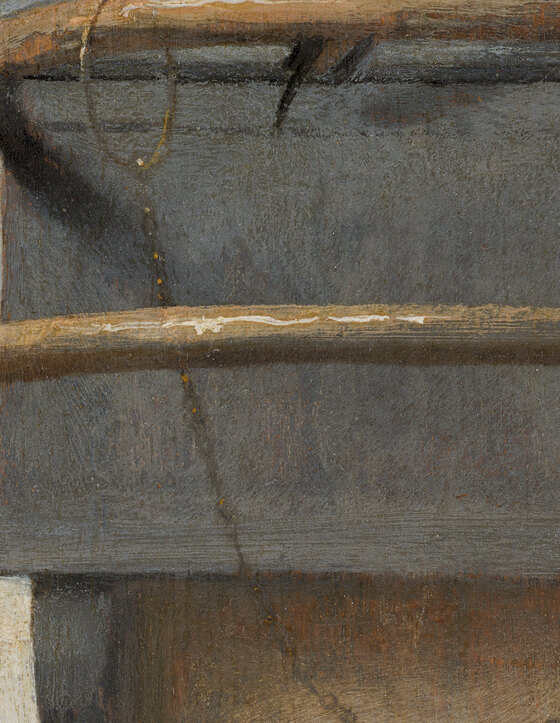
Goldfinches were pets in seventeenth-century Holland, and they were popular because they could be taught a trick: to draw up their own drinking water in a thimble on a chain. The Dutch called the bird puttertje, little water-drawer. The chain in the painting is not cruelty, or not only. It is the ordinary equipment of a household bird, painted as carefully as the bird itself.
But once you have seen it, it is hard to see anything else. The bird is free to turn, to look at you, to lift its wing, and it is going nowhere. Every reading of the picture since the nineteenth century has started from that chain, and every one of them is allowed.
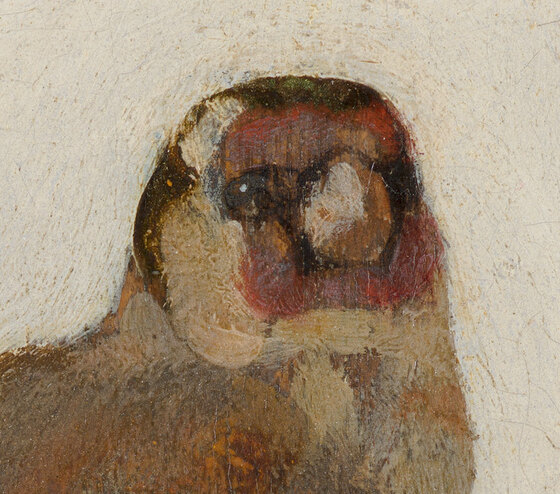
Go close and the bird dissolves. The red mask is a smear, the black cap two strokes, the eye a dot with a fleck of white. The famous yellow bar on the wing is one dragged stroke of thick paint, put on with the brush loaded and not touched again.
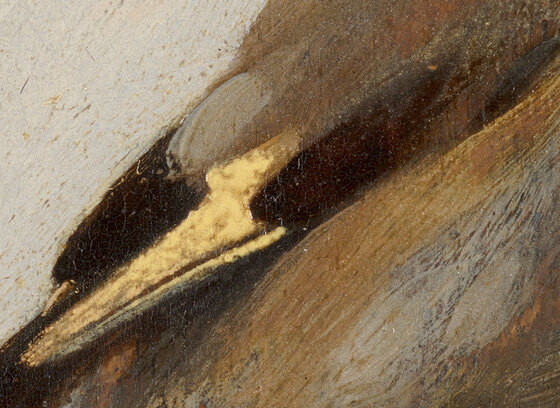
Step back and it all snaps into a bird. That is the trick, and it is a trick Fabritius learned in Rembrandt's studio, where the master built faces out of paint you could stand a coin in. Fabritius took it and applied it to a subject the size of your hand, in daylight instead of Rembrandt's gloom, on a pale wall instead of his brown shadow. Nobody else in Holland was painting like this in 1654. A few years later, in the same town, Vermeer was.
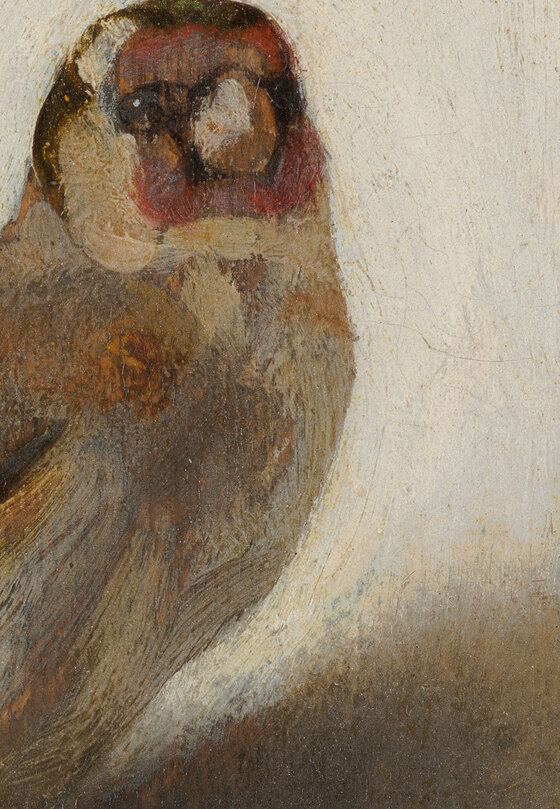
The shadow falls down and to the right, as it would from a window on the left, and the box is seen slightly from below. The painting was designed to hang high on a wall, above eye level, where a real feeding box would hang, so that from across the room a visitor might take it for a bird. It is a trompe l'oeil, a fool-the-eye picture, of a kind the Dutch loved, and the pale wall it is painted on is meant to be the wall it hangs on.
Some historians think it was once part of something larger: a cupboard door, a window shutter, a perspective box. The panel has been trimmed, so we cannot be sure. Whatever it was for, it is now a painting of a bird in a frame, and it works perfectly as that.

Carel Fabritius was thirty-two, the most gifted of Rembrandt's pupils, living in Delft with a growing reputation. On 12 October 1654 the city's gunpowder store exploded. The blast flattened a quarter of Delft, killed at least a hundred people, and buried Fabritius in the wreck of his studio. He died of his injuries that day. His pupil died with him. Most of his paintings were destroyed with the house.
About a dozen survive. The Goldfinch, dated the year of his death, is one of them, and it is the reason his name is remembered at all. The other reason is a guess that has hardened into a tradition: that the young Vermeer, who was in Delft and whose early work looks like this, learned from him. There is no document that says so. There is only the light.
To its first owner it probably meant a pet, a joke and a display of skill. Goldfinches in older painting had carried a religious meaning, the thistle-eating bird of the Passion, but by 1654 that had mostly faded into a fondness for the creature itself.
To us it means something about survival. A small living thing painted in the last year of a short life, by a man about to be killed by an accident, survives because it is small enough to have been carried out of the rubble. The chain, the calm eye, the bare wall: it is hard not to read the painter's fate into them, and Fabritius could not have known it.
In 2013 the novelist Donna Tartt made the painting the centre of The Goldfinch, a story about a boy who carries it out of a bombed museum and cannot let it go. The book won the Pulitzer Prize and sold millions, and the Mauritshuis, which had lent the painting to New York that year, found queues around the block. Tartt's reading is the modern one: the bird as the thing you save.
In the Mauritshuis in The Hague, a few rooms from Vermeer's Girl with a Pearl Earring, which is the other painting most visitors come for. The museum bought it in 1896, at the sale of the French critic Théophile Thoré, who had rediscovered both Fabritius and Vermeer. It is oil on panel, 33.5 by 22.8 centimetres, and the bird is life size.
It is the easiest great painting to live with. It fits anywhere, it asks nothing, and it rewards being hung a little high, as Fabritius intended. Our hand-painted reproduction of The Goldfinch is painted in oil from the Mauritshuis original, at the original size or larger, with the wing bar laid on in one stroke the way he laid it. A plain dark frame, and a wall with some light on it.
More from the Dutch Golden Age archive, and the rest of our Carel Fabritius collection.
Enjoyed this story?
Save articles to your collection
Log in or create a free account, and this article will be waiting in your Private Collection.
Log in or sign upVisible details, documented facts and interpretation are kept separate throughout this article. The Vermeer connection is reported as the unproven tradition it is.