Loading cart…
No products in the cart.

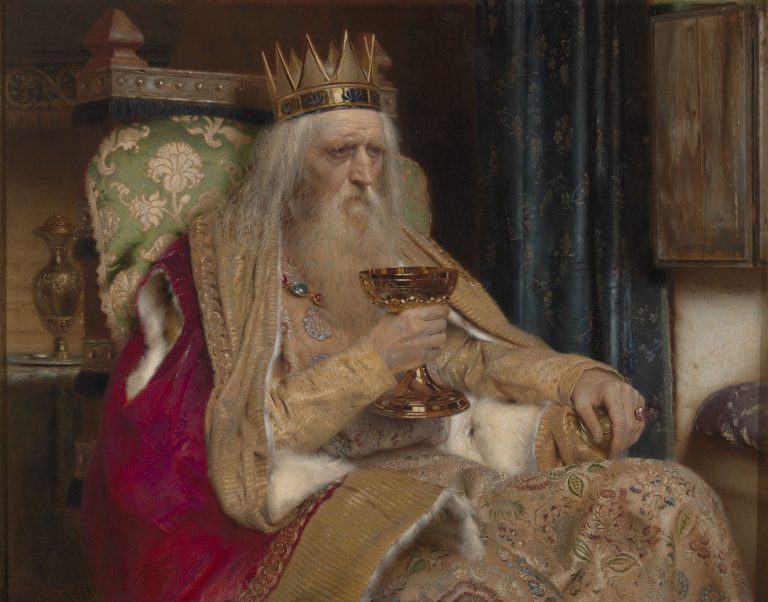
1896 · Oil on canvas · Gaasbeek Castle, Lennik, Belgium
Save articles to your collection
Log in or create a free account, and this article will be waiting in your Private Collection.
Log in or sign up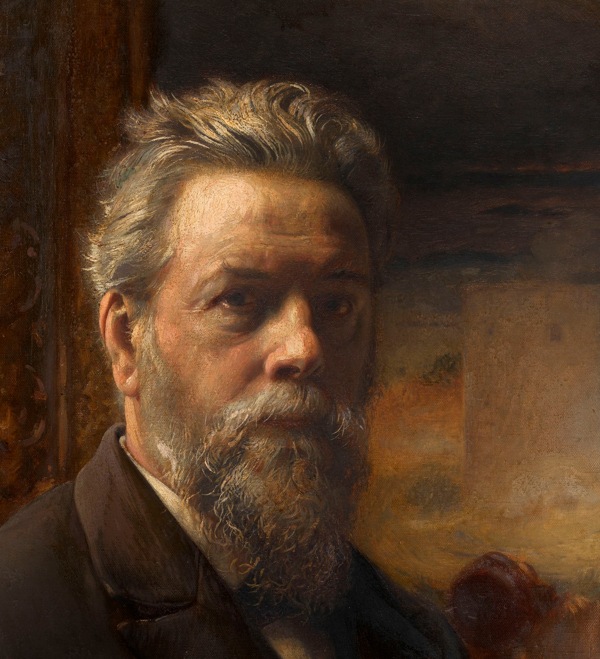 Explore the artistPierre Jean Van der Ouderaa →
The crown is still on his head. Gold fabric covers his body, a red cloak falls over the chair, and a second fine vessel stands behind him. Nothing in the room suggests that this man has lost his rank. Yet his attention seems to have withdrawn from everything that rank can provide.
In The King of Thule, painted in 1896, Pierre Jean Van der Ouderaa shows an old ruler holding a cup close to his body. His other hand rests on the chair. His eyes look beyond the goblet rather than meeting ours. The scene is quiet enough that the difference between these two hands becomes part of its story.
The subject comes from Goethe's ballad Der König in Thule. Knowing the poem changes the cup from a beautiful possession into a reminder of someone who is gone.
Goethe wrote the ballad in 1774. A king receives a golden cup from his dying beloved and values it above everything else. Whenever he drinks from it, his eyes fill with tears. As death approaches, he leaves his kingdom to his heir, but keeps the cup.
Es war ein König in Thule,
Johann Wolfgang von Goethe, Der König in Thule, opening stanza
Gar treu bis an das Grab,
Dem sterbend seine Buhle
Einen goldnen Becher gab.
The opening tells us that the king remains faithful to the grave and that his beloved gave him the cup as she was dying. The poem does not name her or tell us how they lived together. It gives their relationship a single surviving object.
Van der Ouderaa surrounds that small object with an abundance of other things. The painting's richness makes the king's attachment more visible: he has plenty to look at, but only one possession occupies his hand.
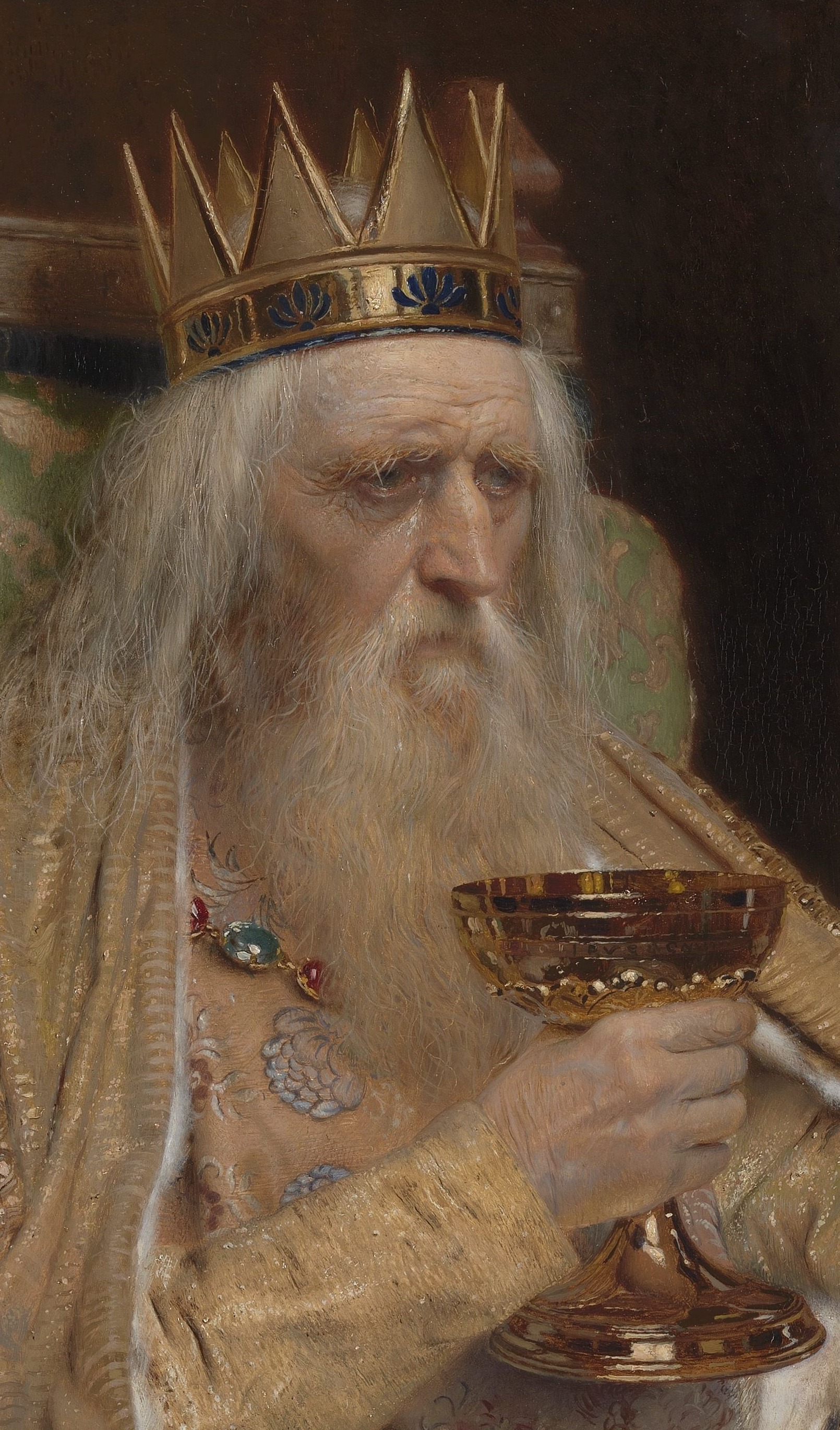
The tall points of the crown rise clearly above the king's white hair. It is easy to recognise his office before looking closely at his expression. Below it, his brows gather, his lower eyelids catch the light, and his mouth is almost hidden by his moustache and beard.
There is no grand gesture of lamentation. His face suggests fatigue and inward attention. Read beside the ballad, the glistening eyes recall the tears that accompany each drink. The painting does not need to show the beloved herself; her absence becomes the reason to study his face.
The crown also prevents us from explaining his sorrow as simple deprivation. He remains surrounded by the signs of power. They offer a setting for the grief without providing an answer to it.
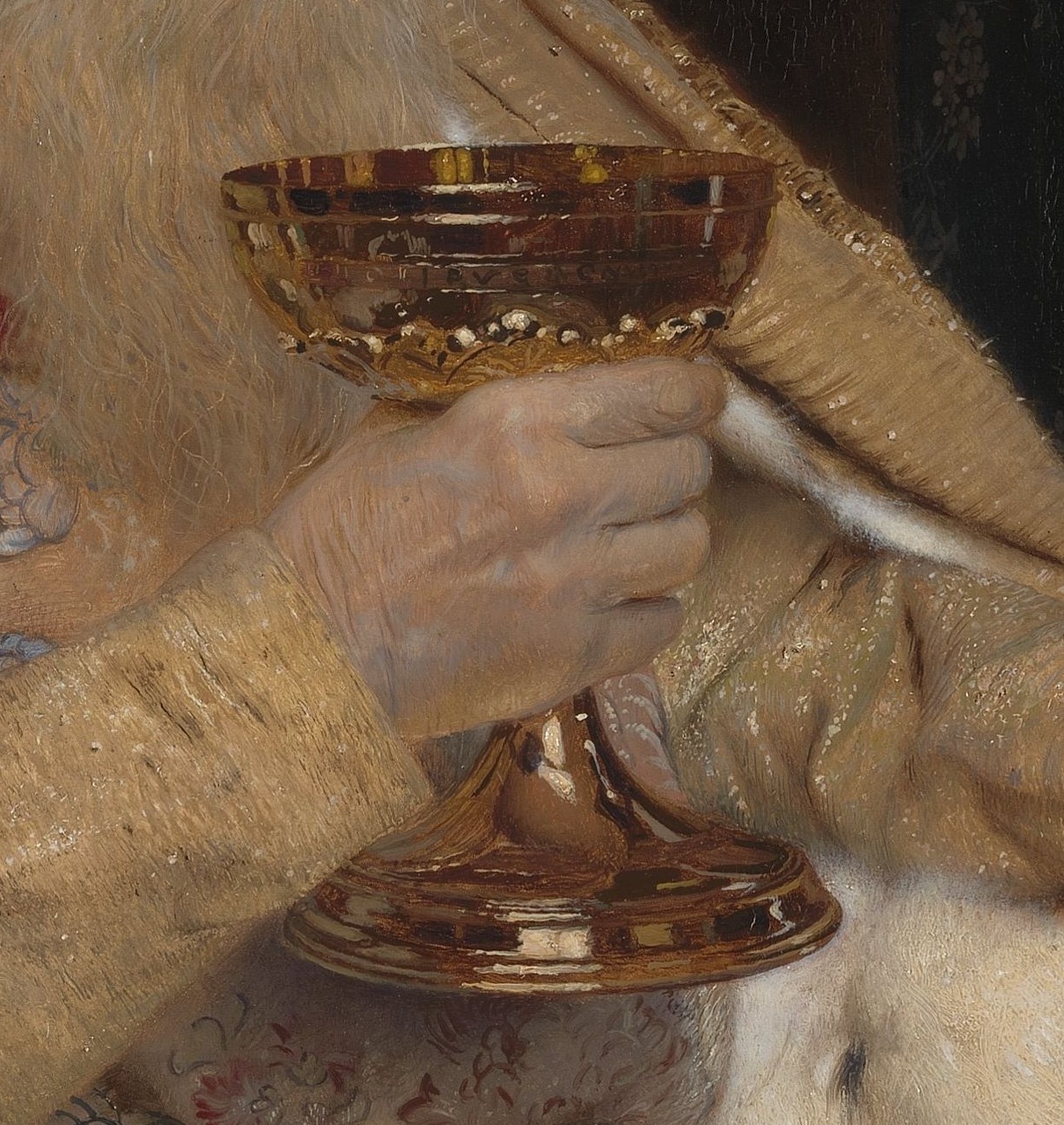
The goblet is held upright and close, with the fingers enclosing its stem beneath a broad bowl. Dark red-brown bands interrupt the gold-coloured surfaces. Its low foot sits against the pale fabric, so that cup, hand and costume overlap rather than forming separate display pieces.
This is a useful distinction from a ceremonial toast. The king does not extend the cup toward another person or raise it above his head. The gesture keeps it within his own space. It can be read as protective, although the image alone cannot tell us exactly what he is thinking.
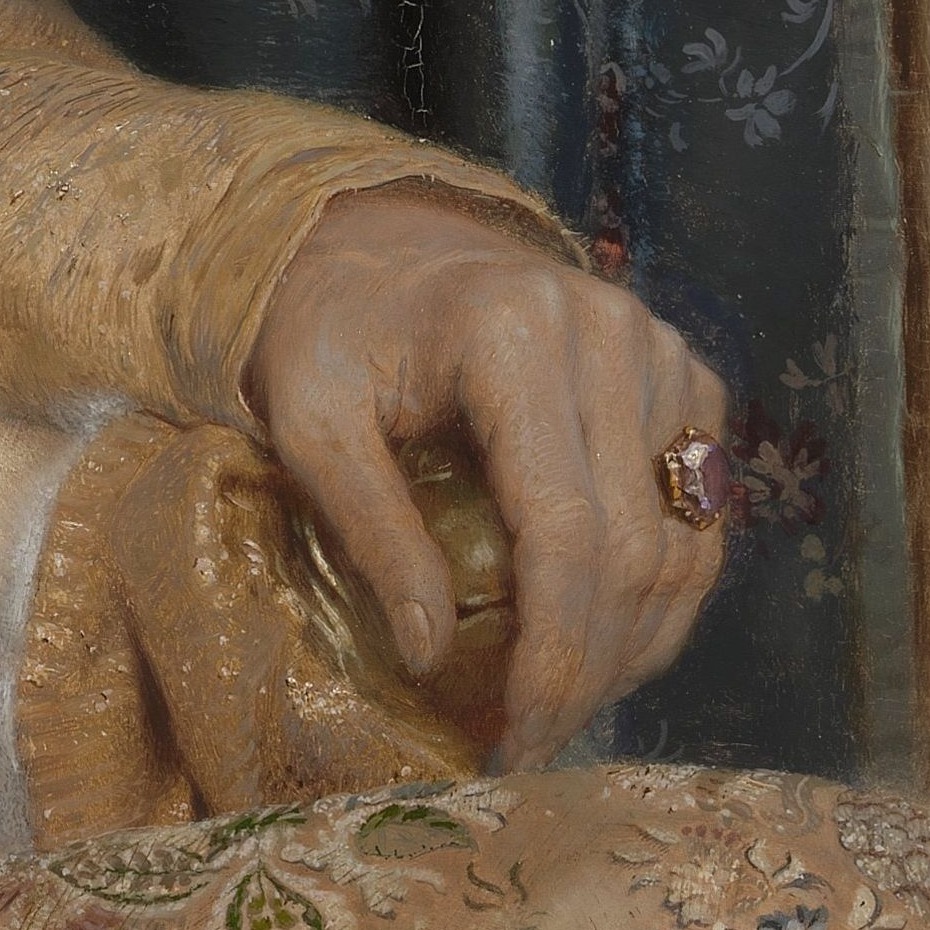
His other hand lies against the chair arm, with a coloured stone visible in the ring. Here the fingers fall downward. Comparing the two hands gives the still pose an internal rhythm: one hand remains involved with an object, while the other seems to have no task.
The ring and cup are both precious-looking objects. Only the cup has the history supplied by the poem. That difference matters more to the story than the quantity of gold in the room.
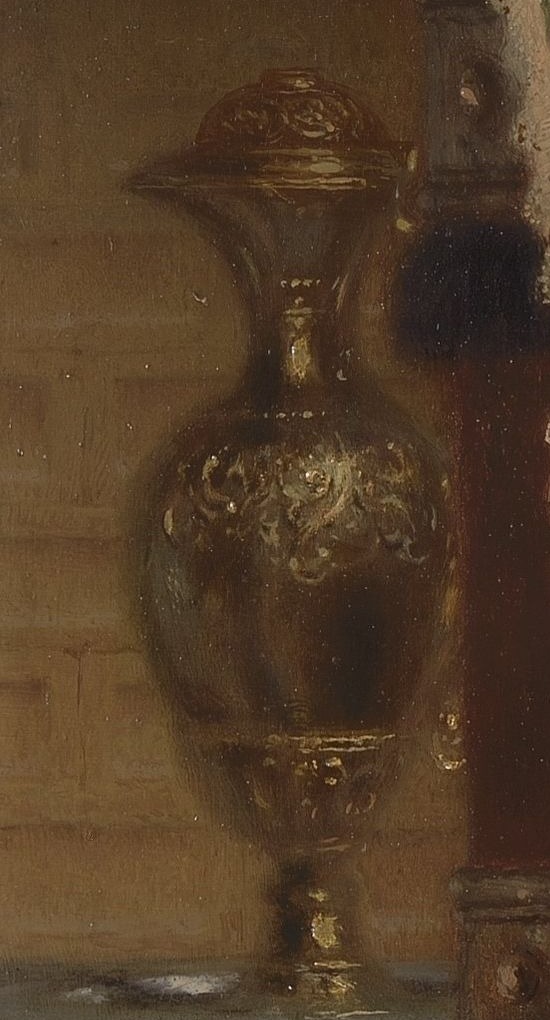
Behind the king, at the left edge of the picture, another ornate vessel stands on a small table. Its lid, narrow neck and rounded body catch subdued highlights. It belongs to the same luxurious setting as the throne and embroidered clothes, but it remains apart from his body.
The ballad gives the treasured cup its meaning. It supplies no comparable story for this second vessel. The contrast lets us distinguish between an object that decorates a room and an object that sustains a memory.
Reading the second vessel this way is an interpretation of the composition, rather than a documented explanation from the painter. What we can see is simpler: the king holds one vessel and leaves the other untouched. The arrangement makes possession feel selective even in a room full of wealth.
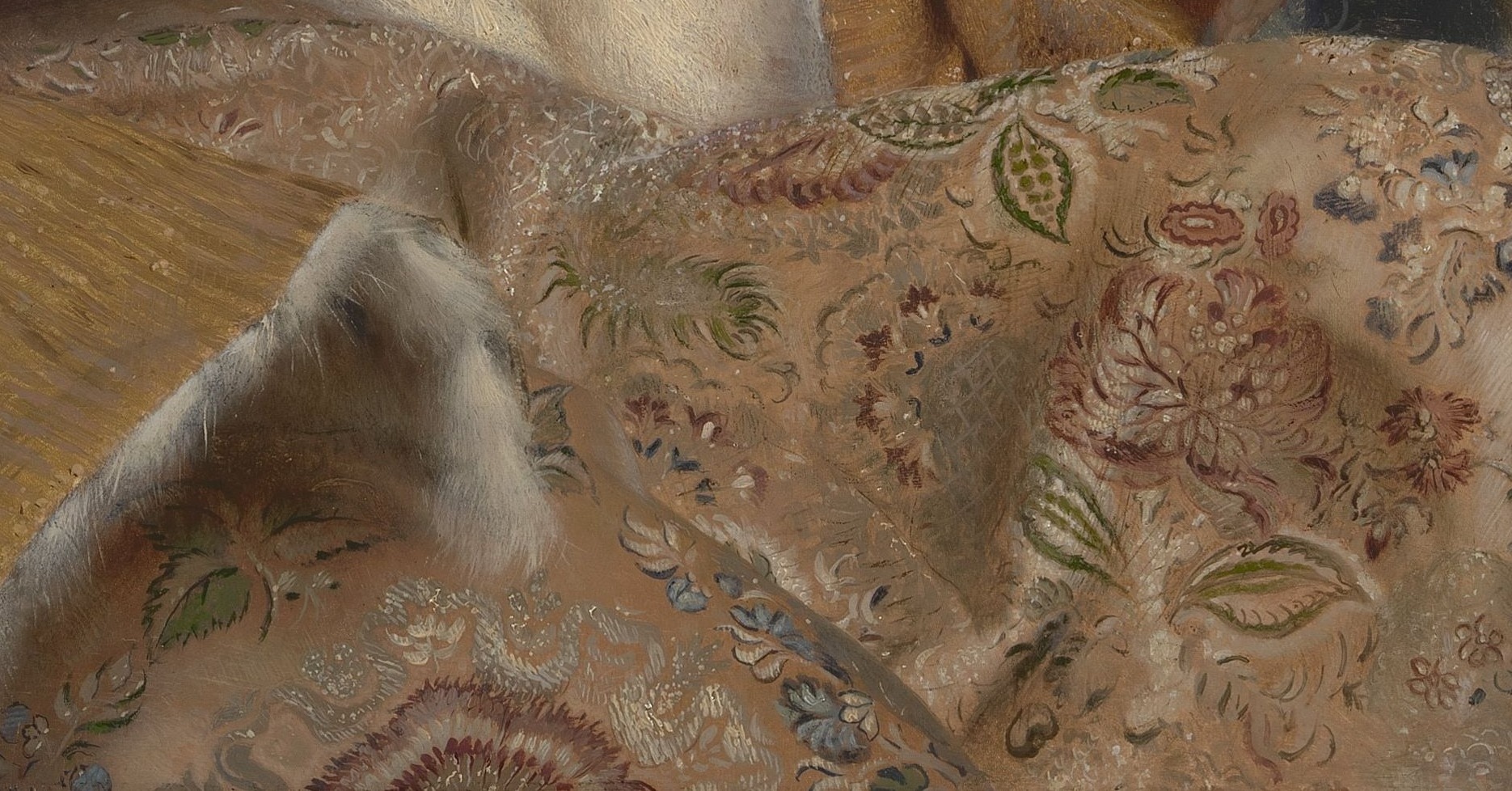
Across the king's lap, tiny flowers and curling stems spread over pale cloth. A white fur border passes diagonally through the costume. Elsewhere, the red cloak and green upholstery introduce stronger areas of colour without breaking the room's enclosed atmosphere.
These textures reward looking, but their abundance also slows the image down. The embroidered fabric lies heavily over his legs, and the armchair contains his seated body. The soft surfaces that might promise comfort seem unable to draw his attention away from the cup.
The painting's emotional effect depends on this patient treatment of material things. Remove the costly setting and we would lose the contrast between what the king possesses publicly and what he values privately.
At the ballad's final banquet, in a castle beside the sea, the king takes a last drink and throws the cup into the water. He watches it sink. His eyes lower, and the poem closes by saying that he never drinks again.
None of that action appears here. There is no open sea, falling cup or company of knights. The painting does not identify an exact stanza; it concentrates on a man who still has the object in his hand.
That changes the viewer's experience of the story. Once we know the ending, the stationary goblet becomes something that will eventually be released. Before we know it, the same gesture may simply look like an old man holding a drink. Literature supplies the future that the painted room keeps out of sight.
The cup is therefore both a physical possession and a link to an absent person. We can recognise the role of such a keepsake without needing the painting to stand for everyone's experience of grief. Its intimacy comes from this particular face, this particular hand and this one object.
Pierre Jean Van der Ouderaa was a Belgian painter who lived from 1841 to 1915. His name also appears as Piet van der Ouderaa and Pieter Jan van der Ouderaa. The Flemish Art Collection records portraits, religious subjects and a 1904 self-portrait among his works in the Royal Museum of Fine Arts Antwerp.
The King of Thule, also called De koning van Thule or Le Roi de Thulé, belongs to the collection of Gaasbeek Castle in Lennik, Belgium. Art in Flanders identifies it with inventory number 1587 and credits the reference photograph to Dominique Provost. Collection membership does not mean the painting is necessarily on display at the time of a visit.
The 1896 date and oil-on-canvas medium are recorded with the supplied historical image. The sources used here do not establish the original canvas dimensions, so the reproduction sizes offered by ByMuseum are kept separate from that historical information.
In Goethe's ballad, the king's dying beloved gives him a golden cup. It becomes a keepsake associated with love and remembrance. That literary history explains its importance in Van der Ouderaa's painting.
The poem calls the woman his beloved. It does not explicitly identify her as his wife. The painting can be read as an image of mourning without adding a marriage that the text does not specify.
This figure is the king in Goethe's ballad. The painting should be approached as a literary subject, rather than a documented portrait of a named historical ruler.
The king holds a broad, gold-mounted cup. A second, lidded vessel remains on the table behind him. The poem gives the cup a personal history; the background vessel is part of the painted setting.
It belongs to Gaasbeek Castle's collection in Lennik, Belgium, inventory 1587. The image used here is identified by Art in Flanders as a public-domain reproduction.
Enjoyed this story?
Save articles to your collection
Log in or create a free account, and this article will be waiting in your Private Collection.
Log in or sign upPainting photograph: Dominique Provost, Gaasbeek Castle collection, artinflanders.be, public domain. Detail images are faithful crops of that historical photograph. Readings of expression, gesture and the second vessel are interpretations of visible details.
In Millais's Ophelia, a literary story gives flowers a place in an image of loss. In Grützner's Mephisto, another figure associated with Goethe's Faust faces the viewer with a very different expression.
Ophelia: the flowers and the story → Mephisto: Goethe's tempter →

Man Writing a Letter
Gabriel Metsu, c. 1664
The gallery list
Every painting is already 50% off. Join the list and we will send you an extra $15 code, plus first access to new collections.
No spam. Unsubscribe anytime. · Privacy Policy
Welcome
Your $15 code is on its way. Explore the gallery while you wait.