Loading cart…
No products in the cart.

1897 · Oil on canvas · Museum of Modern Art, New York
Save articles to your collection
Log in or create a free account, and this article will be waiting in your Private Collection.
Log in or sign upIn 1898 Henri Rousseau wrote to the mayor of Laval, the town in western France where he was born, offering to sell the town a painting. He described it, in case the mayor had not seen it:
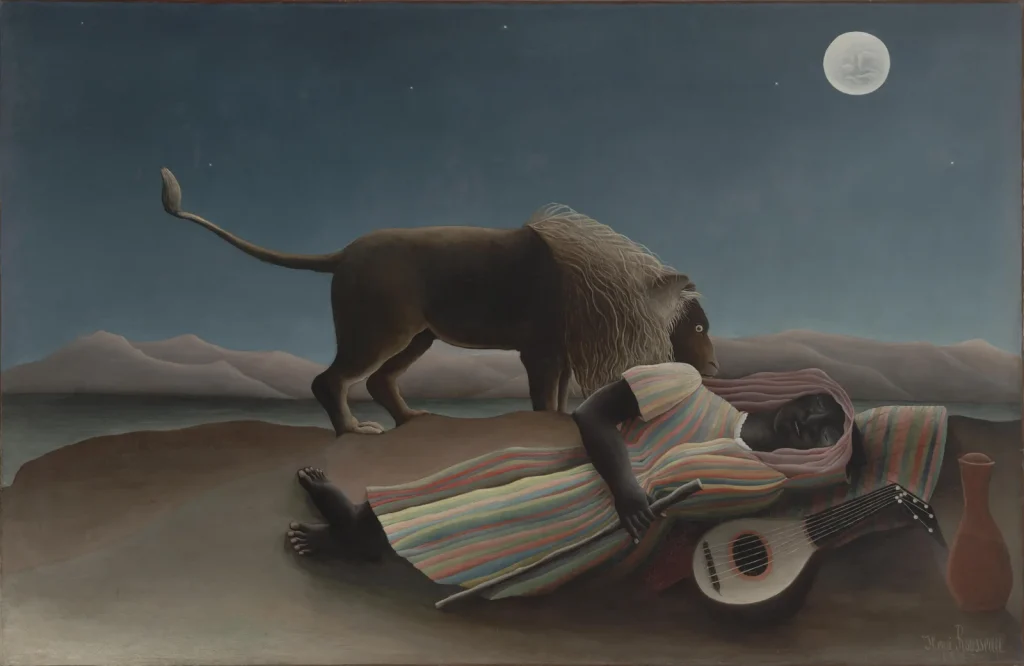
A wandering negress, a mandolin player, lies with her jar beside her, a vase with drinking water, overcome by fatigue in a deep sleep. A lion chances to pass by, picks up her scent, yet does not devour her. There is a moonlight effect, very poetic. The scene is set in a completely arid desert. The gypsy is dressed in oriental costume.
Henri Rousseau to the Mayor of Laval, 10 July 1898
He asked for between 1,800 and 2,000 francs. The mayor did not reply. The painting stayed in Rousseau's studio, then in a junk dealer's, and is now in the Museum of Modern Art in New York, where it is one of the most visited pictures in the building. The letter is the best description of it anyone has written, and it was written by a man everyone in Paris thought was a joke.
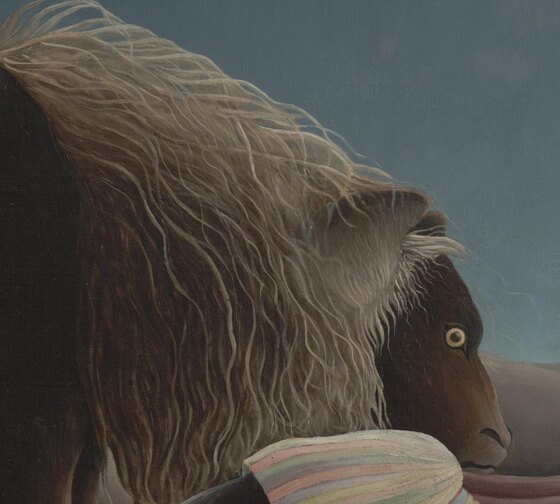
The lion is the picture. He has walked into the frame from the left, tail up, mane hanging in neat strands like a wig, and lowered his head to sniff the sleeping woman. His eye is round and bright and completely awake. He is not a real lion. Rousseau had never seen one outside the Paris zoo and the pages of a children's encyclopaedia, and it shows: the body is stiff, the mane is combed, the eye is a button. And yet nobody who has seen this lion forgets him.
What he is doing is the whole story. He has smelled her, and he has not eaten her. The letter says it plainly. Whether he is deciding, or has decided, or is simply curious, the painting does not say, and the woman sleeps on.
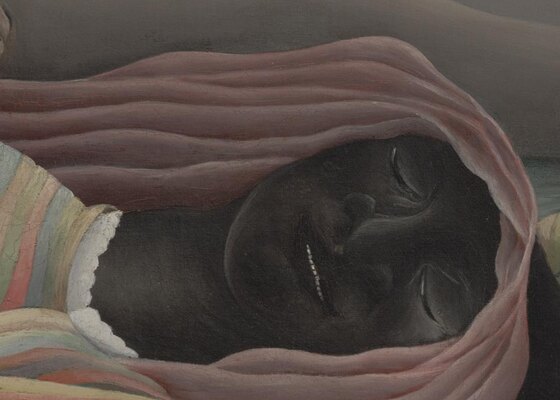
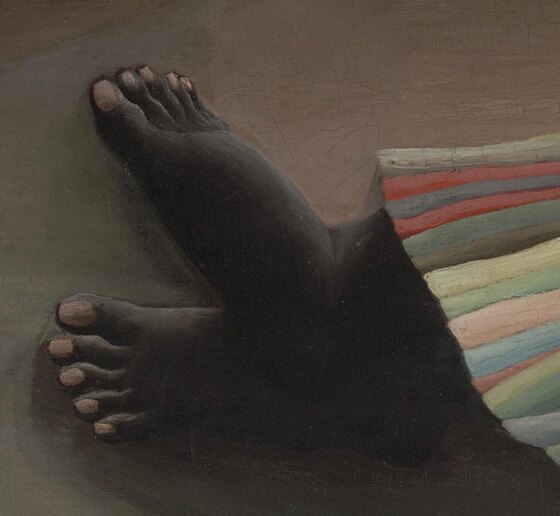
She lies on her back in a striped robe with a staff in her hand, her mandolin and her water jar beside her, her eyes closed and her mouth curved in something close to a smile. Rousseau called her a gypsy and a negress in the same breath, which tells you that he meant a wanderer, an outsider, someone from far away, not a person from anywhere in particular. She is asleep in a place where nobody sleeps safely, and she is safe.
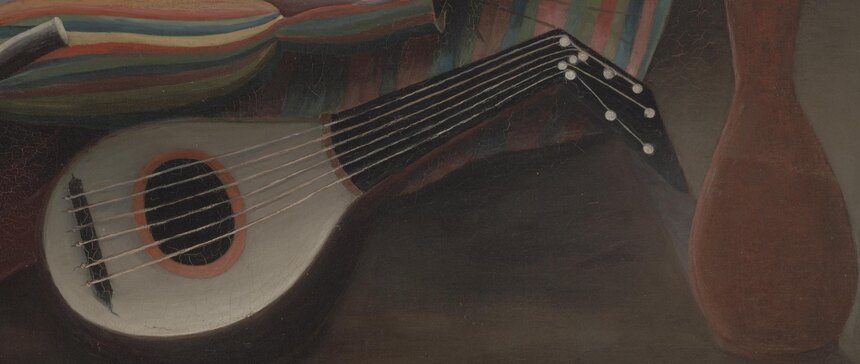
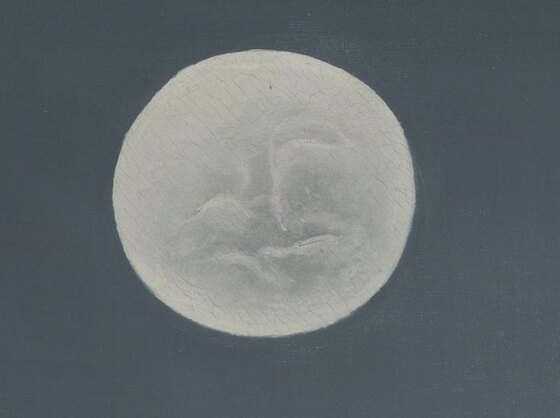
Look at the mandolin and the jar. They are painted with the flat, exact care of a man who taught himself to draw by copying things, and they sit on the sand as if placed there by a hand. Nothing in the picture casts a proper shadow. The moon is full, the stars are painted one by one, the mountains are a pale ridge, the sand is a smooth plane. It is the desert as a child would build it, and it is entirely convincing, because Rousseau believed in it.
Rousseau was a clerk in the Paris customs service, which is why they called him le Douanier, the customs man. He took up painting seriously in his forties, taught himself, and showed every year at the Salon des Indépendants, where the critics laughed and the public came to laugh with them. He did not mind, or did not show it. He believed he was a great painter, told people so, and was, in the end, right.
The young artists noticed before anyone else. Picasso bought one of his portraits from a junk shop for five francs and in 1908 gave a famous banquet in his honour, half tribute and half prank, at which Rousseau told him that they were the two greatest painters of the age, Picasso in the Egyptian style and himself in the modern. Apollinaire wrote his epitaph. Kandinsky put him in the Blue Rider almanac. By the time he died, in 1910, poor and in hospital, the people who mattered had stopped laughing.
Rousseau's letter says what it means: a traveller sleeps, a lion comes, the lion does not kill her. That is a story about grace, or luck, or the peace of the innocent, and the painting lets you choose which. The Surrealists, who adopted Rousseau as an ancestor, read it as a dream: the lion is what she is dreaming, and the picture is the inside of a sleeping head. Both readings work, and the painting is better for not settling it.
What everyone agrees on is the stillness. The moon, the sand, the sleeper, the lion with his tail up: nothing moves, nothing will move, and the moment before something happens has been made permanent. It is the same silence as in the Isle of the Dead, painted fifteen years earlier by a man who could not have been more different, and it comes from the same century's need for pictures you could dream into.
After Laval turned it down the painting vanished. It surfaced in 1924 in the shop of a Paris charcoal merchant, was identified by a dealer, and was bought by the American collector John Quinn, who had the best eye in New York. The critic Louis Vauxcelles, who had mocked Rousseau in life, wrote that it was a masterpiece. Quinn died within the year. His estate sold it, and in 1939 Mrs Simon Guggenheim bought it for the Museum of Modern Art, which had opened ten years earlier with a show that included Rousseau. It has been on Fifty-Third Street ever since.
In the Museum of Modern Art, New York, on the fifth floor with the other founding pictures of modern painting. It is oil on canvas, 129.5 by 200.7 centimetres, so the lion is about life size and the sleeper a little larger. Rousseau signed it in the bottom right corner and dated it 1897.
It is one of the paintings people buy for children's rooms, and one they buy for themselves for the same reason: it is calm, it is strange, and it promises that the lion will not bite. Our hand-painted reproduction of The Sleeping Gypsy is painted in oil on canvas from the MoMA original, flat colours, star by star, the way Rousseau did it. A plain frame, pale wood or white, and a wall it can be the only thing on.
More Rousseau in our Henri Rousseau collection, and the wider Post-Impressionism archive, where the museums file him for want of a better word.
Enjoyed this story?
Save articles to your collection
Log in or create a free account, and this article will be waiting in your Private Collection.
Log in or sign upVisible details, documented facts and interpretation are kept separate throughout this article. Rousseau's letter is given in his own words, including his own terms for the sleeper.
A note from the studio
Our studio is working through an exceptional number of commissions, so we have paused new orders for a short time. We will start taking orders again on 1 October.
Every painting is made entirely by hand, and we would rather pause than rush one. Thank you for your patience and your trust.
Leave your details and we will reserve your place: we will write to you as soon as orders reopen.
Thank you
Your request is saved. We will write to you on 1 October, and a confirmation is on its way to your inbox.