Loading cart…
No products in the cart.

c. 1767 to 1768 · Oil on canvas · The Wallace Collection, London
We know how this painting began because a playwright wrote it down. In October 1767 Charles Collé recorded in his journal a story he had heard from the history painter Gabriel-François Doyen. A gentleman of the court, the Baron de Saint-Julien, had summoned Doyen and explained what he wanted:
I should like you to paint Madame on a swing that a bishop is setting in motion. You will place me in such a way that I am able to see the legs of the lovely girl, and better still, if you want to enliven your picture.
The Baron de Saint-Julien to Doyen, as recorded by Charles Collé, 1767
Doyen, who painted saints and battles, was appalled. He turned the job down and passed it to a younger man who painted for pleasure: Jean-Honoré Fragonard. Fragonard took the brief, quietly removed the bishop, and made the most famous picture of the eighteenth century.
Saint-Julien was the receiver general of the French clergy, which is why he thought a bishop pushing his mistress was funny. Fragonard's version keeps the joke and loses the risk. The man doing the pushing is an anonymous older gentleman in the shadows, and the man in the bushes, getting the view he asked for, is the client.
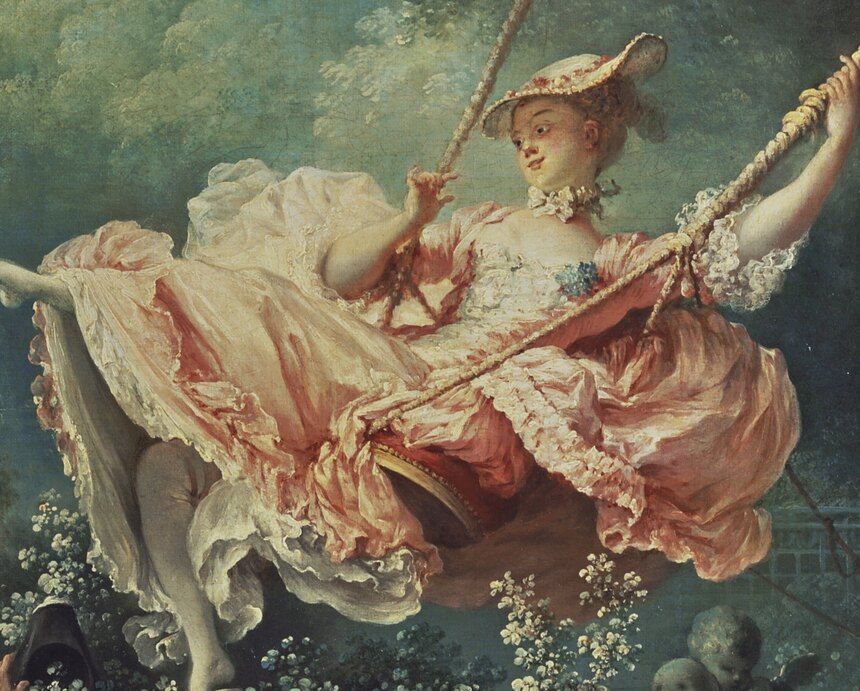
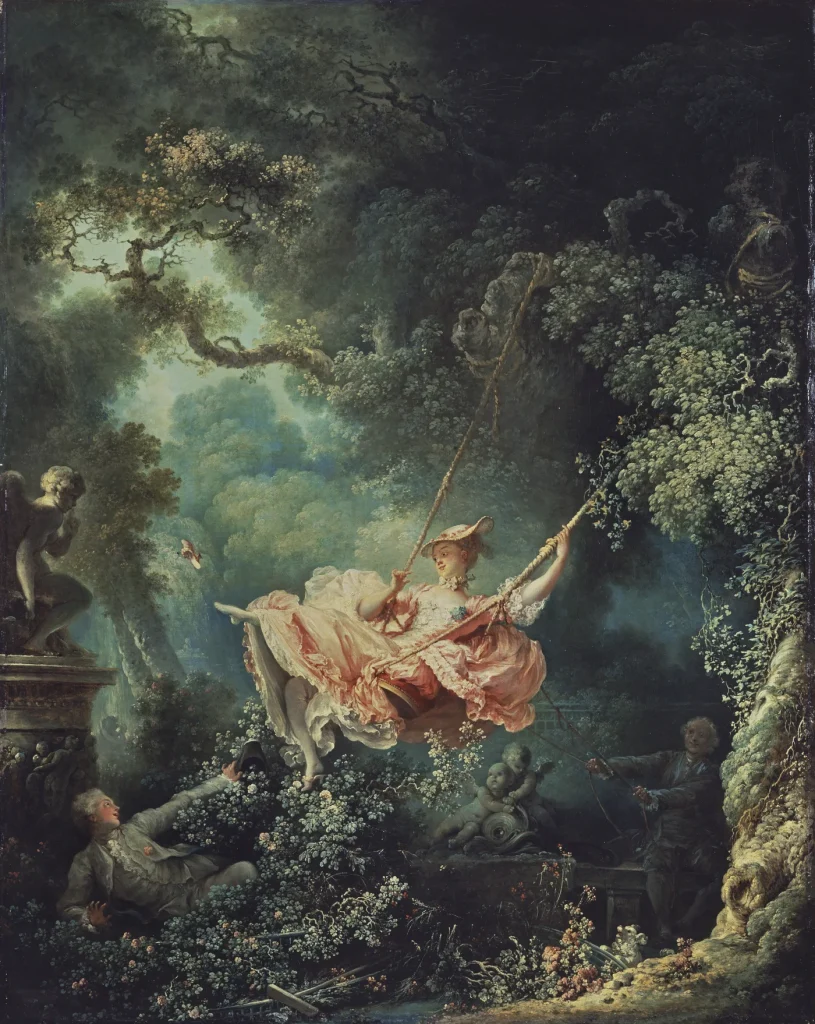
She is at the top of the arc. The swing has carried her up and out of the shade into a shaft of light, her pink silk skirts have opened like a flower, and she has kicked her left leg straight out. A straw hat with a feather sits on her hair. She is looking down and to the left, at the man in the roses, with a small smile.
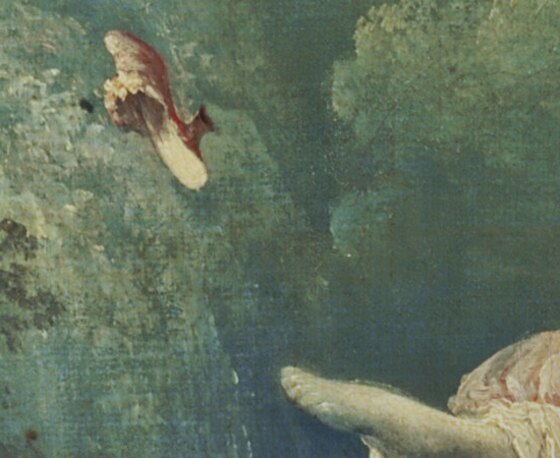
Her shoe has come off. It hangs in the air above the garden, a pink satin slipper with nothing under it, heading for the statue on the left. In the language of the eighteenth century a lost slipper meant a lost virtue, and everyone who saw the painting knew it. Fragonard puts the shoe at the exact centre of the left half of the canvas, where you cannot miss it, and paints it with more care than the girl's face.
The kick is the point of the picture. It is what the client asked for, it is what the lover is looking at, and it is what the pink dress was painted to frame. Every brushstroke in the skirt, and there are hundreds, laid on fast and thick and wet, is there to make the fabric fly.
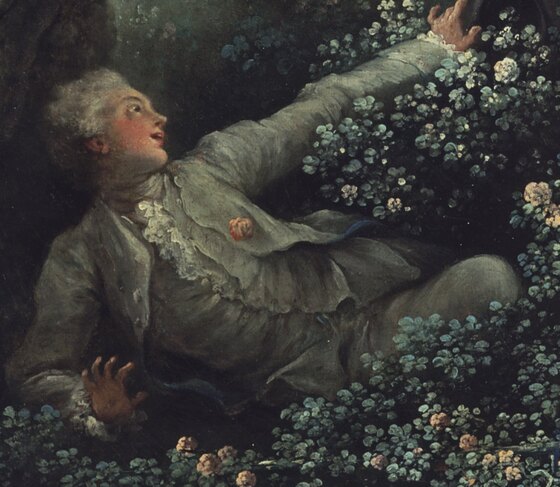
Bottom left, half buried in rose bushes, a young man in grey silk lies back on one elbow with his hat in his outstretched hand. He is directly under the swing and he is looking up. His mouth is slightly open.
This is the Baron, or the Baron's idea of himself: young, elegant, thrilled. Fragonard gives him the best light after the girl, and gives the roses around him the same pinks as her dress, so that the two of them are painted as one colour in a green world. The old man on the right is painted in grey and brown, and he is in the dark.
Note the hat. He has taken it off and holds it out toward her, which is a gallant's gesture, but it also lifts it out of the way of the view. Fragonard thought of everything.
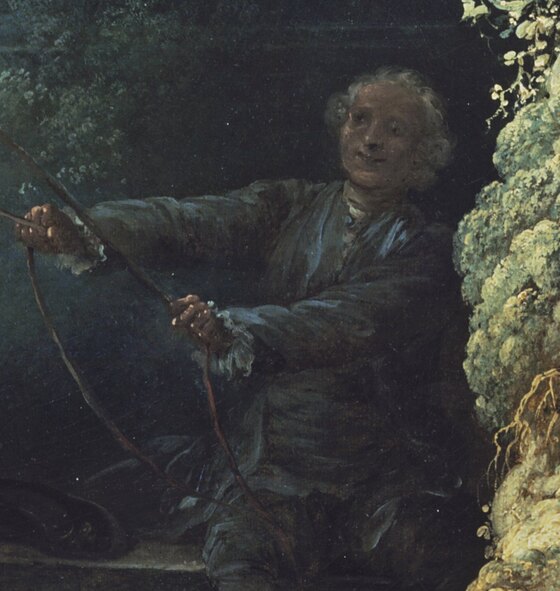
On the right, in the shade of the big tree, an older man sits pulling two ropes that work the swing. He is smiling. He is enjoying pushing her, and from where he sits he has no view at all of the man in the roses.
For a long time he was called the husband, and the painting was told as a story of adultery under the husband's nose. But nothing in the picture says he is married to her; Collé's story called for a bishop, and Fragonard replaced him with a generic old gentleman. He may be a husband, a guardian, a father, a rich protector. What he certainly is, is the person who provides the motion and misses the point. The joke is on him, whoever he is.
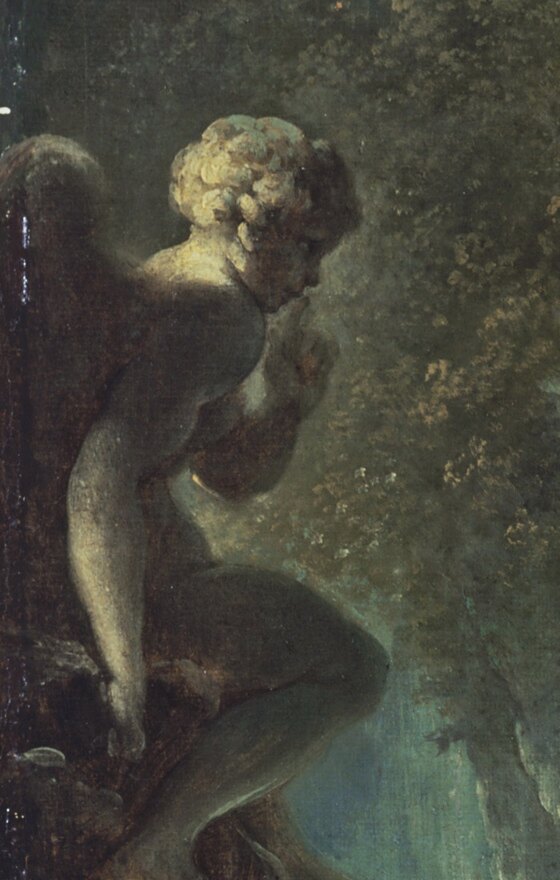
Above the young man, on a stone pedestal, a marble Cupid holds a finger to his lips. Every viewer in 1768 would have recognised him. He is Falconet's L'Amour menaçant, Menacing Love, a statue shown at the Salon a decade earlier and reproduced in porcelain for every fashionable mantelpiece in France. The finger means: say nothing. He is looking at the lover, and he is on his side.
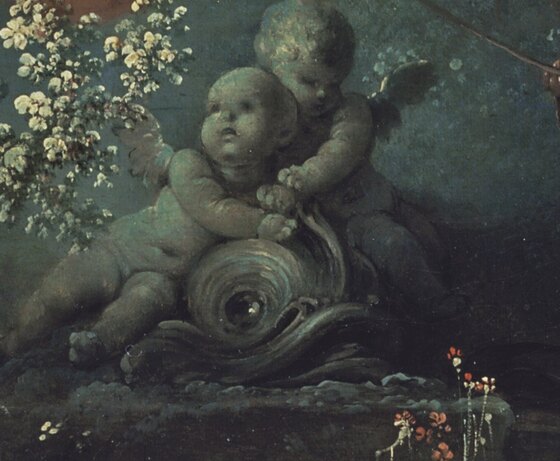
Below the swing, two more stone putti ride a dolphin, and next to them a small white dog looks up and barks. The dog is the traditional emblem of fidelity in painting, and it is the one creature in the garden that objects. Nobody is listening to it.
Ask anyone to name a Rococo painting and this is the one they name. It has everything the style stood for: an aristocratic garden gone half wild, foliage that curls like the scrollwork on a Louis XV chair, light that falls in patches through the leaves, colours of sugared almonds, and a subject that is about nothing except pleasure and the game of being looked at.
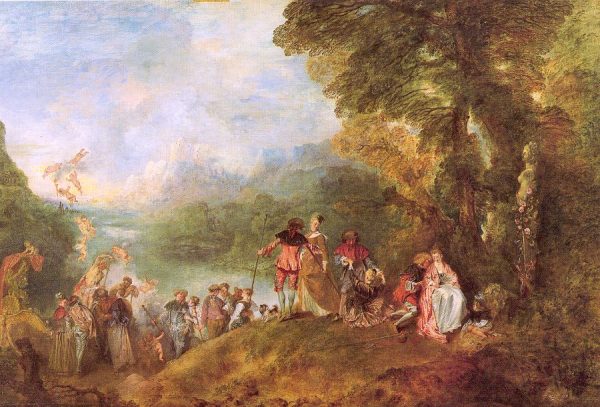
Fragonard did not invent the garden of love. Watteau had painted lovers drifting off to the island of Venus half a century before, and Boucher, Fragonard's teacher, had spent a career on pink flesh and blue silk. What Fragonard added was speed. Look at the leaves: they are not drawn, they are flicked. The dress is scrubbed on. The whole picture was painted fast, with a loaded brush, by someone who knew that a swing is only a swing if it is moving.
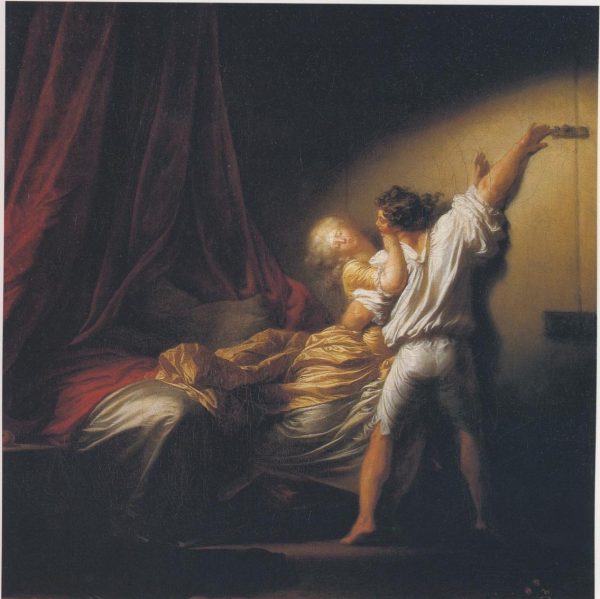
Twenty years later the mood had changed and so had Fragonard. The Bolt, with its lovers in a dark bedroom and a hand reaching for the lock, is the same subject with the sunlight taken away. The Revolution finished the style, and Fragonard, who lived until 1806, died forgotten.
The painting's first recorded owner after Saint-Julien was a tax farmer, Marie-François Ménage de Pressigny, who was guillotined in 1794. It passed through Parisian collections until 1865, when the fourth Marquess of Hertford, the greatest buyer of French eighteenth-century art of his day, bought it at auction in Paris. His collection became the Wallace Collection in London, and The Swing has hung there since the museum opened in 1900.
In 2021 it was cleaned for the first time in over a century. The yellow varnish came off, the pink of the dress and the greens of the garden came back, and the picture went on display again looking, in the museum's words, as Fragonard intended.
It has never stopped being copied. The girl's kick is quoted in Disney's Frozen, where Anna sings in front of it, and in Tangled, whose whole palette is borrowed from this garden. A painting made for one man to look at his mistress became the picture that taught animators what delight looks like.
In the Wallace Collection at Hertford House, London, which is free to visit. It is oil on canvas and surprisingly small: 81 by 64 centimetres, about the size of a large window pane. The girl is the height of your hand.
That smallness is worth knowing before you order a reproduction, because the painting takes enlargement well. At original size it is a jewel; at a metre tall the garden opens up and the brushwork in the leaves becomes visible. Our hand-painted reproduction of The Swing is painted in oil on canvas from the Wallace composition, with the cleaned colours. It suits bedrooms, dressing rooms and any room that could use a joke, and a gilt frame, which is how it hangs in London.
Not to be confused with Renoir's The Swing of 1876, a very different picture with the same name. More Fragonard in our Jean-Honoré Fragonard collection, and the wider Rococo archive.
Visible details, documented facts and interpretation are kept separate throughout this article. The man on the right is not identified as a husband because nothing in the painting or the sources says he is.