Loading cart…
No products in the cart.

1876 · Oil on canvas · Musee d'Orsay, Paris, France

Renoir painted The Swing during the same productive summer of 1876 in which he also worked on Bal du moulin de la Galette, using the garden behind his rented studio on the rue Cortot in Montmartre as the setting for both compositions. The model for the young woman on the swing is believed to be Jeanne, a neighbor who also appears in the larger dance scene. The male figures include Renoir's friends and fellow artists, including the painter Norbert Gonette and the writer Georges Riviere, who documented his time with Renoir and provided firsthand accounts of the working conditions and social environment in which these paintings were produced. The use of a real garden with identifiable individuals grounds the composition in the specifics of a particular time and place.
The painting was exhibited at the Third Impressionist Exhibition in 1877 alongside Bal du moulin de la Galette, and both works attracted significant critical attention. The collector Gustave Caillebotte, himself an important Impressionist painter, purchased The Swing shortly after the exhibition and kept it in his collection until his death in 1894. Following Caillebotte's bequest to the French state, the painting entered the national collection and eventually came to rest at the Musee d'Orsay, where it remains today as one of the highlights of the museum's Impressionist holdings. The early acquisition by Caillebotte indicates the high regard in which the work was held among Renoir's immediate circle of peers.
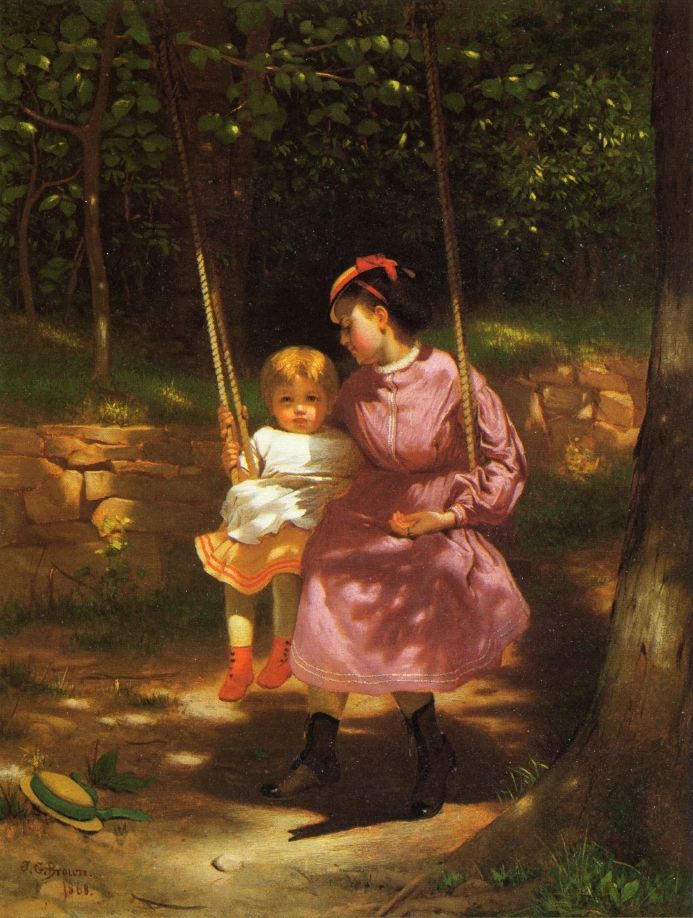
The central compositional device of the swing creates a gentle sense of suspended movement, with the figure of the young woman caught at a moment of stillness within a setting associated with playful motion. Renoir positions her slightly off-center, surrounded by three other figures whose gazes and body language create a dynamic of social attention focused on her. The child in the lower left corner introduces a note of unselfconscious observation that contrasts with the more loaded social interaction among the adults. The vertical lines of the trees and the hanging ropes of the swing provide a structural grid that organizes the otherwise fluid and atmospheric space of the garden.
The most celebrated technical feature of the painting is Renoir's rendering of dappled sunlight filtering through the leaves overhead and falling across the figures and ground as irregular spots and patches of warm light and cool shadow. This effect, sometimes called taches de soleil in French, was a defining challenge of outdoor Impressionist painting, requiring the artist to observe and reproduce the constantly shifting patterns created by light passing through foliage. Renoir uses short, curved brushstrokes of varying opacity to suggest the flickering quality of this light without reducing it to a mechanical pattern. The blue of the young woman's dress is carefully modulated to show how the alternating light and shadow affect local color, a demonstration of one of the core optical principles underlying Impressionist practice.
The Swing participates in a broader cultural conversation about leisure, courtship, and the pleasures of outdoor life that was central to the Impressionist project in the 1870s. The garden setting evokes the private outdoor spaces of the Parisian bourgeoisie and working class alike, places where social conventions were slightly relaxed and where interactions between men and women could occur with a degree of informality not permitted in more formal indoor settings. The swing itself carries symbolic associations with youth, freedom, and flirtation that were well established in French art long before Renoir, most notably in the Rococo tradition of painters such as Jean-Honore Fragonard. Renoir inherits this tradition but transposes it into a contemporary and recognizable social context.
The painting also reflects Renoir's consistent interest in depicting women as the animated centers of social experience, observed with warmth and without the moralistic judgment that characterized academic treatments of similar subjects. The young woman on the swing is neither an allegorical figure nor a social type but an individual caught in a specific and fleeting social moment. The male figures around her are attentive but not threatening, and the overall atmosphere is one of gentle pleasure rather than tension. This refusal of drama in favor of warmth and sensory richness defines the emotional register that Renoir sought throughout his career, making The Swing one of the most characteristic expressions of his vision of modern life.