Loading cart…
No products in the cart.

About 1834–1836 · Five oil paintings on canvas · New York Historical, New York
Save articles to your collection
Log in or create a free account, and this article will be waiting in your Private Collection.
Log in or sign up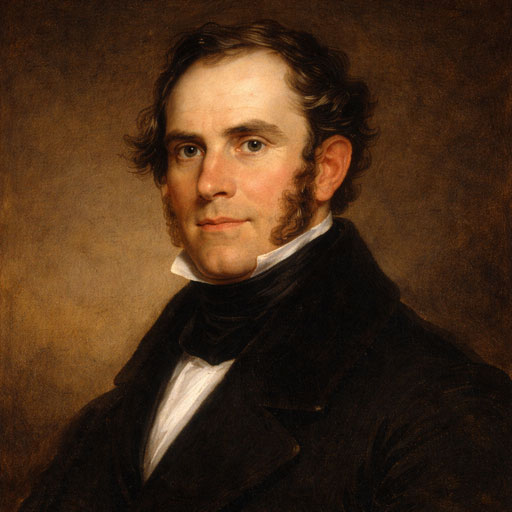 Explore the artistThomas Cole →
A wooded bay becomes farmland, then a magnificent city. Armies tear through it. Finally, trees and water return among the ruins. Across the five paintings, a distinctive rocky height remains recognisable while the human world changes almost beyond recognition.
Thomas Cole's The Course of Empire follows an imagined civilisation through five states. Commissioned by the New York merchant Luman Reed in 1833 and completed in 1836, the series turns landscape into an argument about ambition, prosperity and the limits of power.
These are five related paintings, not five chapters of a documented ancient empire. Cole borrows the appearance of antiquity to ask a question his own century could not keep safely in the past: what happens when a society mistakes its magnificence for permanence?
The sequence runs from The Savage State through The Arcadian or Pastoral State, The Consummation of Empire and Destruction to Desolation.
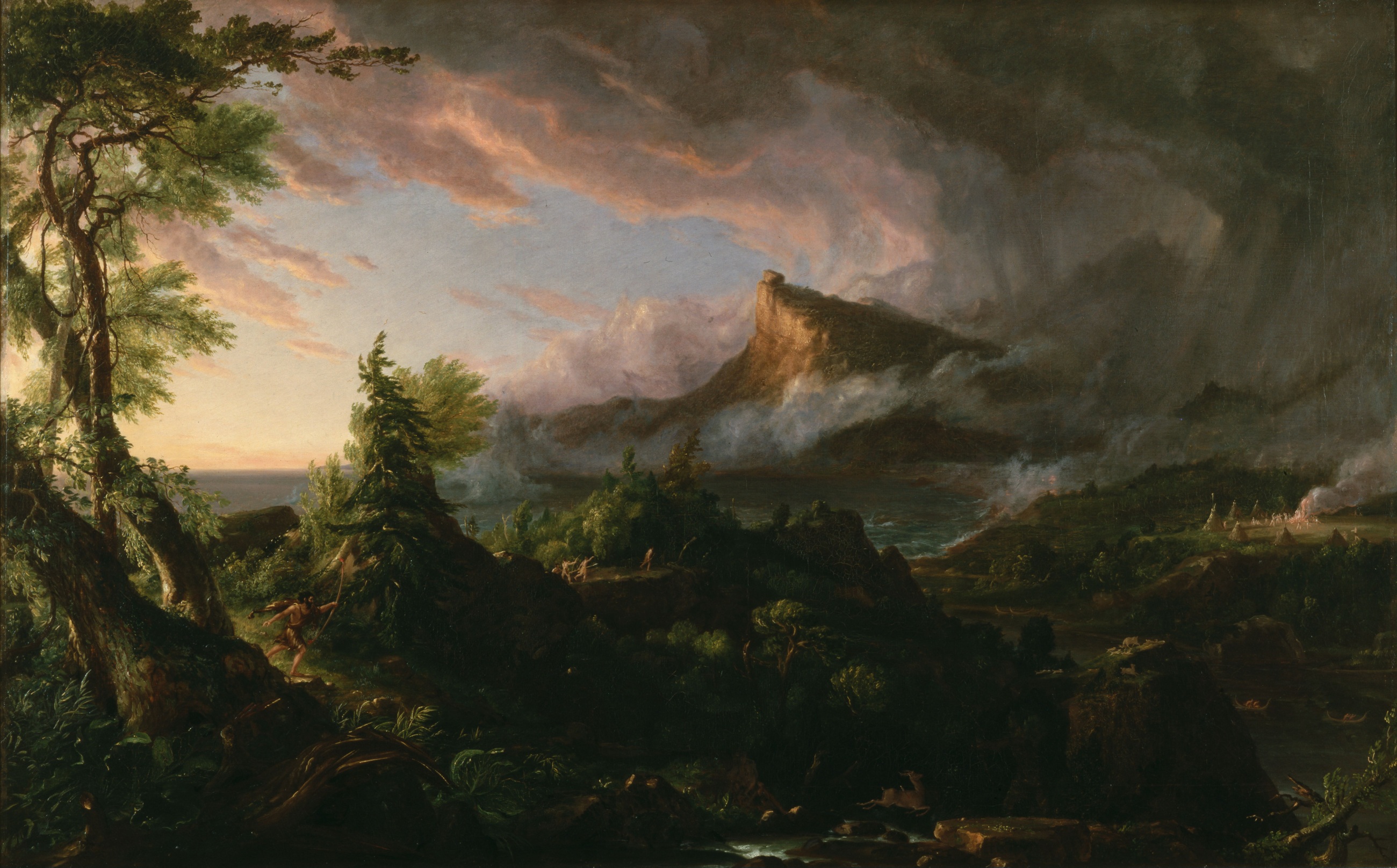
In the first canvas, completed about 1834, dense vegetation and broken terrain dominate. A hunter moves through the foreground; farther away, a small settlement occupies a clearing. Clouds gather around the mountain, and light opens near the water.
The human figures are small within this environment. Their activities do not yet impose a large geometric order on the bay. Trees, slopes and weather determine much of the composition.
The New York Historical identifies the hunting, dwellings and communal activity as the beginnings of the society Cole imagined. The title preserves his nineteenth-century language. It should not be treated as a neutral description of real Indigenous peoples or as a scientific ranking of cultures.
The scene matters to the series because it establishes both the place and its capacity to change. The mountain's distinctive shape will continue to identify the setting after the trees give way to architecture.
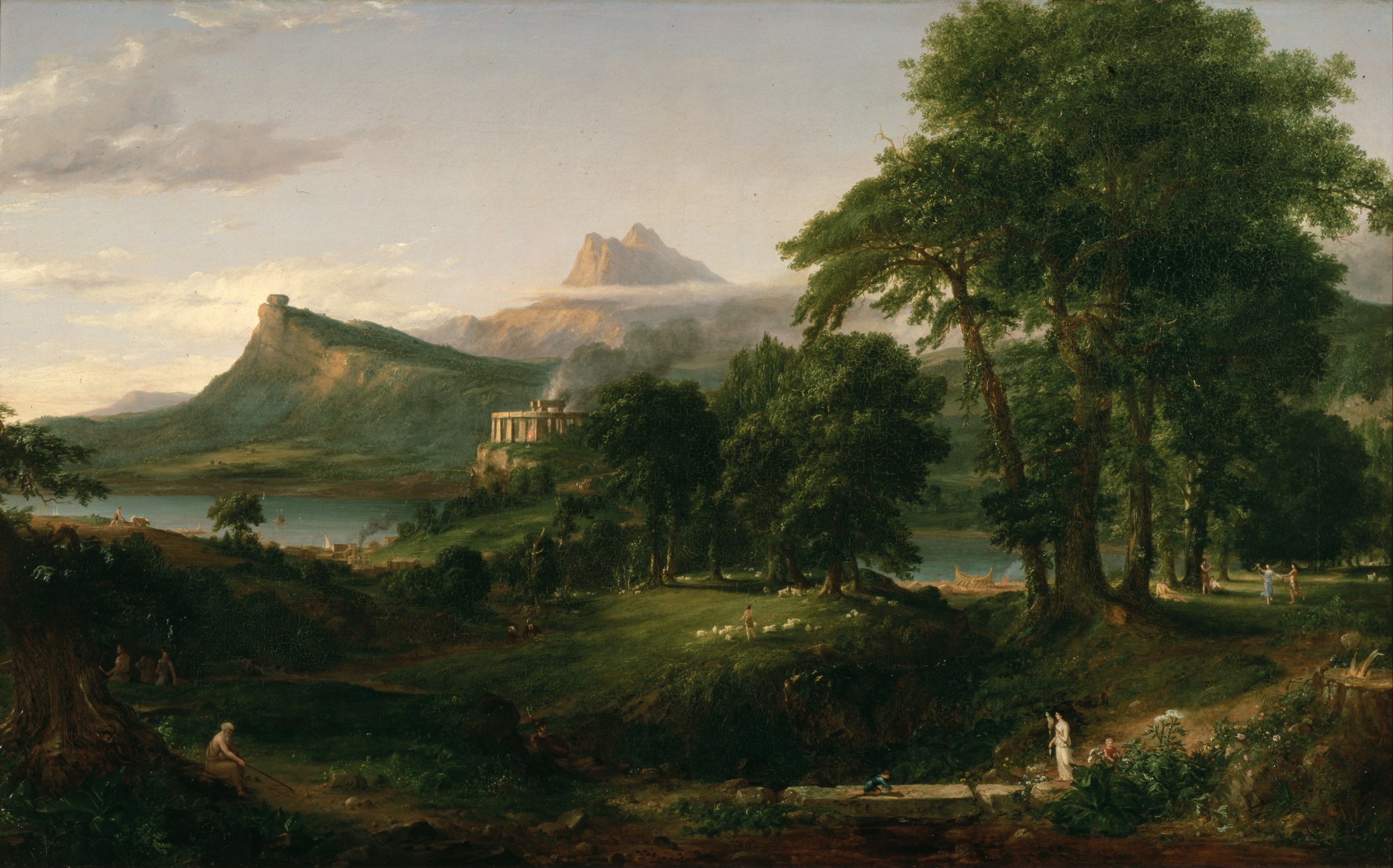
Light fills the second scene. Cultivated ground, grazing animals and people engaged in small tasks occupy a landscape still generous with trees and open space. Across the water, a simple temple sends smoke upward.
Cole brings more forms of human activity into view without yet allowing architecture to overwhelm the land. Farming, music, dance and drawing can be found within the same environment.
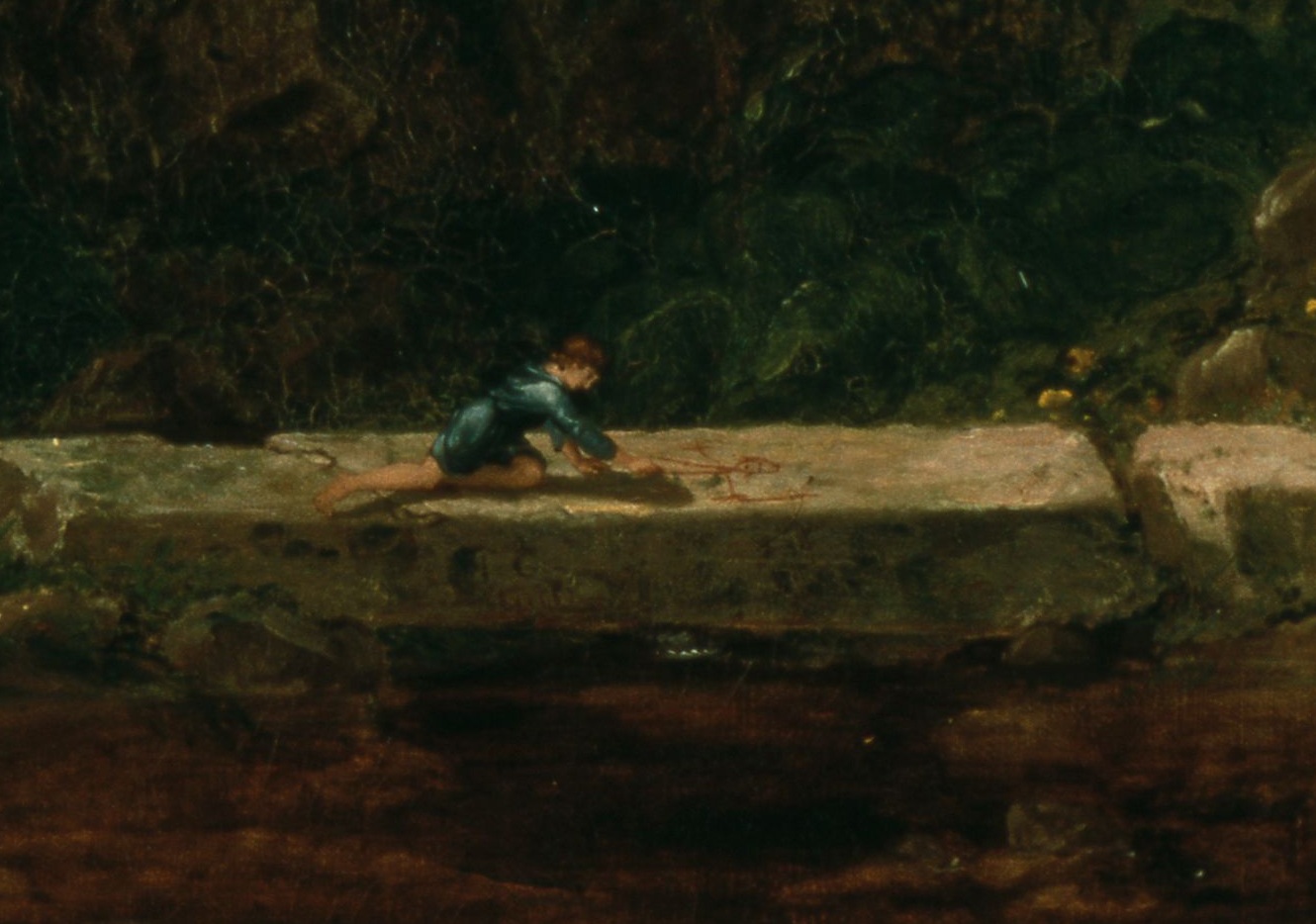
The child making a drawing on a bridge is a particularly small discovery. The museum connects this figure to the beginnings of the visual arts. A few painted marks locate an activity whose later achievements will include the grand series we are looking at.
The scene can appear to be merely a pleasant step on the way to a more impressive city. The museum's account suggests something stronger: Cole imagined this stage as a balance between human development and nature. More building will not necessarily mean a better relationship with the place.
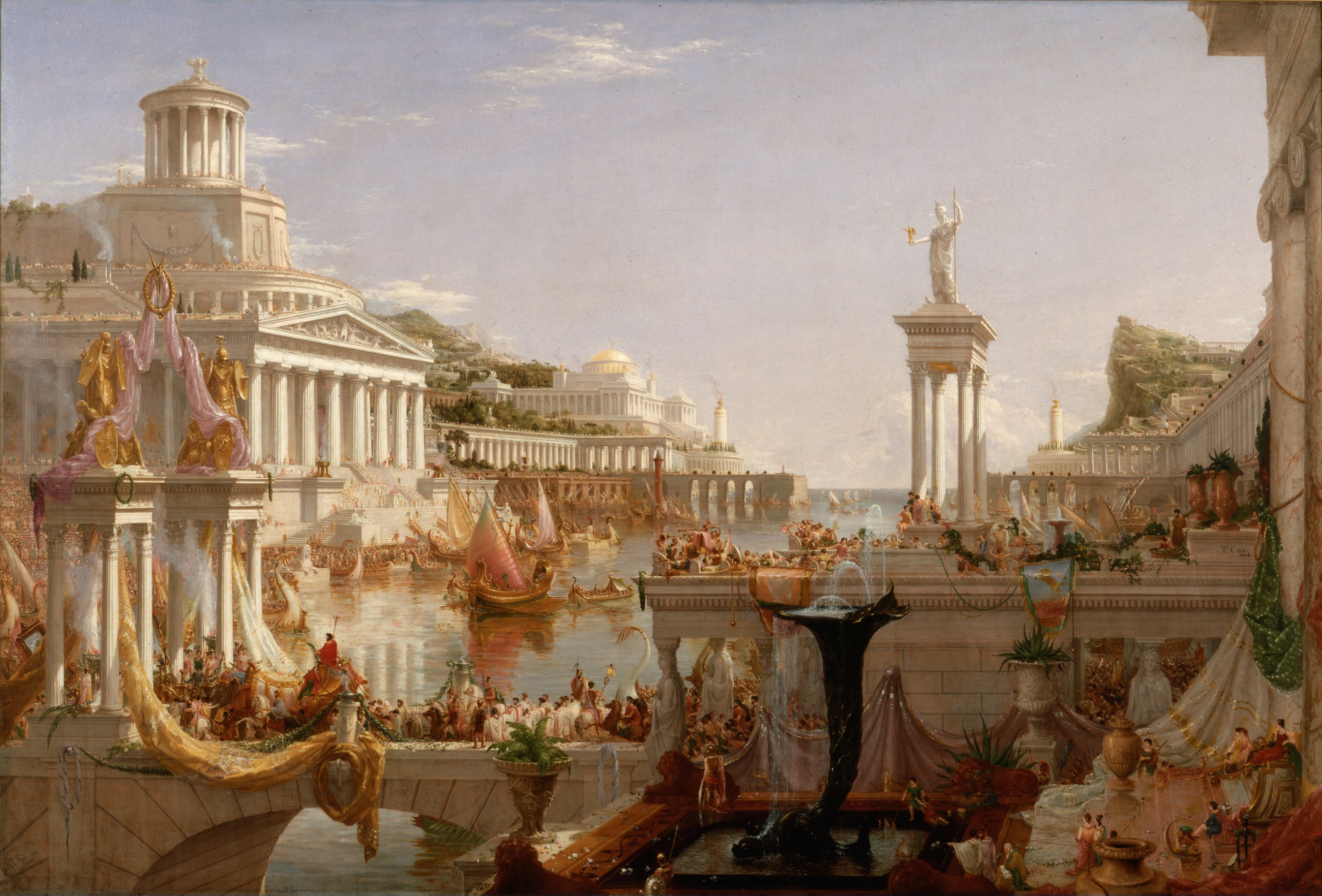
The third painting almost replaces the landscape with architecture. Colonnades, domes, terraces and a bridge crowd the bay. Boats carry decorated sails, people gather in processions, and bright surfaces reflect the abundant light.
The mountain remains, but it no longer commands the scene as it did at the beginning. Buildings compete with it. The society has made its own forms the principal objects of attention.
Cole used a larger canvas for this visual climax. The New York Historical records it at about 130 by 193 centimetres, compared with roughly 100 by 161 centimetres for the other four. The flourishing empire literally occupies more wall space.
Look at the mass of small figures. They celebrate, watch and move through highly organised routes. Where the pastoral view allowed activities to sit within the terrain, this scene creates formal settings for public spectacle.
Its attractiveness is part of the argument. If the city were simply ugly, its fall would offer little difficulty. Cole makes magnificence persuasive before asking what it costs and how long it can last.
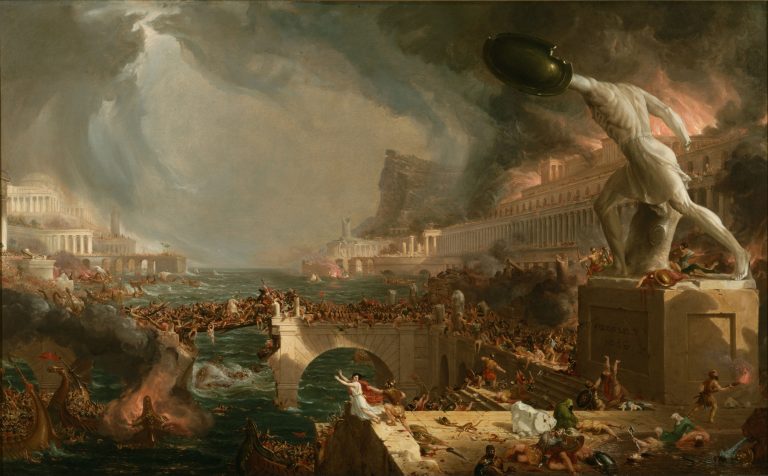
The fourth canvas, shown in the main image above, returns to the crowded city under violent conditions. Fire spreads through the buildings. The bridge is overwhelmed, the water becomes dangerous and the foreground fills with falling, fleeing and fighting bodies.
The shift is more effective because much of the setting is recognisable. The architecture that organised celebration now channels panic. Routes that previously carried processions are no longer safe.
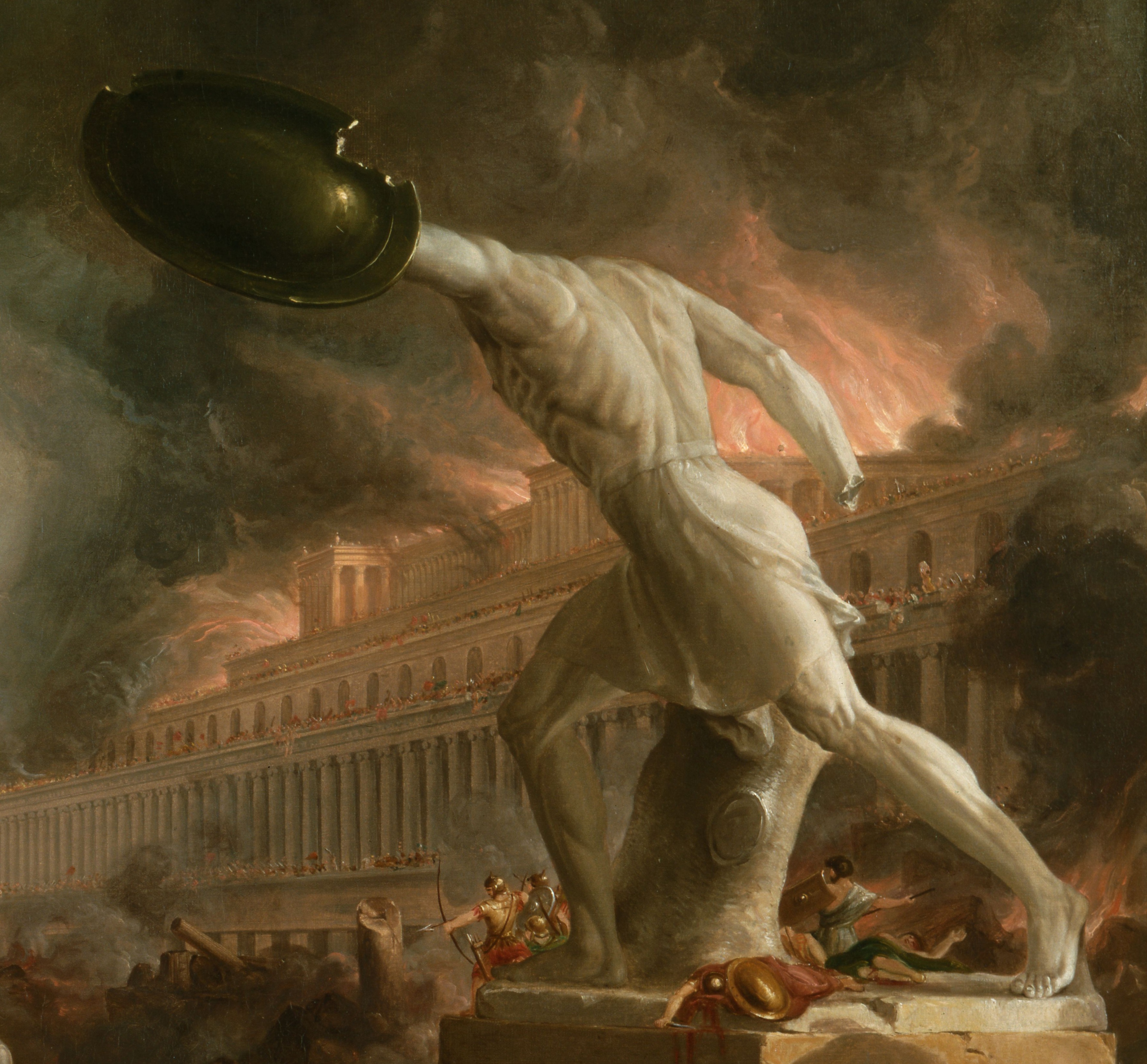
A colossal headless statue dominates the right. Its raised shield and forceful stance survive, but its capacity to represent heroic certainty has been broken. The living people below endure a disaster the stone figure cannot prevent.
The museum connects the scene to Cole's criticism of imperial ambition and discusses its possible resonance with the Great Fire of New York in 1835. These contexts enrich the image without making it a documentary view of that fire or a literal account of Rome's fall.
The painting's noise is imagined, but its visual forms produce it: diagonal weapons, smoke, churning water, crowded bodies and broken masonry compete for attention. There is no single calm place from which to oversee everything.
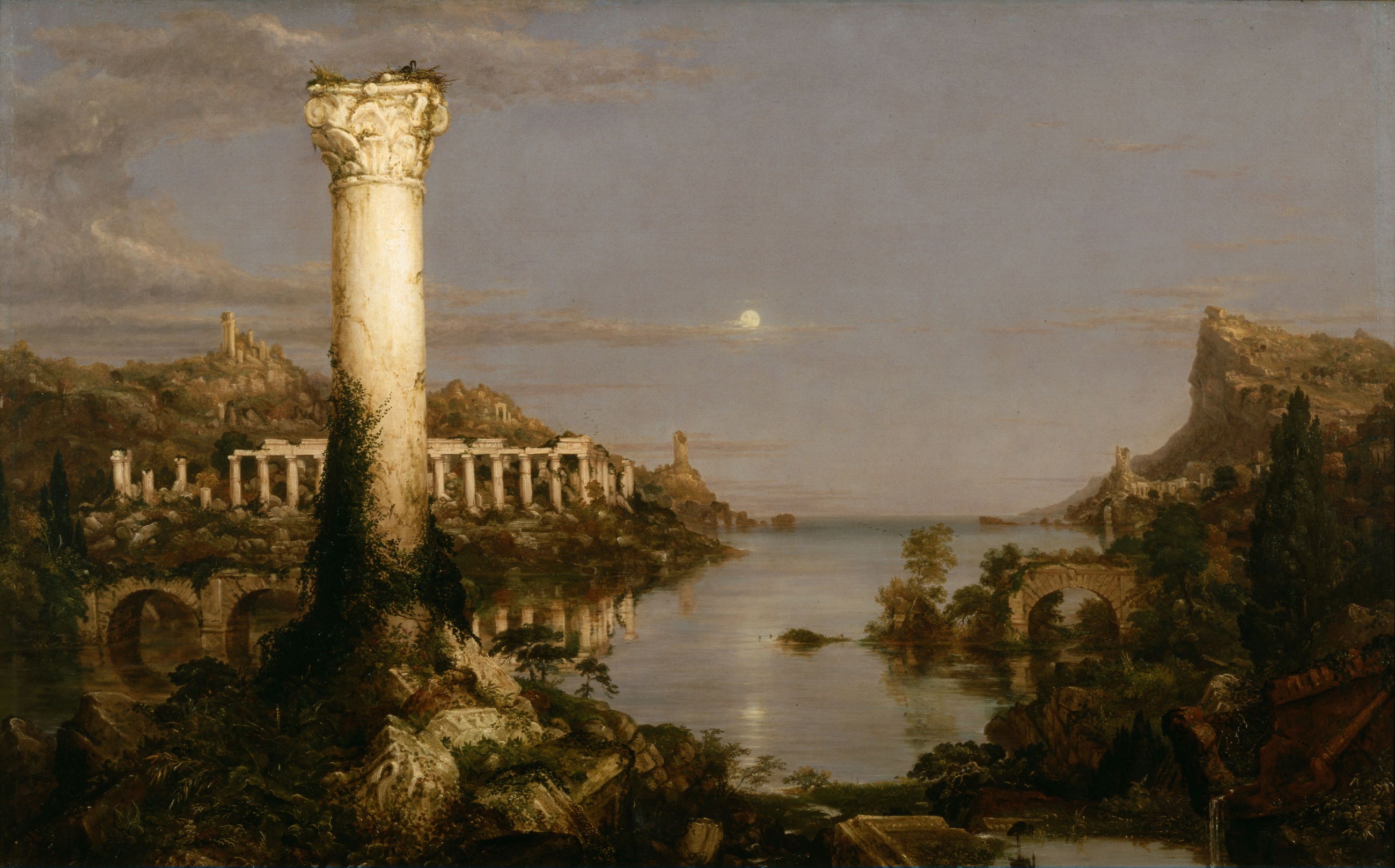
The final scene is quiet. A moon hangs over water that no longer carries a magnificent procession. Plants spread across ruins. One tall column remains near the foreground, its capital supporting birds rather than a roof.
The contrast with Destruction is not another act of violence. Time has done much of the work. The broken structures have become places where vegetation and animals can live.
The New York Historical draws attention to the birds nesting on the column and the return of wildlife among the ruins. These small presences help distinguish an abandoned human world from a world without life.
The mountain remains recognisable at the right. It has not defeated the city in a battle. Its endurance makes the city's confidence look temporary.
The title is therefore only one perspective on the scene. It is desolate in relation to the empire and its inhabitants. Nature continues. Cole leaves viewers with the difficult coexistence of human loss and returning life.
Cole was already known for American landscapes when he sought a commission for the series. The New York Historical describes his ambition to give landscape a larger historical purpose. Luman Reed's support made that project possible.
The cycle does not assume that expansion and wealth guarantee improvement. That scepticism mattered in a young United States often described through confidence in its future.
Scholars have connected details in the series to the politics of Cole's period, including anxieties about presidential power. Such readings should be distinguished from identifying a named politician with certainty in every figure. The broader warning about pride and impermanence does not depend on a one-to-one political code.
A comparison with The Oxbow, also painted in 1836, shows that Cole could make different arguments through landscape. The Oxbow brings cultivation and wilderness into one view. The Course of Empire unfolds change across five canvases and an imagined span of history.
Luman Reed died in June 1836 before the series was finished. His family encouraged Cole to complete it. A surviving backing panel, now in the museum collection, records Cole's grief for the patron who had supported the work.
That small documentary object adds a human timescale to the enormous one represented in the paintings. While Cole imagined centuries of rise and collapse, his own commission was altered by the death of a friend.
The five paintings entered the New York Historical in 1858 with the collection of the New-York Gallery of the Fine Arts. They remain a group. Separating a single dramatic canvas from the others changes the experience: Destruction becomes spectacle, while the complete cycle asks what came before and what remains afterward.
The Savage State; The Arcadian or Pastoral State; The Consummation of Empire; Destruction; and Desolation.
The commission began in 1833. The first two paintings are dated about 1834, the third 1835–1836, and the last two 1836.
All five belong to the New York Historical.
It depicts an imagined civilisation using forms associated with antiquity. Roman history and other literary and artistic sources informed Cole, but the five scenes are not a literal record of one historical empire.
Desolation shows plants and wildlife inhabiting the ruins. That return coexists with the disappearance of the human society shown in the earlier scenes.
Thomas Cole, The Course of Empire, 1834–1836, New York Historical. Public-domain paintings and faithful reproductions, Wikimedia Commons. Detail images are crops of the identified panels.
Enjoyed this story?
Save articles to your collection
Log in or create a free account, and this article will be waiting in your Private Collection.
Log in or sign up
Man Writing a Letter
Gabriel Metsu, c. 1664
The gallery list
Every painting is already 50% off. Join the list and we will send you an extra $15 code, plus first access to new collections.
No spam. Unsubscribe anytime. · Privacy Policy
Welcome
Your $15 code is on its way. Explore the gallery while you wait.