Loading cart…
No products in the cart.

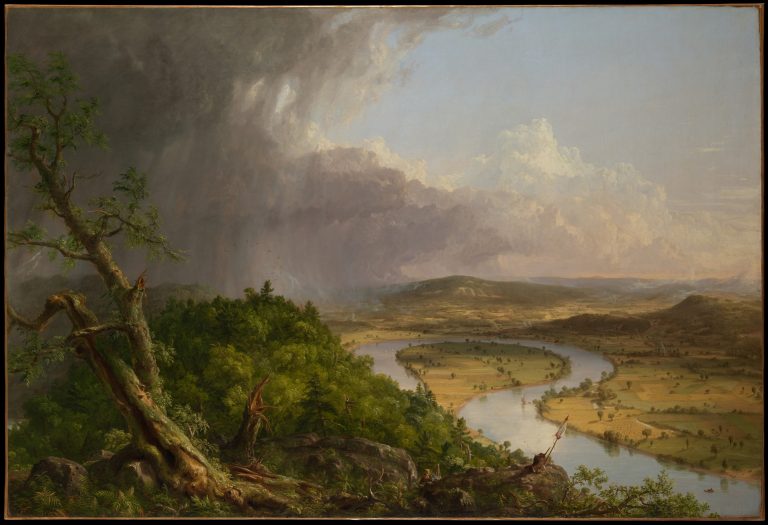
1836 · Oil on canvas · The Metropolitan Museum of Art, New York
Save articles to your collection
Log in or create a free account, and this article will be waiting in your Private Collection.
Log in or sign up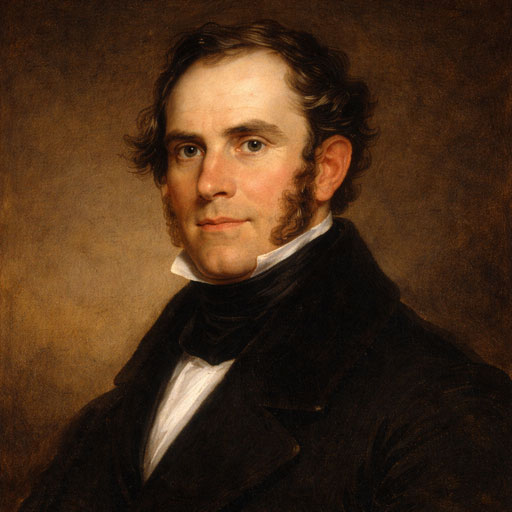 Explore the artistThomas Cole →
The first thing most people notice is the river’s bend. Then the eye moves toward the dark trees, the passing storm and the sunlight across the fields. Only later does a small figure become visible near the bottom of the picture.
Thomas Cole has painted himself into The Oxbow. He is tiny beside the landscape, with his equipment on a rocky ledge. His presence changes the view: this is a place being looked at, selected and turned into a painting.
Completed in 1836, the canvas’s full title identifies the prospect as a view from Mount Holyoke near Northampton, Massachusetts, after a thunderstorm. The distinctive curve belongs to the Connecticut River. The original oil painting is in The Metropolitan Museum of Art, New York.
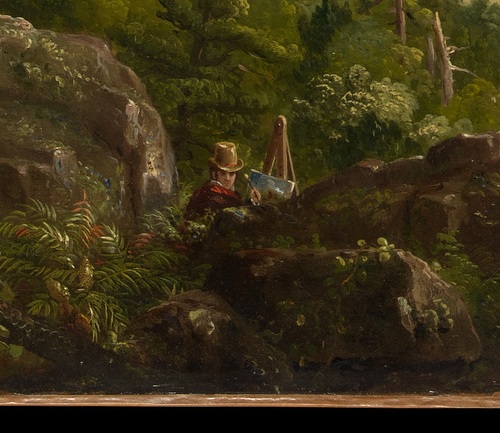
The figure’s size is important. Cole does not compete with the view as a heroic foreground traveller. He lets the viewer discover him among the rocks and vegetation, then look outward again with a new awareness of the person constructing the panorama.
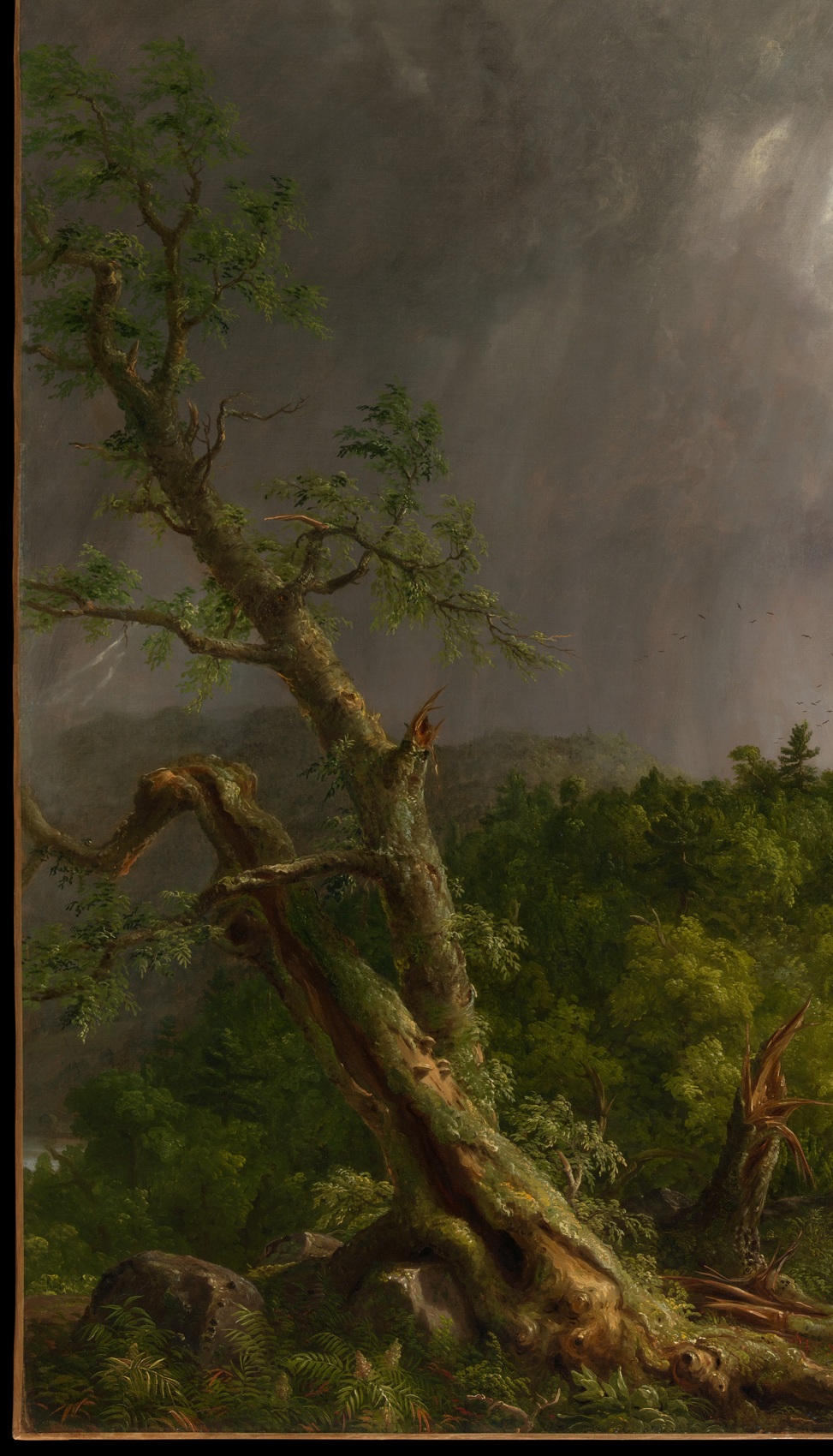
The large tree at the left is damaged and irregular. A thick trunk turns across the foreground, while thinner branches continue upward with patches of green. Broken wood and surviving foliage belong to the same organism.
That combination prevents the foreground from becoming a simple emblem of untouched perfection. Nature already contains damage, growth and change. Tangled plants gather around the roots; dark recesses make parts of the ground difficult to follow.
The trunk also establishes scale. It is close enough to show bark and broken edges, while the buildings and fields far below remain small. Moving from one to the other requires an imaginative change of distance. Cole makes the landscape feel extensive by giving us something near enough to compare with it.
The tree’s long diagonal does compositional work as well. It carries the eye upward toward the darker sky, then back down into the forest. Even the most conspicuous object refuses to hold our attention in only one place.
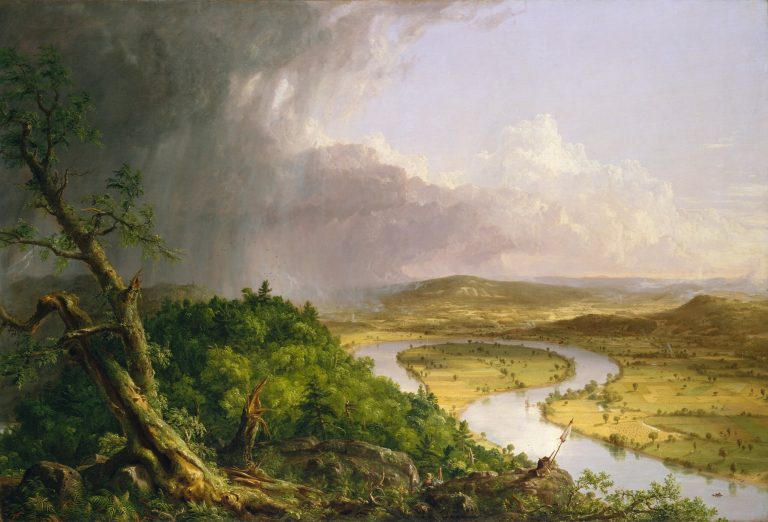
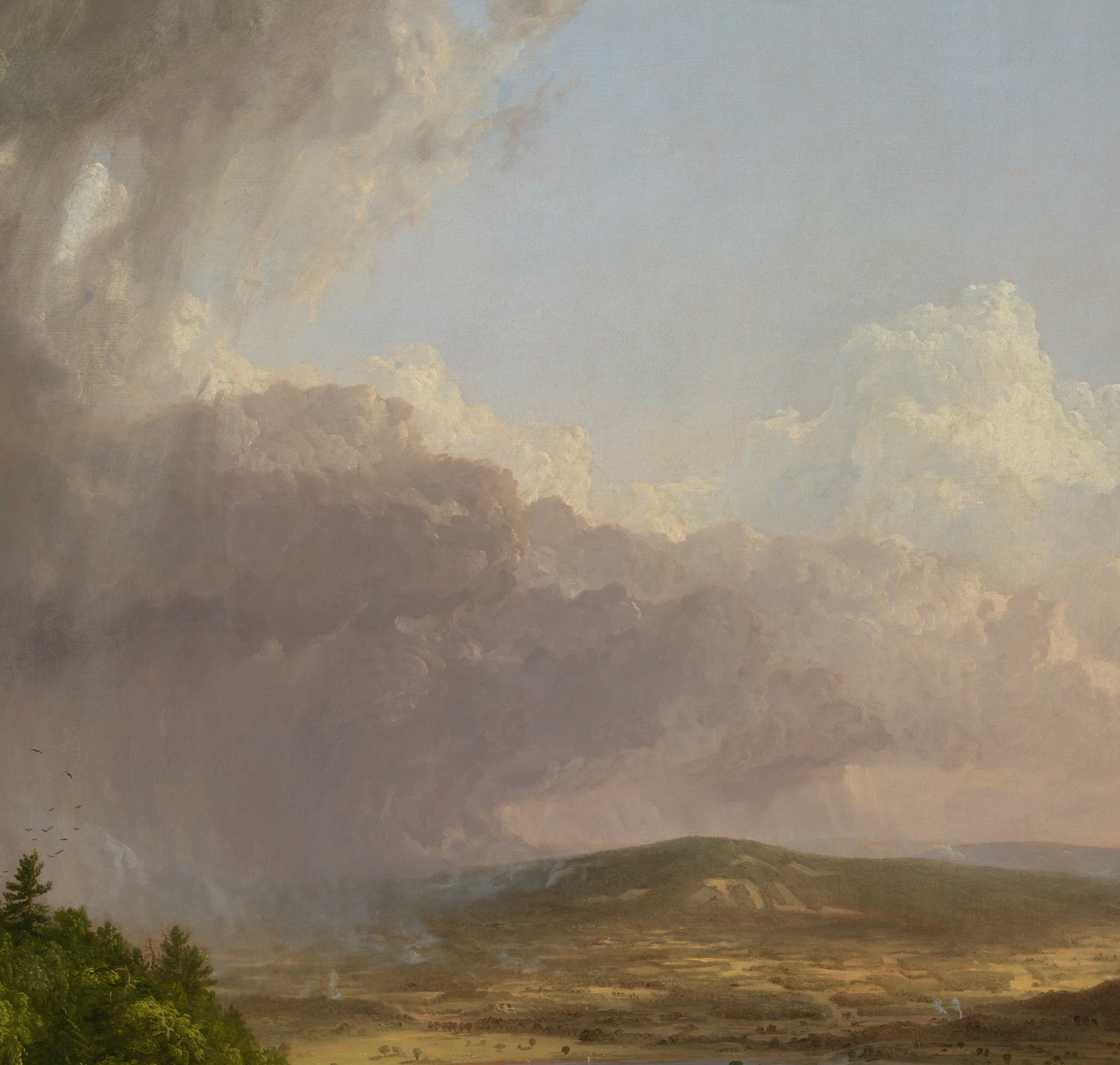
The storm does not end along a ruler-straight boundary. Dark cloud gathers at the left, rain veils the middle distance, and a brighter opening appears beyond it. Changes of light spread across the hills below.
Calling the painting a division between storm and sunshine is useful at first, but look at their meeting place. The clouds turn and thin. Their grey shades continue into the paler sky. The weather connects the two sides even as it makes them feel different.
The long title’s phrase “after a thunderstorm” encourages a sense of time passing. The scene is not simply a permanent opposition between two territories. A storm has moved, and the landscape will look different again. The viewer arrives at one selected moment within that change.
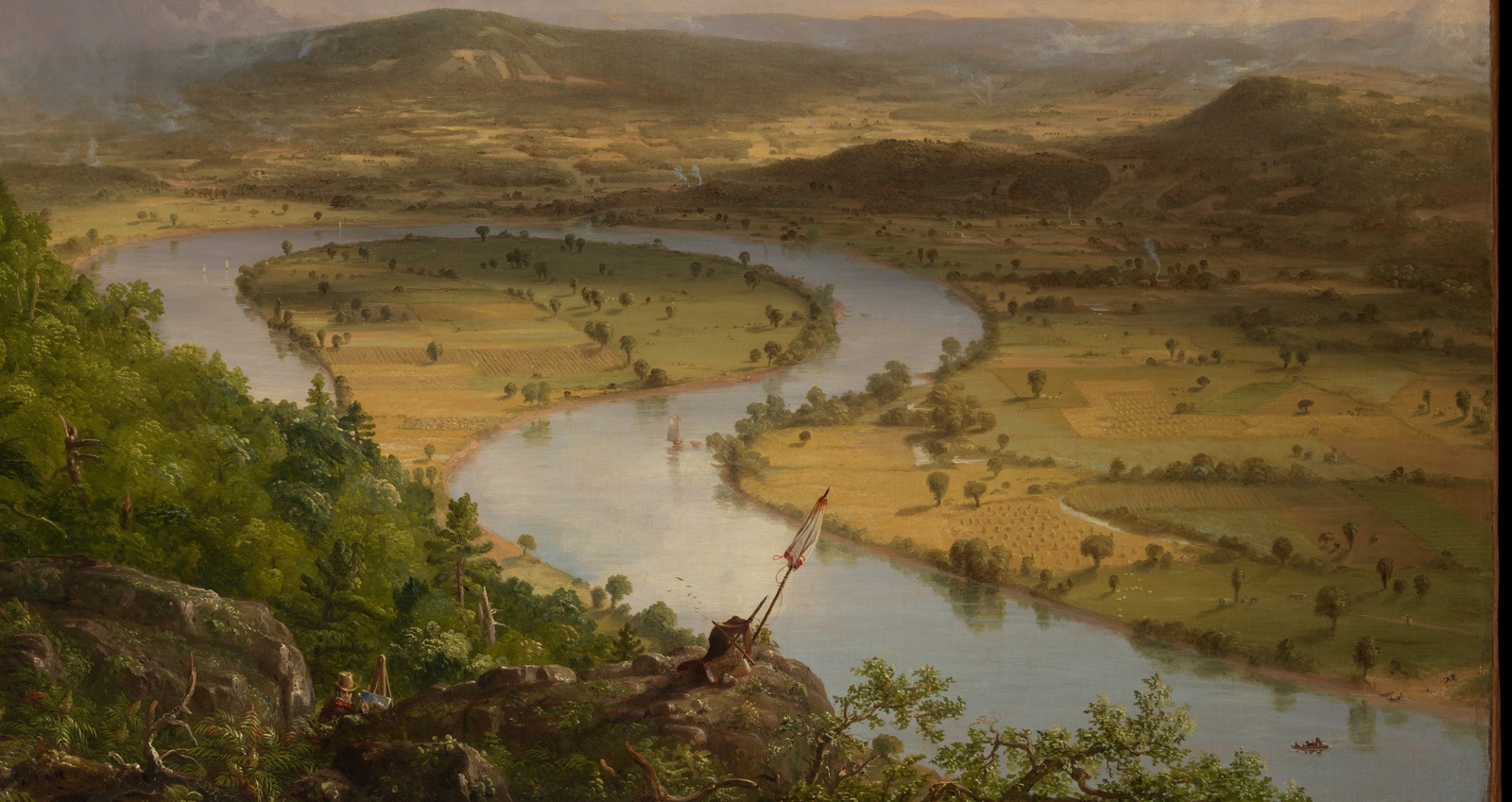
In the distance, the Connecticut River turns around a broad area of land. Its pale surface makes the curve easy to follow. Roads, fields and scattered trees divide the surrounding valley into smaller areas.
The shift from the foreground is striking. Dense overlapping vegetation gives way to horizontal spaces that can be surveyed. The fields appear manageable from this height, while the near forest resists an equally simple reading.
The Met interprets this relationship in the context of Euro-American settlement and the transformation of the landscape. “Wilderness” is not a neutral description of land without a history or inhabitants. The view’s apparent emptiness should not be mistaken for evidence that no people had lived or worked there before the farms shown by Cole.
At the same time, it would flatten the picture to turn every sunlit field into an identical symbol of harm. Their clarity and varied colours are visually appealing. Cole makes the cultivated valley attractive enough for the question about change to remain difficult.
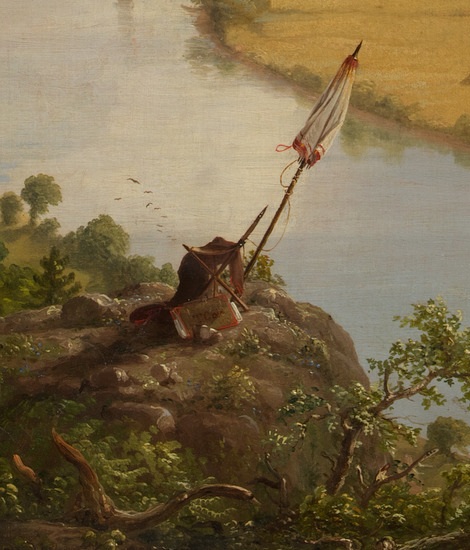
An angled umbrella stands near the painter’s equipment. Its long shaft interrupts the river and the rocks, a small straight line within a landscape of irregular edges.
It is a practical object associated with working outdoors. Within the painting, it also reminds us that this immense view has been selected from a particular position. The observer has a body, materials and a place to sit or stand.
The Thomas Cole National Historic Site traces the painting’s development through drawings and a preliminary oil sketch. The final canvas was worked out in the studio. A painted artist outdoors does not prove that the entire large picture was made on that ledge.
That distinction helps us see the picture’s ambition. An observed place becomes a carefully arranged image. Cole can keep the recognisable river while strengthening the storm, foreground tree and contrast of distances.
In his Essay on American Scenery, published in 1836, Cole urged readers to pay attention to landscapes they often passed without consideration. He also expressed sorrow over the destruction of natural scenery. The concerns were connected: people needed to value what they might otherwise allow to disappear.
Those written ideas provide context for The Oxbow without turning it into an illustrated slogan. The forest is powerful, but troubled by weather and broken wood. The farms are orderly, but part of a changing environment. The painting gives us reasons to look at both.
The Met’s account of Cole’s work places the canvas alongside The Course of Empire, the series he was also developing during this period. Both use landscape to ask questions about human ambition and change. Here, those questions are held within one recognisable American view.
Some interpretations find letter-like forms in the distant hillside and attach religious meanings to them. The Cole site presents that as an interpretation, not a secure inscription to be read as the painting’s single answer. The small painter and the broad river offer more immediate places to begin.
Return to the tiny figure after following the water and the weather. The landscape remains immense, but the act of looking is no longer anonymous. Cole has placed an observer inside the scene and turned him toward us.
We look at the place he is painting, and also at him looking back. That exchange gives the panorama a human scale without making the land merely a backdrop. The painting’s expansiveness and its smallest figure depend on each other.
It is a view from Mount Holyoke toward the Connecticut River near Northampton, Massachusetts. The title refers to the river’s U-shaped bend.
Thomas Cole painted it in 1836. He is associated with the Hudson River School of American landscape painting.
Yes. His small figure and painting equipment appear on the rocky foreground hillside. The figure turns toward the viewer.
The Metropolitan Museum of Art holds the oil painting, accession 08.228. It measures 130.8 by 193 centimetres.
Thomas Cole, View from Mount Holyoke, Northampton, Massachusetts, after a Thunderstorm (The Oxbow), 1836. The Metropolitan Museum of Art, Gift of Mrs. Russell Sage, 1908, 08.228. Public domain, museum Open Access image.
Enjoyed this story?
Save articles to your collection
Log in or create a free account, and this article will be waiting in your Private Collection.
Log in or sign up
Man Writing a Letter
Gabriel Metsu, c. 1664
The gallery list
Every painting is already 50% off. Join the list and we will send you an extra $15 code, plus first access to new collections.
No spam. Unsubscribe anytime. · Privacy Policy
Welcome
Your $15 code is on its way. Explore the gallery while you wait.