Loading cart…
No products in the cart.

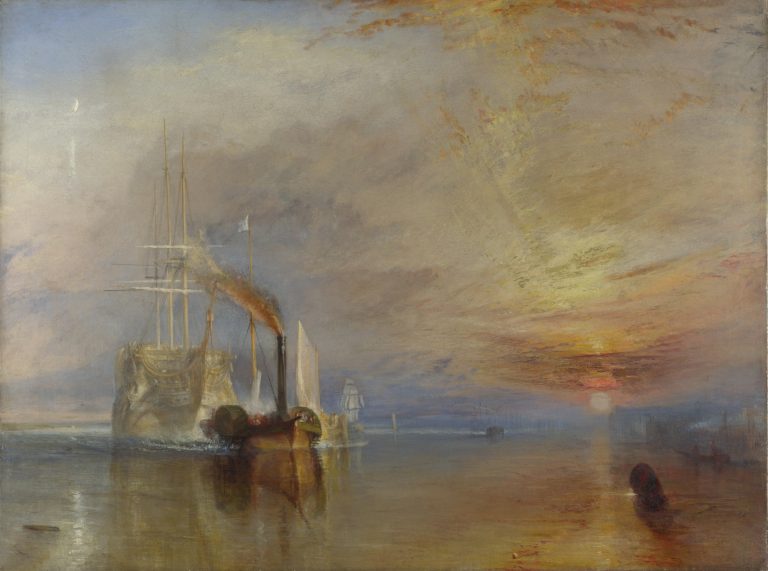
1839 · Oil on canvas · National Gallery, London
Save articles to your collection
Log in or create a free account, and this article will be waiting in your Private Collection.
Log in or sign up Explore the artistJ. M. W. Turner →
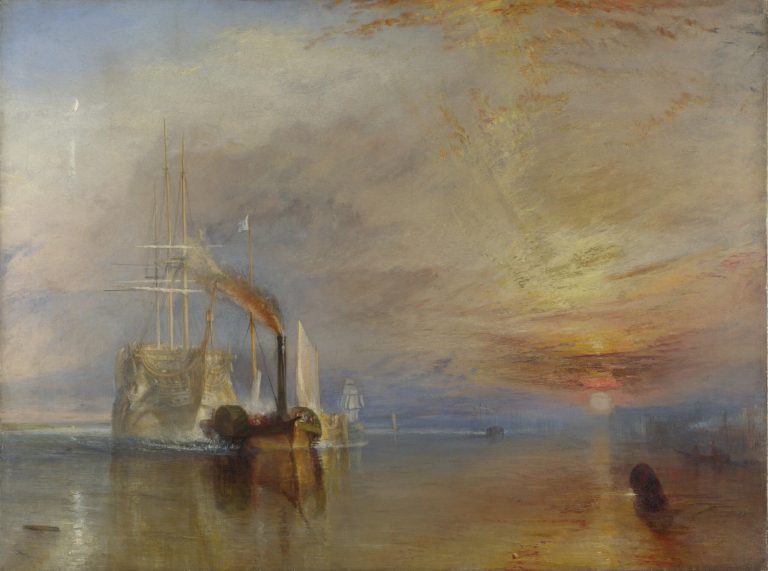
The warship is the larger vessel, but it no longer determines where it goes. A steam tug pulls it toward the viewer. Smoke crosses the pale rigging, and the low sun turns the river into a field of reflected colour.
J. M. W. Turner painted The Fighting Temeraire in 1839. Its long title tells us the destination: the ship is being taken to its last berth to be broken up. This is a farewell disguised, at first glance, as a magnificent river scene.
The event took place in 1838. Turner did not offer an exact eyewitness record. He changed the appearance of the ship and arranged the journey so that a practical act of towing could become an image of historical change.
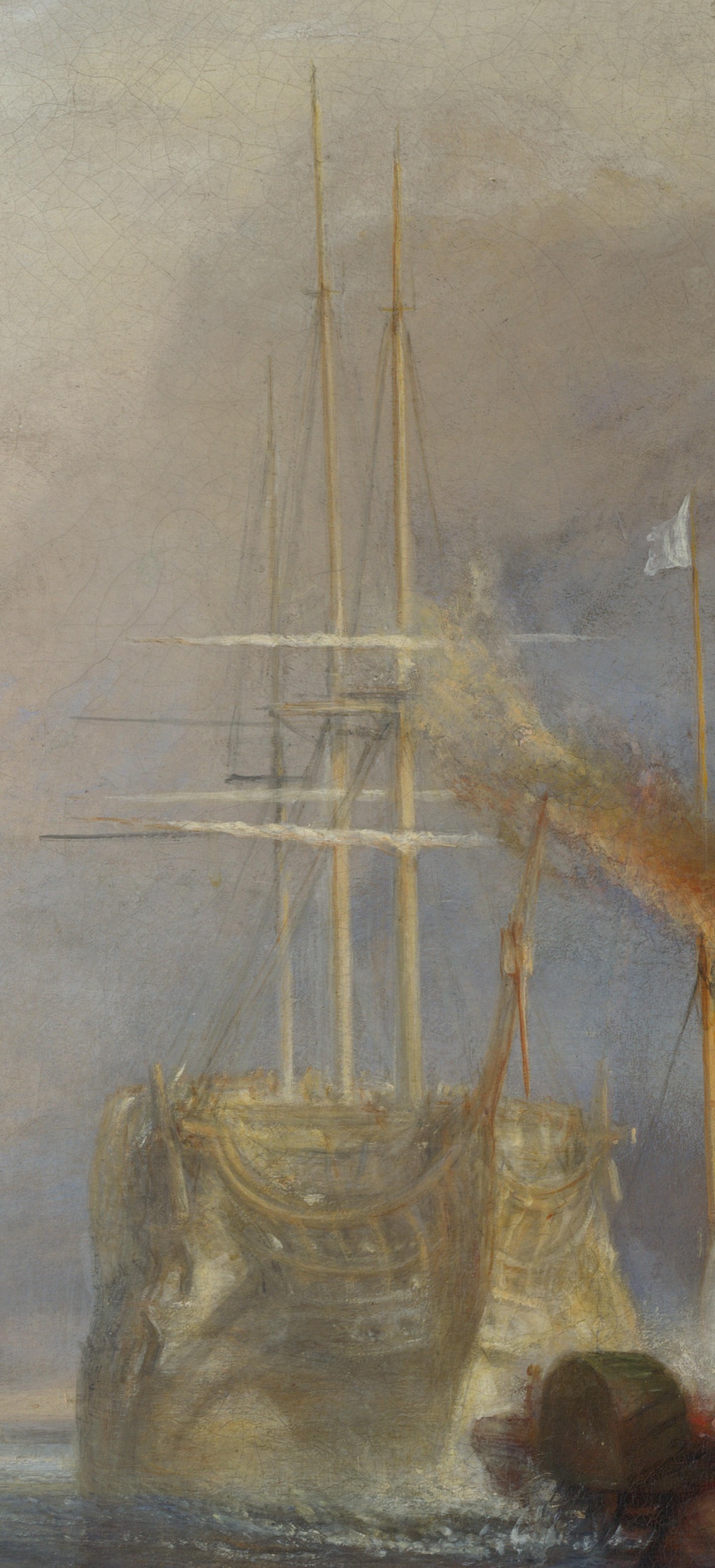
The Temeraire was a British warship that fought at the Battle of Trafalgar in 1805. By the time it was sold for breaking in 1838, its celebrated fighting career belonged to the past.
The National Gallery's catalogue traces its later service and its final sale. The towing journey ran from Sheerness to the breaker's yard at Rotherhithe on the Thames. Two steam tugs were involved in the actual movement.
Turner shows the old ship as a pale, towering presence. Its hull seems almost luminous against the cooler sky. The masts raise its silhouette far above the tug, allowing former grandeur to remain visible even when the vessel has lost its independence.
The distinction between size and agency is essential. The ship is impressive because of what it appears to have been. The smaller machine in front has the immediate capacity to act.
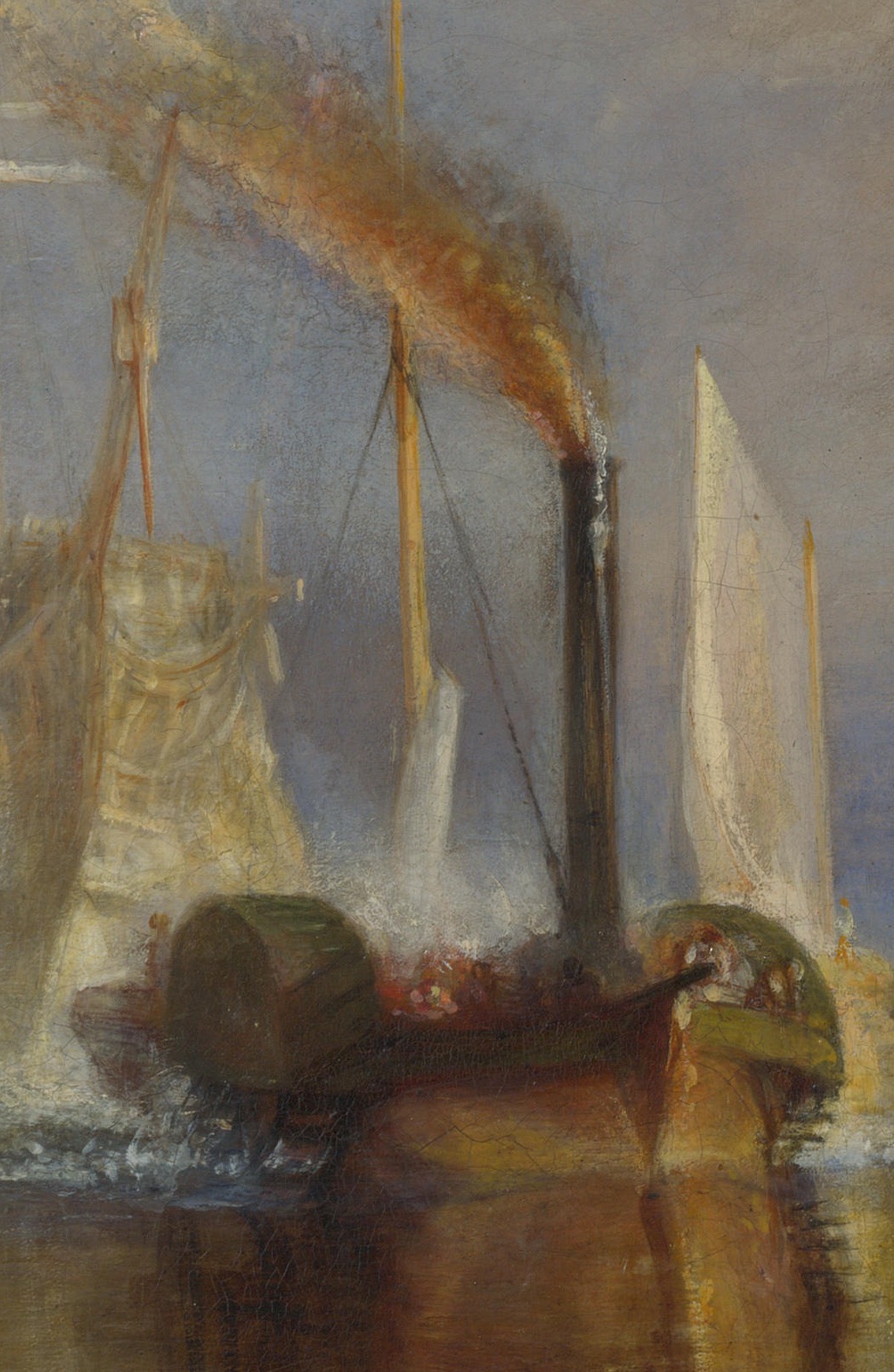
The tug's hull is low and dark. Its funnel sends smoke diagonally across the air in front of the Temeraire's rigging. Paddle wheels agitate the water beside it.
These shapes have little of the warship's delicate verticality. The tug is compact, functional and visibly active. Turner makes the contrast readable before the viewer knows either vessel's history.
The National Gallery explains that the representation is deliberately altered. Turner emphasised the tug's dark, squat appearance and its fiery smoke. This is not a neutral comparison between two accurately catalogued machines.
That does not require us to decide that every steam vessel is a villain. The tug is carrying out the work assigned to it. The picture becomes moving because something necessary and ordinary can also feel like the end of a world.
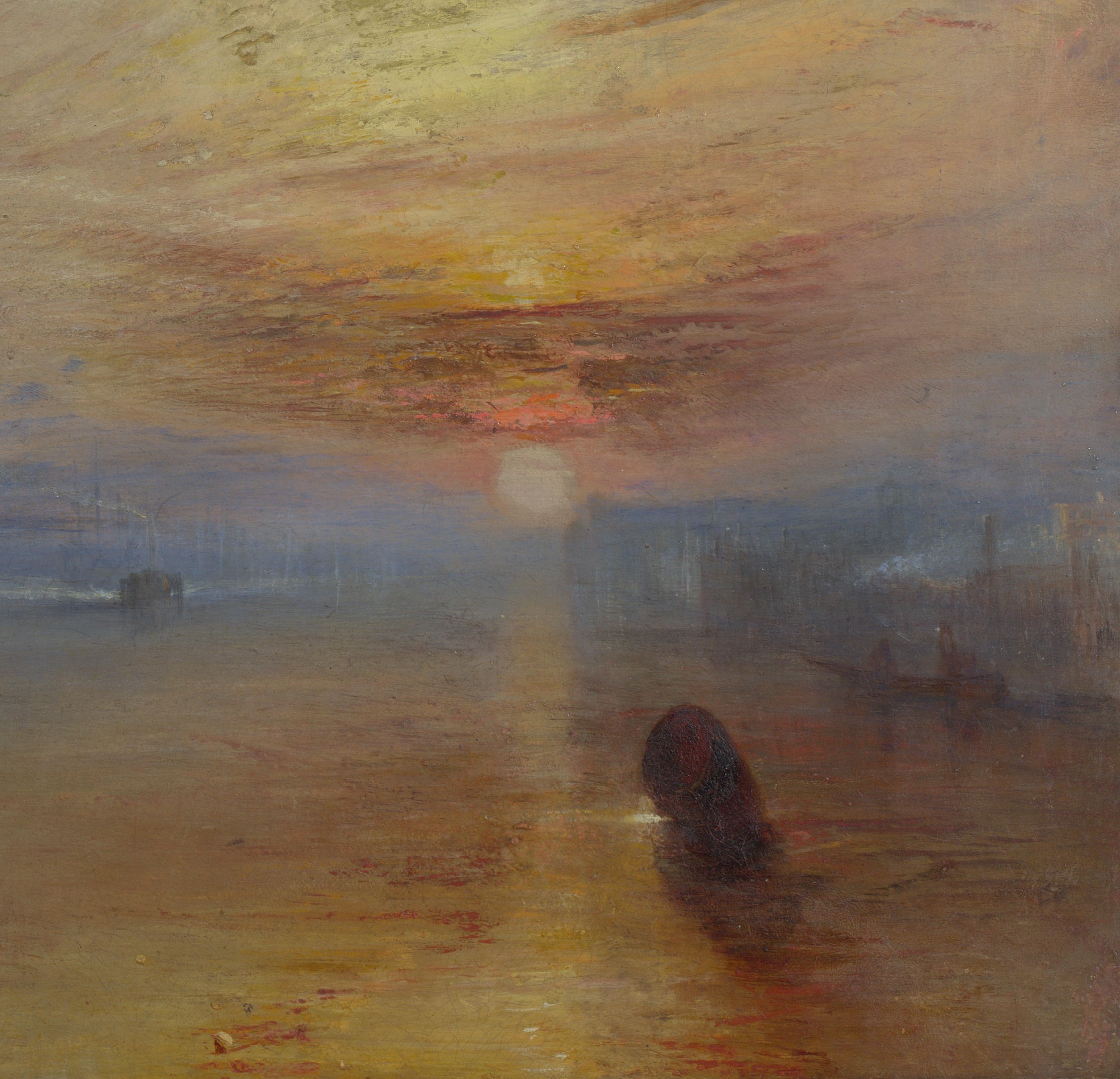
At the right, the sun sits low above the river. Its reflection extends downward, breaking into the water's smaller movements. Orange, gold and red spread across an area much broader than the sun itself.
The fading day invites a comparison with the ship's approaching end. Turner does not need to place an inscription beside the vessel to make that association possible. The sky supplies a familiar experience of something brilliant passing away.
Yet the sunset is not simply a sad colour. It is one of the painting's most radiant passages. The picture lets an ending become magnificent without reversing what is going to happen to the ship.
Notice the smaller craft and dark objects on the river. They bring interruptions into the reflected light. The Thames remains a working waterway rather than a completely empty stage prepared for a single farewell.
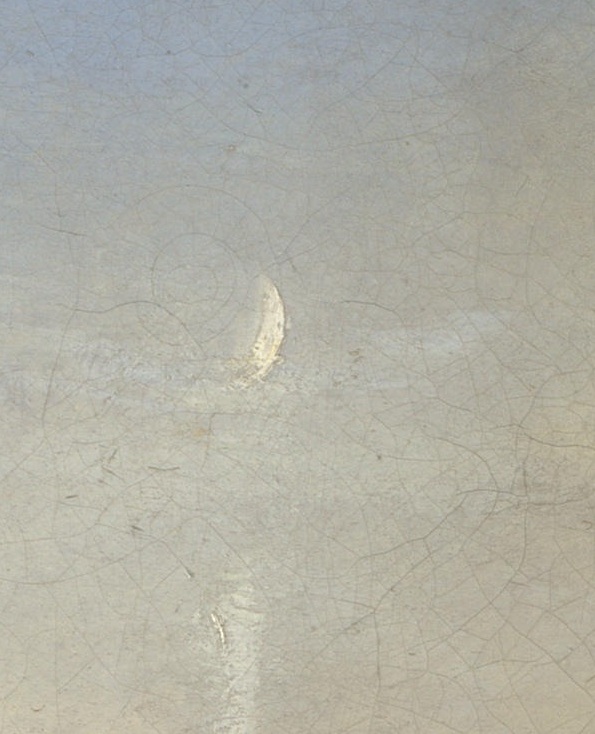
A small crescent appears in the cooler sky at the left. It occupies far less space than the sunset, but its light shape is distinct enough to reward close attention.
The two sides of the painting do not offer the same atmosphere. Around the old ship, pale and cool tones make its presence seem fragile. Toward the right, the sky and river become warmer and more saturated.
The moon is often considered within readings of transition and renewal. Those associations need not be treated as a single authorised code. Its visible function is already useful: it gives the quiet side of the sky its own small point of brightness.
By the time of the tow, reusable equipment had been removed from the Temeraire, including its tall masts. Turner restores them in the painting. Their height allows the vessel to retain the dignity of its former identity.
The National Gallery also notes the altered colour of the hull. White and gold replace the darker yellow and black of the actual ship. The result is an idealised memory rather than a straightforward inventory of a vessel awaiting demolition.
Turner's single prominent tug similarly concentrates the action. Historical documentation describes two tugs, while the painting creates one strong contrast between the pale sailing ship and the dark source of steam power.
These changes are not mistakes to be corrected by imagining a more accurate painting underneath. They are choices that explain what Turner wanted this particular image to do. Its subject includes memory, admiration and loss.
Stories later placed Turner on the river witnessing the tow. The National Gallery's catalogue treats such accounts cautiously. It is not established that he saw the event, and the painting itself is not presented as proof that he did.
Contemporary reports could provide the basis for an imagined scene. Turner then reorganised the material into a composition that makes the past visible beside its replacement.
This distinction prevents a misleading reading of the sunset as a documentary timestamp. The image's light serves the painting's meaning. It need not reproduce the actual hour or direction of the ship's arrival.
Turner exhibited the painting at the Royal Academy in 1839 and retained it. It entered the National Gallery through the Turner Bequest in 1856.
That history gives the subject another resonance. A ship sold for its materials becomes, in paint, a vessel whose appearance continues to command attention. Turner cannot prevent its destruction, but he can determine how it will be remembered.
The contrast with his Slave Ship subject should not be collapsed into a general taste for spectacular water. Different maritime scenes demand different historical and moral attention. Here the quiet force comes from towing, ageing and the passage between technologies.
Return to the line of smoke. It crosses the space between the two vessels like an action that cannot be taken back. The tug keeps moving, and the old warship follows.
Turner painted and exhibited it in 1839. The final towing journey represented in the title took place in 1838.
It is in the National Gallery, London, inventory NG524. It measures 90.7 by 121.6 centimetres and is painted in oil on canvas.
The old warship's final journey is commonly read as a farewell to the age of sail and a reflection on historical change. The sunset and the contrast with the steam tug support that reading.
No. Among other changes, Turner includes masts already removed from the real ship and makes one tug dominate a journey that involved two.
J. M. W. Turner, The Fighting Temeraire, 1839, National Gallery, London. Faithful public-domain reproduction, Wikimedia Commons.
Enjoyed this story?
Save articles to your collection
Log in or create a free account, and this article will be waiting in your Private Collection.
Log in or sign up
Man Writing a Letter
Gabriel Metsu, c. 1664
The gallery list
Every painting is already 50% off. Join the list and we will send you an extra $15 code, plus first access to new collections.
No spam. Unsubscribe anytime. · Privacy Policy
Welcome
Your $15 code is on its way. Explore the gallery while you wait.