Loading cart…
No products in the cart.

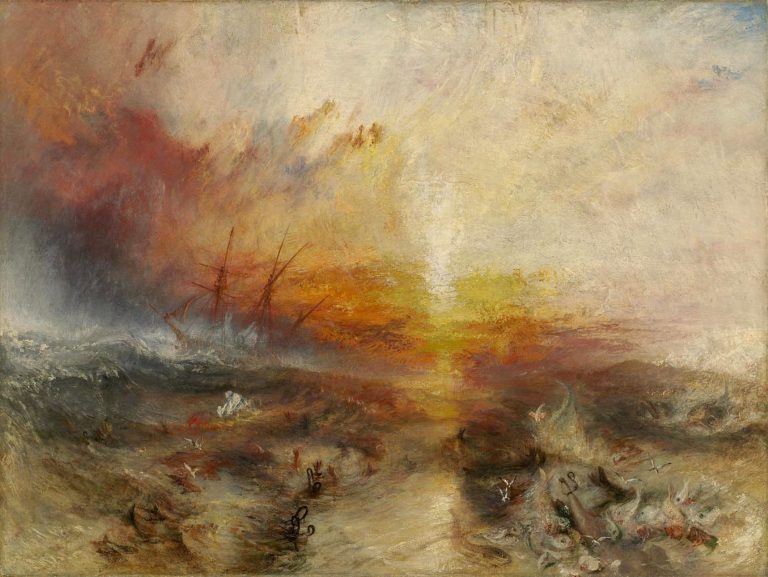
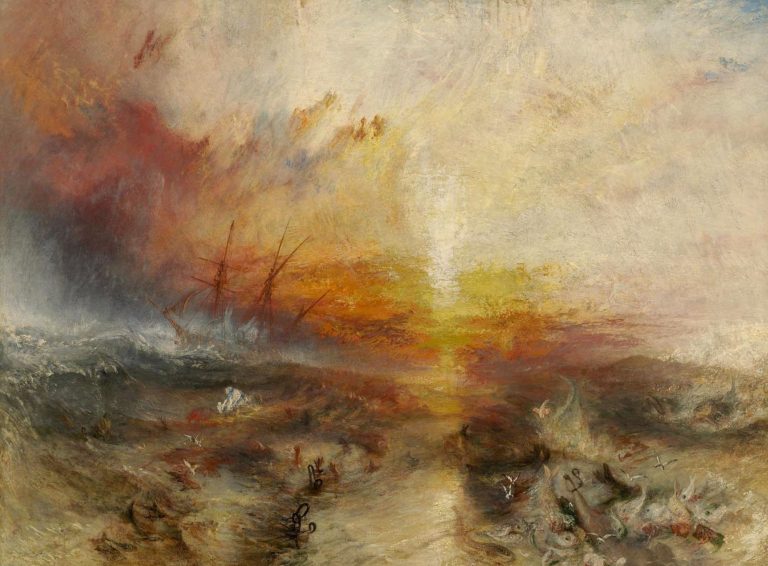
1840 · Oil on canvas · Museum of Fine Arts, Boston
Save articles to your collection
Log in or create a free account, and this article will be waiting in your Private Collection.
Log in or sign up Explore the artistJ. M. W. Turner →
A ship recedes into a sea of orange, red and white. The light can attract the eye before the foreground becomes legible. Then hands, a leg and dark shackles emerge among the waves.
J. M. W. Turner's Slave Ship was exhibited in 1840. Its longer title identifies the human action within the storm: enslavers have thrown people overboard while a typhoon approaches.
The painting is in the Museum of Fine Arts, Boston. Its subject demands more than admiration for dramatic water and a radiant sky. Turner uses that visual force to bring an atrocity into view.
The MFA connects the painting to the Zong massacre of 1781, when enslavers killed more than a hundred captive Africans by throwing them into the sea. The subsequent insurance dispute exposed the way a commercial system treated human beings as property.
The London Museum's account explains that the ship's owners sought compensation for the people thrown overboard. The legal dispute concerned an insurance claim rather than a prosecution that recognised the killings as the central crime.
Turner's painting is not an eyewitness record of the Zong. It was made nearly six decades later, and its approaching storm belongs to the image's constructed drama. The historical connection explains the moral subject without making every wave documentary evidence.
The distinction matters. These people were not simply passengers lost in a natural disaster. The title and the shackles identify human decisions and an organised system of violence.
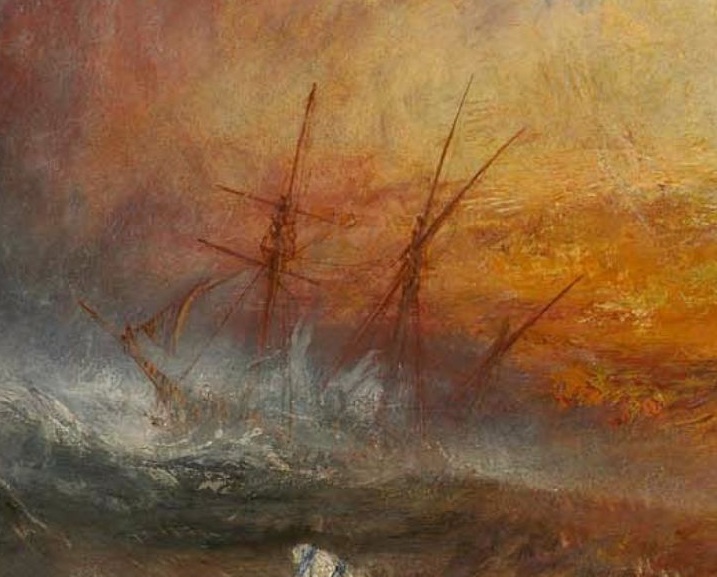
The ship is not a solid, sharply outlined object commanding the centre. Its masts lean through smoke-like colour and spray. The hull becomes difficult to separate from the rising water.
Its distance contrasts with the people abandoned near the viewer. Turner does not place the most immediate human evidence safely beside the ship on the horizon. It interrupts the space closest to us.
The vessel's diminishing appearance can be read as withdrawal from responsibility. That is an interpretation of the arrangement, not a claim that the captain's thoughts can be recovered from the painted rigging.
The ship also establishes how little protection the sea offers. A large vessel is already vulnerable within the weather. The people left in the water have been stripped of even that precarious refuge.
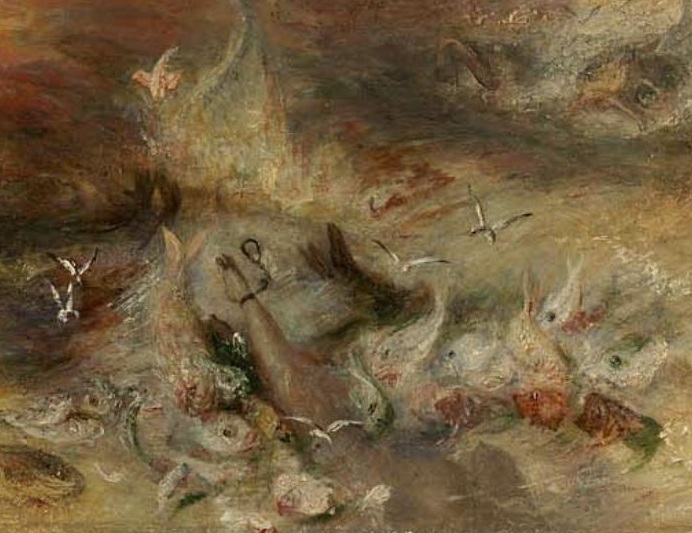
A partly submerged leg appears in the right foreground. The shackle is small in relation to the whole canvas, but it changes the meaning of the surrounding water.
Without it, the body might be read as the victim of a shipwreck whose cause remained unknown. The iron identifies captivity. The violence that placed this person here began before the storm.
Fish and birds crowd the area. Turner combines recognisable fragments with forms that remain difficult to resolve. The scene refuses the reassuring clarity of an orderly marine illustration.
Looking closely should not turn the person into a visual puzzle whose identification becomes the reward. The fragment matters because a human life has been made vulnerable, then reduced within a system that counted lives as financial losses.
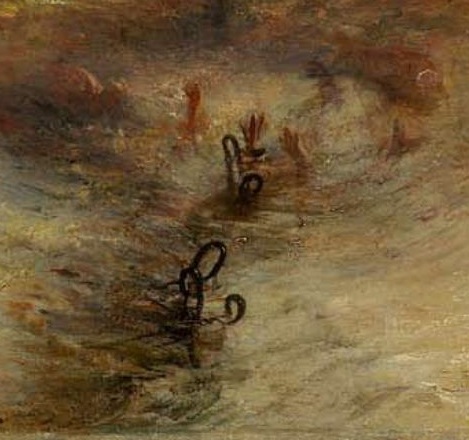
Other hands and dark chains emerge farther left. They are easy to confuse with the sea's scattered marks until their shapes become recognisable.
There is no upright central victim whose face gives the viewer a complete emotional encounter. Bodies have been separated by water, distance and the painting's turbulent surface.
That fragmentation is part of the image's difficulty. Turner makes the presence of people visible while denying the compositional stability associated with a commanding heroic figure.
The absence of named, fully described individuals is also a limit of the painting. It should not be treated as sufficient access to the lives of the people murdered in the historical massacre. Their existence exceeded the fragments through which this later artist represented an atrocity.
The brightest passage lies near the centre, where sea and sky appear to merge. A vertical movement of pale colour draws attention into the distance, while red and orange spread across the surrounding air.
The eye can be pulled away from the foreground bodies toward that radiance. Recognising the attraction makes the act of viewing more uncomfortable. Beauty and violence are experienced within the same surface.
The MFA describes the work through both human and elemental violence. The storm enlarges the scene's terror, but it should not be allowed to absorb the responsibility of the enslavers into a vague idea that nature is cruel.
The title keeps directing us back. However uncertain individual forms become, the named action cannot be dissolved into colour alone.
At the Royal Academy in 1840, Turner paired the painting with lines from his own unfinished poem, Fallacies of Hope. The verse connected the approaching storm, the throwing of people overboard and the pursuit of money.
The words sharpen the image's accusation. They do not allow the scene to be understood simply as a vessel struggling against bad weather.
The MFA's account of Turner's modern subjects places the painting within his engagement with abolition and the human cost of contemporary systems. Its date is therefore important: it was a nineteenth-century intervention into the memory and legacy of the slave trade.
This does not make a modern viewer's response automatic. An image can denounce violence while still raising difficult questions about how suffering is made available for spectators to admire.
Turner painted The Fighting Temeraire a year earlier. That work is often read as a farewell to an old warship and a reflection on technological change.
The shared presence of water, vessels and brilliant light does not make the emotional subject interchangeable. Slave Ship requires attention to people held in captivity and deliberately abandoned to death.
Comparing the paintings is useful when it shows Turner's ability to give marine subjects different historical burdens. It becomes misleading if every dramatic sea is described with the same language of adventure or romantic escape.
From a distance, the painting can appear close to a struggle between broad passages of colour. Closer attention reveals chains and parts of bodies. The act of recognition changes the image already seen.
That movement between attraction and recognition is central to its lasting power. A viewer cannot honestly return to the sunset as if the foreground were merely incidental.
Turner's canvas does not supply a complete history of the Zong, the people held aboard or the abolition movement. Museum records and historical scholarship remain necessary companions. The image gives urgency to looking; it does not replace the work of learning whose history is at stake.
It dates to 1840 and was exhibited at the Royal Academy that year.
The Museum of Fine Arts, Boston, holds it, accession 99.22. It is painted in oil on canvas and measures 90.8 by 122.6 centimetres.
The MFA identifies the Zong massacre as an important historical source. The painting is a later imaginative treatment, not an eyewitness depiction of the 1781 event.
They identify the people in the water as captives and connect their danger to human violence and enslavement.
Slave Ship, or Slavers Throwing Overboard the Dead and Dying, Typhoon Coming On. The longer title identifies an atrocity that a casual view of the colour alone could miss.
J. M. W. Turner, Slave Ship,1840, Museum of Fine Arts,Boston,99.22. Public-domain painting and faithful museum-source reproduction via Wikimedia Commons. Details are crops of the source.
Enjoyed this story?
Save articles to your collection
Log in or create a free account, and this article will be waiting in your Private Collection.
Log in or sign up
Man Writing a Letter
Gabriel Metsu, c. 1664
The gallery list
Every painting is already 50% off. Join the list and we will send you an extra $15 code, plus first access to new collections.
No spam. Unsubscribe anytime. · Privacy Policy
Welcome
Your $15 code is on its way. Explore the gallery while you wait.