Loading cart…
No products in the cart.

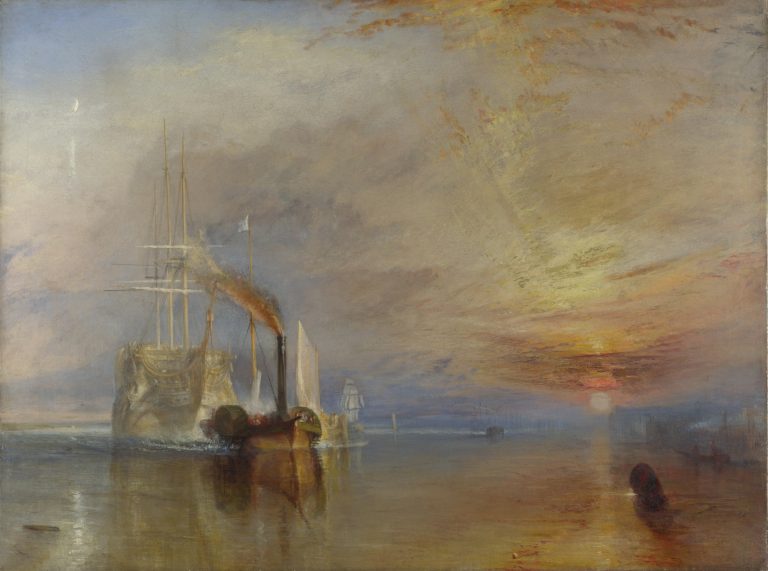
1839 · Oil on canvas · National Gallery, London
Save articles to your collection
Log in or create a free account, and this article will be waiting in your Private Collection.
Log in or sign up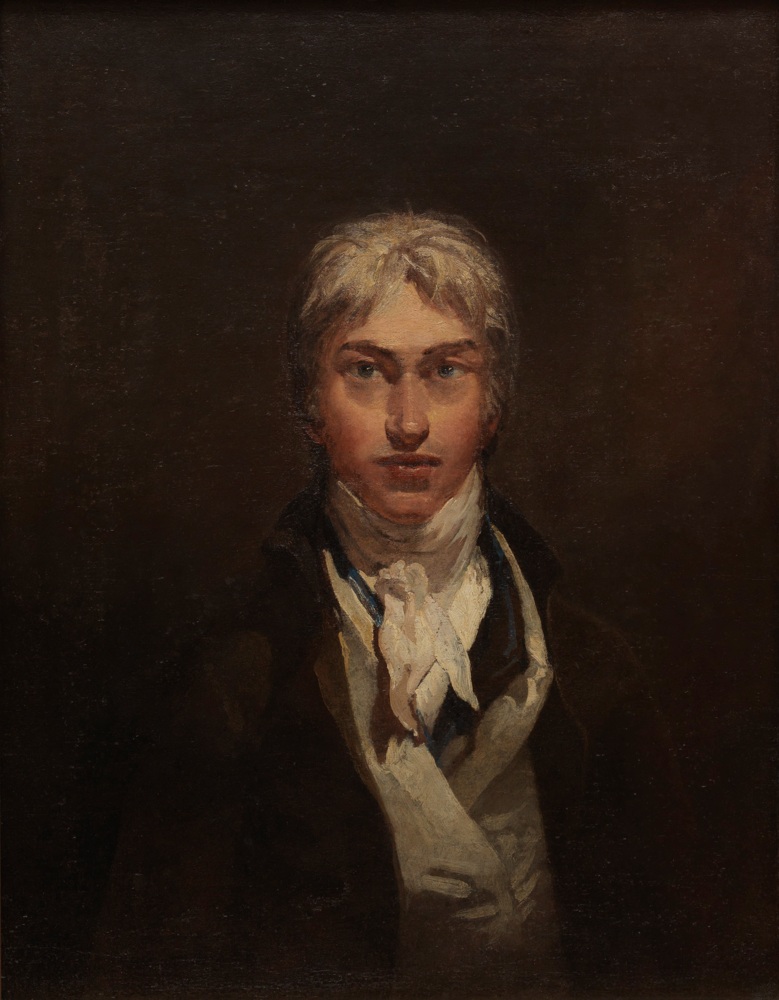 Explore the artistJ. M. W. Turner →
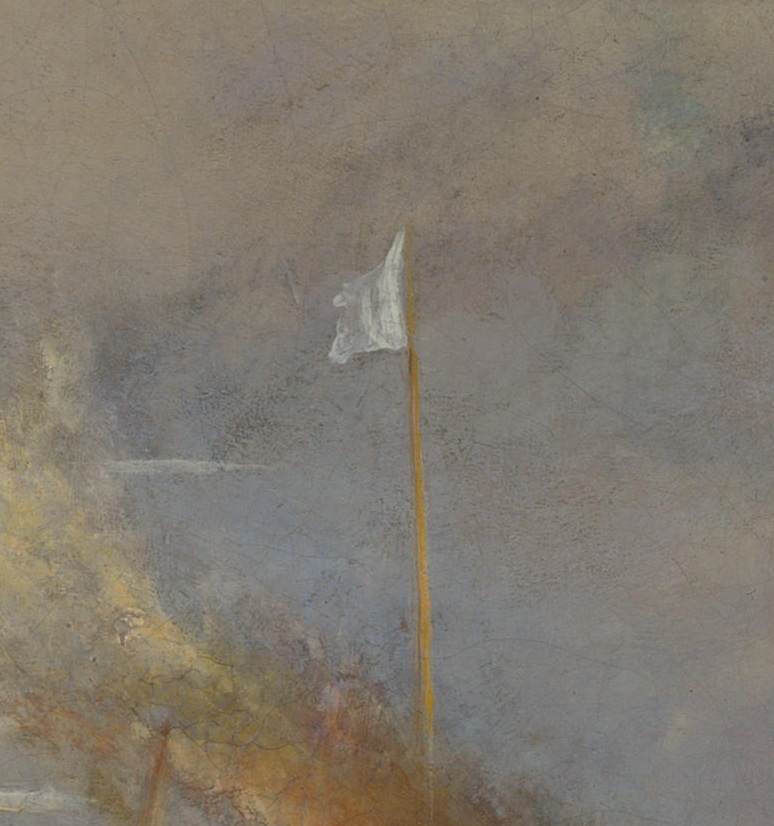
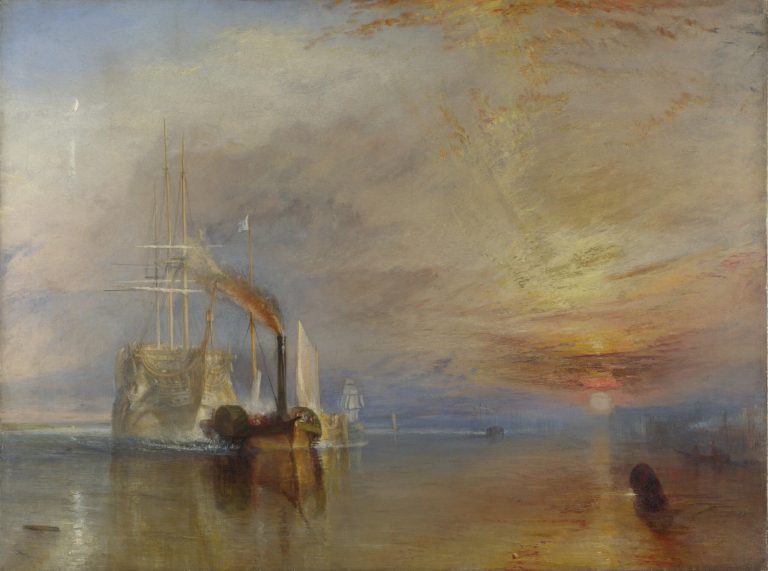
A small white flag flies above the smoke in J. M. W. Turner’s The Fighting Temeraire. It belongs to the tug. Behind it, the tall masts of the old warship are bare of naval colours. That small difference tells you something the size of the ships might make you miss. The Temeraire has been sold, and the little boat is taking her to be broken up.
Turner painted and exhibited this scene in 1839. The last date in his long title, 1838, refers to the actual tow up the Thames. He gives the journey a sunset, restores the ship’s masts and puts a dark streak of smoke across them. By the time we know where the ships are going, the subtraction of a flag has become as telling as everything Turner put back.
HMS Temeraire was a 98-gun warship launched in 1798. At the Battle of Trafalgar in 1805 she sailed behind Nelson’s Victory under Captain Eliab Harvey. When the French Redoutable threatened Nelson’s flagship, the Temeraire came to its aid and fought with French ships on both sides. That was the day's fighting for which the ship was remembered more than thirty years later.
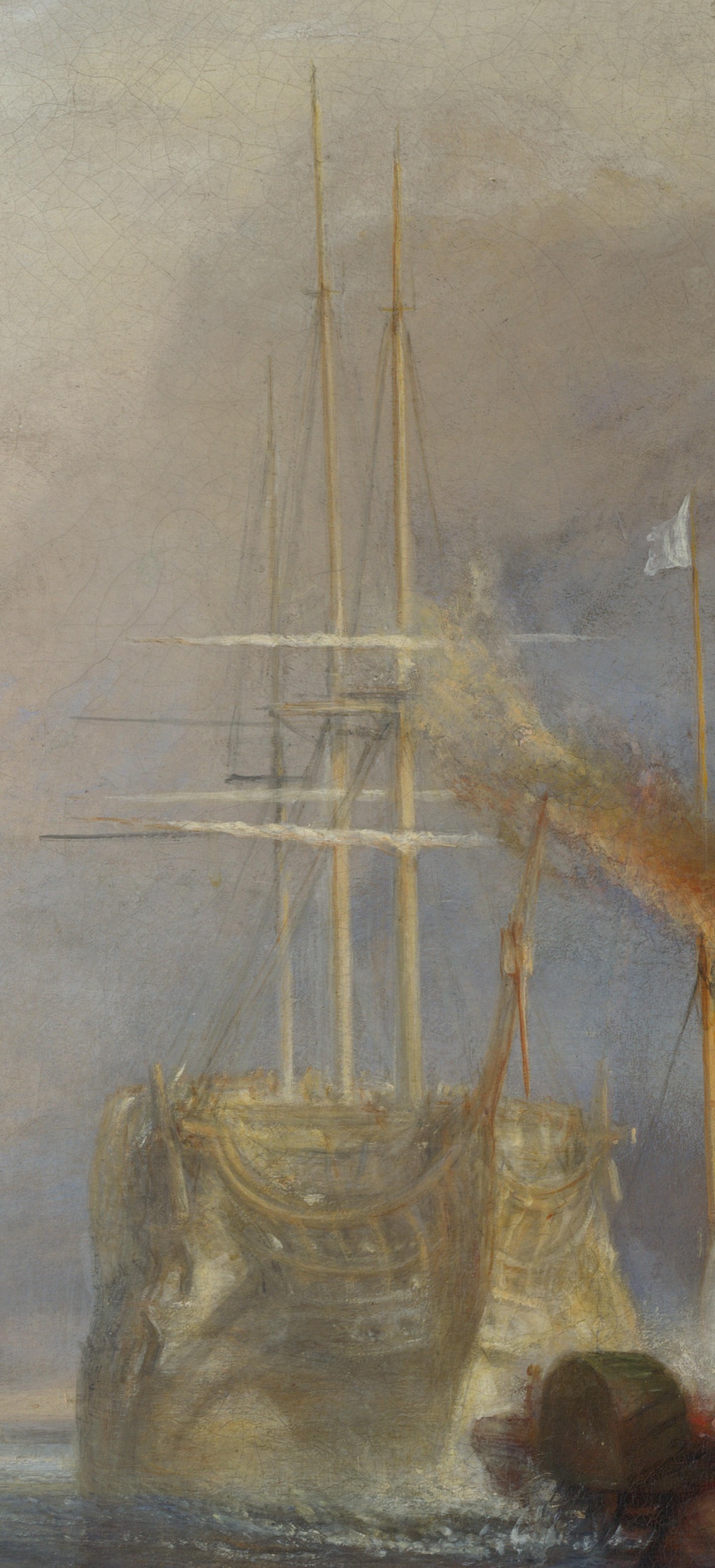
Turner keeps that past visible. Pale yards still cross the upright masts. Fine lines give the ship a rig that seems to come and go in the haze. The tall stern and its galleries catch a warmer light near the waterline. The colours turn a huge wooden hull into something that looks surprisingly fragile.
Thomas Campbell’s Ye Mariners of England celebrates the country’s sailors and the flag under which they serve. Its first stanza includes these lines.
“Whose flag has braved a thousand years
Thomas Campbell, Ye Mariners of England, historical anthology text
The battle and the breeze!”
Turner adapted the verse for the Royal Academy catalogue. He kept the words about battle and the breeze and changed what follows.
“The flag which braved the battle and the breeze,
J. M. W. Turner, Royal Academy exhibition catalogue, 1839, as recorded by the National Gallery
No longer owns her.”
In Campbell, the flag carries centuries of national pride. Turner’s second line makes the absence personal. The Royal Navy had sold the Temeraire by the time she was towed, and the commercial flag flies from the boat now in charge of her passage. The poem makes us look for something Turner has left out of the sky.
Before the sale, the Admiralty removed the ship’s guns, anchors, rigging and masts for reuse. The Rotherhithe ship-breaker John Beatson bought what remained for £5,530 in August 1838. He hired two steam tugs, London and Samson, to bring the old hull from Sheerness to his yard. The tow took place on 5 and 6 September.
Turner puts the rig back, gives the warship a pale hull and lets one tug dominate the scene. The National Gallery identifies a second tug in the distance. A contemporary picture of the ship being dismantled at Beatson’s wharf makes the difference clear. The hull that arrived had lost the tall silhouette Turner gives it.
The black funnel stands in front of the tug’s mast. That reversal of the usual steamboat arrangement lets the smoke stream back through the warship’s rigging. Turner had travelled on steamers and knew their construction. Moving that one part of the boat lets him direct the smoke through the most delicate lines in the scene.
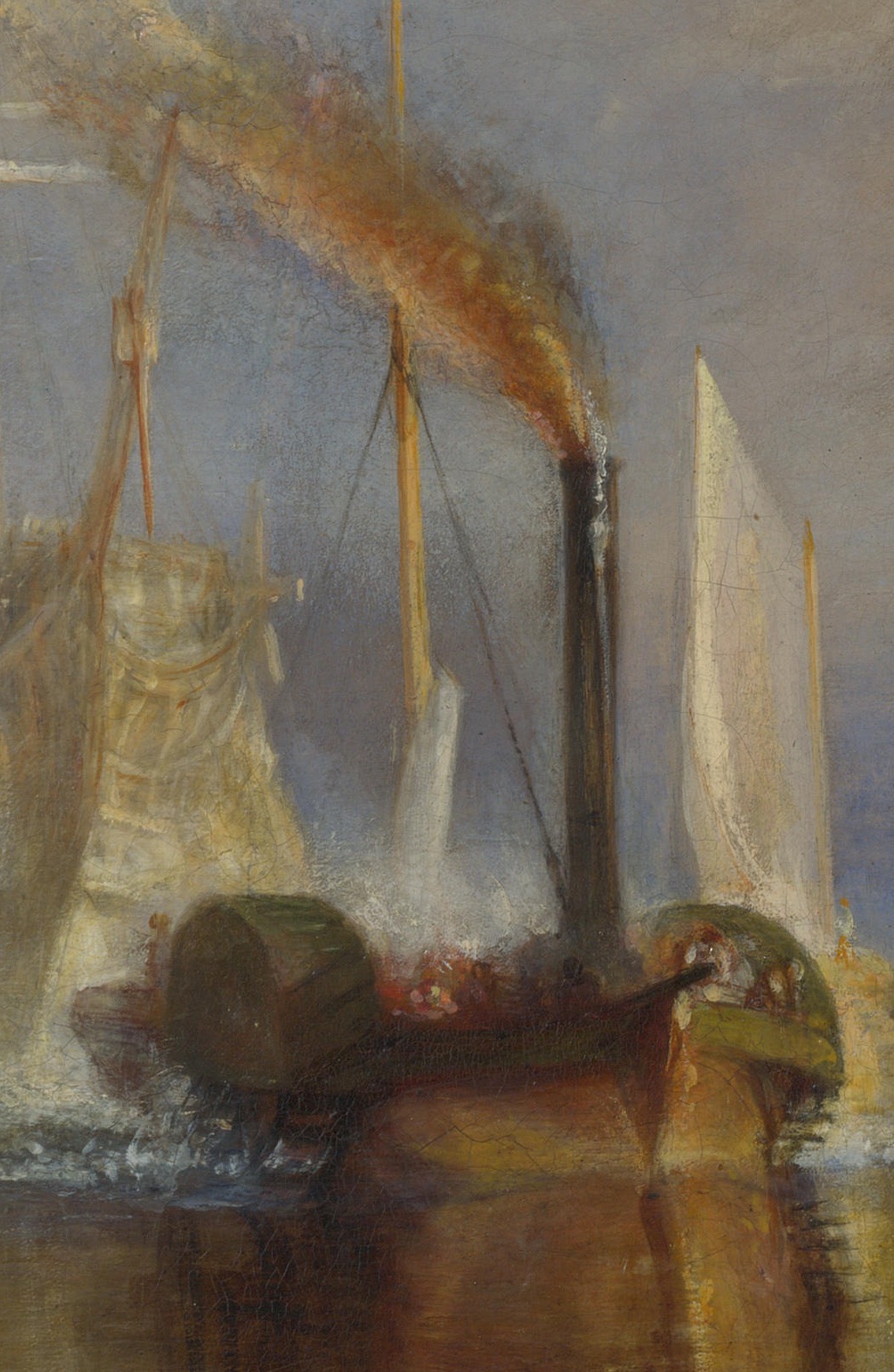
Look next at the paddle wheel and the water beside it. Turner gives the wheel a dark solid shape and scores the water with short white marks. Under the tug, rust and ochre stretch down into the quieter water. The vessel makes its presence felt in both the smoke it throws behind it and the wash it leaves in the river.
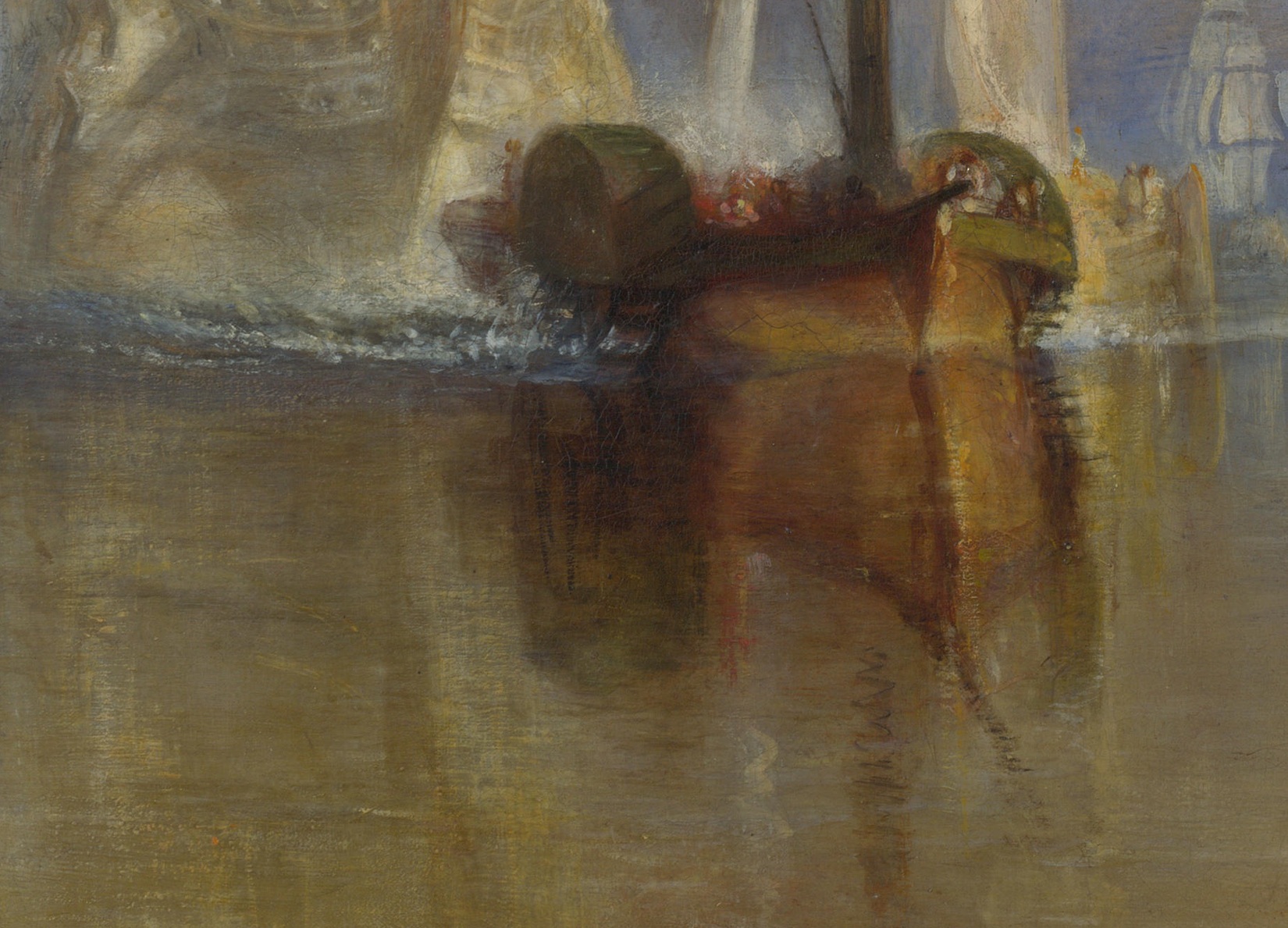
The detail mattered when the work was reproduced. As Judy Egerton records, the engraver J. T. Willmore moved the funnel back in an 1845 print. A later impression restored it to the position Turner had painted. The change affects how long the line of smoke can run and where it crosses the ship.
The sun hangs just above the distant masts. Its round shape is small, but the surrounding orange and red fill much of the sky. Below it, a broken column of light picks its way down the river. The National Gallery’s technical notes describe the use of both thick paint and thin glazes to build the sunset. The light can feel solid in one passage and almost transparent in the next.
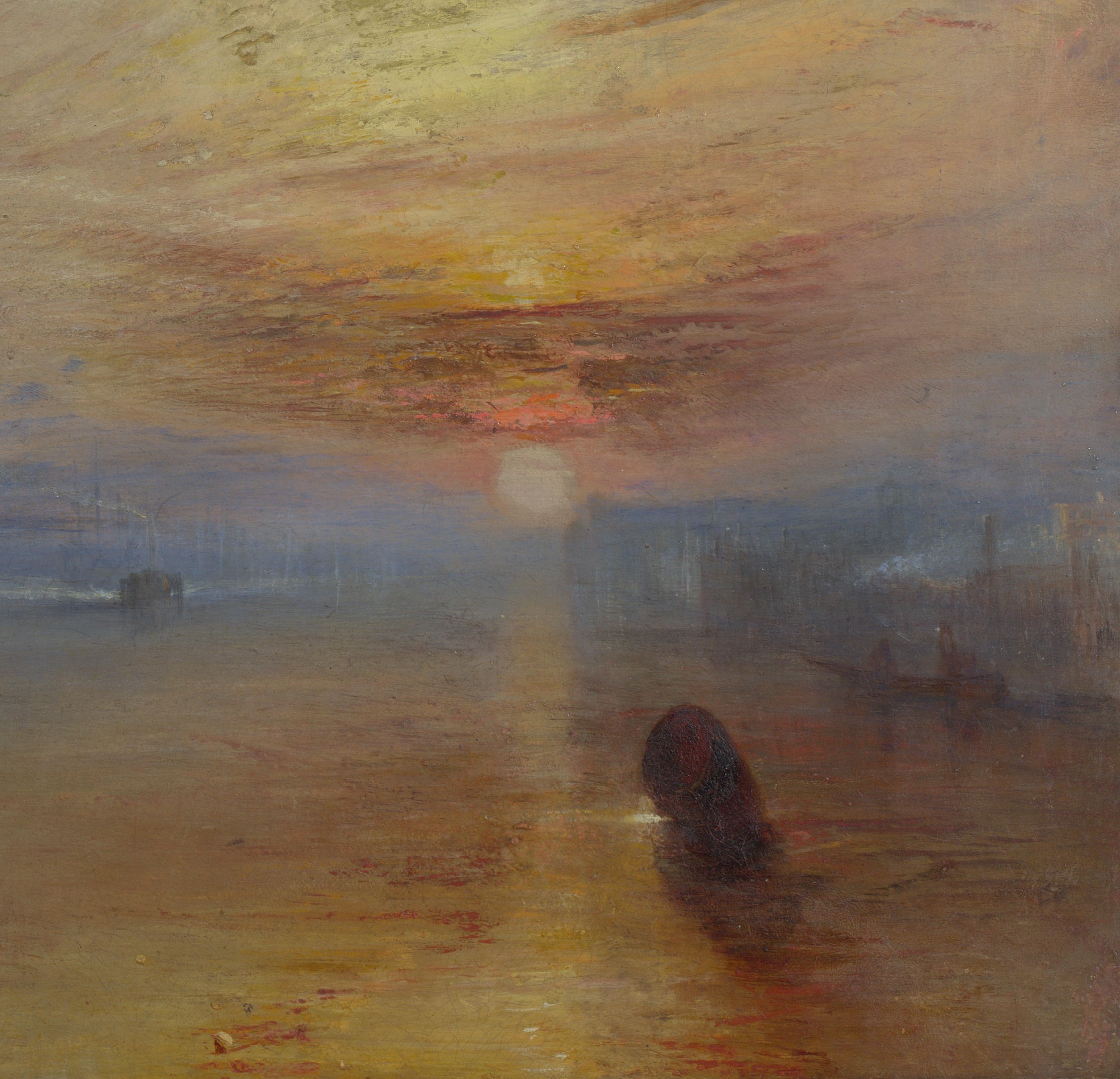
Using the 1838 tide tables, researchers estimated that the ship was probably secured at Beatson’s wharf by about three in the afternoon, well before sunset. Later readers also argued about the position of the sun on an upstream journey. In the painting, the setting sun lets the end of a day coincide with the end of a ship’s working life.
Far across the canvas from the sun, a small crescent appears in the cooler sky. Keep your eye on it and your eye can follow the same pale colours down through the thin masts and the hull to the water. The sunset warms a broad area. Turner gives the left-hand sky a much smaller point of light.
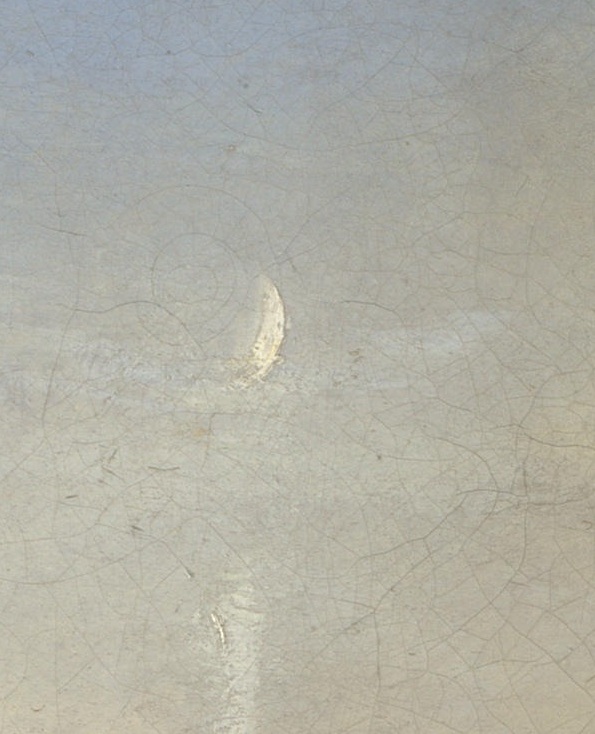
A setting sun and a young moon invite a reading about endings and beginnings. The tug complicates that reading. It brings steam into the farewell, yet small sailing craft are still visible beside it. Several kinds of river traffic share this one stretch of water.
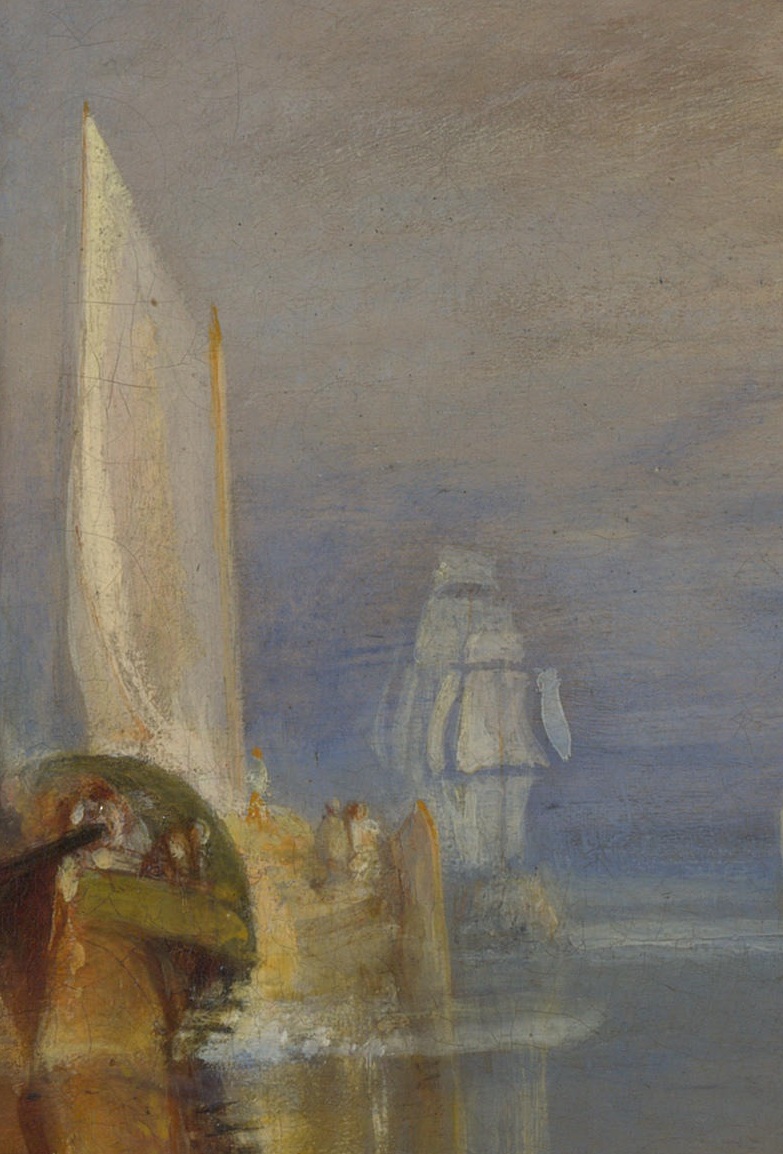
Just to the right of the tug, a pale sail catches the light. A square-rigged vessel farther back nearly disappears into the blue. Look beyond those sails and the horizon fills with faint masts. The big ship’s retirement is one event on a river full of other journeys.
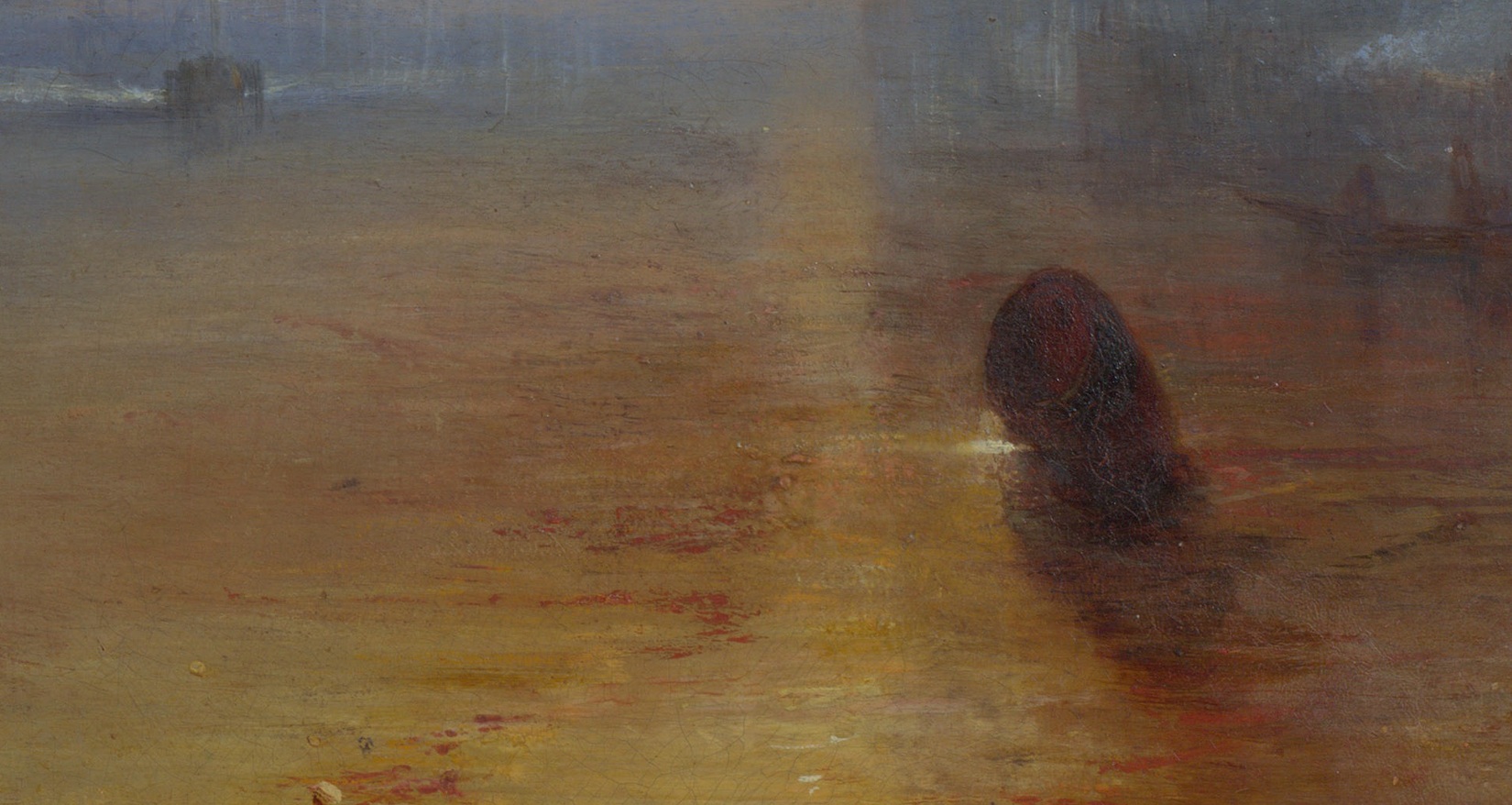
The dark buoy anchors the lower right corner. A small stroke of light meets it at the waterline, while for much of the river the shapes are too distant or too reflective to name at first glance. The buoy gives the eye something firm to come back to after the sunset.
There is no reliable record of Turner witnessing it. The National Gallery catalogue treats the later eyewitness stories cautiously and points to newspaper reports as a probable source. The route, sale and tow belong to the historical record. The arrangement of the vessels and lights shows what Turner made of that record.
Turner kept the canvas and referred to it as “my Darling” in a draft letter about lending it. It entered the National Gallery in 1856 through the Turner Bequest. He could paint the Thames as a busy modern river and still give the old ship the space and height of a monument. The pale hull remains the largest thing on the water, even as the tug leads it away.
Turner also used the sea to confront the violence of the slave trade in The Slave Ship.
Turner painted and exhibited it in 1839. The year 1838 in the full exhibition title refers to the voyage the painting depicts.
The painting is often read as a farewell to the age of sail. Turner sets the warship’s pale rigging against a working steam tug and gives the ship’s last journey the light of a setting sun. The lost flag adds a more specific point about a warship that had passed out of the navy’s hands.
It belongs to the National Gallery in London, inventory NG524. Turner painted it in oil on canvas. It measures 90.7 cm high by 121.6 cm wide.
J. M. W. Turner, The Fighting Temeraire, 1839. National Gallery, London, NG524. Faithful public-domain reproduction and details via Wikimedia Commons. Painting image · Turner’s self-portrait.
Enjoyed this story?
Save articles to your collection
Log in or create a free account, and this article will be waiting in your Private Collection.
Log in or sign up
Man Writing a Letter
Gabriel Metsu, c. 1664
The gallery list
Every painting is already 50% off. Join the list and we will send you an extra $15 code, plus first access to new collections.
No spam. Unsubscribe anytime. · Privacy Policy
Welcome
Your $15 code is on its way. Explore the gallery while you wait.