Loading cart…
No products in the cart.

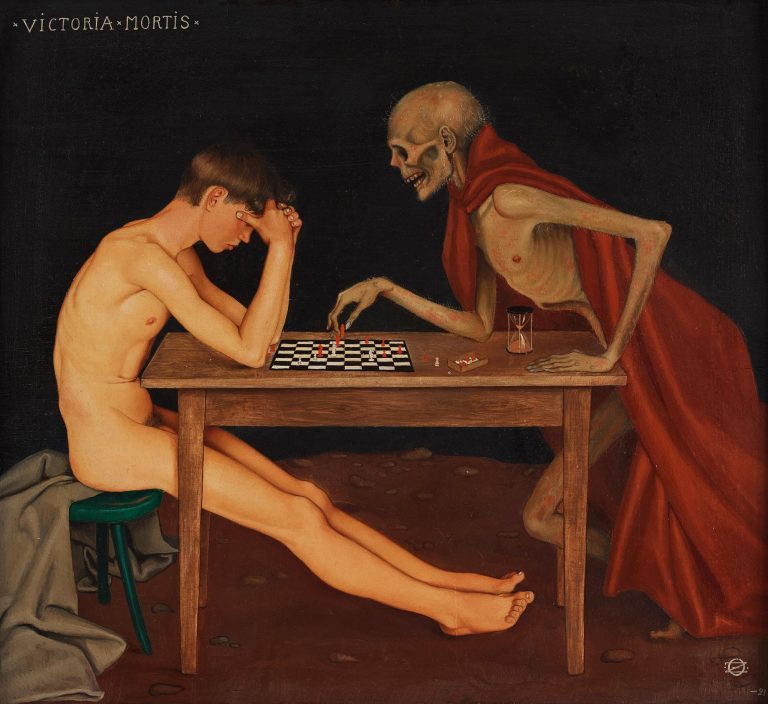
1921 · Oil on panel · Private collection
Save articles to your collection
Log in or create a free account, and this article will be waiting in your Private Collection.
Log in or sign upA naked young man sits at a plain wooden table, his hands pressed against his forehead. Across from him, a skeleton in a red cloak reaches toward a chessboard. An hourglass stands beside Death. The background is almost entirely black, so nothing distracts from the move being made.
Owe Zerge painted Victoria Mortis in 1921. He reduced the scene to two players, one game and one limit. The young man can think, plan and resist. Death has time on its side.
The painting gives us no story about who the young man is or how the match began. That absence makes the scene universal. He can be any person trying to find one more move before time runs out.
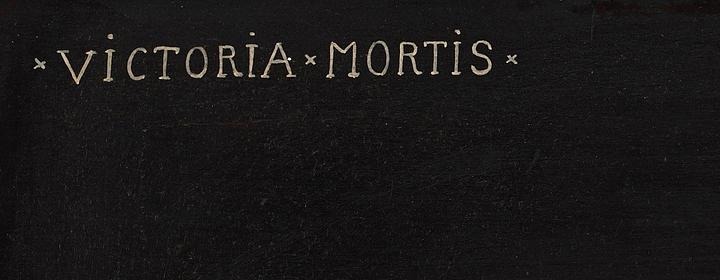
The words at the upper left read Victoria Mortis. The Latin is commonly translated as “the victory of death” or “Death’s victory.” Mortis is the possessive form of mors, meaning death, so the title identifies the winner before we have examined the board.
That matters because the young man does not look defeated in an ordinary sporting sense. No king is visibly lying on its side, and Death is still making a move. The certainty comes from the title, not from a clearly announced checkmate. Zerge lets us watch the contest continue while telling us that its final result cannot change.
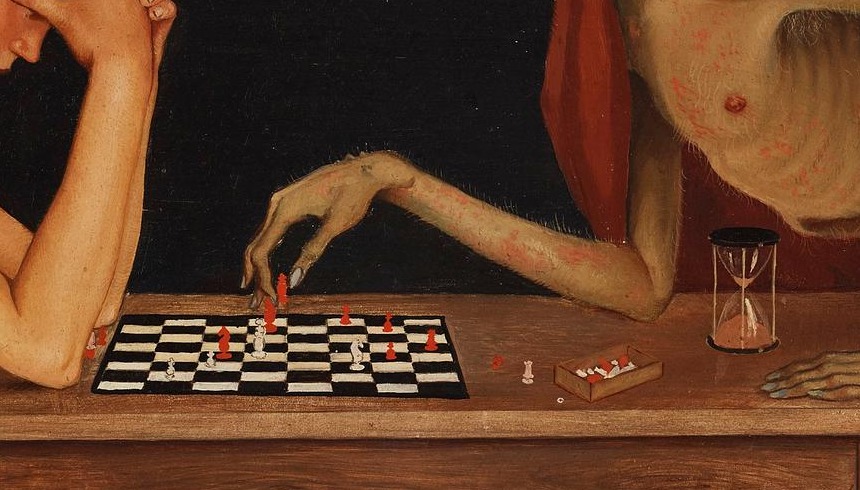
Death has the red pieces and the active hand. The young man appears to have the pale pieces, but he is not touching one. He folds his hands, lowers his head and studies the board while his opponent calmly moves.
It is tempting to treat the painting as a chess puzzle and search for checkmate. The details do not support a confident reconstruction. The pieces are simplified, several are difficult to identify, and perspective hides the exact squares. A small tray beside the board holds more pale and red pieces, but it is unclear whether they are captured pieces or pieces waiting to be used.
What you can see, and what is interpretation: Death is making a move, the young man is under pressure, and the title promises Death’s victory. The exact chess position does not prove which move is being played. The painting works as an allegory rather than a rule-perfect diagram.
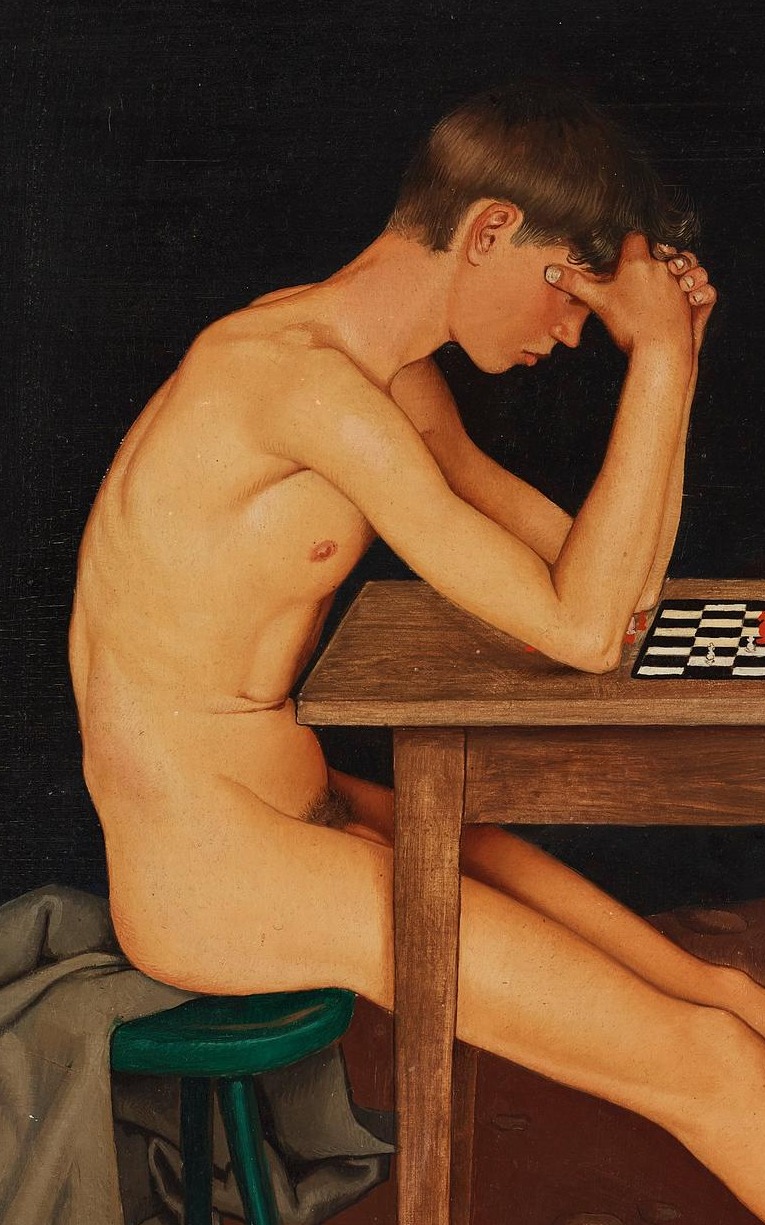
The player has no clothes, weapons, money or signs of social rank. His nudity strips away the things that might identify him as rich or poor, soldier or civilian, ancient or modern. He meets Death simply as a human body.
His pose adds a second kind of exposure. He is folded inward, with his elbows on the table and his forehead against his clasped hands. The skeleton opens outward and reaches across the board. One figure is tense and contained. The other occupies the room with complete ease.
The green stool and the grey cloth beneath it are the only soft objects on the young man’s side. Death needs no seat. It leans over the table as if the game belongs to it.
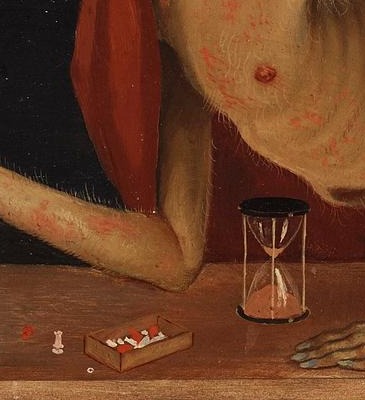
The hourglass makes the painting more than a contest of intelligence. A chess clock might give both players equal turns. This older timer belongs visually to Death, standing close to its hand and red cloak. The young man is not only searching for the right move. He is spending a finite amount of life while he searches.
Hourglasses and skulls have long appeared in memento mori art. The Latin phrase means a reminder of death. The Cleveland Museum of Art describes the skull and spent hourglass in William Harnett’s Memento Mori, “To This Favour” as symbols of mortality, while the National Gallery explains that such images present death as the great leveller of worldly achievement.
Zerge turns those familiar symbols into characters and action. The skull is no longer an object on a shelf. It has become the opponent. The hourglass is no longer a quiet warning in the background. It sits beside the board while the last game continues.
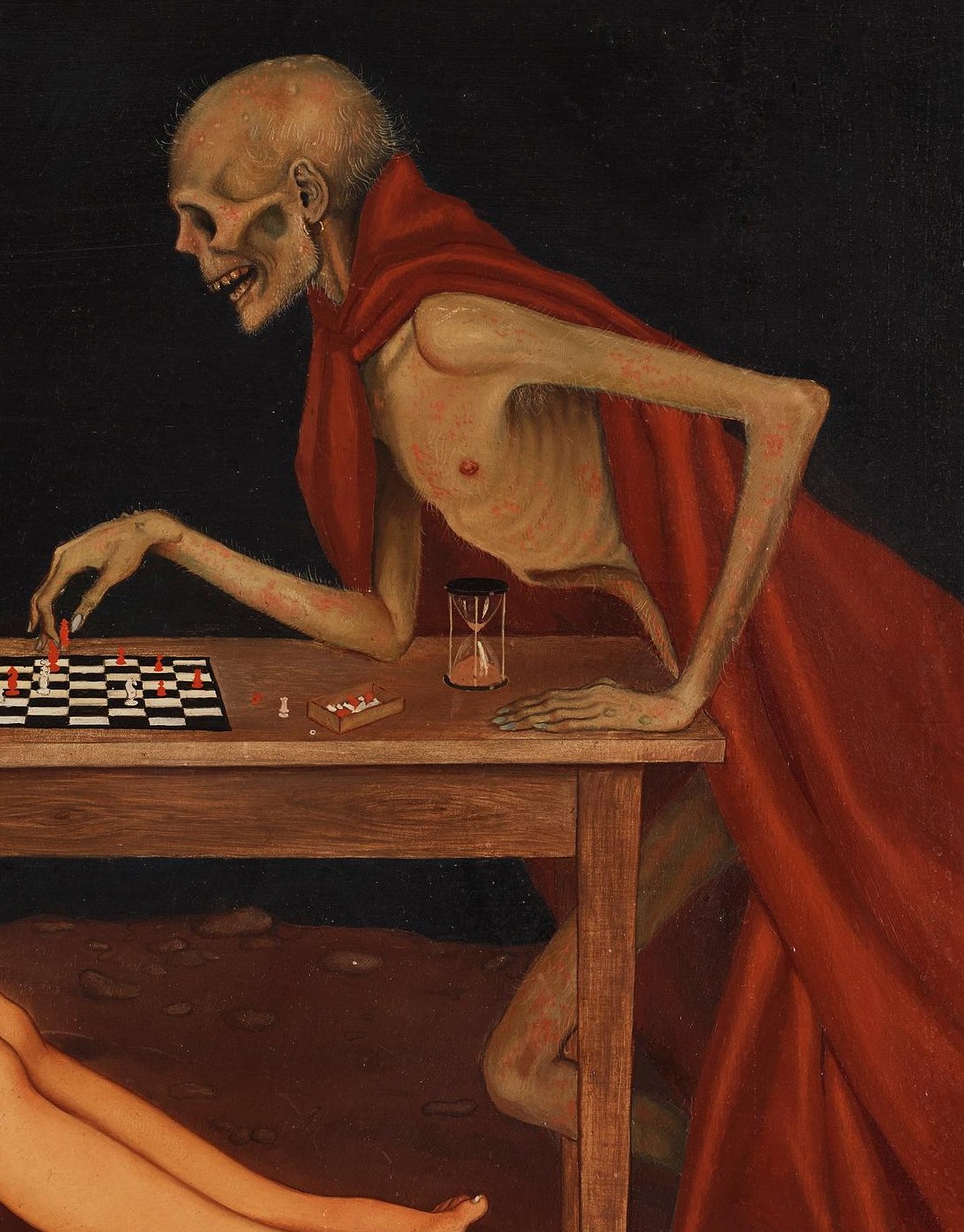
The cloak is the strongest colour in the painting. It flows from Death’s shoulders to the floor and creates a large red mass against the black background. Without it, the skeleton might look brittle or insubstantial. Wrapped in red, Death appears larger than the young man and firmly rooted in the room.
Red can suggest blood, life, danger, authority or ceremony. Zerge left no known statement explaining this particular colour, so choosing one fixed meaning would go beyond the evidence. Its visual effect is clear: the colour associated with a living body belongs to the skeleton, while the living player is pale and exposed.
Death is frightening, but not frantic. The skull seems to grin because its teeth are exposed. Its eyes cannot meet the player’s. The real menace comes from its relaxed posture and precise hand. It has no reason to hurry.
Yes. Victoria Mortis belongs to the long tradition of images that ask viewers to remember that life ends. Zerge uses the most direct signs possible: a skeleton, a timer and a living body. The chessboard adds the idea of choice. We make moves, form plans and respond to consequences, but we do so inside a game with a limit.
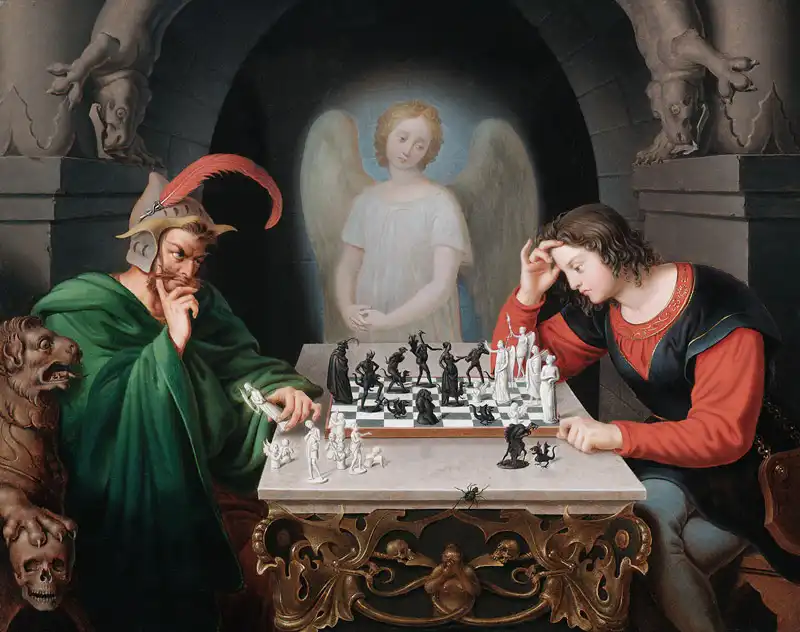
The meeting between a person and Death over a chessboard also has a specific Swedish precedent. In the 1480s, Albertus Pictor and his workshop painted Death Playing Chess in Täby Church near Stockholm. The church explains that medieval chess images could carry moral lessons and that a now-faded inscription over the game said, in old Swedish, “I play you checkmate.”
There is no documented statement that Zerge copied the Täby mural. The connection is contextual rather than proven. Yet a Swedish viewer in 1921 could encounter a centuries-old visual idea: Death does not need to attack with a weapon. It can sit across from a person, play by rules, and still win.
Owe Zerge was born in Kristianstad, Sweden, in 1894. He studied at the Althin Painting School in Stockholm in 1914 and 1915, then at the Royal Institute of Art from 1915 to 1919 under Olle Hjortzberg and Oscar Björck. He also spent time at Axel Tallberg’s etching school and later studied in France under André Lhote.
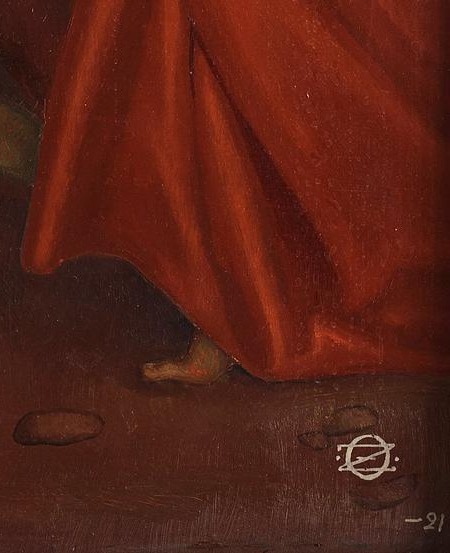
The year 1921 was important for him. He made his debut at the Salon de Paris, and he signed and dated Victoria Mortis that same year. In 1922 the painting appeared in “Salongen” at Liljevalchs Konsthall in Stockholm as catalogue number 666.
Zerge later became known especially for portraits and figure paintings, often rendered with unusually sharp detail. He also painted flowers and landscapes. His work is represented in Swedish museum collections including Gävle, Kristianstad and Tomelilla.
The original is oil on panel and measures 45 by 49 centimetres. Bukowskis records the work as signed with Zerge’s monogram and dated “-21.” Its early owner was Mr Hedstrand of Helsingborg, whose name also appeared with the painting in the 1922 Liljevalchs exhibition catalogue.
The painting was acquired in southern Sweden during the 1950s and then passed down within the same family. It returned to public view at Bukowskis in Stockholm in June 2023, where it sold for 370,000 Swedish kronor against an estimate of 100,000 to 150,000 kronor. The present owner has not been publicly identified, so its current location is best described as a private collection.
We paint Victoria Mortis by hand in oil on canvas, preserving the black field, the red cloak and the intense contrast between living flesh and bone. See the hand-painted oil reproduction.
Enjoyed this story?
Save articles to your collection
Log in or create a free account, and this article will be waiting in your Private Collection.
Log in or sign upVisible details, documented history and interpretation are kept separate throughout this article.