Loading cart…
No products in the cart.

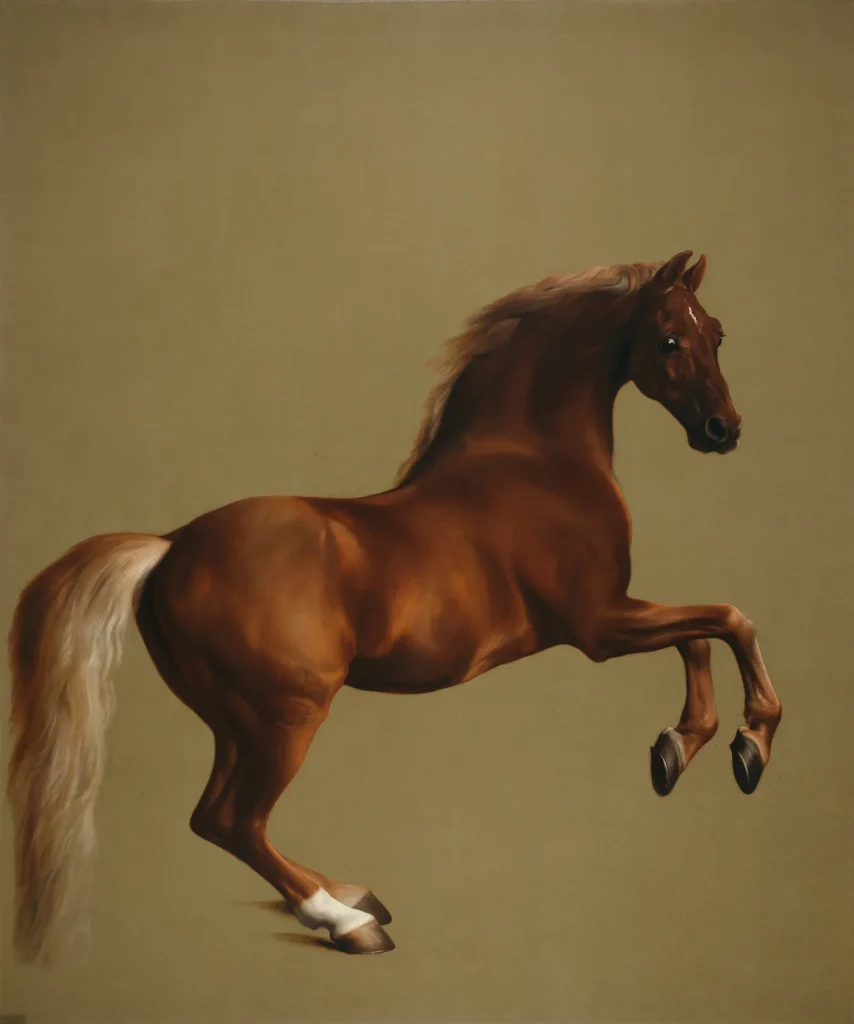
c. 1762 · Oil on canvas · The National Gallery, London
Save articles to your collection
Log in or create a free account, and this article will be waiting in your Private Collection.
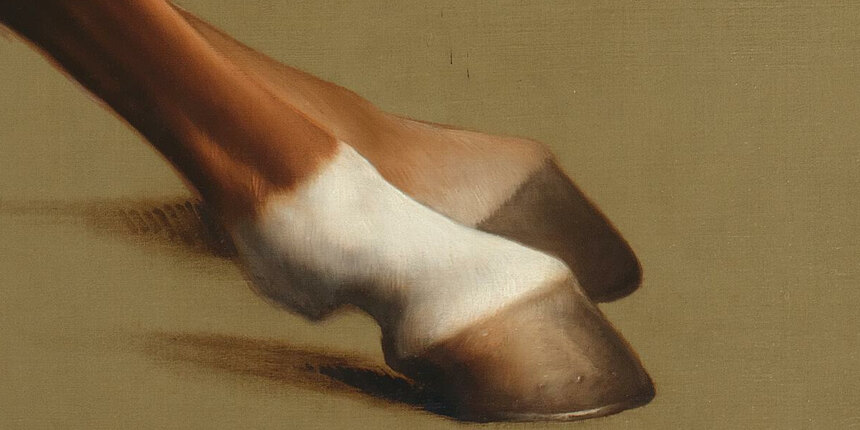
Log in or sign upNearly three metres high, a chestnut stallion rears against a plain ochre ground. There is no rider, no saddle, no bridle, no groom, no stable, no tree, no sky. There is not even a ground line: the shadow under his hind hooves is the only thing that tells you he is standing on anything at all. Everything a horse portrait of 1762 was supposed to have has been left out, and what is left is the horse.
Nobody had painted an animal like this before. Life size, alone, filling the canvas, with the attention a painter would give a king. Stubbs did it for a man who could afford it, and the result is the most famous animal in British art.
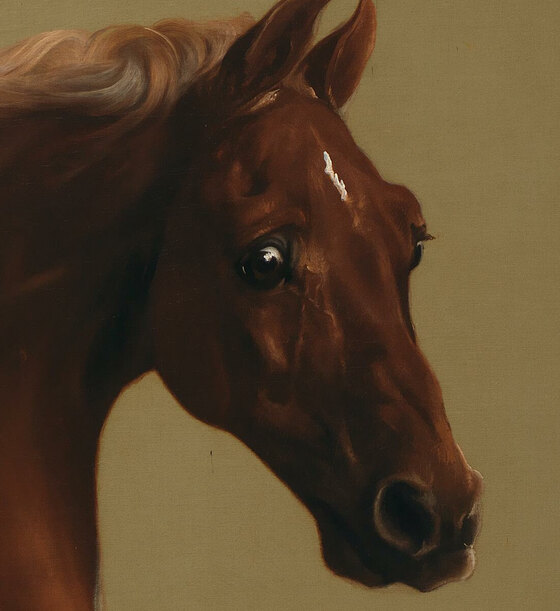
Whistlejacket was a real horse: an Arabian-blooded chestnut foaled in 1749, named after a cold remedy of gin and treacle, and a racehorse of some quality. His great day was at York in August 1759, when he won a match over four miles for a purse of two thousand guineas, an enormous sum. By 1762 he had retired to stud at Wentworth Woodhouse in Yorkshire, the largest private house in England, and belonged to its owner, Charles Watson-Wentworth, second Marquess of Rockingham.
Rockingham was thirty-two, one of the richest men in the country, a mad-keen breeder of horses and, three years later, Prime Minister. He had already had Stubbs paint his mares and foals, his hunters and his grooms. Then he asked for something bigger.
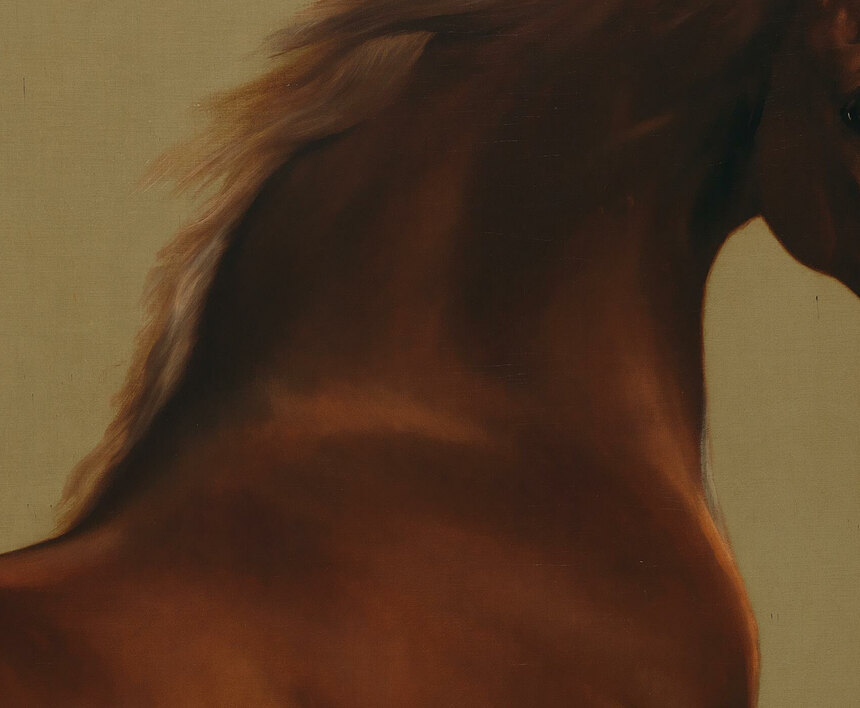
George Stubbs was not trained as a painter of horses. He was trained, largely by himself, as an anatomist. In 1756 he rented a farmhouse at Horkstow in Lincolnshire, bought dead horses, hung them from the ceiling with hooks and tackle, and spent eighteen months dissecting them layer by layer, drawing each stage. The stench drove the neighbours away. The result, published in 1766 as The Anatomy of the Horse, was the first accurate account of the subject and stayed in use for a century.
That is why Whistlejacket looks the way he does. Look at the shoulder, the flank, the tendons in the raised forelegs: each muscle is where a muscle is, doing what that muscle does when a horse rears. Every horse painter before Stubbs had painted the outside. Stubbs painted the outside knowing the inside, and the animal comes alive because of it.
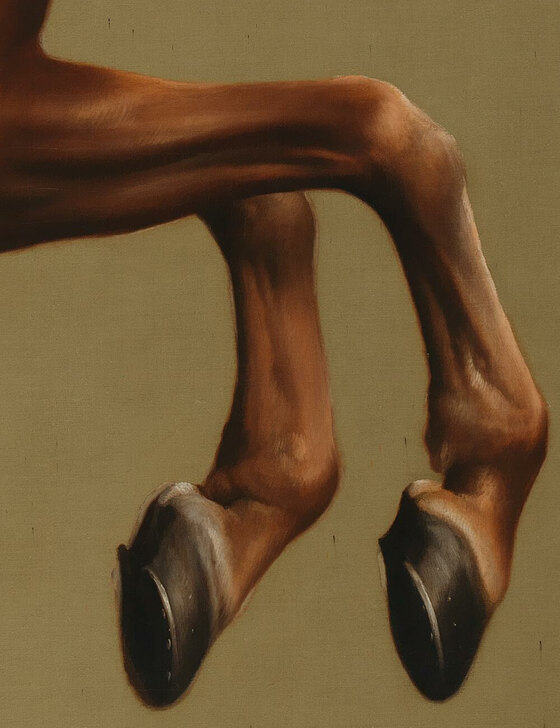
The pose is the levade, the controlled rear taught in the classical riding schools, which is also the pose of every royal equestrian statue from Marcus Aurelius on. Stubbs gave a racehorse the pose of an emperor's mount and then took the emperor away.
Why is the background empty? The story told for two hundred years is that it was never meant to be. Rockingham, it was said, planned an equestrian portrait of the young George III, with Stubbs painting the horse, a second artist adding the king, and a third the landscape. Then Rockingham quarrelled with the king, the project died, and the horse was left alone on its bare canvas.
It is a good story and it may be true. But nothing in Rockingham's papers supports it, and the painting does not look unfinished. The ground is evenly painted, the shadow is deliberate, and Stubbs left other horses on plain grounds for the same patron. The likelier truth is that Rockingham, who liked to be ahead of fashion, wanted exactly this: a horse without a story, painted as if it were the subject of a Roman bust.
There is a second story, from Stubbs' own circle, that Whistlejacket saw the finished painting being carried across the yard, took it for a rival stallion and attacked it, and had to be dragged off by his groom. That one is probably true. Horses do that. It is the best review the picture ever had.
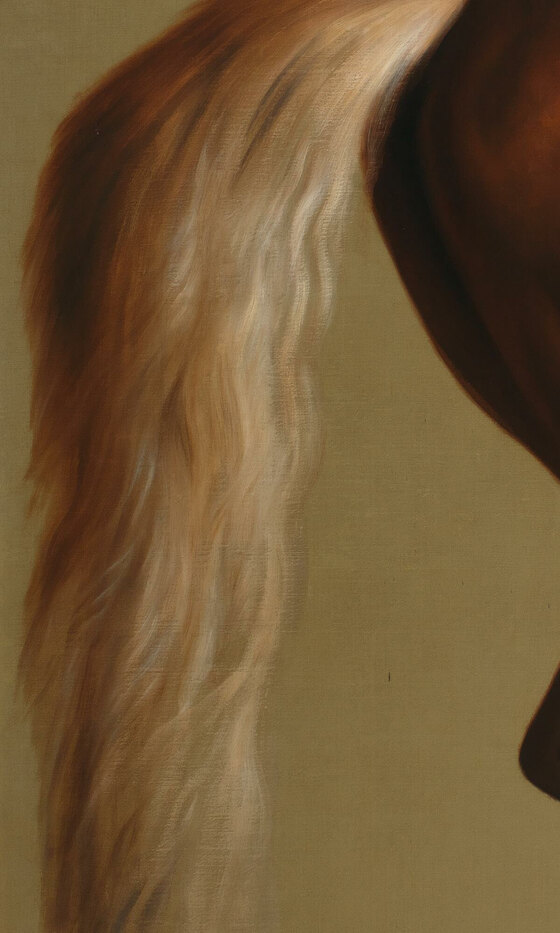
It means a horse. That is the radical thing about it. In 1762 a painting of this size was for a battle, a coronation or a god, and here it is spent on an animal with no human in sight, treated with complete seriousness and no sentiment. Stubbs does not make Whistlejacket noble or sweet. He makes him accurate, and lets the accuracy do the rest.
Two centuries later that looks like the birth of something. The empty ground, the isolated subject, the refusal to tell a story: these are the habits of modern painting, and Stubbs arrived at them by a different road, through science and a rich man's whim. Whether you see it as the end of the equestrian portrait or the beginning of the modern one, it is the point where the horse stopped being a prop.
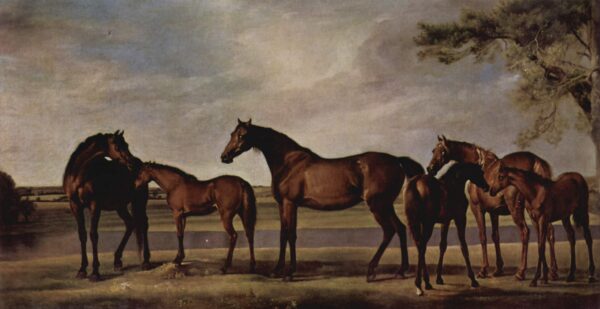
Stubbs painted for Rockingham for the rest of the decade, and the Wentworth pictures are the core of his work: the frieze of Mares and Foals against another bare ground, the mares startled by an approaching storm, and the lions and horses in which the same anatomical eye is turned to violence.
The painting stayed at Wentworth Woodhouse with Rockingham's heirs for 235 years. In 1997 the National Gallery in London bought it for eleven million pounds, with help from the Heritage Lottery Fund, and hung it at the end of a long enfilade of rooms so that you see it from a distance, framed by doorways, before you reach it. It is oil on canvas, 292 by 246 centimetres. The horse is life size.
It is one of the few paintings that improves with almost any wall, because the wall becomes part of it: the empty ground reads as the room. Our hand-painted reproduction of Whistlejacket is painted in oil on canvas from the National Gallery original. It wants height more than width, a plain frame or none, and a room with space in front of it to step back. People choose it for halls, stairwells and studies, and for anyone who has ever loved a horse.
More Stubbs in our George Stubbs collection.
Enjoyed this story?
Save articles to your collection
Log in or create a free account, and this article will be waiting in your Private Collection.
Log in or sign upVisible details, documented facts and interpretation are kept separate throughout this article. The George III story and the stallion's attack on the canvas are reported as the traditions they are.