Loading cart…
No products in the cart.

Original price was: $518.00.$259.00Current price is: $259.00.
A woven basket of fruit by Caravaggio, painted with fruit both ripe and wormholed, considered the work that founded Italian still-life painting.
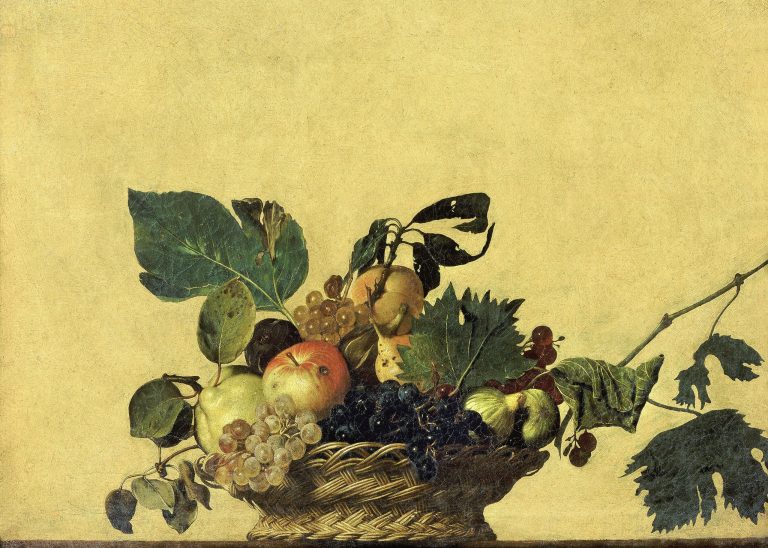
Historians have called Basket of Fruit reproduction worthy of its reputation as the founding work of Italian still-life painting, and four centuries of looking at it have not worn that claim thin. Scholars point to it as the moment fruit and leaves on a ledge became a subject serious enough to stand alone, without a saint or a patron in sight. Return to the canvas itself and the reasons are plain enough: a woven basket, pushed to the very edge of a stone ledge, holding peaches, apples, a pear, figs, quince, and heavy clusters of grapes, every one of them painted as it actually was rather than as convention demanded.
Caravaggio sets the basket against a bare, pale wall and lets daylight fall across it from the left, so that each fruit reads as a separate study in weight and surface. A peach shows its soft bloom, a vine leaf curls and browns at the edge, an apple carries a worm hole left uncovered rather than hidden. The painting records spotted leaves, split skins, and fruit past its best alongside fruit still firm, so that the whole arrangement reads less as a display of abundance than as a record of time passing on a kitchen ledge. This unflinching naturalism, painted around 1599, belongs to the same eye that would soon turn to religious drama and dramatic lighting, though here the subject is humble and the drama is entirely in the paint surface itself.
The restraint of the composition does most of the work. There is no landscape, no tablecloth, no second object to compete with the basket; the ledge and the wall exist only to hold the light. That economy, carried forward by a painter working at the edge of a new century, is part of what makes this small canvas feel larger than its size. ByMuseum artists recreate it as a hand-painted oil painting reproduction, working in oil on canvas to match the palette of ochres, greens, and dulled reds, and to keep the visible brushwork that gives the fruit its weight and the woven basket its texture. This oil on canvas reproduction is built layer by layer by a trained painter, not printed, so the surface itself carries the depth of the original.
A painting that has held attention for over four hundred years earns a place on a wall where it can keep being looked at, and owning a hand-painted version of it means living with that same quiet attention every day rather than a copy that only resembles it from a distance.
| artists |
|---|
Empty walls flatten a room. A classical artwork restores structure and visual hierarchy. One painting defines the space, anchors furniture, and establishes identity.
Worldwide shipping included. Each painting is produced to order and safely packed for international transport.
All payments are encrypted and processed through trusted payment providers.
Real brushwork, layered oil paint, and durable pigments on museum-quality canvas.
If the result does not meet expectations, return it for a full refund.


Your artwork is painted on premium cotton canvas, then shipped safely rolled in a rigid tube with extra blank canvas border — ready for stretching or framing locally.
Select a handcrafted frame and we’ll deliver your painting fully assembled, protected, and ready to hang.
For safe shipping, framing is available up to a maximum size. Larger sizes will automatically disable the frame option.


Choose “Stretched” to receive your canvas mounted on wooden stretcher bars — perfect if you’ll frame it later or display it as-is.
Gallery Wrap is a deeper, 1.5" style stretcher. The canvas wraps around the sides and is stapled on the back for a clean, modern, frameless look.
We ship with UPS, FedEx, or DHL straight to your door. You’ll receive a tracking number as soon as your order leaves our studio. Typical delivery is 5 to 7 days after dispatch; large, framed, or stretched pieces may take longer depending on the safest shipping route.


Unframed canvases are protected with a film, carefully rolled, and secured inside a rigid shipping tube.

Stretched, Gallery Wrapped, and Framed paintings are wrapped, cushioned with foam protection, and boxed for safe transit.
Reviews
There are no reviews yet.