Loading cart…
No products in the cart.

c. 1595 · Oil on canvas · Kimbell Art Museum, Fort Worth
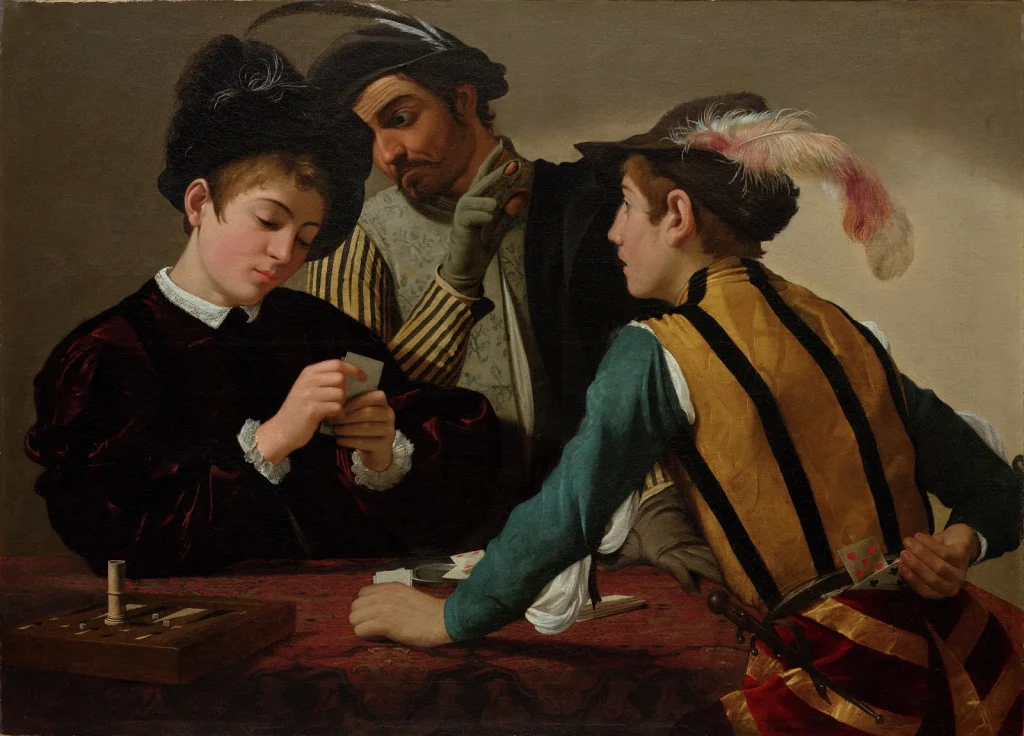
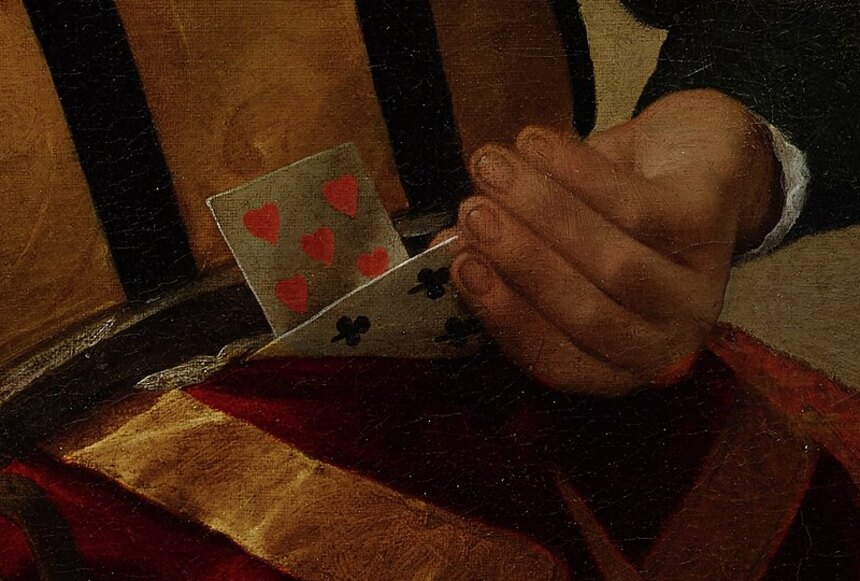
Start where the cheat's right hand is, behind his back, where the boy across the table cannot see it. Two fingers are drawing a card out of his belt. Next to the card, in the same belt, is a dagger. Caravaggio puts the two together on purpose: the card is how the game will be won, and the dagger is what happens if the winning is noticed.
The boy on the left, in the good velvet and the lace collar, is looking at his own cards. He has not noticed anything. He is about to lose his money, and if he is unlucky, more than that.
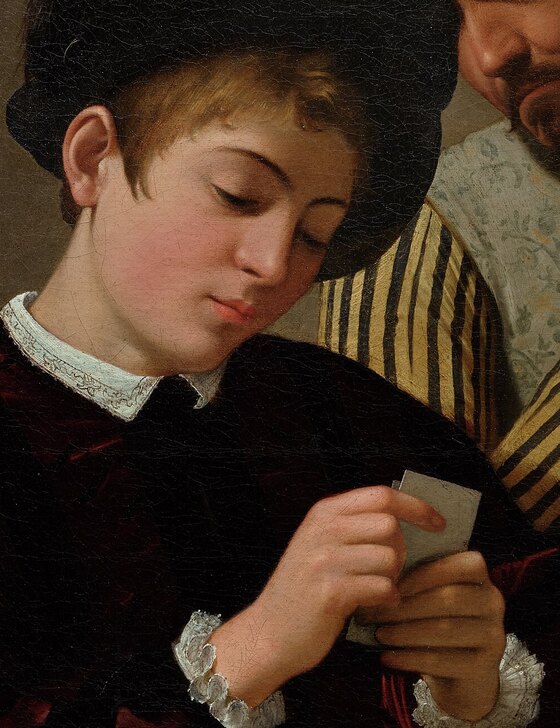
The game is primero, the sixteenth-century ancestor of poker. There are three players at the table, but only one of them is playing.
The boy on the left is the mark. He is perhaps sixteen, dressed in the dark velvet of a good family, with a feather in his hat and his eyes on his cards. Caravaggio painted him with the kind of soft, fresh face he gave all his boys, and it is the face of someone who has never been cheated before.
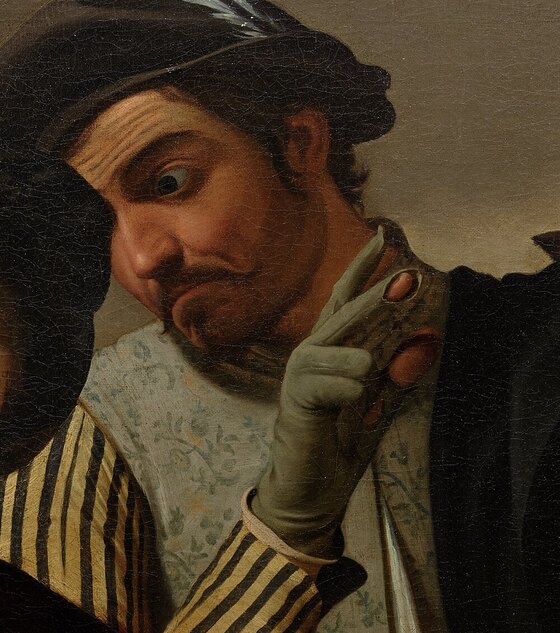
Behind him, an older man leans over his shoulder, reading his cards and signalling the count to his partner with raised fingers. Look at his glove: the fingertips have been cut away. That is a professional's tool. Cheats marked cards with tiny pricks or roughened edges, and read the marks by touch.
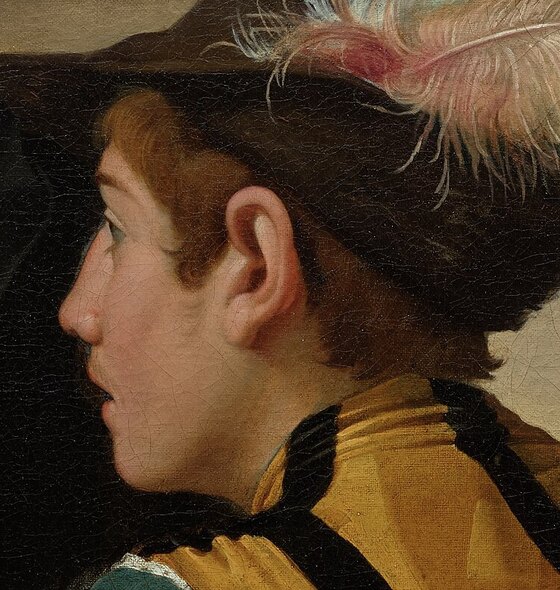
And on the right, the third player: a boy the same age as the mark, in a striped doublet and a hat with an enormous pink feather, half out of his chair with excitement, eyes on his accomplice, hand behind his back. He is the one Caravaggio loves. The mark is painted with sympathy, the older man with contempt, but the young cheat is painted with delight.
Caravaggio was about twenty-three when he painted this, newly arrived in Rome, poor, and working for a dealer who sold his pictures out of a shop window. The Cardsharps and its companion, The Fortune Teller, were painted to sell: low-life subjects with pretty boys and a moral, the kind of thing a collector could enjoy and defend.
The man who bought it was Cardinal Francesco del Monte, the Medici ambassador in Rome, a connoisseur, musician and scientist who kept an open house for artists. He liked The Cardsharps enough to take the painter in. Caravaggio moved into the cardinal's palace, painted for him for years, and through him got the commission for the Calling of Saint Matthew that made him famous. The most important career in Baroque painting starts with this picture of three boys and a crooked card game.
On the surface it is a warning, of the kind moralists had been issuing for a century: a young man of good family falls among thieves and loses his inheritance at cards. The Prodigal Son in modern dress. Del Monte could hang it and call it edifying.
But the painting does not feel like a sermon. It feels like a scene from a play, caught in the second before the reveal, and it is told from the cheats' side. Caravaggio was a street painter who knew the taverns, carried a sword, and would later kill a man over a bet on a tennis match. He painted these three from models he found in the same streets. The picture's real subject is not the danger of gambling. It is how much fun it is to watch someone else get robbed.
That is what Caravaggio brought to painting and what the painting introduced: real people, real light from one side, no idealising, and a story that happens in front of you at the speed of life. Within ten years half the young painters in Rome were doing it. Within a generation, so were painters in Utrecht, Naples and Seville.
Del Monte's Cardsharps stayed in Rome until the eighteenth century, then disappeared. For nearly two hundred years it was known only from copies, of which there are more than thirty, and scholars argued over which one, if any, was the original. In 1987 it turned up in a private European collection, was examined and accepted as Caravaggio's own, and was bought at once by the Kimbell Art Museum in Fort Worth, Texas.
The story had a sequel. In 2006 another version, long in an English family, was sold at Sotheby's as a copy for £42,000. The buyer was Sir Denis Mahon, the great Caravaggio scholar, who declared it an autograph second version worth millions. The family sued the auction house. In 2015 the High Court in London ruled that Sotheby's had not been negligent, and the question of the second picture is still open. The Kimbell's is the one nobody disputes.
In the Kimbell Art Museum in Fort Worth, in Louis Kahn's famous building, where it has hung since 1987. It is oil on canvas, 94 by 131 centimetres, and the figures are a little under life size. Its companion, The Fortune Teller, is in Rome, at the Capitoline Museums, with a second version in the Louvre.
It is a painting for a room where people talk: dining rooms, studies, bars, games rooms. Our hand-painted reproduction of The Cardsharps is painted in oil on canvas from the Kimbell original, and it hangs best at eye level in a dark frame, so that the light seems to come from the room.
The rest of the story, from the cardinal's palace to the flight from Rome, is in our guide to Caravaggio, with articles on The Calling of Saint Matthew, Judith Beheading Holofernes and David with the Head of Goliath.
Visible details, documented facts and interpretation are kept separate throughout this article. The name of the card game and the purpose of the cut glove are as identified by the Kimbell and by Langdon.