Loading cart…
No products in the cart.

Original price was: $518.00.$259.00Current price is: $259.00.
A hand-painted fine art reproduction of Salvator Mundi by Leonardo da Vinci, rendering the blessing gesture, crystal orb, and deep blue robe in oil on canvas.
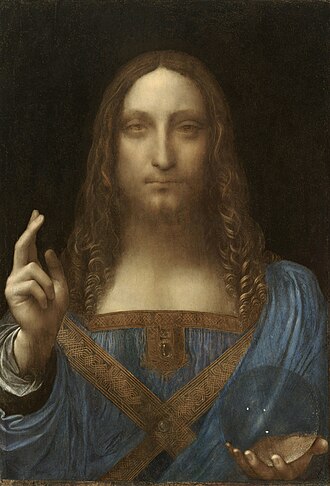
About the painting. Salvator Mundi shows Christ facing the viewer, one hand raised in blessing and the other holding a crystal orb, in a blue robe with embroidered bands. Attributed to Leonardo da Vinci around 1500, valued at thirty pounds in 1649 and forty-five in 1958, it sold for 450 million dollars in 2017, the most ever paid for a painting, and has not been seen in public since. Painted c. 1499 to 1510, attributed to Leonardo. Oil on walnut panel, 65.6 x 45.4 cm. Private collection; last shown publicly in 2017.
Most paintings by Leonardo da Vinci give the eye somewhere to travel: a landscape receding into blue distance, a hand caught mid-gesture, a face turned slightly from the viewer. Salvator Mundi reproduction work follows a different logic, one built on stillness and direct confrontation. Christ looks straight out of the panel, and there is nowhere else in the picture to look but back at him.
The figure is set against a plain dark ground, frontal and symmetrical in a way that recalls Byzantine icons more than the turning, dramatic poses found elsewhere in the career of Vinci. The right hand is raised in blessing, fingers loosely curled, while the left holds a sphere of rock crystal rendered with small inclusions and soft internal reflections rather than the sharp refraction a modern lens would produce. Waves of hair fall in tight ringlets on either side of the face, painted with the same attention to soft transition that defines the sfumato technique associated with this artist, where one tone dissolves into the next without a visible line.
The robe is where the picture allows itself colour: a deep ultramarine blue, gathered in soft folds across the chest, with a woven trim picked out in gold thread. Light falls evenly across the face, avoiding harsh shadow, so that the expression reads as calm rather than severe. Scholars continue to debate how much of the surviving panel reflects the hand of Vinci himself against later restoration, and that unresolved question is part of what keeps the composition under discussion.
Producing this painting as a fine art reproduction means matching that restraint rather than exaggerating it. The ByMuseum artist works in oil on canvas, building the blue of the robe in layers and letting the transitions around the eyes and mouth stay soft, the way they are in the original panel. This is a painted oil painting reproduction, worked by hand with visible brushwork and real surface texture, not a printed copy of a photograph. The crystal orb is rendered with the same patient, low-contrast handling, so the surface holds light rather than glaring under it.
A picture this contained suits a room where it will be looked at rather than glanced past: a study, a hallway with steady light, a collection already built around quiet, formal portraiture. It works as well for a collector drawn to the unresolved history of the image as for someone who simply wants the blessing gesture and the blue robe on their own wall.
| artists |
|---|
Artwork guide
Explore the painting’s history, composition and meaning in the ByMuseum art guide.
Read the history and meaning of Salvator Mundi by Leonardo da VinciEmpty walls flatten a room. A classical artwork restores structure and visual hierarchy. One painting defines the space, anchors furniture, and establishes identity.
Worldwide shipping included. Each painting is produced to order and safely packed for international transport.
All payments are encrypted and processed through trusted payment providers.
Real brushwork, layered oil paint, and durable pigments on museum-quality canvas.
If the result does not meet expectations, return it for a full refund.


Your artwork is painted on premium cotton canvas, then shipped safely rolled in a rigid tube with extra blank canvas border — ready for stretching or framing locally.
Select a handcrafted frame and we’ll deliver your painting fully assembled, protected, and ready to hang.
For safe shipping, framing is available up to a maximum size. Larger sizes will automatically disable the frame option.


Choose “Stretched” to receive your canvas mounted on wooden stretcher bars — perfect if you’ll frame it later or display it as-is.
Gallery Wrap is a deeper, 1.5" style stretcher. The canvas wraps around the sides and is stapled on the back for a clean, modern, frameless look.
We ship with UPS, FedEx, or DHL straight to your door. You’ll receive a tracking number as soon as your order leaves our studio. Typical delivery is 4–5 business days after dispatch; large, framed, or stretched pieces may take longer depending on the safest shipping route.


Unframed canvases are protected with a film, carefully rolled, and secured inside a rigid shipping tube.

Stretched, Gallery Wrapped, and Framed paintings are wrapped, cushioned with foam protection, and boxed for safe transit.



Reviews
There are no reviews yet.