Loading cart…
No products in the cart.

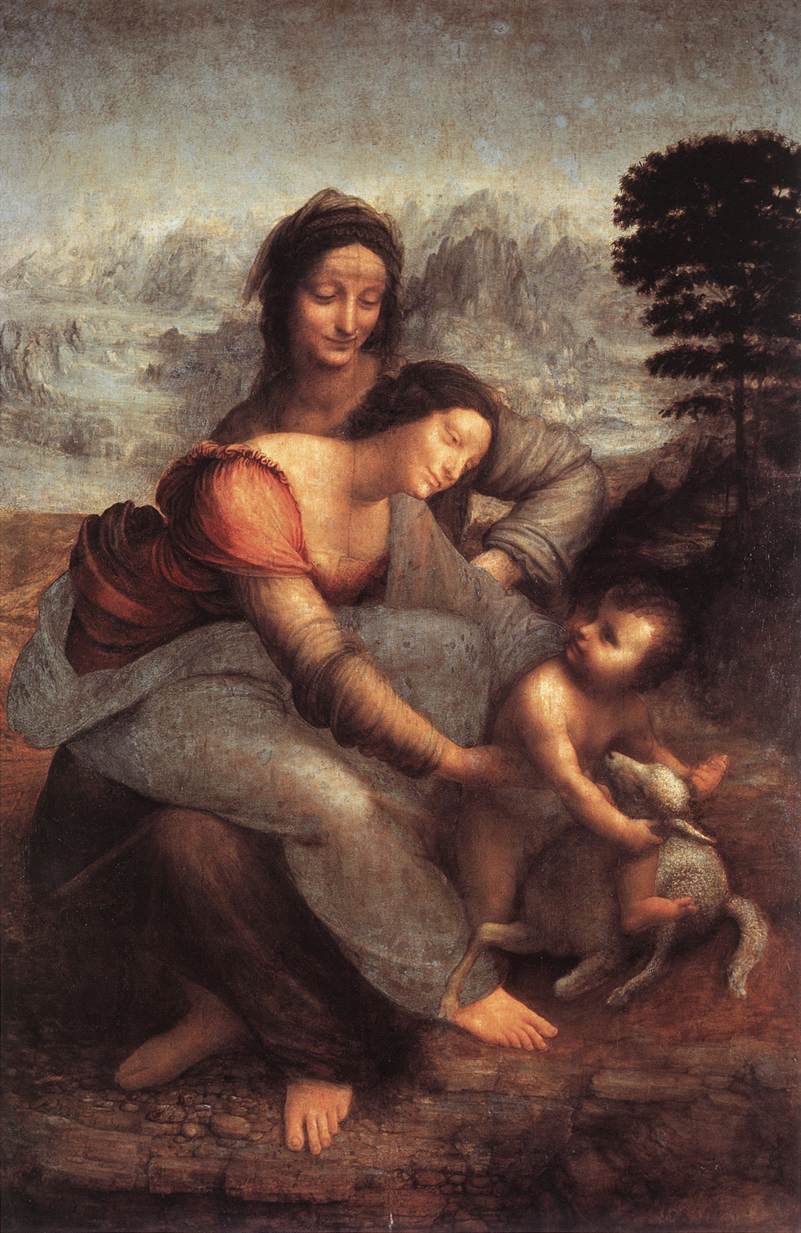
c. 1503-1519 · Oil on wood panel · Louvre Museum, Paris, France
Save articles to your collection
Log in or create a free account, and this article will be waiting in your Private Collection.
Log in or sign upThe Virgin and Child with Saint Anne occupied Leonardo da Vinci attention over a long period, with preparatory drawings and cartoons dating back to around 1499 and the final painted version believed to have been worked on until near the end of his life in 1519. A large preparatory cartoon, now housed in the National Gallery in London, shows an earlier compositional arrangement without the lamb, suggesting that the design evolved significantly over time. The painting was likely commissioned for the high altar of the Church of Santissima Annunziata in Florence, though it was ultimately never delivered there. Giorgio Vasari, writing in the sixteenth century, described a cartoon displayed publicly in Florence that attracted enormous crowds of admiring citizens, indicating the wide interest the composition generated even in preparatory form. The final painted version remained with Leonardo until his death and passed into the French royal collection, eventually finding its permanent home in the Louvre Museum in Paris. The painting underwent extensive technical analysis and a major restoration completed in 2012, which revealed the original vibrancy of the colors beneath centuries of accumulated varnish and overpaint. The restoration sparked debate among art historians regarding how much of the current surface reflects Leonardo original intentions and how much was altered during subsequent interventions. Despite these controversies, the painting remains one of the most studied and discussed works in the history of Western art, attracting millions of visitors to the Louvre each year.
The composition of The Virgin and Child with Saint Anne is built around a carefully organized pyramidal arrangement of three figures that creates both visual stability and a sense of dynamic, intertwining movement. Saint Anne sits at the base, her daughter Mary partially in her lap, while Mary reaches forward to restrain the Christ Child as he grasps a lamb, a symbol of his future sacrifice. This layered grouping allows Leonardo to explore complex spatial relationships between the figures, with each body turning and overlapping in ways that create depth and visual rhythm. The sfumato technique is applied throughout, softening outlines and creating smooth transitions between light and shadow that give the figures a sense of weight and volume without harsh contours. The landscape behind the figures is among the most elaborate and mysterious that Leonardo ever painted. Rocky formations dissolve into a hazy blue distance, with glacial peaks and water formations that seem to belong to a primordial, almost geological time. This landscape is not a recognizable place but rather a constructed environment that reflects Leonardo deep interest in natural science and earth formation. The light in the painting is diffused and sourceless, illuminating the figures evenly without casting strong shadows, a quality that reinforces the timeless, otherworldly atmosphere of the scene. The hands and faces of the figures demonstrate Leonardo finest painterly skills, with subtle blushes of color and incredibly delicate surface modeling.
The theological meaning of this composition is rich and carefully considered. The three generations represented, Saint Anne, the Virgin Mary, and the Christ Child, embody the concept of divine lineage and the fulfillment of prophecy. Anne, as the grandmother of Christ, represents the Old Testament heritage that prepared the way for salvation, while Mary represents the human vessel through which the divine entered the world. The Christ Child reaching toward the lamb is a clear prefiguration of the Crucifixion, linking the innocent joy of infancy directly to the redemptive suffering that awaited. Leonardo has layered these theological meanings into a scene that appears, on the surface, to be a warm and intimate family gathering. Beyond the religious symbolism, the painting reflects Leonardo philosophical interest in cycles of time, generation, and continuity. The way in which the figures are intertwined and overlapping suggests that the boundaries between individual identities are permeable, that the identity of the child is shaped by and inseparable from the generations that preceded him. This idea resonates with Renaissance humanist thought, which placed great emphasis on the inheritance of virtue and knowledge across generations. The serene yet knowing expression of Saint Anne, who watches the interaction between her daughter and grandson with a slight smile, suggests an awareness of the divine plan unfolding before her, adding a contemplative dimension to what might otherwise be a straightforward devotional image.
Enjoyed this story?
Save articles to your collection
Log in or create a free account, and this article will be waiting in your Private Collection.
Log in or sign up