Loading cart…
No products in the cart.

1495 to 1498 · Tempera and oil on dry plaster · Santa Maria delle Grazie, Milan
Save articles to your collection
Log in or create a free account, and this article will be waiting in your Private Collection.
Log in or sign upThirteen men are eating supper at a long table. A moment ago it was a quiet meal. Then Jesus said one sentence, and the whole room exploded.
Verily, verily, I say unto you, that one of you shall betray me.
John 13:21, King James Version
That is the instant Leonardo da Vinci painted, around 1495 to 1498, on the end wall of the dining hall of the monastery of Santa Maria delle Grazie in Milan. The Duke of Milan, Ludovico Sforza, paid for it, and the monks ate their meals beneath it. Earlier painters showed the Last Supper as a still, holy ceremony. Leonardo showed the shock: twelve faces hearing the worst news of their lives at the same second.
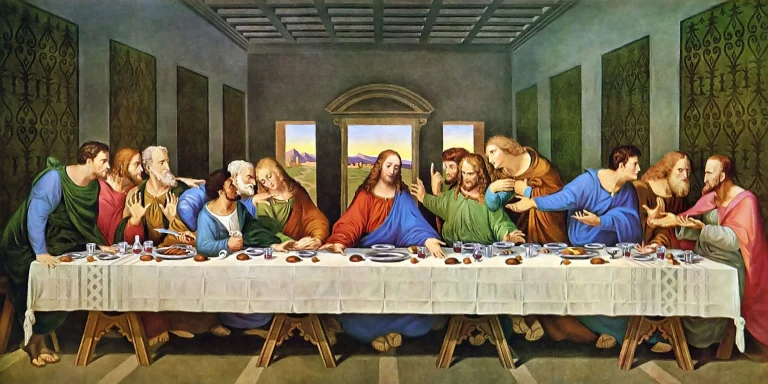
This is what the wall looks like today, five hundred years later.
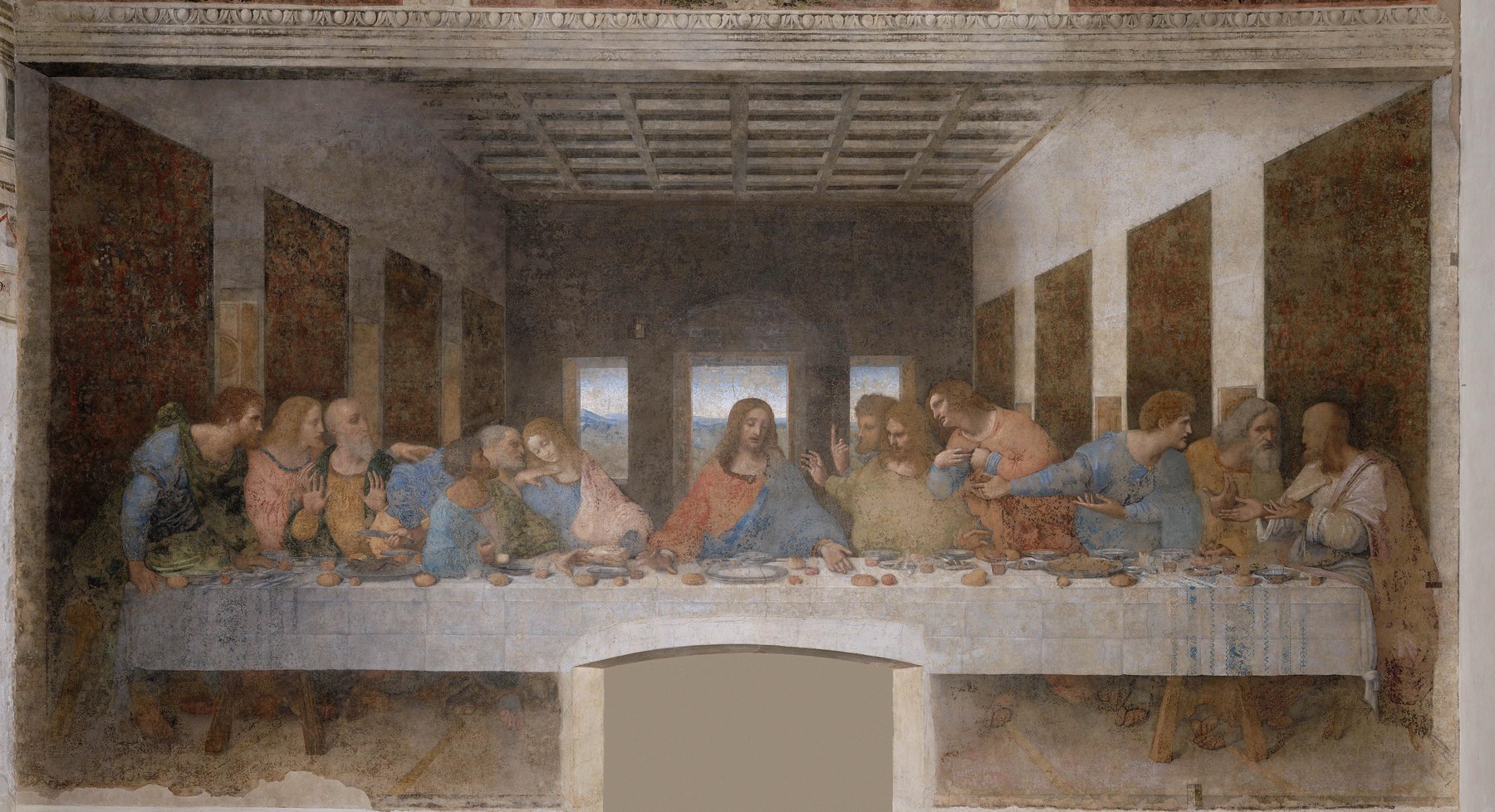
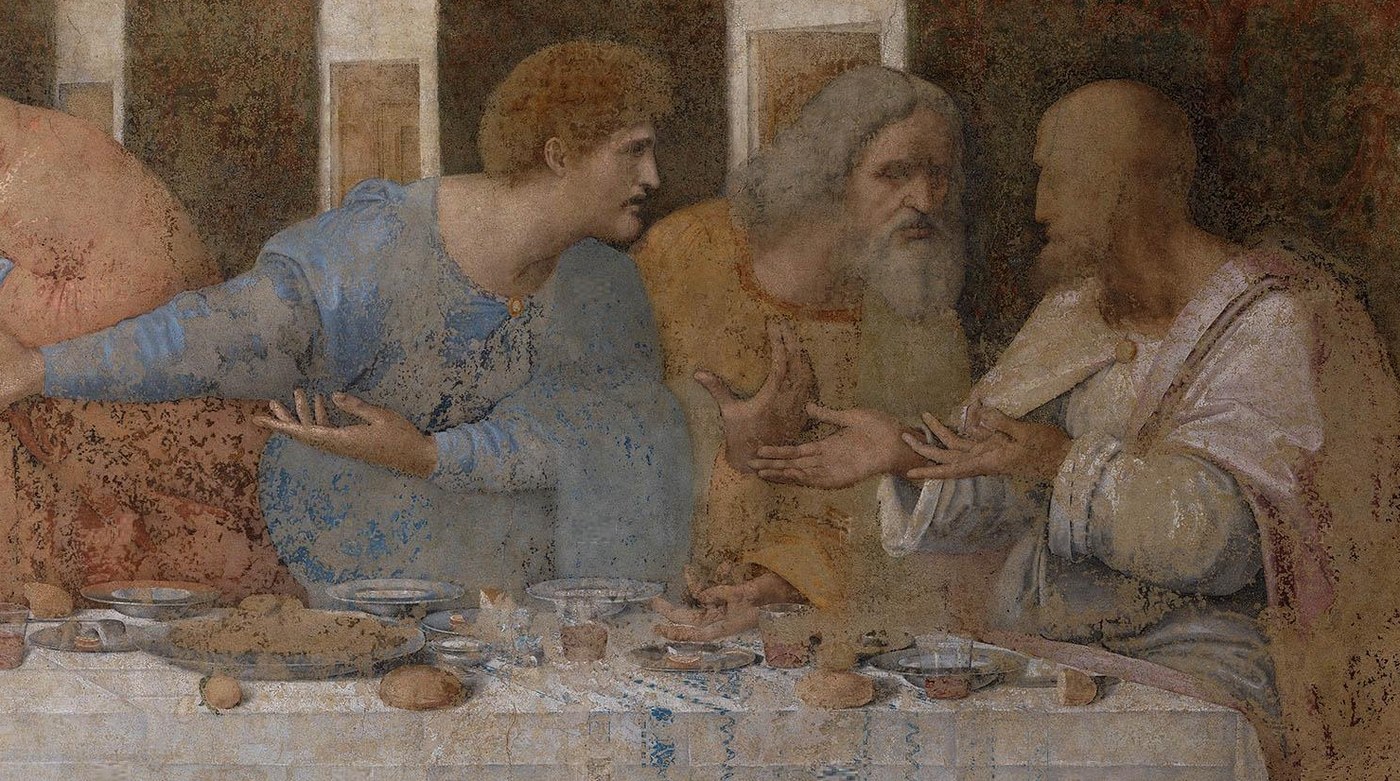
Leonardo did not line the apostles up in a row. He broke them into four groups of three, like waves spreading out from the centre after a stone is dropped in water. Reading from left to right, scholars identify them like this.
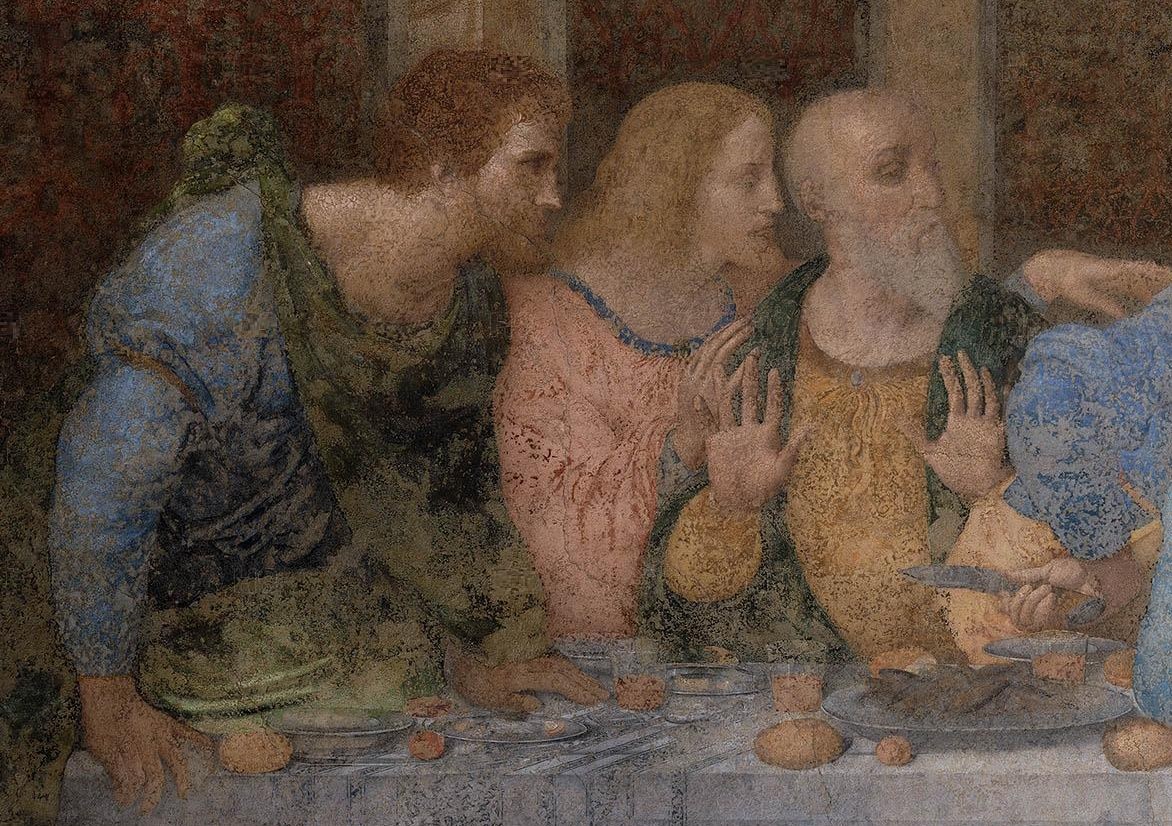
At the far left, Bartholomew has jumped up, leaning on the table to hear better. James the Less stretches an arm behind Andrew to reach Peter, and Andrew lifts both palms as if to say: not me. Next comes the darkest group, Judas, Peter and John, which we come back to below. Then Jesus, alone in the middle.
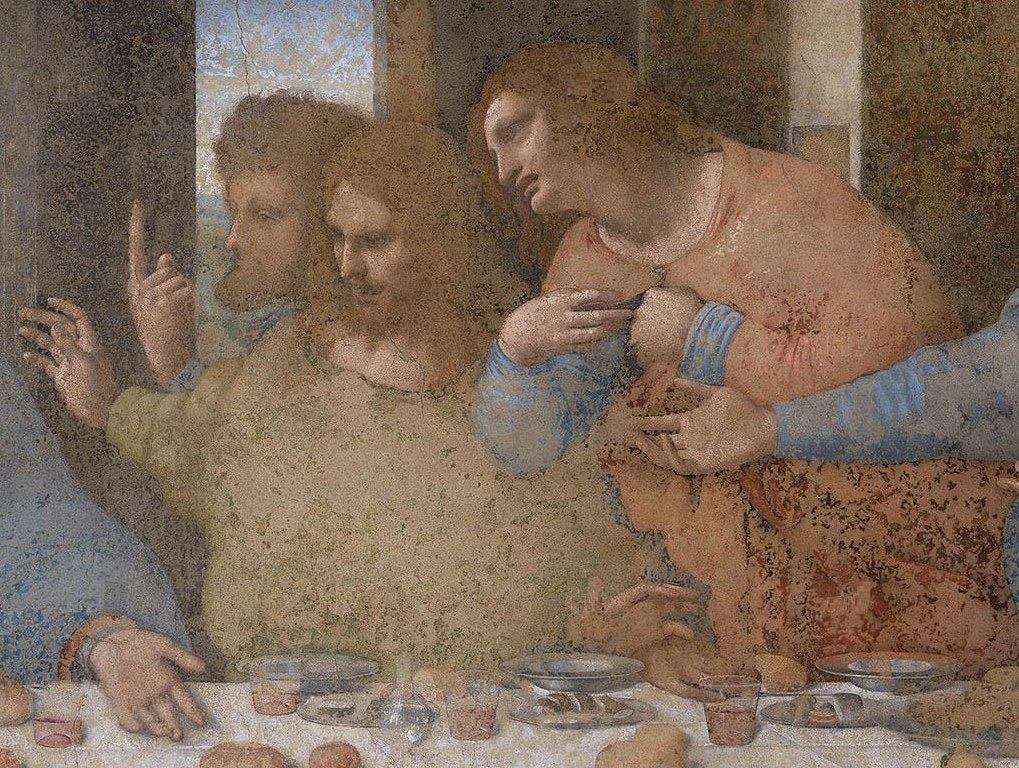
On his left, Thomas raises a single pointing finger, the doubter even now. James the Greater flings his arms wide in horror, and young Philip stands and presses both hands to his chest: is it I, Lord? At the far right, Matthew, Jude Thaddeus and Simon the Zealot have turned to each other, arguing about what they just heard, Matthew pointing back at Jesus as if asking the others to listen again.
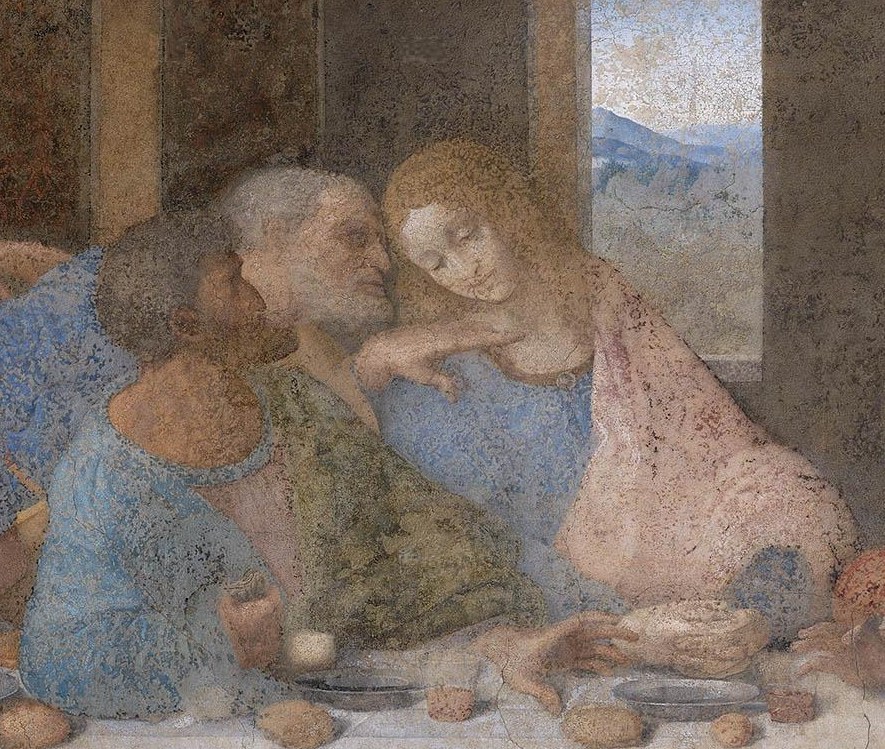
For centuries painters made Judas easy to find, usually by sitting him alone on the near side of the table. Leonardo put him right in among the others, which is far more unsettling. He is the dark profile pulled back from Jesus, his face in shadow, his right hand gripping a small bag: the thirty pieces of silver. In front of him a salt cellar has been knocked over, an old sign of bad luck that later copies show clearly.
Behind him, hot-tempered Peter leans in to whisper to John, and in his hand, twisted behind his back, is a knife. It is the knife he will use a few hours later to cut off a servant's ear in the garden. John, the youngest and the beloved disciple, leans away with closed eyes, the calm one in the storm.
It is John who launched a famous modern theory. Because Leonardo painted him beardless, with soft features and long hair, the novel The Da Vinci Code claimed in 2003 that the figure is really Mary Magdalene. Art historians disagree: Florentine painters always showed John as a gentle young man, and if this were Mary, one of the twelve apostles would be missing from the table.
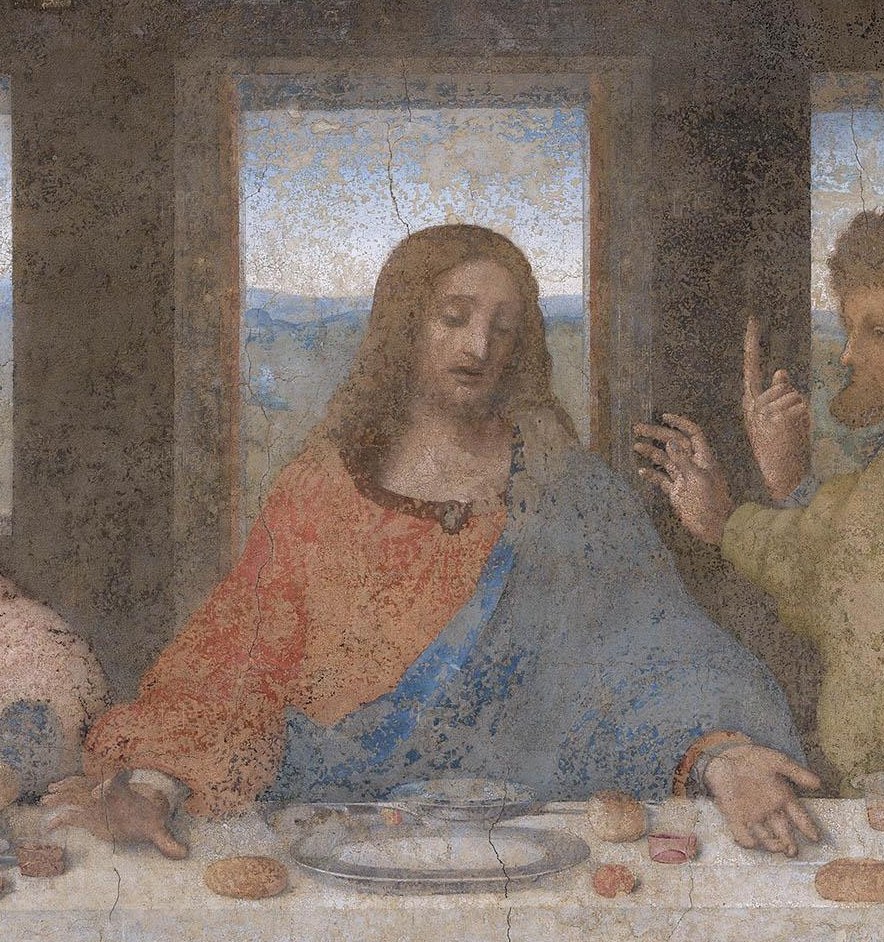
In the middle of all that noise, Jesus is the only still figure. His body makes a calm triangle, arms spread on the table, head lowered, one hand reaching toward the bread and wine. Leonardo did not paint a gold halo. Instead he put the brightest window in the room directly behind Christ's head, so the sky itself frames him.
Every line in the room leads to him too. The ceiling beams, the tapestries on the side walls and the edges of the table all run toward one vanishing point on Christ's right temple. Restorers found a tiny hole in the plaster at exactly that spot, where Leonardo is thought to have fixed a nail and stretched strings out to the corners to draw his perspective lines.
Leonardo worked on the wall for about three years, and the monks found him maddening. The writer Matteo Bandello, who watched as a boy in the convent, remembered him climbing the scaffold at dawn and painting until dark without stopping to eat, then staying away for days, then walking in at noon, adding one or two strokes, and leaving again.
The prior of the monastery complained to the Duke that the painter was wasting time. According to Giorgio Vasari, Leonardo answered that he was still searching for a face evil enough for Judas, and that if he found nothing better, he would happily use the prior's.
Leonardo's slowness had a price. A true fresco is painted quickly into wet plaster, a patch a day, and it lasts for centuries. Leonardo wanted to work slowly, rework details and blend his shadows, so he invented his own method: tempera and oil painted onto a dry wall. It looked glorious for a few years. Then the damp in the old refectory got behind it, and the paint began to flake while Leonardo was still alive. When Vasari saw it in 1566, he described it as a blur of stains.
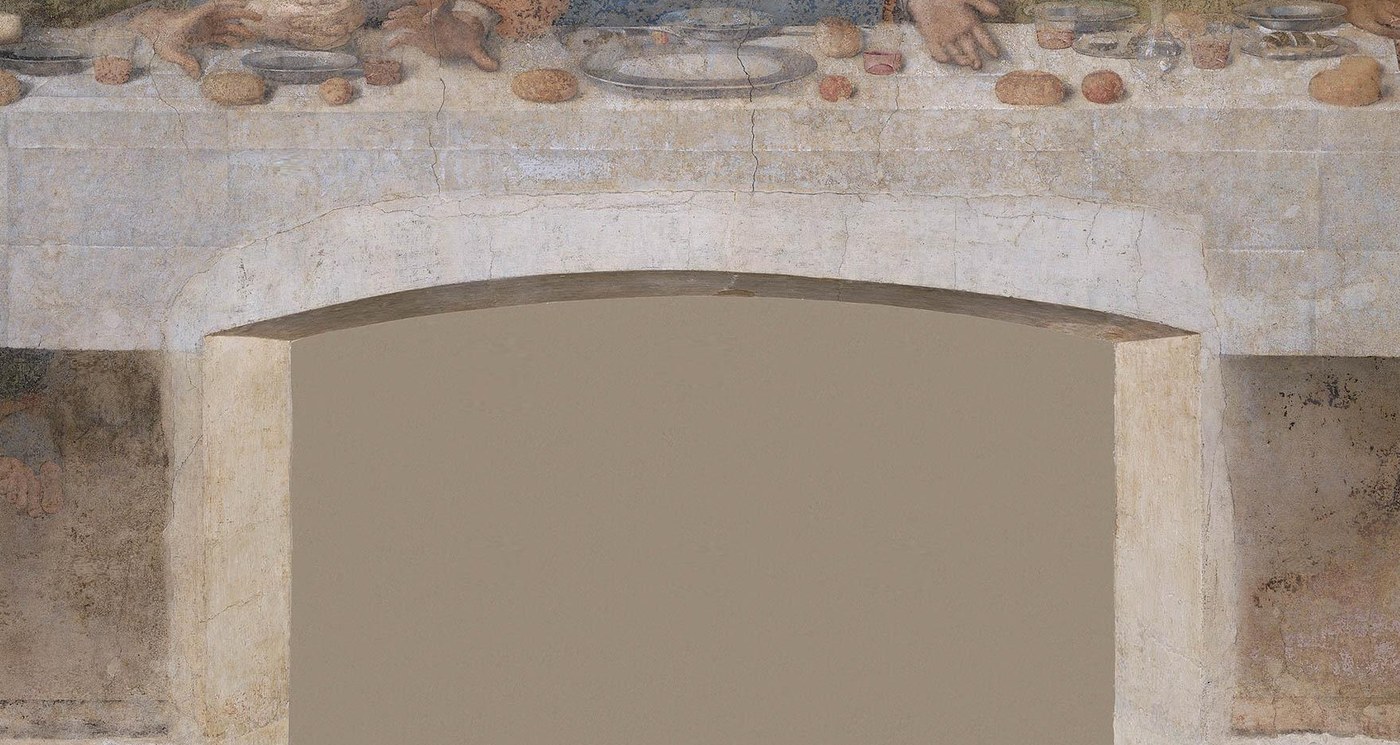
People made it worse. In 1652 the monks cut a doorway through the bottom of the wall to reach their kitchen, removing Christ's feet. French troops of Napoleon's army later used the hall as a stable. In August 1943 an Allied bomb destroyed most of the refectory; the wall survived only because it had been braced with sandbags and scaffolding.
The latest restoration, led by Pinin Brambilla Barcilon, took from 1978 to 1999, longer than Leonardo spent painting it. Centuries of overpaint were removed with a scalpel, square centimetre by square centimetre, to find what remains of his own brushwork. Today visitors enter in small groups, through filtered air locks, for fifteen minutes at a time.
On one level it is a painting about the Eucharist: Jesus reaches toward the bread and wine he is about to share, the moment Christians remember at every communion. For the monks eating below it every day, the painted table was an extension of their own.
But Leonardo's real subject is people. He once wrote that a painter must show the motions of the mind through the motions of the body, and here he does it twelve times over: anger, fear, disbelief, grief, suspicion and guilt, each one in a different pair of hands. It is the first great psychological painting, and five centuries of films, adverts and parodies have borrowed its composition because everyone still recognises that feeling of a dinner that suddenly goes wrong.
Still on the same wall, in the former refectory of Santa Maria delle Grazie in Milan, now a museum called the Cenacolo Vinciano. It cannot be moved, so the only way to see it is to go to Milan. Tickets are timed and sell out weeks ahead, so book early, and expect to spend about fifteen minutes in the room.
A painting this damaged is a strange thing to own as a reproduction, which is exactly why people do. Our hand-painted reproduction of The Last Supper is painted in oil on canvas as the composition looks fully restored, with the colours, the feet and the details the wall has lost. More in our Leonardo da Vinci collection.
Enjoyed this story?
Save articles to your collection
Log in or create a free account, and this article will be waiting in your Private Collection.
Log in or sign upThe Bible quotation follows the King James Version. Bandello's and Vasari's accounts are paraphrased.