Loading cart…
No products in the cart.

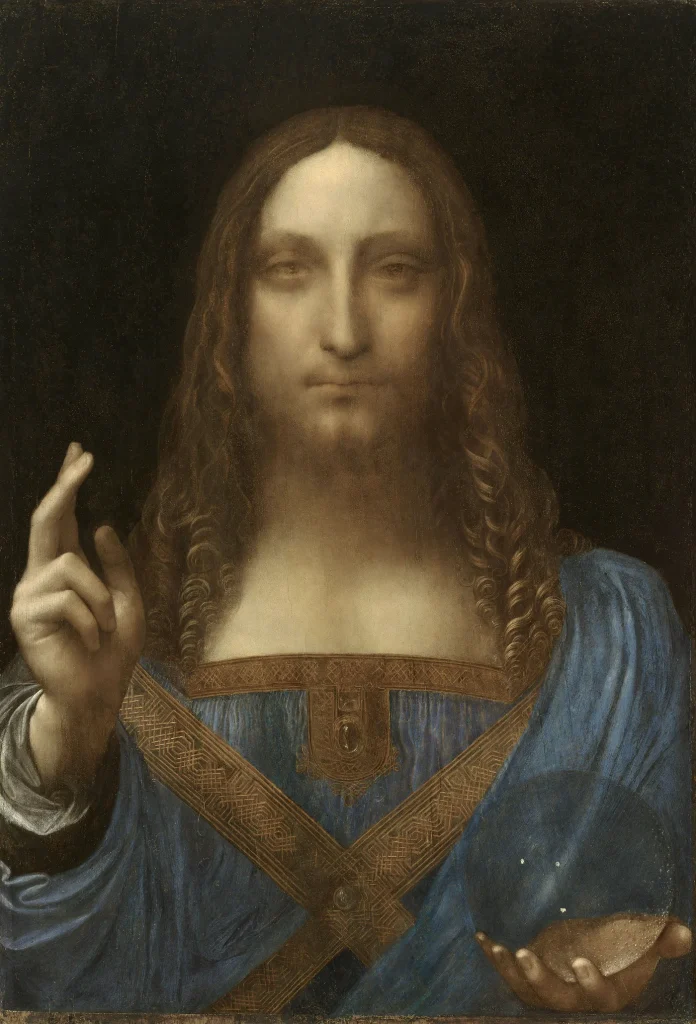
c. 1499 to 1510 · Oil on walnut panel · Private collection, location undisclosed
Save articles to your collection
Log in or create a free account, and this article will be waiting in your Private Collection.
Log in or sign upWhen the English Parliament sold off the collection of the executed King Charles I in 1649, the clerks listed a small panel of Christ blessing and gave it a price:
A peece of Christ done by Leonardo. Thirty pounds.
Inventory of the sale of Charles I's goods, 1649 to 1651
In 1958 the same painting, or what was left of it under centuries of repainting, sold at Sotheby's in London for forty-five pounds, as the work of a follower. In 2005 it sold at an estate auction in New Orleans for one thousand one hundred and seventy-five dollars. On 15 November 2017, at Christie's in New York, it sold for four hundred and fifty million three hundred thousand dollars, the most ever paid for a work of art, and then it disappeared.
That is the story of the Salvator Mundi: a painting that has spent most of its existence being worth almost nothing, that was worth more than any object ever sold for one evening, and that nobody has seen in public since.
Christ faces us square on, which almost no Renaissance painter dared: a frontal face is hard to make alive. He wears a blue robe with crossed bands of embroidery, raises his right hand in blessing, and holds in his left a transparent globe, the world he saves. The title, Salvator Mundi, Saviour of the World, was a standard subject in the years around 1500, and Leonardo's Milan workshop turned out a number of them. This is the one that may be his.
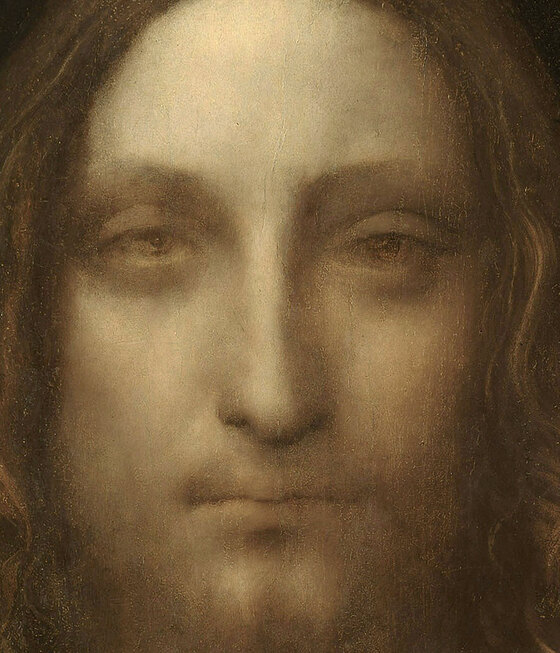
Look at the eyes and the mouth. The edges are softened into shadow with the same smoke technique as the Mona Lisa, and the whole upper face has the same stillness. Then look at the rest. The face has suffered: the panel split down the middle, was planed, repainted, cleaned, and repainted again over four hundred years, and what you see in the area of the face is partly Leonardo, partly the ruin of Leonardo, and partly the restorer.
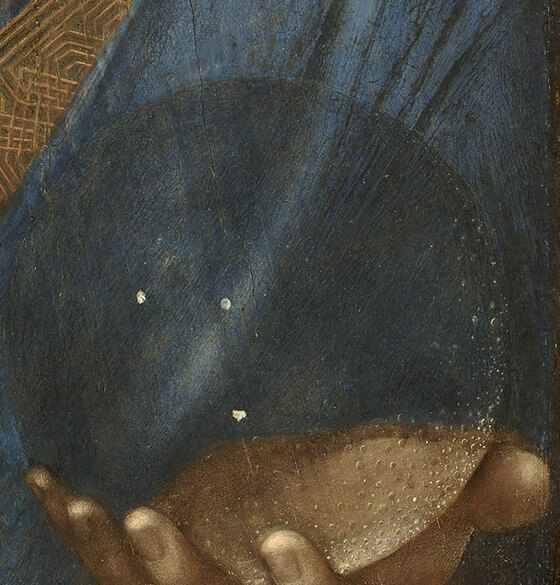
The orb is the detail everyone argues about. A solid sphere of glass or crystal inverts and magnifies whatever is behind it; hold one up to your hand and your palm turns upside down. Leonardo knew that. He studied optics obsessively and drew the way light bends through water and glass. And yet the robe seen through this orb is not inverted or magnified. It is simply there, slightly softened, as if the sphere were a soap bubble.
Three explanations have been offered. That the painter was not Leonardo. That Leonardo chose not to paint the distortion because it would have made Christ's hand look grotesque, and a saviour's world should not distort him. Or that the orb is hollow, a glass shell, which would behave much as painted. The three bright points inside it, painted as inclusions in rock crystal, argue for a solid sphere and against the third theory. The debate has not ended and probably cannot.
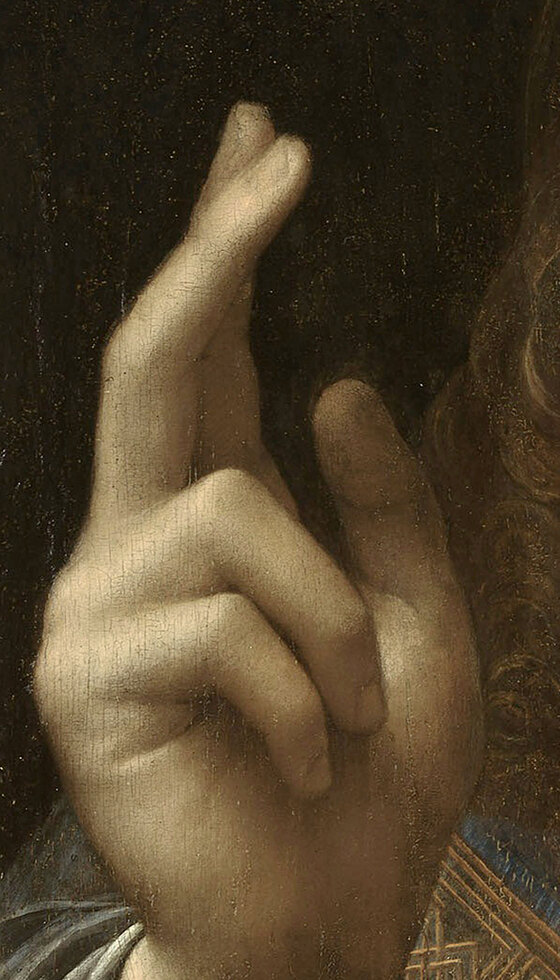
The right hand, raised in blessing, is the best-preserved part of the painting and the strongest evidence for Leonardo. It is drawn with complete command, the fingers rounded, the light on the knuckles exact. Under infrared, the thumb shows a first position, later changed: a pentimento, the kind of correction a painter makes and a copyist does not. Two drapery studies for the sleeve, in red chalk, are at Windsor Castle and are Leonardo's beyond doubt. Whatever else is true of the picture, the hand and the sleeve came from his studio and his mind.
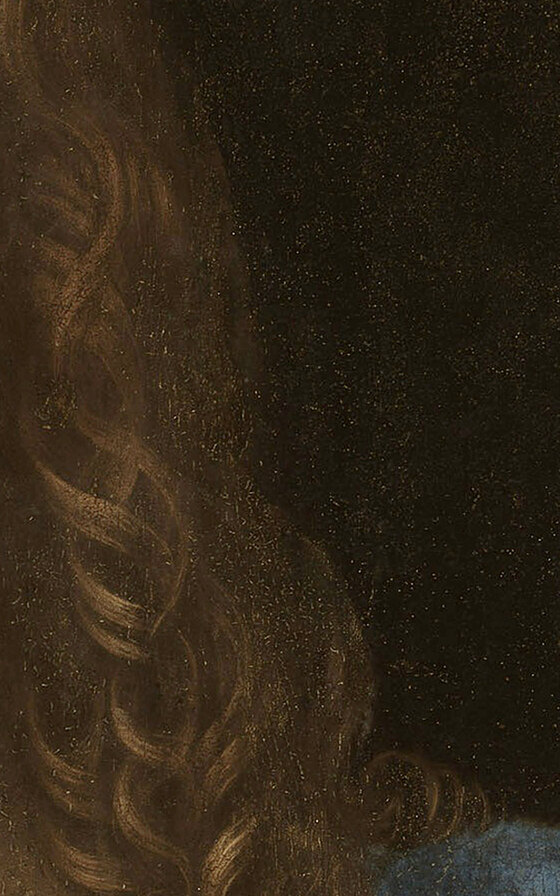
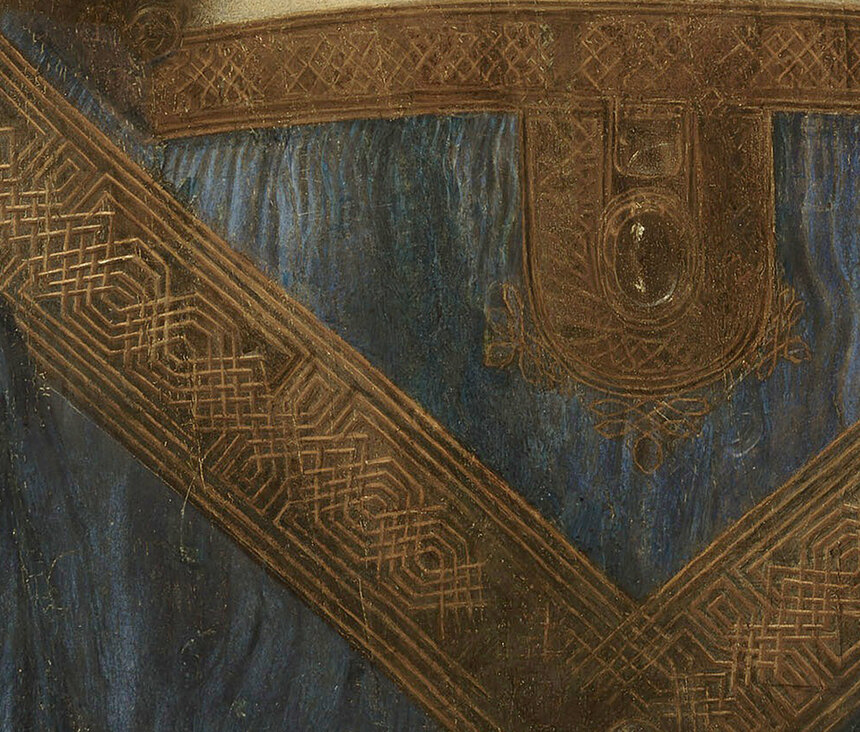
The curls, too, are Leonardo's kind of curl: the spiralling ringlets he drew when he studied eddies in water, turning the same way and catching the light on the same side. The embroidered bands crossing the chest are painted with a jeweller's care.
Here is the honest answer: the best scholars disagree, and they disagree in public.
In 2011 the National Gallery in London showed the painting in its exhibition of Leonardo's Milan years as a work by Leonardo, after several experts had examined it in the studio and, according to the gallery, agreed. That exhibition is what turned a forty-five-pound follower into a Leonardo. Martin Kemp, the leading Leonardo scholar of his generation, has defended the attribution since. Dianne Modestini, who spent six years restoring it, is certain.
Others are not. Frank Zöllner, author of the standard catalogue of Leonardo's paintings, thinks it is largely by a pupil, perhaps finished by the master. Carmen Bambach of the Metropolitan Museum attributes most of it to Boltraffio, with touches by Leonardo. Several argue that the painting is so damaged and so restored that the question cannot be settled from what survives. In 2019 the Louvre, preparing its great Leonardo exhibition, examined the panel and, by most accounts, was ready to show it as a Leonardo; the owners did not lend it, and the entry in the catalogue was never published.
A fair summary is this. The composition is Leonardo's. The hand and the drapery are from his studio and probably his hand. The face is a Leonardo face, badly worn. How much of the paint that is left was applied by the man himself is a question that four hundred and fifty million dollars did not answer.
The modern story starts in 2005, when two New York dealers, Robert Simon and Alexander Parish, bought a badly overpainted panel at an estate sale in Louisiana. It had been in the collection of an English baronet, Sir Francis Cook, since 1900, catalogued as a follower's work, and sold from it in 1958 for the forty-five pounds. Simon and Parish paid a little over a thousand dollars and took it to Modestini, who removed the overpaint, found the split and the losses, and found what she believed was Leonardo underneath.
After the London exhibition the painting sold in 2013 to a Swiss dealer, Yves Bouvier, for about eighty million dollars, and within days to a Russian collector, Dmitry Rybolovlev, for a hundred and twenty-seven million. Rybolovlev discovered the difference and sued Bouvier across three continents. In 2017 he put it into Christie's, which marketed it as the last Leonardo in private hands, showed it in Hong Kong, London and San Francisco, and sold it in nineteen minutes to a Saudi prince bidding, it later emerged, on behalf of Crown Prince Mohammed bin Salman.
The Louvre Abu Dhabi announced that it would go on display in September 2018. The unveiling was cancelled without explanation. It was not lent to the Louvre in 2019. Reports since have placed it on the crown prince's yacht, in storage in Switzerland, and in a planned museum in Riyadh. None has been confirmed. The most expensive painting in the world has not been seen by the public since the night it was sold.
As a picture it means what every Salvator Mundi meant: Christ as the ruler and protector of the world, holding it in his hand, blessing whoever kneels in front of him. It was painted for a private chapel or a bedroom, to be prayed to, at a size you could hold.
As an object it has come to mean something Leonardo could not have imagined: what a name is worth. The paint did not change between 1958 and 2017. The word Leonardo was added, and the price went from forty-five pounds to four hundred and fifty million dollars. That is a fact about the art market, not about the painting, but the painting now carries it, and it will carry it wherever it is.
And it means, for anyone who has looked at it, the strange experience of a face that stares back from a wreck. The Mona Lisa's stillness is intact. This one's has survived a split panel, five restorations and four centuries of neglect, and it is still there. If that is Leonardo's doing, it is one of the great survivals. If it is a pupil's, the pupil learned everything.
Nobody outside its owner's circle knows. It was last seen in public at Christie's, New York, in November 2017. It is oil on walnut panel, 65.6 by 45.4 centimetres, a little smaller than the Mona Lisa, and if it is ever shown again it will probably be in Saudi Arabia.
That makes it the one Leonardo you cannot go and see, and the one for which a reproduction is not a substitute for a visit but the only option. Our hand-painted reproduction of Salvator Mundi is painted in oil on canvas from the photographs made after the 2011 restoration, the state in which the world saw it. It is a devotional picture and hangs well where those hang: a bedroom, a study, a quiet wall, in a dark frame, at eye level, so that the blessing is aimed at you.
The rest of Leonardo in our guide to Leonardo da Vinci and our Leonardo collection.
Enjoyed this story?
Save articles to your collection
Log in or create a free account, and this article will be waiting in your Private Collection.
Log in or sign upVisible details, documented facts and interpretation are kept separate throughout this article. The attribution is presented as the open question it is, and the painting's current location as unknown.