Loading cart…
No products in the cart.

Original price was: $518.00.$259.00Current price is: $259.00.
A hand-painted Vitruvian Man reproduction by Leonardo da Vinci, painted in oil to preserve the geometry and warm pen-and-ink tone of the original study.
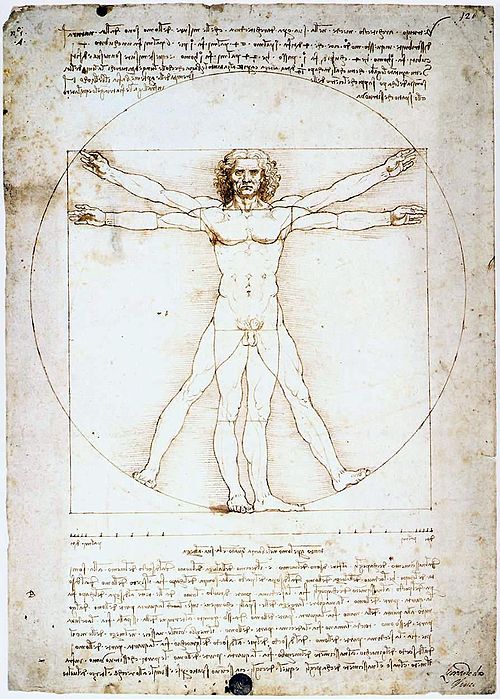
Around 1490, working in Milan in the years he spent at the court of Ludovico Sforza, Leonardo da Vinci turned to a page of paper to test an old architectural idea against the human body. This Vitruvian Man reproduction brings that page into oil, keeping the pen lines, the faint construction marks, and the warm aged tone of the original sheet. A museum quality reproduction of a study this precise has to hold its geometry as carefully as its colour.
The drawing shows a single male figure in two overlaid positions, arms and legs spread to touch the edge of a circle, then drawn again with arms out and feet together to meet the corners of a square. Leonardo based the exercise on a passage by the Roman architect Vitruvius, who argued that the proportions of a well-built man could generate the proportions of a temple. The figure carries faint ruled lines across the chest, the groin, the knees, marking the measurements Leonardo checked one against another. Mirror-script notes run along the top and bottom margins, dense and unbroken, the hand of a man thinking on paper rather than presenting a finished statement.
What survives on the page is closer to a working diagram than a portrait, and that is part of what makes it hold attention: the pale ink, the slight buckle of old paper, the compass marks left half visible near the circle. Leonardo was around forty when he drew this, deep in the anatomical and architectural studies that fed his later painting, and the sheet reads as a private note to himself rather than a commission for anyone else. The tone throughout is closer to sepia than black, aged by five centuries of handling and light.
Painting this study in oil is a different exercise from printing it. A trained artist working for ByMuseum builds up the warm ground tone in thin layers, then lays the ruled lines and the mirror-script notes by hand, brush by brush, so the surface carries real paint rather than a flat reproduction of ink on paper. The circle and the square are drawn freehand onto canvas rather than mechanically reproduced, which means each oil painting reproduction carries small variations of the kind the original itself shows under close inspection. Hung on a wall, it keeps the tactile quality of a hand-painted object: raised paint at the ruled lines, brush texture across the aged ground, none of the flatness of a printed sheet.
Living with it rewards slow looking. The two overlaid postures separate and rejoin depending on where the eye rests, the faint proportion lines emerge only after repeated viewing, and the notes along the margins keep their density without resolving into anything legible, which is exactly how the page has always worked.
| artists |
|---|
Empty walls flatten a room. A classical artwork restores structure and visual hierarchy. One painting defines the space, anchors furniture, and establishes identity.
Worldwide shipping included. Each painting is produced to order and safely packed for international transport.
All payments are encrypted and processed through trusted payment providers.
Real brushwork, layered oil paint, and durable pigments on museum-quality canvas.
If the result does not meet expectations, return it for a full refund.


Your artwork is painted on premium cotton canvas, then shipped safely rolled in a rigid tube with extra blank canvas border — ready for stretching or framing locally.
Select a handcrafted frame and we’ll deliver your painting fully assembled, protected, and ready to hang.
For safe shipping, framing is available up to a maximum size. Larger sizes will automatically disable the frame option.


Choose “Stretched” to receive your canvas mounted on wooden stretcher bars — perfect if you’ll frame it later or display it as-is.
Gallery Wrap is a deeper, 1.5" style stretcher. The canvas wraps around the sides and is stapled on the back for a clean, modern, frameless look.
We ship with UPS, FedEx, or DHL straight to your door. You’ll receive a tracking number as soon as your order leaves our studio. Typical delivery is 4–5 business days after dispatch; large, framed, or stretched pieces may take longer depending on the safest shipping route.


Unframed canvases are protected with a film, carefully rolled, and secured inside a rigid shipping tube.

Stretched, Gallery Wrapped, and Framed paintings are wrapped, cushioned with foam protection, and boxed for safe transit.


Reviews
There are no reviews yet.