Loading cart…
No products in the cart.

c. 1490 · Pen and ink on paper · Gallerie dell Accademia, Venice, Italy
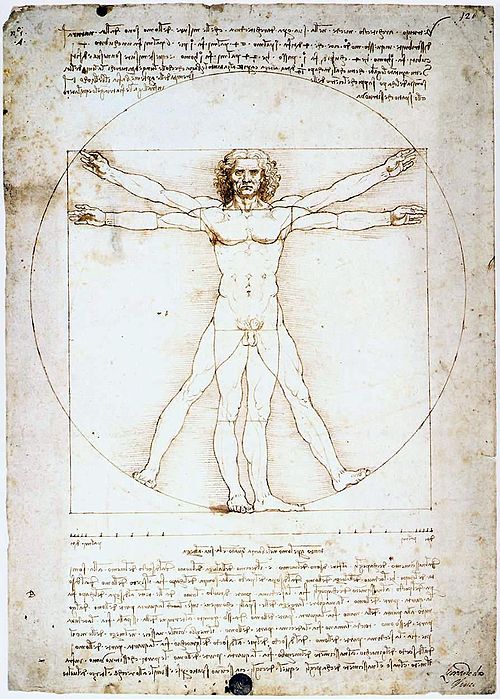
Created around 1490 in Milan, the Vitruvian Man emerged from Leonardo da Vinci's sustained investigation into the relationship between human anatomy and classical architectural theory. The drawing takes its name from Marcus Vitruvius Pollio, a Roman architect and engineer whose first-century treatise De Architectura proposed that ideal human proportions could serve as a foundation for architectural design. Leonardo encountered these ideas through his study of Vitruvius and set out to visualize them with a precision that no previous artist had achieved. The work was produced during a period when Leonardo was deeply engaged with both scientific inquiry and artistic practice, treating each discipline as inseparable from the other. The drawing has remained in Italy since its creation and is now housed at the Gallerie dell Accademia in Venice, where it is preserved under strict conservation conditions due to its fragile paper support. Because of its extreme sensitivity to light, it is rarely placed on public display, making exhibitions of the original a notable event. The work passed through several collections before entering the Accademia and is accompanied by Leonardo's handwritten notes describing his measurements and observations. These annotations reveal the methodical nature of his approach, recording specific ratios between body parts with the care of a natural philosopher rather than simply an artist seeking a pleasing composition.
The composition of the Vitruvian Man is structured around the superimposition of two geometric forms, a circle and a square, upon a single male figure depicted in two overlapping positions. The figure stands with arms and legs extended in two distinct arrangements simultaneously, one fitting within the circle with navel as center, and another fitting within the square with groin as center. This dual configuration solved a problem that earlier Renaissance artists had struggled with, namely how to reconcile two different ancient interpretations of human proportion without contradiction. Leonardo resolved this by showing both positions at once, allowing the figure to inhabit both geometries through careful adjustment of the center points. The draftsmanship throughout the drawing demonstrates an exceptionally controlled line quality, with the figure rendered in fine pen strokes that describe musculature, facial features, and hairline with equal attention. The geometric overlay is drawn with compass and ruler precision, contrasting with the organic forms of the body it circumscribes. Leonardo's accompanying text runs along the top and bottom of the sheet in his characteristic mirror script, which he wrote from right to left. The integration of text and image treats the sheet as a unified document of investigation rather than a purely aesthetic object, reinforcing the idea that for Leonardo, drawing was a mode of thinking as much as a mode of representation.
The Vitruvian Man carries layered significance as both a scientific document and a philosophical statement about the place of humanity within the natural order. By demonstrating that the human body fits within the two most fundamental geometric forms, the circle and the square, Leonardo articulated a Renaissance conviction that the cosmos operates according to rational principles accessible through observation and measurement. The human figure was understood not merely as a subject of artistic representation but as a microcosm reflecting the structure of the universe itself. This belief, rooted in Neoplatonic philosophy and classical science, gave the image a meaning that extended far beyond its immediate technical purpose. For Leonardo personally, the drawing represented a convergence of his deepest intellectual commitments. His notebooks from this period are filled with anatomical studies, mechanical diagrams, and observations of natural phenomena, all conducted with the conviction that underlying laws govern visible reality. The Vitruvian Man gave visual form to that conviction in a single, compact image. In the centuries since its creation, the drawing has become widely recognized as a symbol of the Renaissance ideal of combining artistic skill with scientific inquiry, and it continues to appear in cultural contexts ranging from medical institutions to educational materials, attesting to the enduring resonance of its central argument about the measurable harmony of the human form.