Loading cart…
No products in the cart.

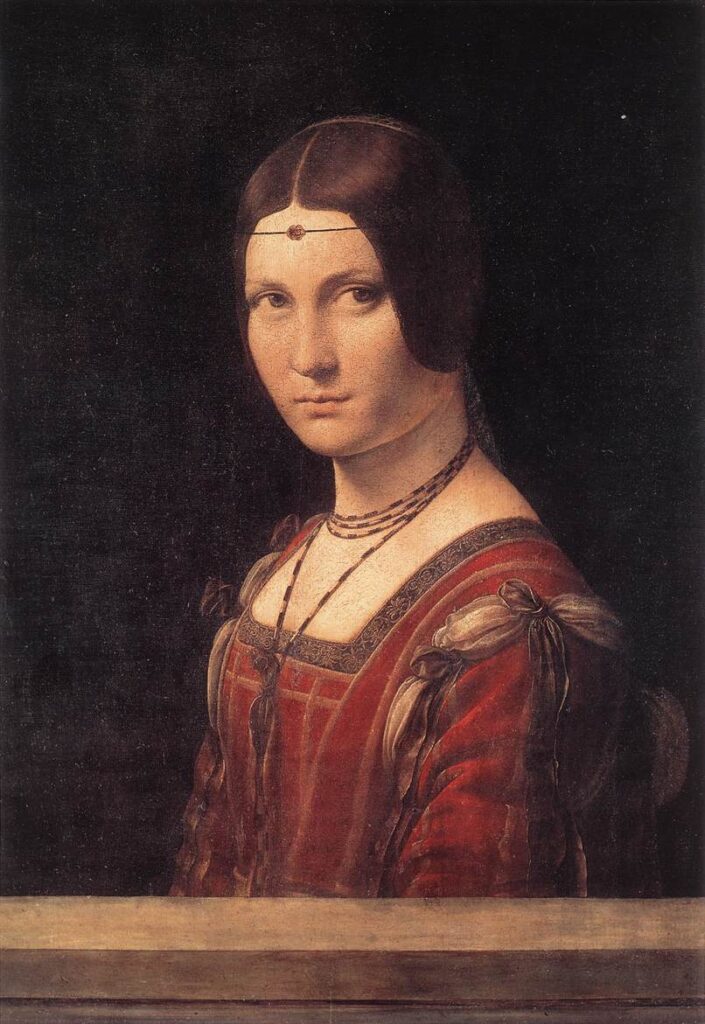
c. 1490-1497 · Oil on wood panel · Louvre Museum, Paris, France
Save articles to your collection
Log in or create a free account, and this article will be waiting in your Private Collection.
Log in or sign upLa Belle Ferronniere was painted during Leonardo da Vinci residence in Milan, where he served as court painter and engineer to Ludovico Sforza. The title of the painting is a later designation and is not connected to any historical record from Leonardo lifetime. The nickname, which translates roughly as the beautiful wife of the ironmonger, was applied based on a misidentification of the sitter and has no reliable foundation in documentary evidence. Various identities have been proposed for the subject over the years, including Cecilia Gallerani, who is more confidently identified as the subject of Lady with an Ermine, as well as Lucrezia Crivelli, who was known to be a mistress of Ludovico Sforza in the 1490s. A poem written by the court poet Bernardo Bellincioni praising a portrait of Lucrezia has led some scholars to connect her to this painting. The painting entered the French royal collection at an early date, possibly brought to France by Leonardo himself when he relocated there in 1516 at the invitation of King Francis I. It has been part of the Louvre collection for centuries and is displayed near other works by Leonardo in the museum Italian paintings galleries. The attribution to Leonardo has been broadly accepted by the scholarly community, though as with many works from his Milanese period, the possibility of workshop participation in certain areas of the painting is not entirely ruled out. Technical examination has confirmed the use of oil paint over a prepared ground and has revealed underdrawings consistent with Leonardo working method.
La Belle Ferronniere shares several compositional features with Leonardo other female portraits from his Milanese period, most notably the placement of the figure behind a low stone parapet that separates the sitter from the viewer while simultaneously creating a sense of staged presentation. The sitter is shown in a three-quarter view with her body slightly turned away from the picture plane while her gaze shifts in the opposite direction, creating a dynamic tension between her physical orientation and the direction of her attention. This device gives the portrait a sense of interrupted movement, as if the viewer has caught the sitter in the process of turning to look at something just outside the frame. The rendering of the face is accomplished with the smooth, luminous quality characteristic of Leonardo oil painting technique. The skin tones are built up in very thin, transparent layers that create a sense of internal light, with delicate modeling around the eyes, nose, and mouth that gives the face sculptural presence without harsh outlines. The ferroniere, or jeweled headband worn across the forehead, provides a strong horizontal accent that frames the face and draws attention to the eyes. The costume is painted with careful attention to the fall of fabric and the decorative details of the neckline, demonstrating Leonardo skill in rendering different materials and textures within a single composition.
The identity of the sitter, while unconfirmed, is closely tied to the meaning and function of this portrait within its original context. Portraits of this type at the Sforza court served multiple purposes simultaneously, functioning as records of personal appearance, as tokens of affection and possession, and as statements of the patron aesthetic taste and social connections. If the sitter is indeed Lucrezia Crivelli, as some scholars believe, the portrait would have served as a memorialization of a significant personal and political relationship between the woman and the duke. The care with which Leonardo has rendered her features and clothing reflects the value placed on the subject and the importance of the commission. The indirect gaze of the sitter carries a particular psychological significance within the tradition of Renaissance portraiture. Unlike the direct, confrontational gaze of many male portraits, the glance directed to the side creates an air of mystery and unavailability. The viewer is presented with a face of great beauty and apparent intelligence but is denied direct eye contact, which in the conventions of Renaissance social interaction was a charged form of communication. This combination of visual accessibility and psychological distance invites continued looking and reflection, drawing the viewer into an ongoing attempt to read the thoughts and emotions behind the carefully composed exterior. The painting thus functions not simply as a record of a specific individual but as a meditation on the complexity of human personality and the limits of visual knowledge.
Enjoyed this story?
Save articles to your collection
Log in or create a free account, and this article will be waiting in your Private Collection.
Log in or sign up