Loading cart…
No products in the cart.

Original price was: $518.00.$259.00Current price is: $259.00.
A crowded arrest scene lit by a single lantern: this hand-painted oil on canvas reproduction of The Taking of Christ by Caravaggio brings the tenebrism of the original into real brushwork and texture.
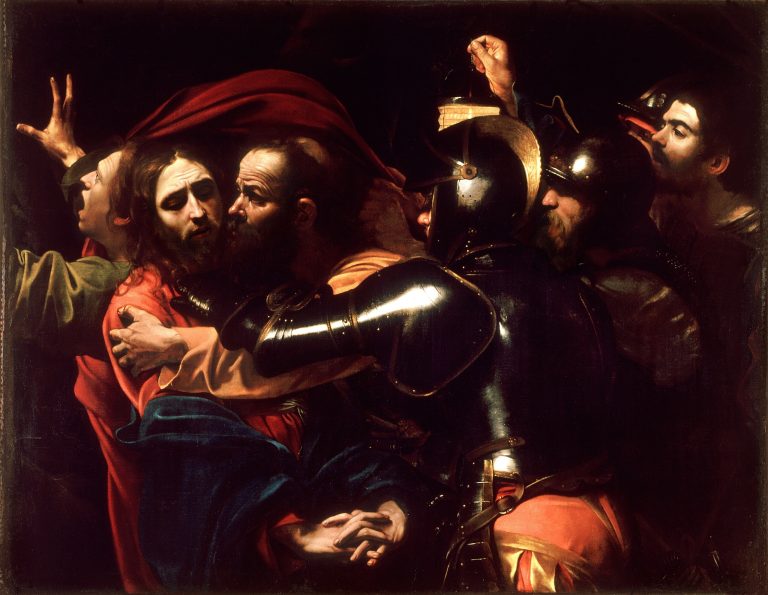
A kiss, a crowd of armored hands, and one man fleeing into the dark: this is the instant Caravaggio chose for The Taking of Christ, the moment Judas identifies his teacher to the soldiers sent to seize him. The scene held the attention of the artist because it compresses betrayal, violence, and panic into a single breath, seven figures pressed into a shallow space with nowhere to retreat.
Judas leans in close, his hand closing on the shoulder of Christ, while armored arms reach across the canvas from the right, metal catching what little light there is. John bolts at the far left, his cloak torn upward into blackness, his mouth open in a cry that gets no answer. A lantern held at the edge of the scene throws its narrow beam across the crowded figures, and Caravaggio builds the whole composition from that single source, letting faces and breastplates flare out of the dark while everything else drops away. This is tenebrism pushed as far as it will go, the figures stacked so tightly that the picture reads less like a landscape event and more like something glimpsed through a half-open door.
Painted in 1602 for the Roman nobleman Ciriaco Mattei, the canvas belongs to the years when Caravaggio was working out how far naturalism and darkness could carry a sacred subject, and the result is one of his most physically direct narrative paintings. The original vanished from record for close to two centuries before resurfacing in a Jesuit house in Dublin in 1990, and it now hangs on long-term loan at the National Gallery of Ireland, a history that only adds weight to a composition already built around disappearance and discovery.
ByMuseum artists work from the original palette and composition to produce this oil painting reproduction entirely by hand, layer by layer in oil on canvas rather than printed. A trained painter builds up the armored textures, the lantern glow, and the void of black behind the figures with real brushwork, so the surface carries ridges and layered colour the way the original does, and the result functions as an oil on canvas reproduction a collector can examine up close rather than a flat image on paper. What keeps people looking at this scene centuries later is the same thing that will hold a wall in a home: the crush of bodies, the single cone of lantern light, and a face at the center trying to stay calm inside a moment that is already out of his control.
| artists |
|---|
Empty walls flatten a room. A classical artwork restores structure and visual hierarchy. One painting defines the space, anchors furniture, and establishes identity.
Worldwide shipping included. Each painting is produced to order and safely packed for international transport.
All payments are encrypted and processed through trusted payment providers.
Real brushwork, layered oil paint, and durable pigments on museum-quality canvas.
If the result does not meet expectations, return it for a full refund.


Your artwork is painted on premium cotton canvas, then shipped safely rolled in a rigid tube with extra blank canvas border — ready for stretching or framing locally.
Select a handcrafted frame and we’ll deliver your painting fully assembled, protected, and ready to hang.
For safe shipping, framing is available up to a maximum size. Larger sizes will automatically disable the frame option.


Choose “Stretched” to receive your canvas mounted on wooden stretcher bars — perfect if you’ll frame it later or display it as-is.
Gallery Wrap is a deeper, 1.5" style stretcher. The canvas wraps around the sides and is stapled on the back for a clean, modern, frameless look.
We ship with UPS, FedEx, or DHL straight to your door. You’ll receive a tracking number as soon as your order leaves our studio. Typical delivery is 5 to 7 days after dispatch; large, framed, or stretched pieces may take longer depending on the safest shipping route.


Unframed canvases are protected with a film, carefully rolled, and secured inside a rigid shipping tube.

Stretched, Gallery Wrapped, and Framed paintings are wrapped, cushioned with foam protection, and boxed for safe transit.

Reviews
There are no reviews yet.