Loading cart…
No products in the cart.

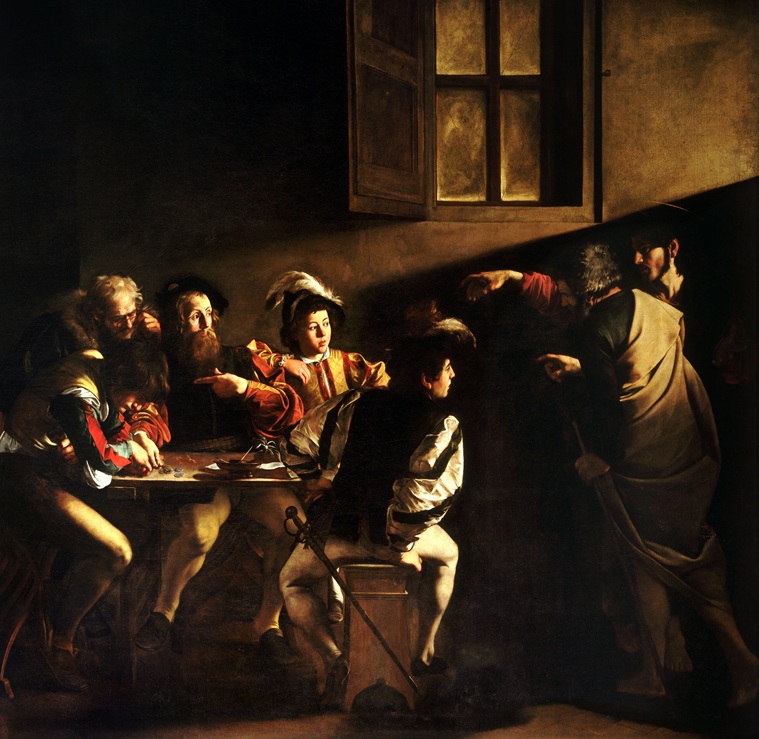
1599-1600 · Oil on canvas · Contarelli Chapel, San Luigi dei Francesi, Rome, Italy
Save articles to your collection
Log in or create a free account, and this article will be waiting in your Private Collection.
Log in or sign upThe Calling of Saint Matthew was commissioned by Cardinal Francesco Maria Del Monte for the Contarelli Chapel in the church of San Luigi dei Francesi in Rome. The commission, received around 1599, was one of the first major public commissions Caravaggio received, and it marked a turning point in his career. The painting was completed alongside its pendant, The Martyrdom of Saint Matthew, and both were installed in the chapel by 1600. The Contarelli Chapel commission came about after the death of the French cardinal Matthieu Cointrel, who had left instructions and funds for the decoration of his family chapel. Cardinal Del Monte, a powerful patron who had housed Caravaggio in his palazzo, used his influence to secure the commission for the young painter. The work caused considerable discussion among contemporaries because of its radical approach to a sacred subject, placing biblical figures in what appeared to be a contemporary Roman tavern rather than a timeless religious setting. Despite the unconventional treatment, the painting remained in place and became widely admired.
The composition is structured around a ray of light that enters from the right side of the picture plane, cutting diagonally across an otherwise dark and enclosed interior space. Christ and Saint Peter stand at the far right, partially cropped by the picture edge, with Christ extending a hand toward the group of men seated at the table. The gesture of Christ echoes the famous pointing hand from Michelangelo, yet here it is rendered with a naturalistic restraint that grounds it in human experience. Matthew, possibly the bearded man pointing toward himself in disbelief, sits among companions who appear entirely absorbed in the counting of coins. Caravaggio uses chiaroscuro to isolate faces and hands from the surrounding darkness, directing the viewer toward the critical emotional exchange at the heart of the narrative. The tavern setting, the contemporary clothing worn by several figures, and the mundane activity of money counting all reinforce the idea that divine grace interrupts ordinary life without ceremony or spectacle.
The theological meaning of this painting centers on the concept of divine election and the transformative power of a single moment of calling. Matthew was a tax collector, a profession associated with moral compromise and social disdain in first-century Judea. By placing him in a position of worldly occupation at the moment of his calling, Caravaggio emphasizes that redemption is available even to those deeply embedded in secular and morally ambiguous activities. The light in the painting functions as a visual metaphor for divine grace, arriving unsolicited and cutting through the darkness of an ordinary scene. The uncertainty in Matthew pointing at himself also reflects the human response to an unexpected summons, a mixture of disbelief and dawning recognition. For Baroque audiences shaped by the Counter-Reformation, this imagery reinforced the idea that the Church offered salvation to all people regardless of their past, a message with direct relevance to the spiritual anxieties of the era. The painting continues to resonate as a study of the human encounter with the sacred.
Enjoyed this story?
Save articles to your collection
Log in or create a free account, and this article will be waiting in your Private Collection.
Log in or sign up