Loading cart…
No products in the cart.

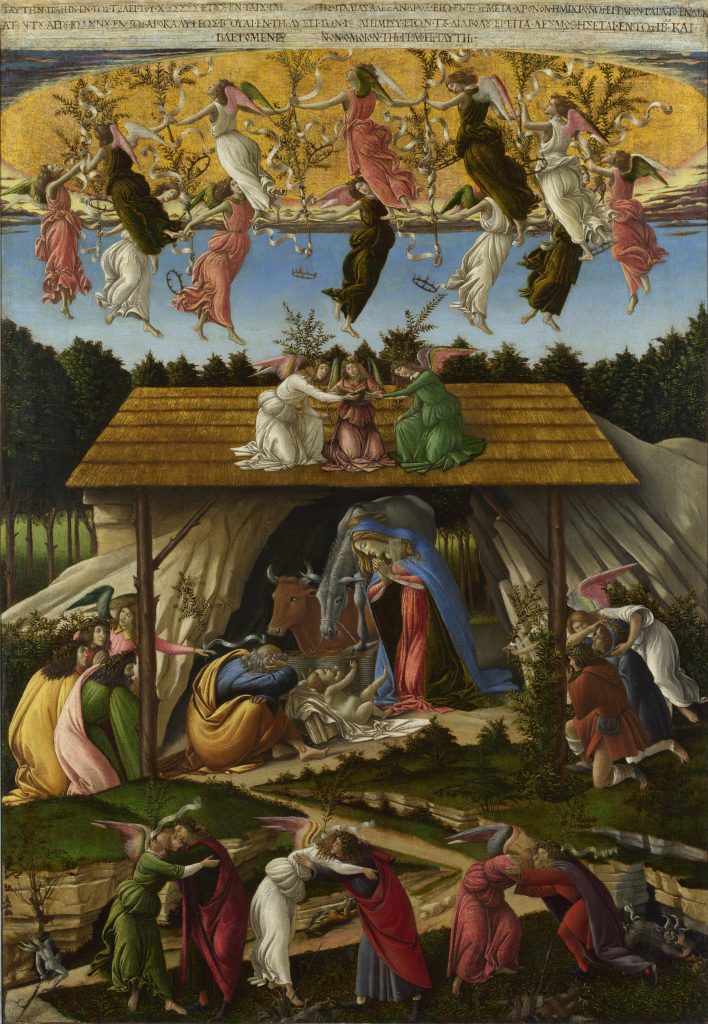
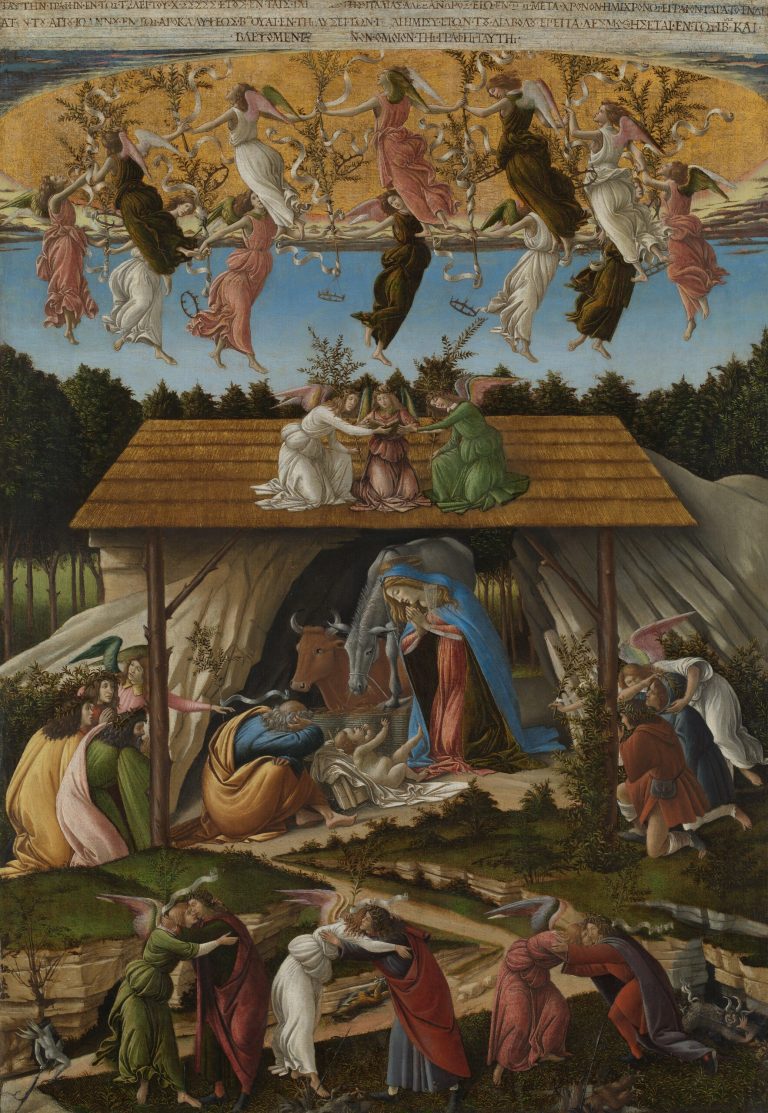
1500 · Oil on canvas · National Gallery, London
Save articles to your collection
Log in or create a free account, and this article will be waiting in your Private Collection.
Log in or sign up Explore the artistSandro Botticelli →
At the foot of Botticelli’s Mystic Nativity, a horned face peers out from a crack in the rock. An angel bends to embrace a man just above it. Neither turns to look at the creature. Farther up the canvas, the infant Christ reaches towards Mary. All three things happen in the same clearing.
Sandro Botticelli painted Mystic Nativity in 1500, the date he wrote in Greek across the top. In this oil painting, now in the National Gallery in London, the birth at Bethlehem opens onto a second story. Heaven and earth draw together, while the creatures at the bottom lose their place in the world.
Under the thatched roof, Mary holds her hands together and bows her head. The infant lifts both arms from his bedding. Behind him the long head of the donkey comes down almost to the level of his raised fingers. The ox turns its face into the light and Joseph huddles at the left, his head low against his arm.
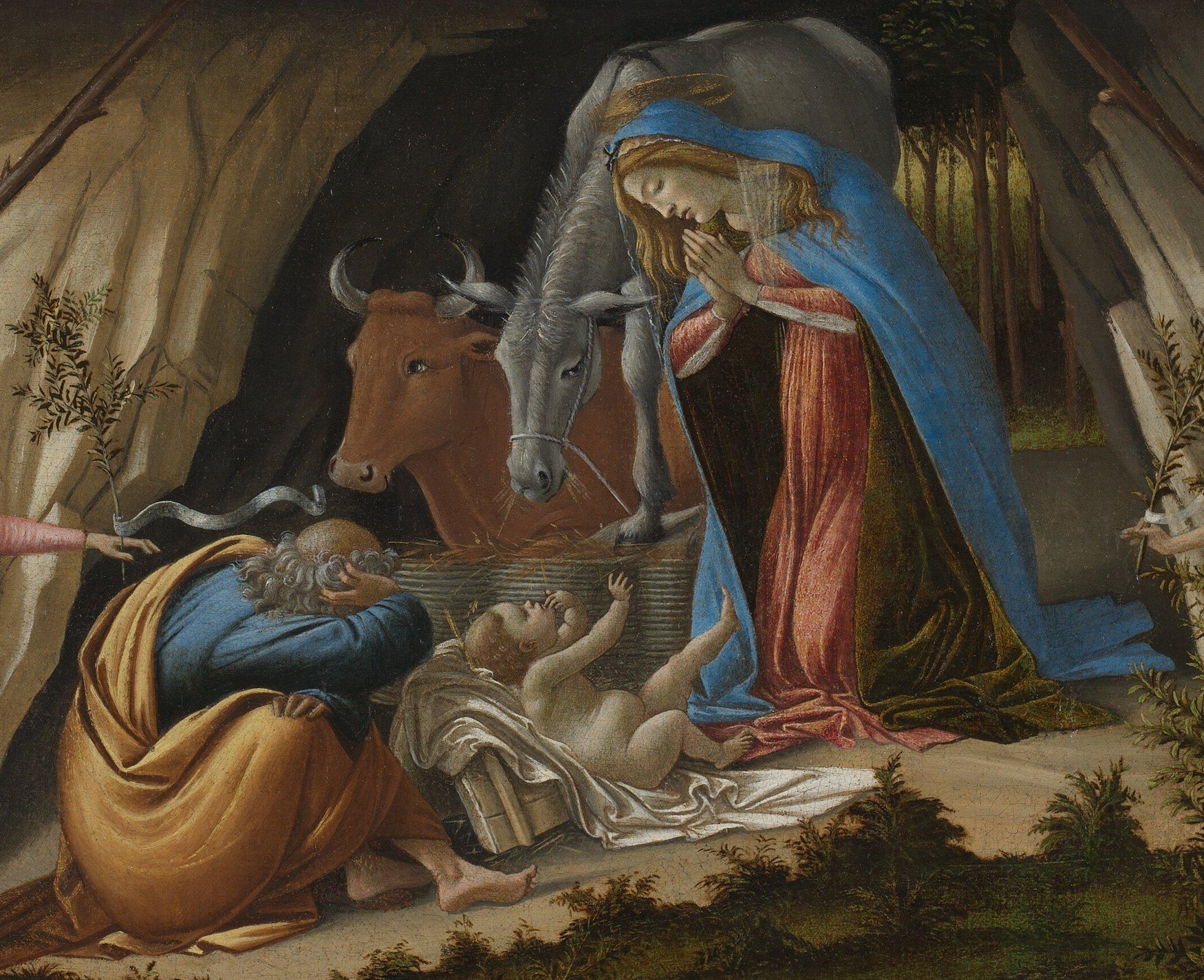
Botticelli makes the shelter from a roof and two posts set against the mouth of a cave. The opening behind Mary lets a little daylight through the trees. Look out to the sides and the painting becomes more crowded. The Magi approach from the left, their rich robes spreading along the ground. The shepherds kneel on the right. An angel bends down among each group and directs its attention towards the child.
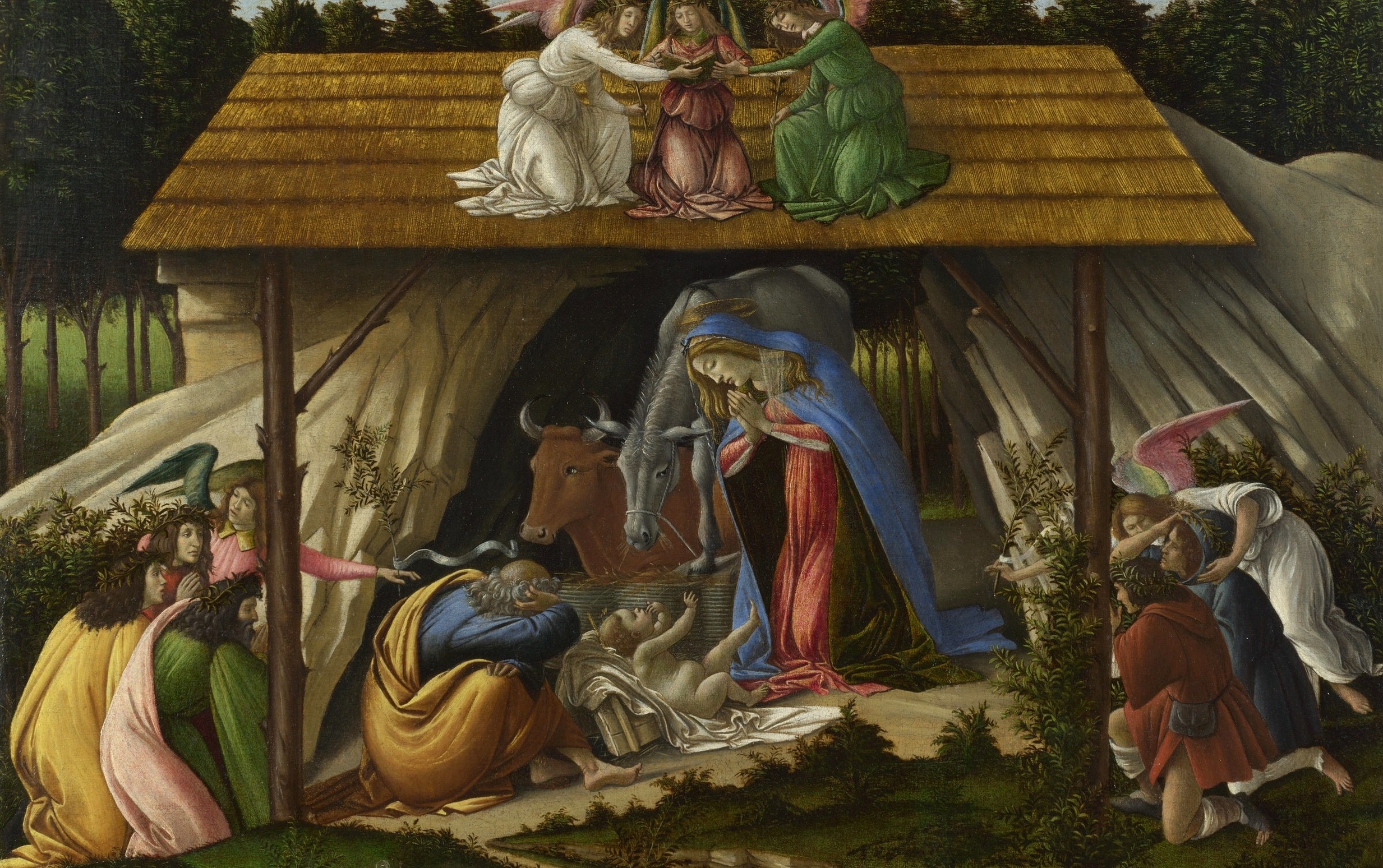
Luke places the shepherds at the manger and Matthew tells of the Magi. Botticelli gives the two groups opposite entrances to the same scene. At its centre, the child has eyes only for his mother.
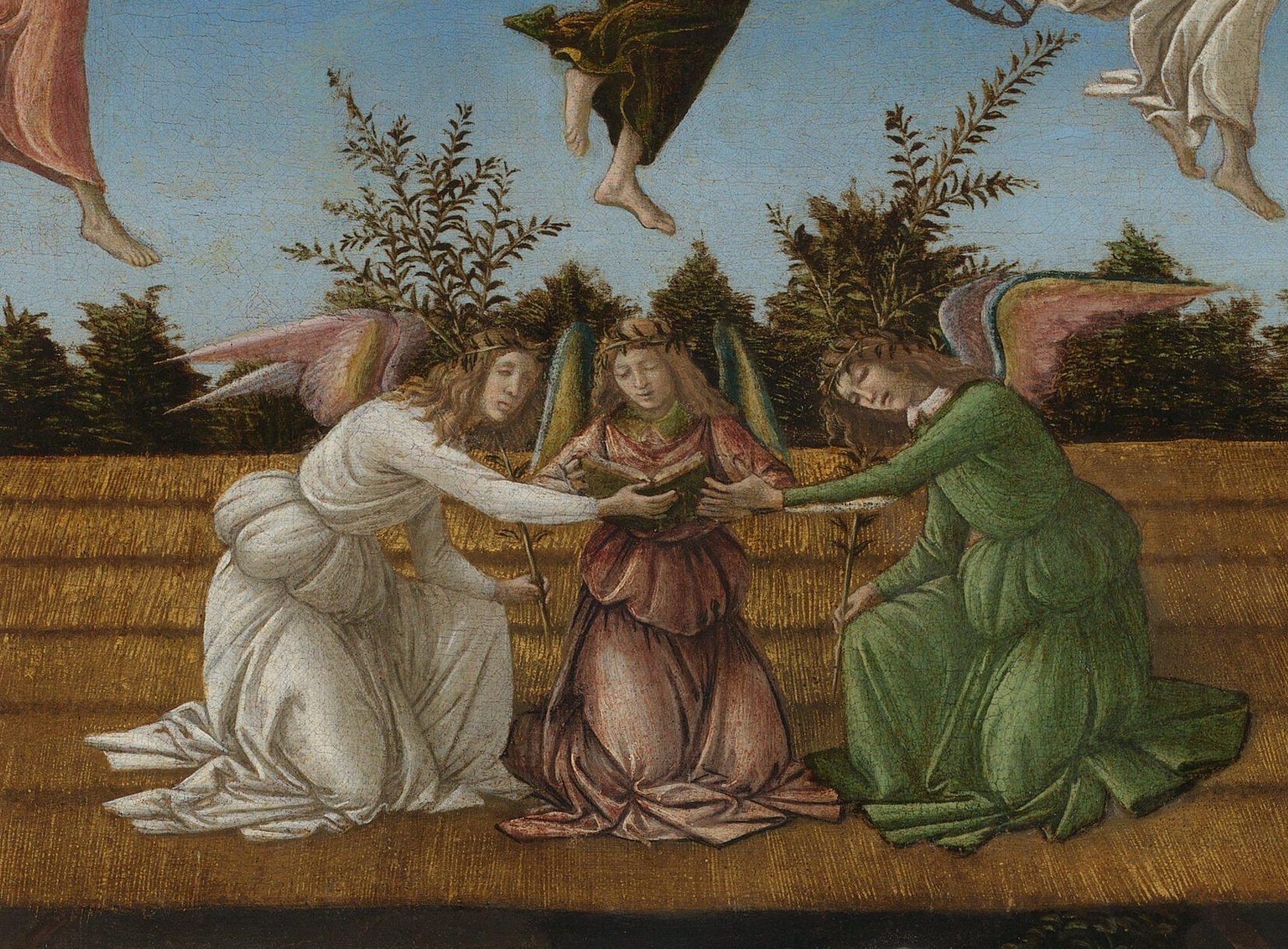
Just above Mary, three angels kneel on the thatch and gather around an open book. The figures in white and green lean in from either side of the angel in rose-red. Their hands converge at the centre. Below them Mary bows in silence. Above them the dance has already begun.
“Glory to God in the highest: and on earth peace to men of good will.”
Luke 2:14, Douay–Rheims translation
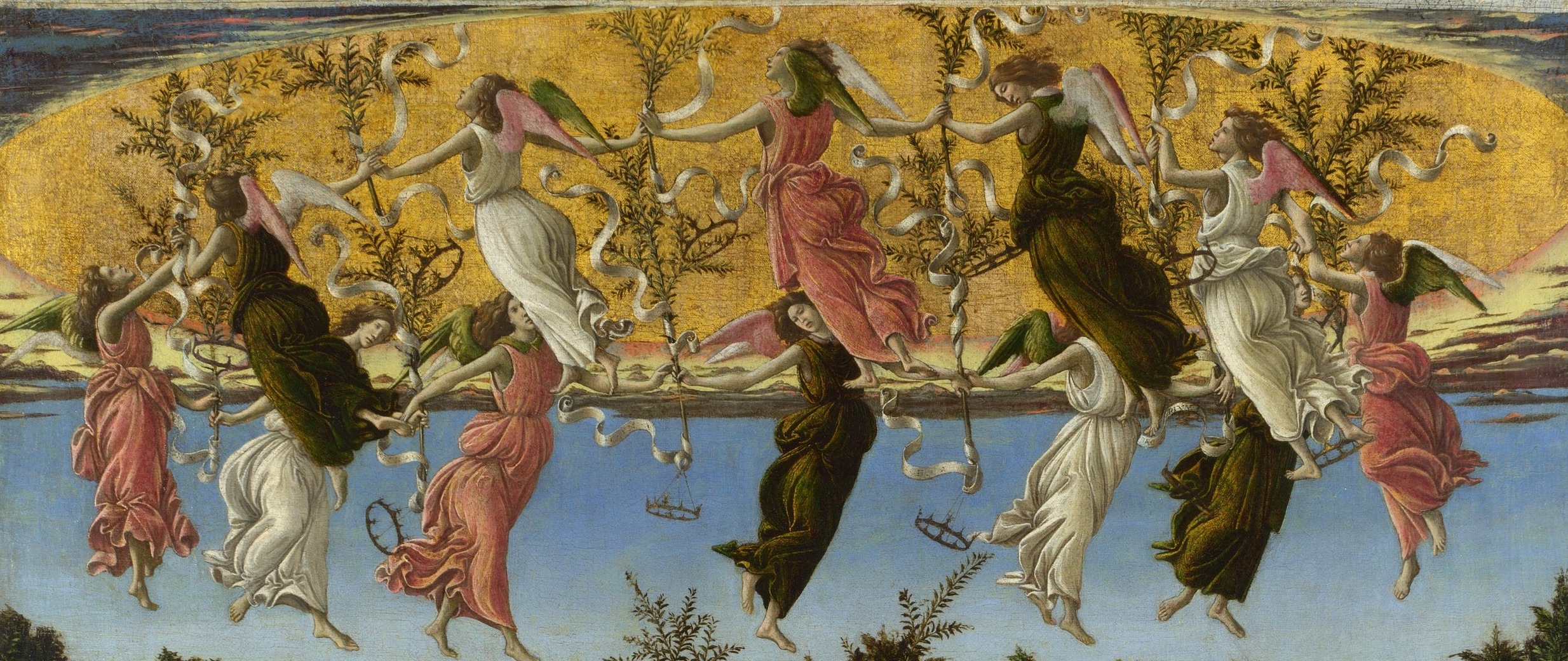
In Luke, the heavenly host praises God with these words after an angel tells the shepherds of the birth. Art historian Rab Hatfield identifies parts of the Latin song among the inscriptions carried by Botticelli’s angels. The words about peace find their answer at the bottom of the painting, where the angels and men reach for one another.
Twelve angels circle beneath the golden opening. Some arc high against the gold while others swing lower against the blue. Cloth trails around their ankles and white ribbons curl between their arms. The little crowns, suspended from olive branches, hang low enough to be seen against the blue sky.
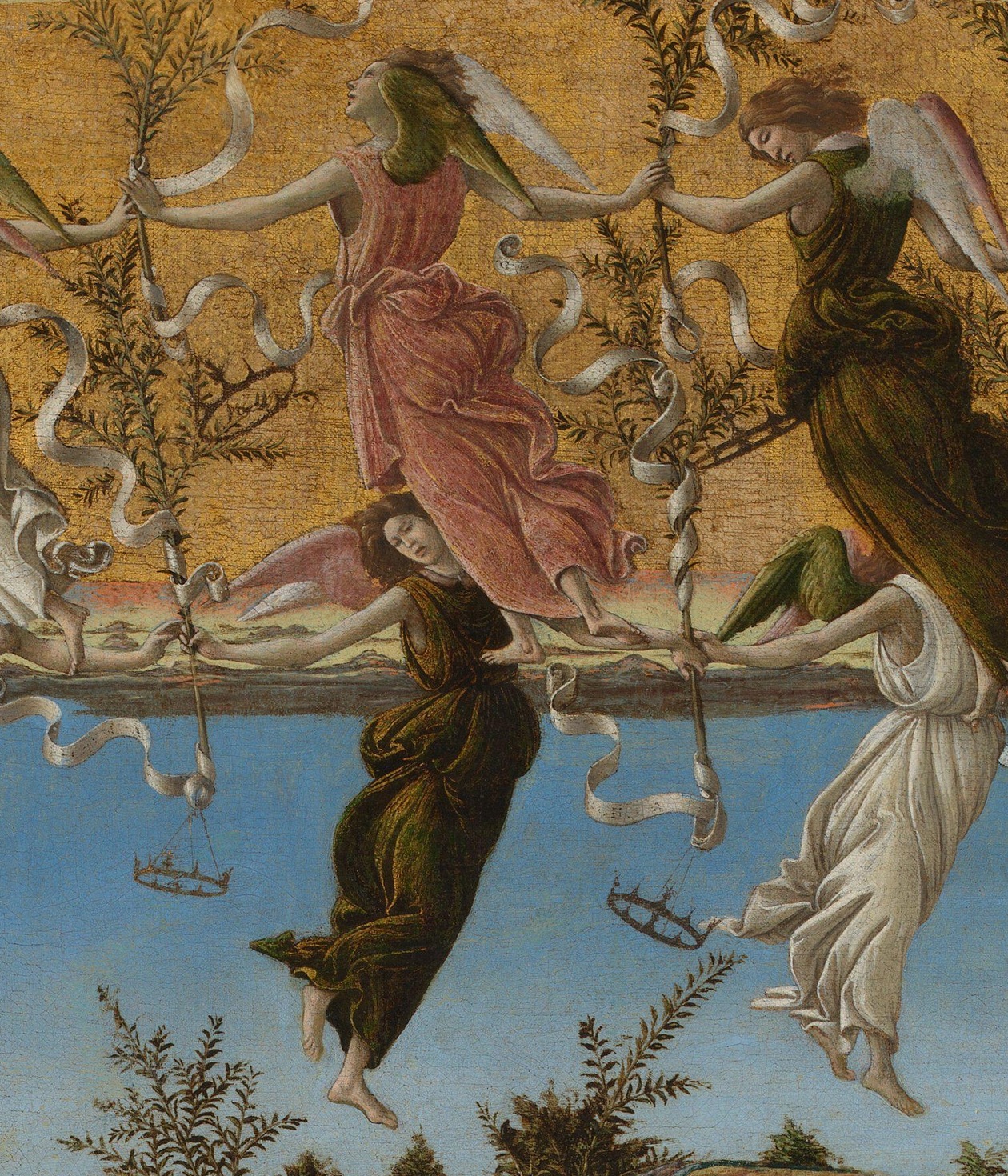
Olive branches signal peace. The ribbons carry another meaning. Hatfield identified seven surviving inscriptions that match invocations to Mary in Savonarola’s Compendium of Revelations. The friar imagined these prayers as part of a crown offered to the Virgin. In Hatfield’s reading, the angels carry the prayers upwards. The small painted crowns make a form of devotion visible.

Botticelli starts with the date and gives his name as Alessandro. A phrase in that opening connects the painting to the years Florence had just lived through.
“This picture, at the end of the year 1500, in the troubles of Italy, I, Alessandro, painted…”
Botticelli’s inscription, opening excerpt from Rab Hatfield’s English translation
The inscription goes on to invoke Revelation 11 and 12 and speaks of the devil being loosed for three and a half years before being chained. Its references bring together different parts of the book. Chapter 11 gives a period of upheaval and two witnesses. Chapter 12 describes a woman, her child and a dragon cast down from heaven. The binding of Satan is described explicitly in chapter 20.
The National Gallery connects the troubles with the French campaigns in Italy and conflict in Florence. The Medici were driven out of the city in 1494. The Dominican preacher Girolamo Savonarola read the upheaval as divine judgement and was executed in 1498. Vasari later described Botticelli as a follower of the friar. The parallels in the painting are close, especially in the angelic ribbons and embraces. The Greek inscription also gives us Botticelli’s own reading of the times, in words he chose to put above the scene.
Three pairs meet at the front of the clearing. At the left a green-robed angel reaches up to a man in red. At the right both figures bend towards the kiss. In the middle, the man in the red mantle presses his cheek against a white-robed angel, whose hand extends across his shoulder. The people wear olive wreaths, bringing the same narrow leaves that the angels carry down to earth.
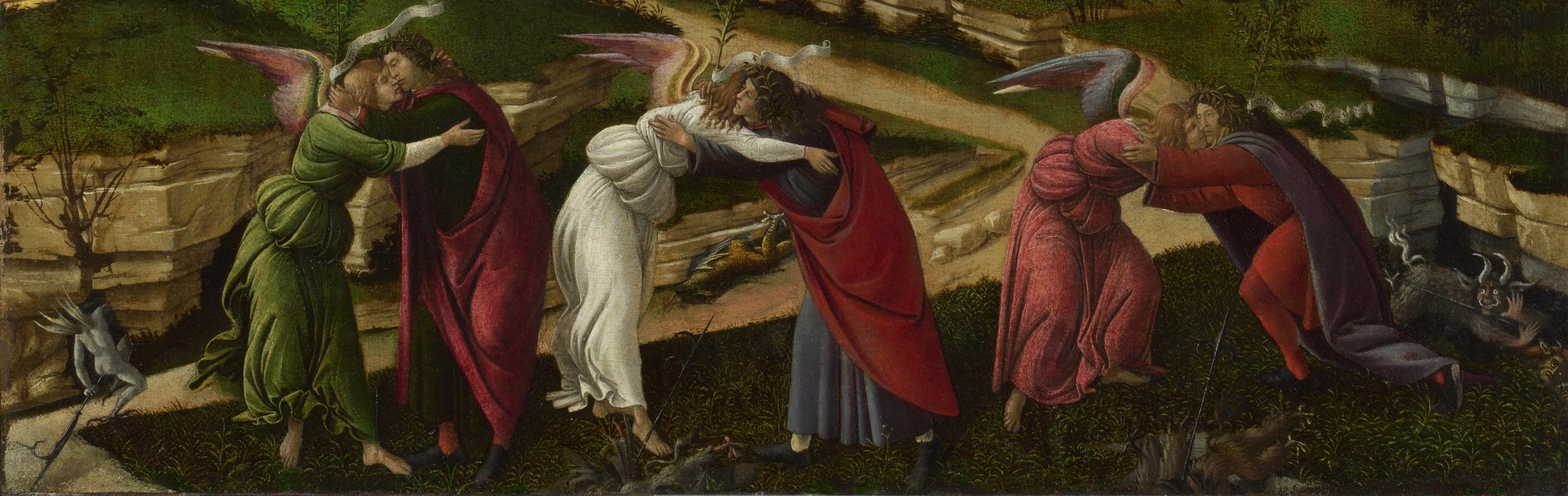
“Righteousness and peace have kissed each other.”
Psalm 85:10, King James Version
Hatfield brings this psalm into the picture through Savonarola, who used the verse to describe reconciliation at Christ’s birth. In the sermon, Peace descends and meets Righteousness with a kiss. The text gives us a way to read what Botticelli has painted without having to assign a name to each person. Peace looks like the physical act of taking someone in your arms.
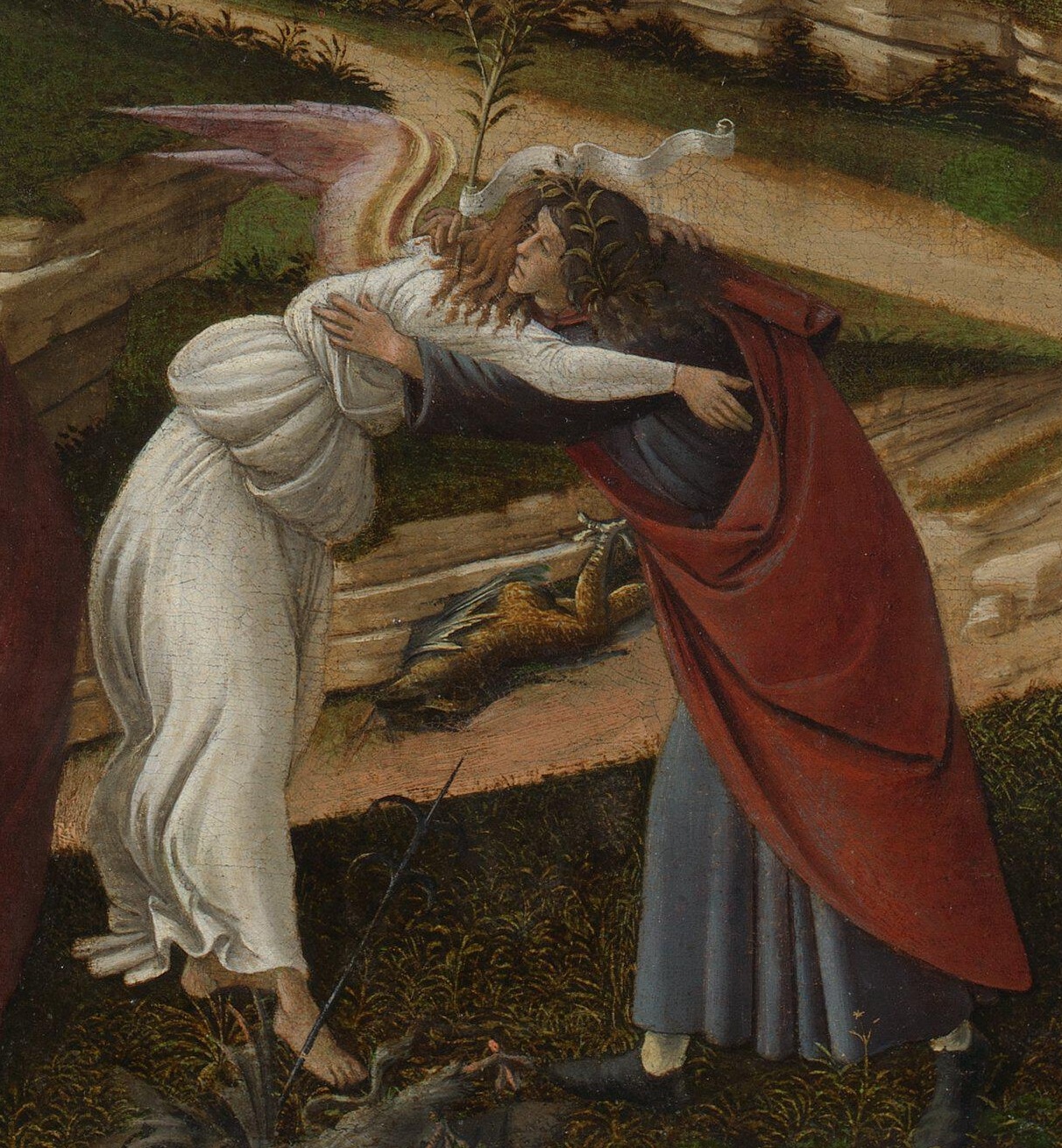
Look along the cracks by the pairs’ feet and you can make out five little demons. At the right a horned head and two hands stand out against the dark gap beneath a shelf of stone. Other figures are so close in colour to the rocks and grass that you may first mistake them for marks in the landscape. Several are pierced by their own weapons, as Hatfield notes.
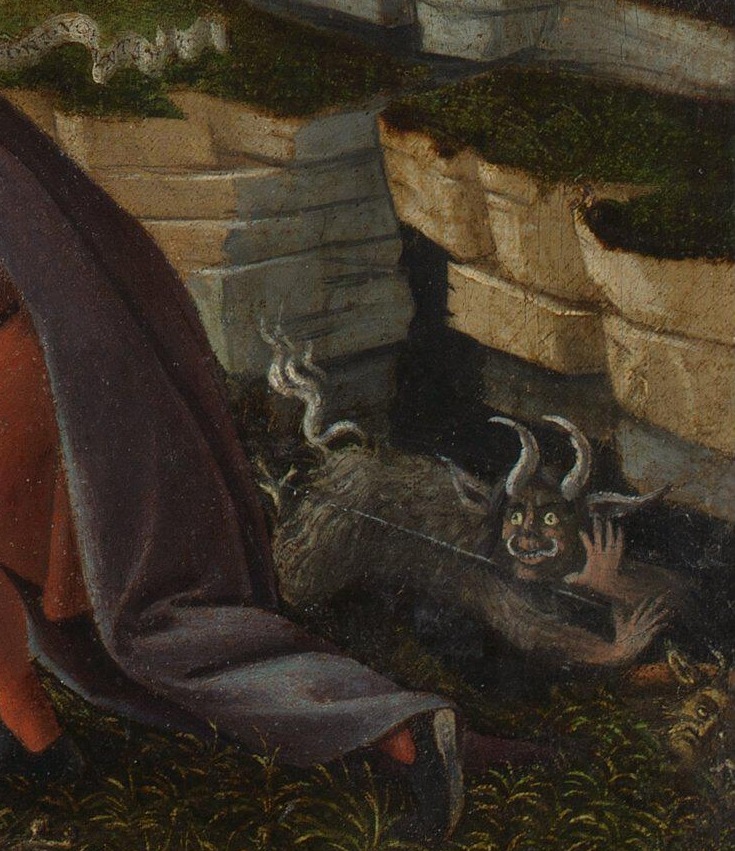
The demons occupy a remarkably small part of a painting framed by the Apocalypse. Botticelli gives their defeat a few dark corners and lets the embraces fill the foreground. Go back to Mary and the child and the two moments now read together. A birth in the cave begins the reconciliation already taking place on the ground outside it.
The National Gallery in London holds the original as NG1034. It acquired the painting in 1878. The canvas measures 108.6 cm high by 74.9 cm wide. The museum catalogues it as oil on canvas, and its technical research identified walnut oil in the paint.
Mystic Nativity and The Mystical Nativity refer to the same painting. The title points to the way Botticelli joins Christ’s birth to visions of heaven opening and evil being defeated. For other ways artists pictured the same birth, see the Christmas paintings collection.
Sandro Botticelli, Mystic Nativity, 1500. National Gallery, London, NG1034. Public-domain reproductions via Wikimedia Commons. Full image and existing details · Source for the additional close-ups.
Enjoyed this story?
Save articles to your collection
Log in or create a free account, and this article will be waiting in your Private Collection.
Log in or sign up
Man Writing a Letter
Gabriel Metsu, c. 1664
The gallery list
Every painting is already 50% off. Join the list and we will send you an extra $15 code, plus first access to new collections.
No spam. Unsubscribe anytime. · Privacy Policy
Welcome
Your $15 code is on its way. Explore the gallery while you wait.