Loading cart…
No products in the cart.

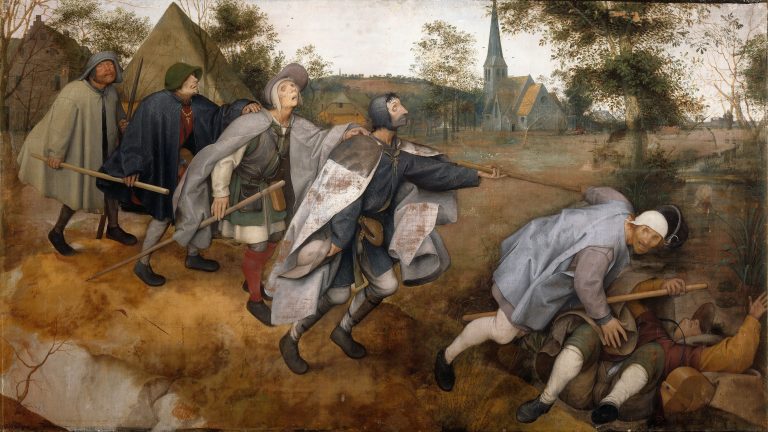
1568 · Distemper (glue-tempera) on linen · Museo e Real Bosco di Capodimonte, Naples, Italy
Save articles to your collection
Log in or create a free account, and this article will be waiting in your Private Collection.
Log in or sign up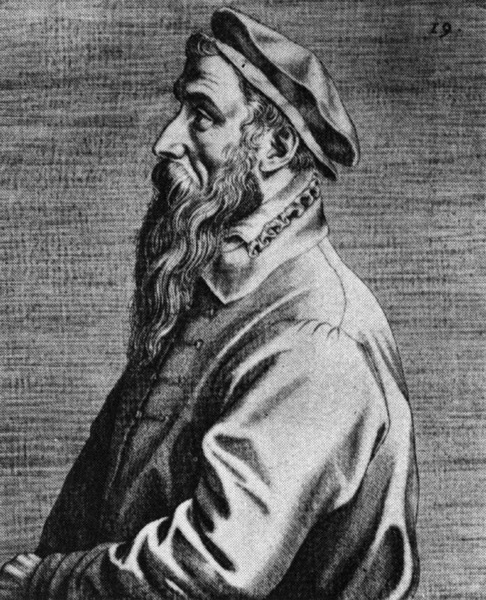 Explore the artistPieter Bruegel the Elder →
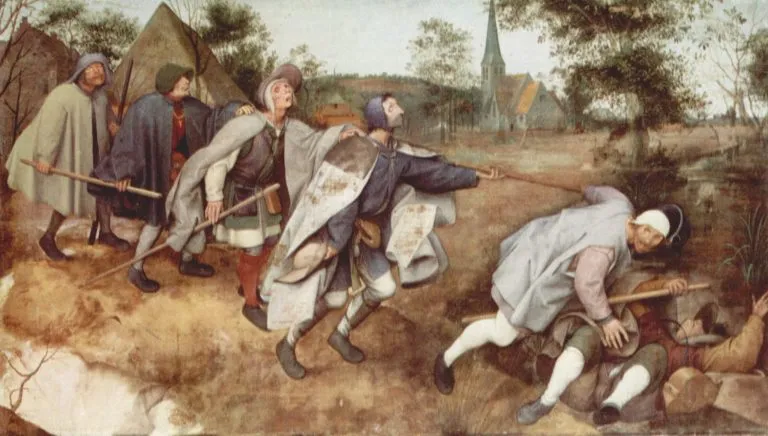
The man at the back of the line has almost no warning. His feet are on the path, his cloak hangs straight, and he holds a stick across his body. Follow the line to the right and the ground seems to give way. One man is already on his back. Another is falling over him. Between them and the last walker, hands and wooden staffs connect the six bodies.
Pieter Bruegel the Elder painted The Parable of the Blind, also known as The Blind Leading the Blind, in 1568. The original belongs to the Museo e Real Bosco di Capodimonte in Naples. Its subject comes from Christ’s warning about following a guide who cannot see the danger ahead.
Bruegel gives us something the men cannot have. We can look along the whole procession at once. We know where the next step leads before everyone in the picture has taken it.
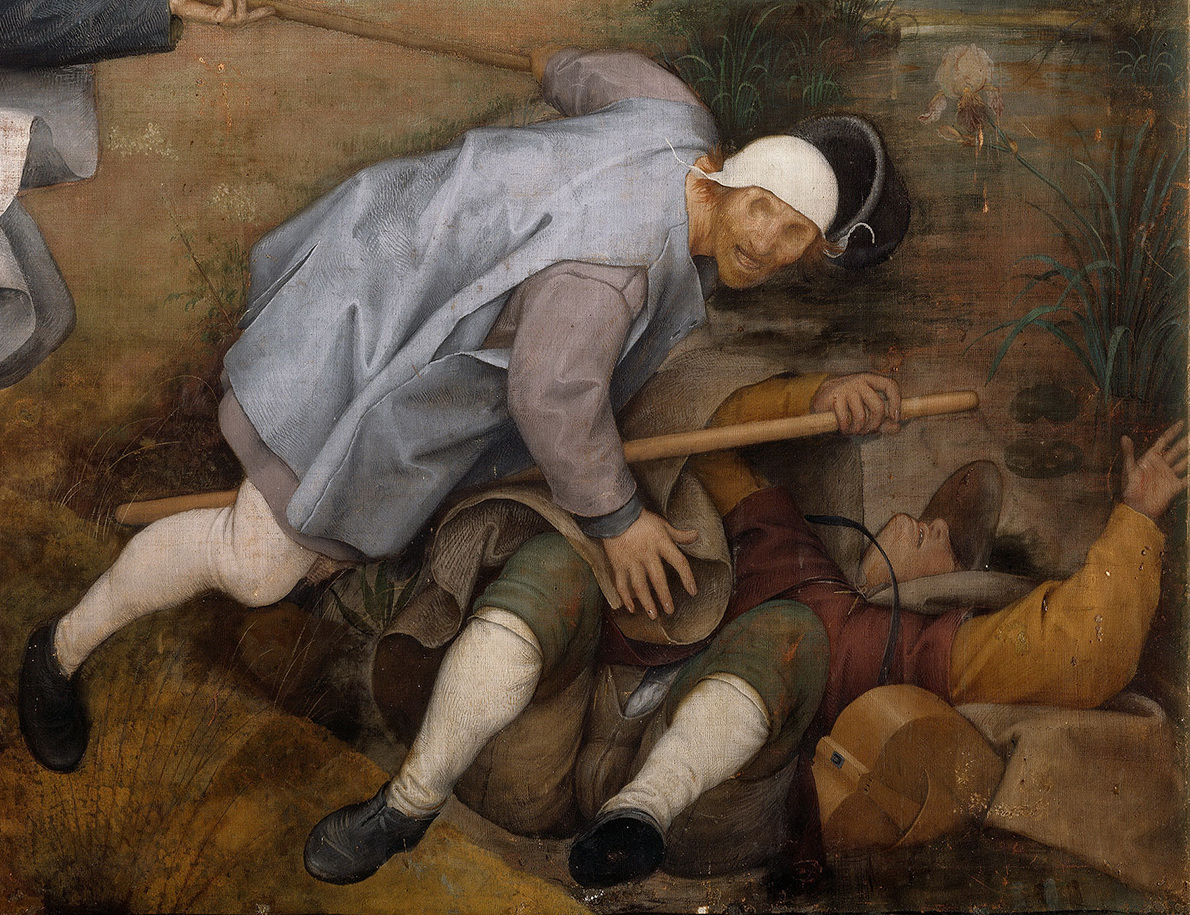
The leader lies with his legs towards us and one arm lifted at the edge of the canvas. His face is turned away. The pale stockings, dark shoes and bent knees make his fall awkward and heavy. The man behind pitches forward, his light cloak spread across his back. One hand opens against the fallen man’s body while the other keeps its grip on a stick.
Their feet point in different directions. Their coats overlap. It takes a moment to separate one body from the other. Bruegel lets that confusion arrive at the place where the orderly line breaks apart.
Farther left, the man in the dark hood is still reaching ahead. His torso leans, his cloak flares behind him and his feet have begun to leave their earlier footing. The fall is moving back through the group.
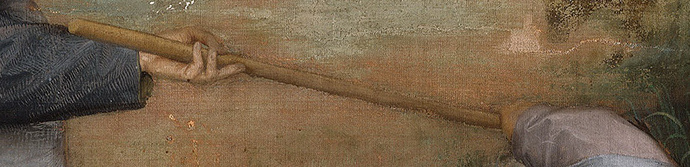
Look at the long staff in the hooded man’s forward hand. It runs towards the man who is falling and disappears behind him. The hand keeps its grip. The straight wood makes the connection easy to follow across the space between the two bodies.
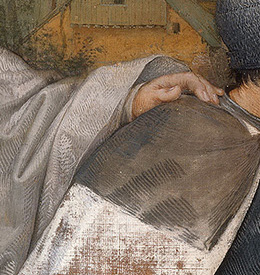
Behind the hooded man, another hand rests on his shoulder. Farther back, the same gesture recurs. One person follows by feeling where the next person goes. The men have built a way of moving together, and the collapse travels through those same points of contact.
That is what gives the picture its tension. A change at the front is enough to unsettle everyone behind.
The painting turns a warning about misguided leadership into an action we can follow. In Matthew’s Gospel, Jesus calls the Pharisees blind guides. The passage ends with the consequence of one person placing trust in another.
“And if the blind lead the blind, both shall fall into the ditch.”
Matthew 15:14, King James Version. Read the verse.
The verse speaks of two. Bruegel makes a procession of six, extending the interval between the first mistake and the last person’s discovery of it. We see trust being passed along a line whose leader has already failed.
Capodimonte’s account places the subject within the religious arguments of the sixteenth-century Netherlands. Catholic and Protestant writers could both use the parable against their opponents. The museum describes Bruegel’s own allegiance within this picture as deliberately ambiguous. Its warning can reach anyone certain that the person ahead knows the way. Capodimonte exhibition commentary.
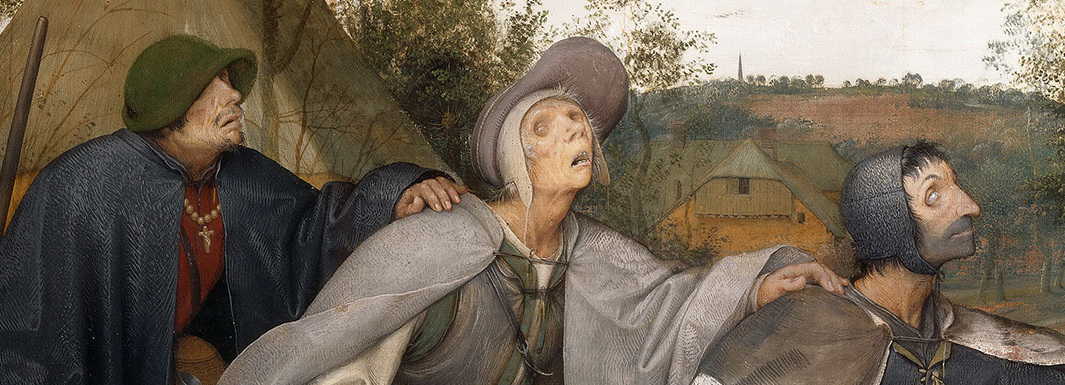
The three faces across the middle refuse to settle into a repeated type. A man in a green cap turns his head sideways. The next lifts his chin beneath a pale hood. The face farther right is framed by a dark close-fitting covering and angled towards the sky. Mouths, cheeks and eyes change from one person to the next.
Capodimonte notes that Bruegel represented distinct forms of blindness and that the lifted heads suggest the men’s reliance on hearing. The biblical metaphor occupies the painting, but so does this close attention to individual bodies. Capodimonte collection record.
Return to the hands after looking at the faces. A person touches a shoulder without knowing what the person beyond it is doing. The short distance between neighbours holds both their cooperation and their vulnerability.
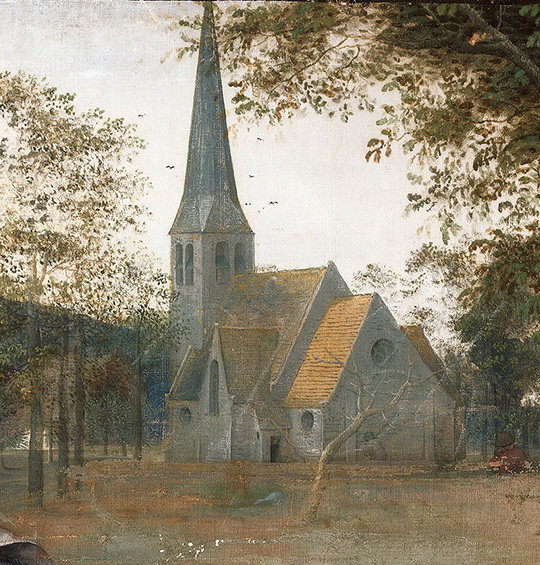
The church stands beyond the men, across a pale field. Its tower rises vertically, its roof catches a warmer colour and its walls seem settled firmly into the landscape. In front of that stability, the procession slopes down towards the ditch.
The museum identifies the village as Sint-Anna-Pede near Brussels. A familiar Netherlandish place gives the biblical warning a setting Bruegel’s viewers could recognise. Religion appears in the verse behind the subject and in the building behind the men. Capodimonte collection record.
As we look between church and figures, the distance remains. The field is quiet. The tree still spreads over the water. The village offers no visible interruption to the accident happening across the foreground.
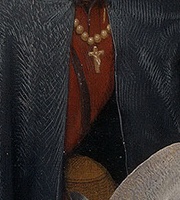
A cross hangs over the red shirt of the man in the dark blue cloak. Bruegel gives this small personal object a place beside the much larger church behind the procession. A sign of faith travels with someone whose destination we can already see. It adds to the picture’s religious questions while leaving the precise target of its warning open.
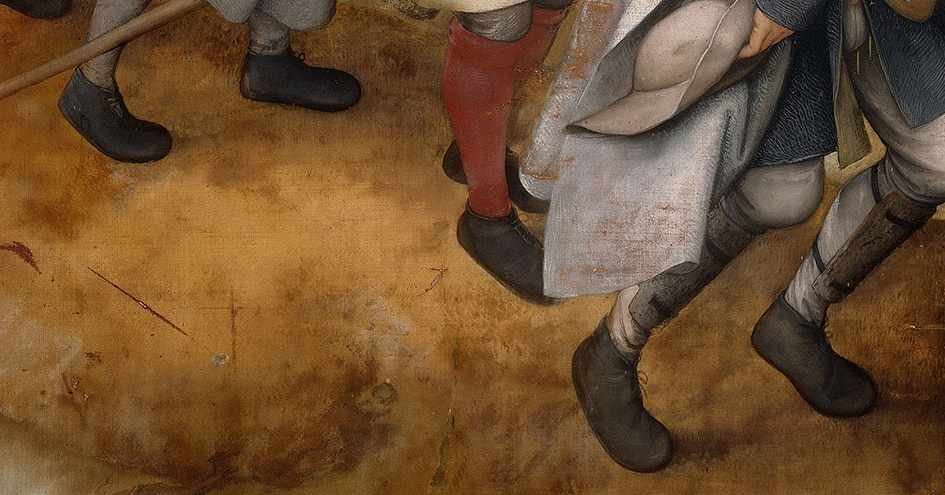
The men’s heads draw a descending line, but the shoes make that movement feel physical. Some feet remain spread on the path. A red stocking drops almost vertically beneath a pale tunic. Farther right, bent legs lift dark shoes away from the ground. Each position offers a slightly later moment in the same loss of balance.
Follow the chain from left to right and it seems to gather speed. Reverse the direction and the picture gives you time to reconsider the people who have yet to fall. Bruegel fits anticipation and consequence into one long foreground.
He had already included this proverb within the busy village of Netherlandish Proverbs in 1559. Here it takes over almost the entire width of the canvas. For the earlier picture’s many simultaneous mishaps, see our Netherlandish Proverbs guide.
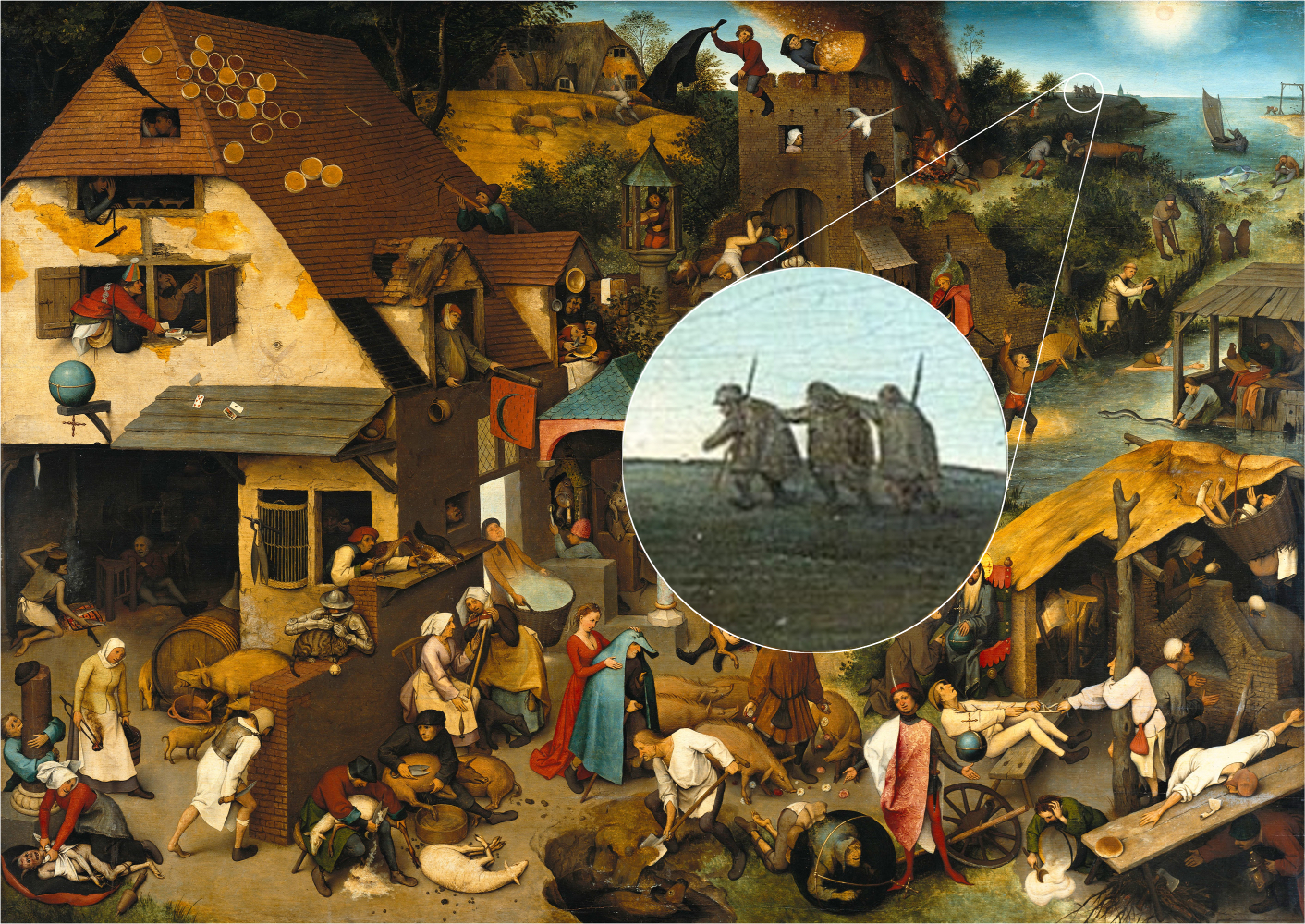
In the upper-right distance of Netherlandish Proverbs, three small figures walk one behind another. One reaches towards the man ahead, while their sticks rise above the low ridge. At this scale, they share a busy village with dozens of other enacted sayings.
In the 1568 painting, Bruegel brings the procession right across the foreground and doubles its number. We can follow each grip and each uncertain step. The small warning at the edge of the earlier picture has become an event that fills almost the whole width of the later one.
See the surrounding village in our Netherlandish Proverbs story.
Bruegel painted this work in distemper, or glue-tempera, on linen. Pigments bound in glue produce a surface with a different appearance from the deep gloss often associated with oil painting. The cloaks, field and sky share a dry softness. Their greys and muted greens keep the few reds and ochres conspicuous.
Capodimonte conservator Angela Cerasuolo explains that glue-tempera dries light and porous, and that varnish or oily materials can disturb its appearance. In her history of conservation in Naples, she records a decision made on 13 May 1853 to place the museum’s two Bruegel temperas behind glass. Protecting them helped preserve the optical qualities of the paint. Angela Cerasuolo, Conserving Canvas, Getty Conservation Institute.
Even the faint passages matter to how we read the landscape. Capodimonte notes that seventeenth-century copies preserve details now lost from the original, including a herdsman and a deeper ravine. The remaining picture asks us to look carefully at a surface that has itself survived centuries of change. Capodimonte exhibition commentary.
The original forms part of the Farnese collection at Capodimonte. The museum’s collection account traces it, with Bruegel’s The Misanthrope, to the Masi family in Parma. The Farnese seized the paintings following an attempted conspiracy against the ruling dynasty in 1611. Capodimonte collection record.
Bruegel signed and dated the picture 1568, the year before his death. It measures approximately 86 × 154 cm. The broad linen support gives the line of figures room to stretch across our field of vision.
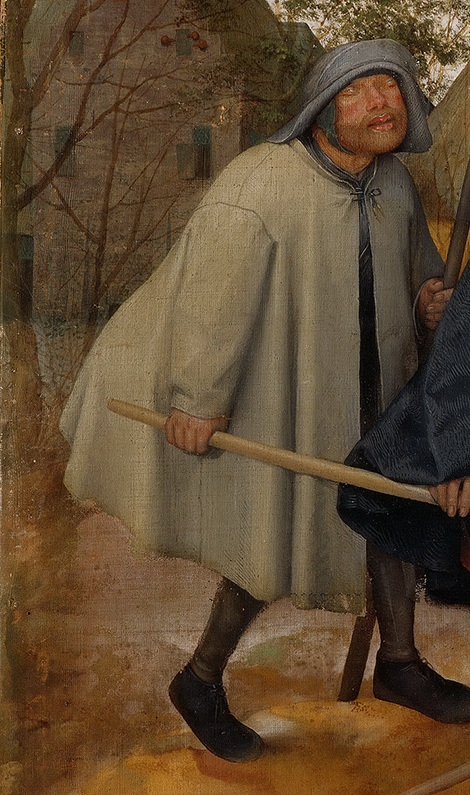
After the tumbling bodies and the reaching hand, the last man’s upright pose looks different. His feet have not reached the broken ground. He belongs to the same group, but the fall has yet to arrive where he stands.
That small delay makes it difficult to leave the painting at the first pair in the ditch. We keep looking back along the people who follow. Somewhere between the hand on a shoulder and the next step, there is still a moment before the danger becomes their own.
William Carlos Williams devoted a poem to this painting in Pictures from Brueghel and Other Poems (1962). Near its end, the movement narrows to the people following and the sticks in their hands.
“one
William Carlos Williams, The Parable of the Blind, short excerpt. Text of the collection.
follows the others stick in
hand triumphant to disaster”
The last word sends us back to the fallen leader. Before we reach it, the line is still moving forwards.
Pieter Bruegel the Elder painted the Capodimonte original in 1568. It is also called The Parable of the Blind.
The subject comes from the warning about blind guides in Matthew 15:14. A related saying appears in Luke 6:39.
There are six. The leader has fallen into the ditch, the next man is falling, and the remaining figures connect the accident to the last man still upright on the path.
Bruegel used distemper, also called glue-tempera, on linen. The original is in the Museo e Real Bosco di Capodimonte in Naples.
ByMuseum offers a hand-painted oil reproduction of The Parable of the Blind in several sizes.
Pieter Bruegel the Elder, The Parable of the Blind, 1568. Museo e Real Bosco di Capodimonte, Naples. Public-domain reproduction via Wikimedia Commons. Canvas image source.
Enjoyed this story?
Save articles to your collection
Log in or create a free account, and this article will be waiting in your Private Collection.
Log in or sign up
Man Writing a Letter
Gabriel Metsu, c. 1664
The gallery list
Every painting is already 50% off. Join the list and we will send you an extra $15 code, plus first access to new collections.
No spam. Unsubscribe anytime. · Privacy Policy
Welcome
Your $15 code is on its way. Explore the gallery while you wait.