Loading cart…
No products in the cart.

1565 · Oil on oak panel · Kunsthistorisches Museum, Vienna
Save articles to your collection
Log in or create a free account, and this article will be waiting in your Private Collection.
Log in or sign up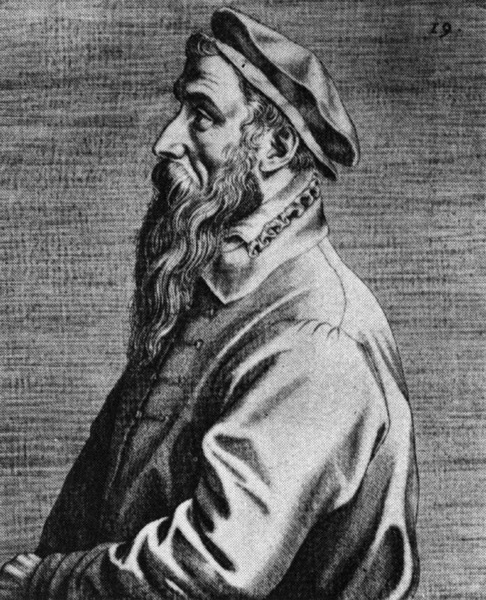 Explore the artistPieter Bruegel the Elder →
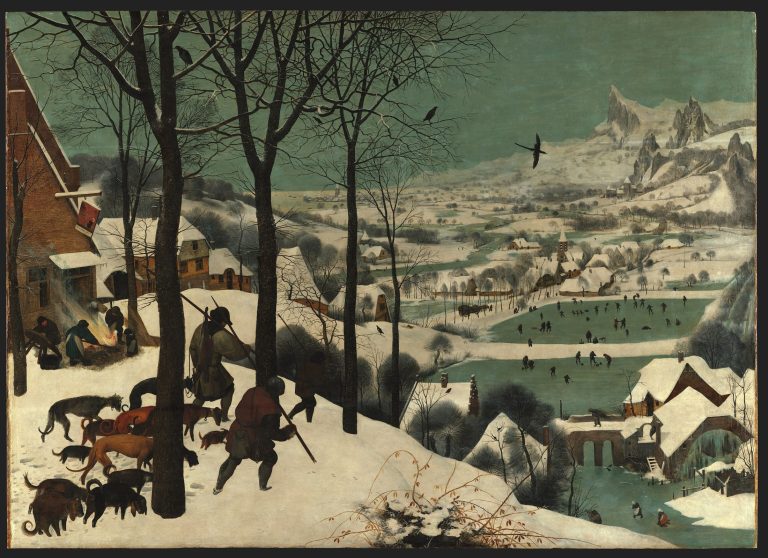
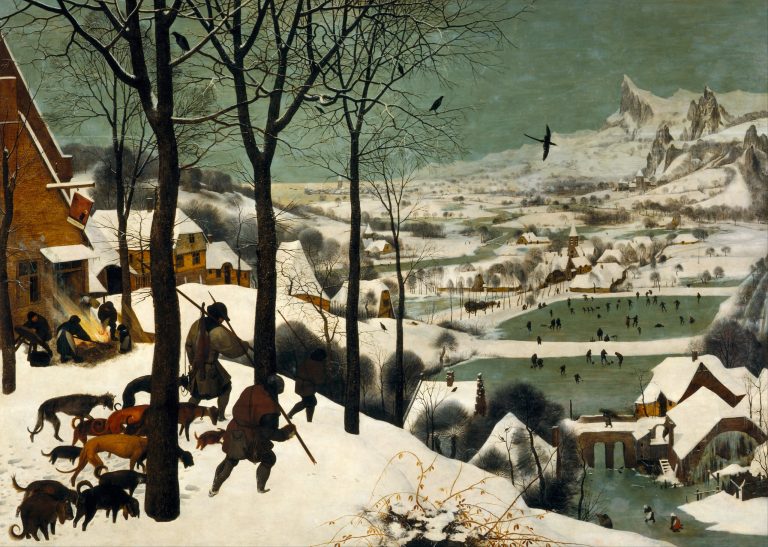
The men and dogs descend the hill with their heads lowered. Beyond them, people skate, tend a fire, cross the ice and move between houses. The hunters’ tired procession is only one rhythm within an entire winter world.
Pieter Bruegel the Elder painted The Hunters in the Snow in 1565. It belongs to the Kunsthistorisches Museum in Vienna and formed part of a series representing the seasons. The landscape’s cold colours are immediately recognisable, but its apparent stillness does not survive close attention.
Begin with the people returning from the hunt, then let the hill carry your eye toward the village. The painting keeps changing scale. A dog’s curved tail, a tiny person on the ice and a distant mountain all help construct the same inhabited place.
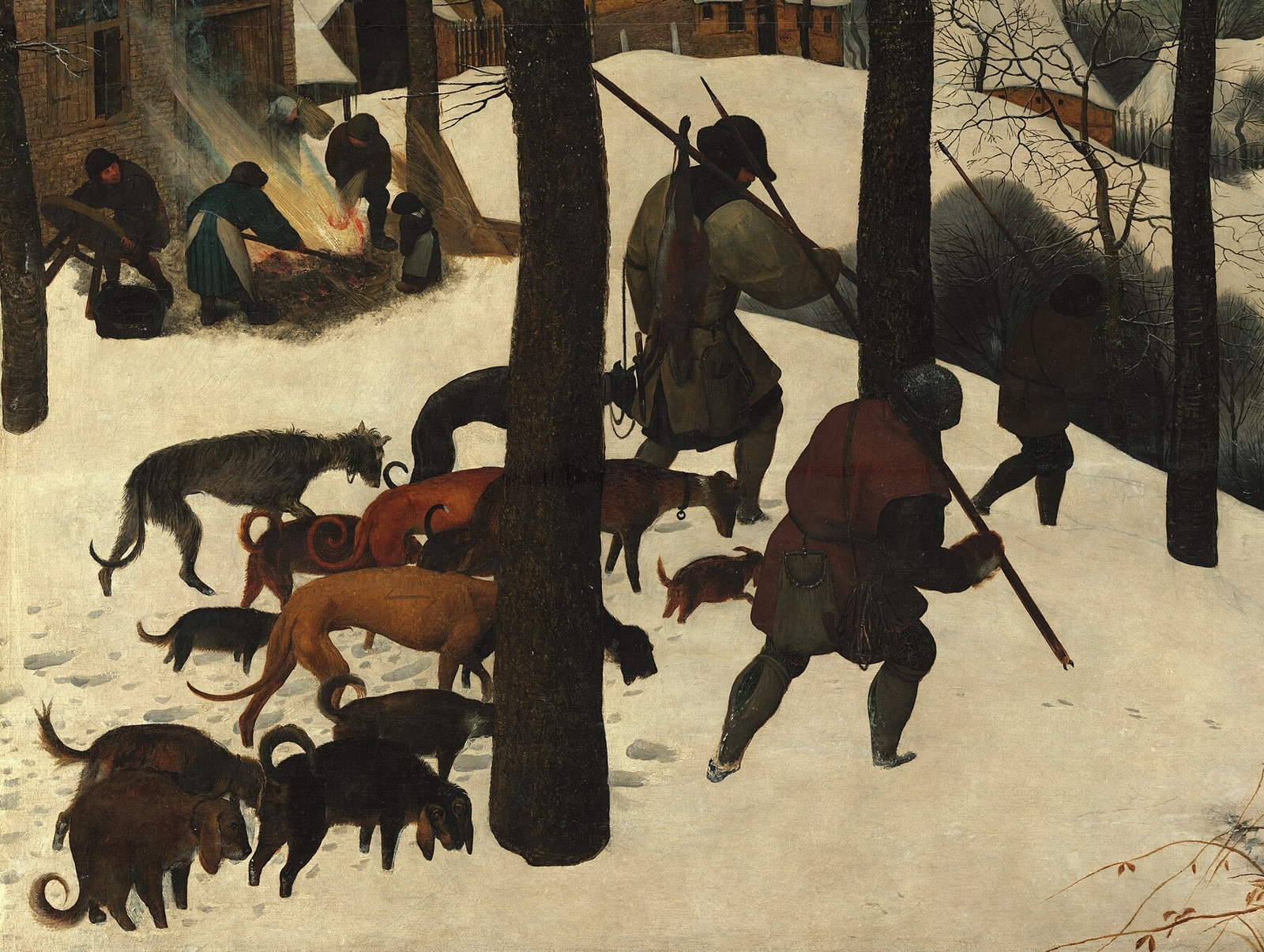
We see the hunters mainly from behind. Faces do little of the storytelling. Instead, shoulders incline, backs round and legs take the downward path.
The dogs repeat the movement at another height. Some noses approach the snow; tails curve across other bodies; dark legs become difficult to separate from the trees. Bruegel makes the pack varied without giving it a different destination from the men.
Notice how the foreground trees interrupt the group. Bodies disappear behind trunks, then emerge again. The painting does not arrange every figure for unobstructed inspection. It allows the act of returning to pass through a landscape that has its own strong shapes.
Calling the hunters exhausted is an interpretation of their posture, not a statement supplied by an inscription. The lowered lines and poor visible catch support that reading. Their specific thoughts remain beyond the picture.
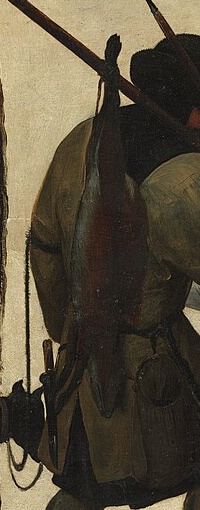
A fox hangs down the back of the hunter at the left. Its narrow shape almost merges with his coat and equipment. The museum’s collection interpretation identifies this as the party’s meagre catch.
That small object changes the mood of the return. The long weapons and numerous dogs have not produced an abundant load of game. Bruegel does not need a dramatic gesture of disappointment: the relationship between effort and result is already visible.
The fox also rewards a kind of looking different from following the broad valley. At first it is a dark vertical shape among other dark shapes. Once recognised, it gives a practical detail to the activity named in the title.
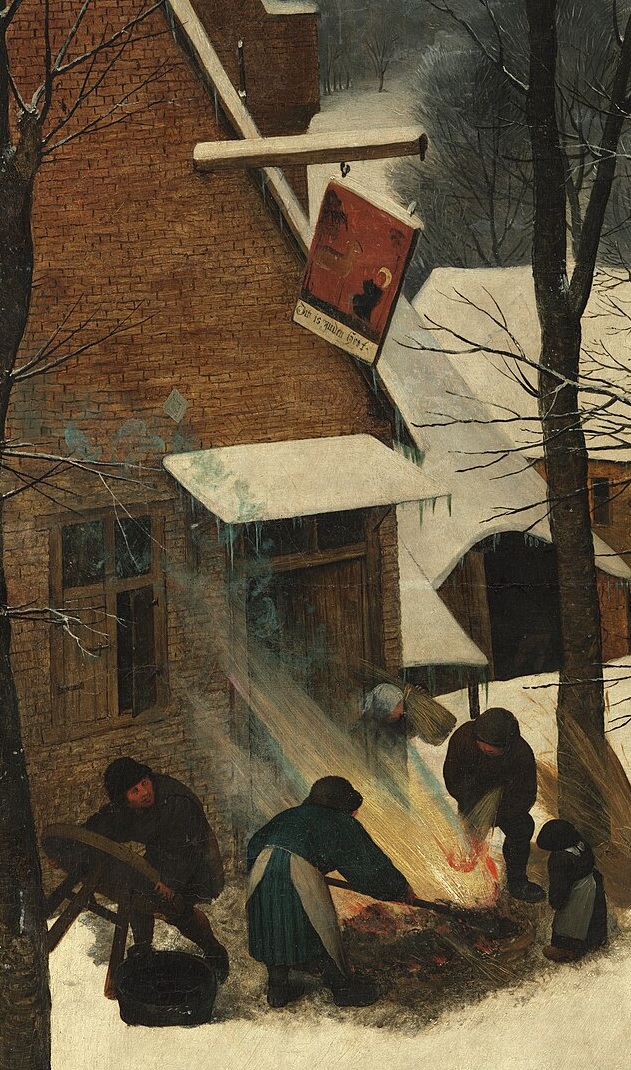
At the left, people gather around an outdoor fire. Orange and yellow flame rise within a scene otherwise dominated by white snow, brown bodies and blue-green distance.
The museum identifies the action as preparation for singeing a pig, a winter task familiar from earlier images of the months. It is work rather than a group simply warming itself. That distinction adds another source of food to the picture beside the unsuccessful hunt.
Above them, the inn’s sign hangs at an angle. The arrangement is visibly imperfect: the sign tips, the bodies bend, and the flame sends its movement upward. Small irregularities keep the village from looking like a decorative model.
The fire does not make the whole scene warm. Its limited reach helps us feel how extensive the surrounding cold is. A bright patch can describe an environment as effectively as a large area of subdued colour.
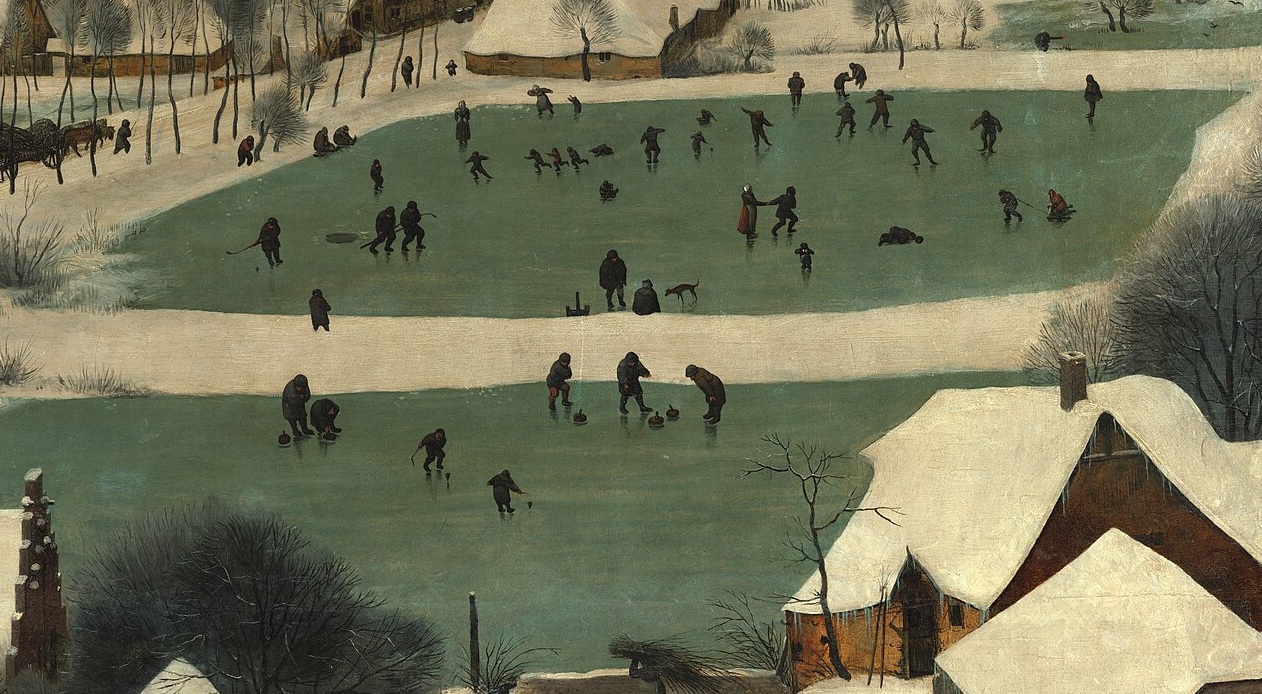
The ponds below contain dozens of small figures. Some stand together; others lean or travel apart. A few marks are enough to give a body a direction.
Compare these figures with the hunters. The foreground procession moves along a narrow, shared path. On the ice, people scatter across open surfaces. The contrast makes the same winter feel restrictive in one place and permissive in another.
The pale dividing strips between the ponds help us read their shapes. A frozen surface is still a form of water, but here it supports people who would ordinarily have to move around it. The season has altered the village’s routes.
It is tempting to give every game a modern name. Unless an action is clear, looking at the particular posture is more reliable. A leaning torso or a spread pair of legs can be expressive without requiring the viewer to identify a precise set of rules.
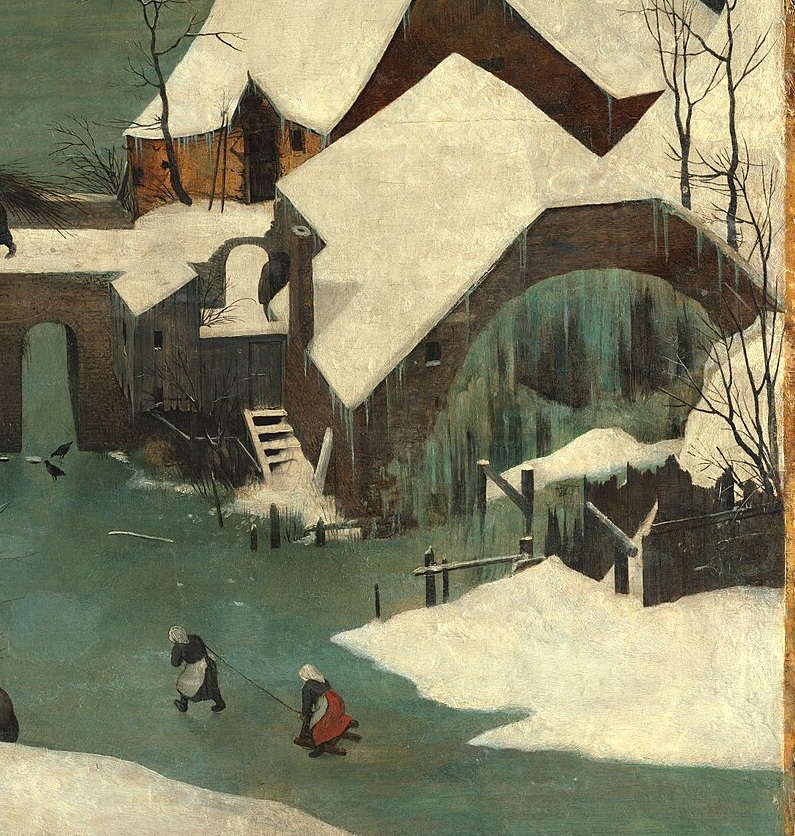
At the lower right, snow lies heavily on roofs near a bridge and watercourse. Ice hangs below the structure. Small figures move through the colder, darker area in front.
The passage joins architecture to the altered conditions of winter. These buildings belong to a working village, but frozen water changes how that work can proceed. The museum’s interpretation draws attention to the frozen mill-wheel among the painting’s signs of cold.
Bruegel gives the near figures enough colour to remain visible without enlarging them. A patch of red can separate one person from the ice. From that small distinction, the eye can move toward another house, another tree and another route into the distance.
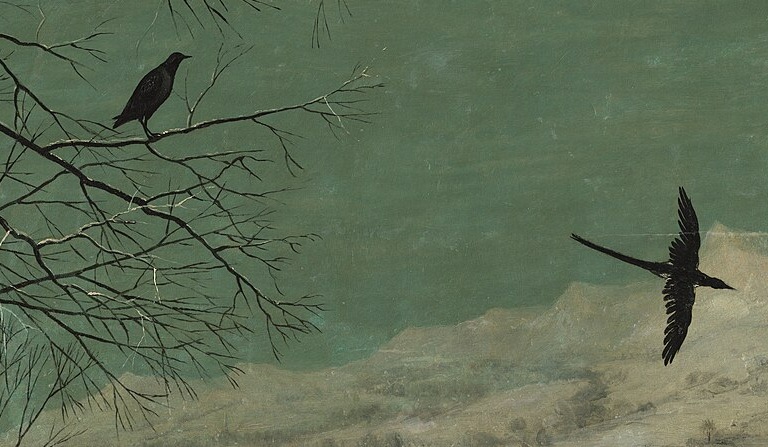
One bird rests on a branch while another flies over the open landscape. Their dark silhouettes repeat the colour of the foreground trunks and the hunters’ clothing.
The flying bird occupies a gap between near branches and distant mountains. It is small enough to belong to the air, but distinct enough to keep the distance from becoming empty. Its spread wings give a different shape to movement from the bent human figures below.
Winter does not suspend every kind of activity. The birds, people, dogs and fire continue within it. Much of the painting’s life comes from the coexistence of actions that do not acknowledge one another.
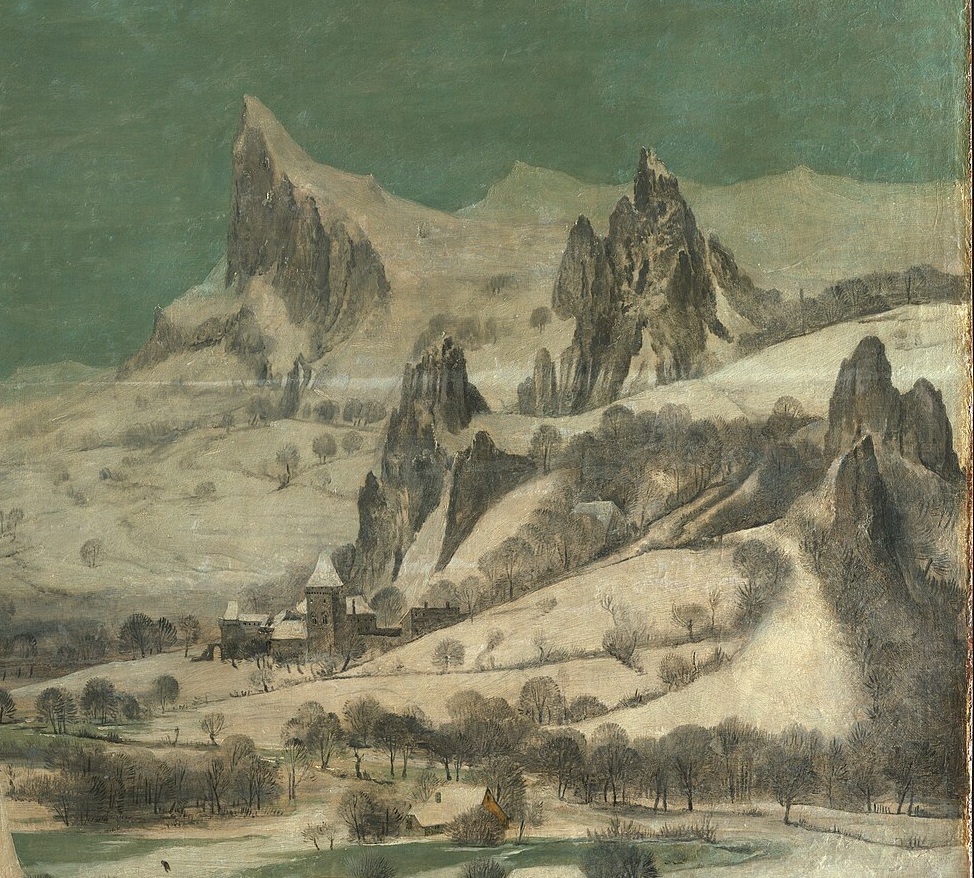
Steep peaks rise beyond the houses and fields. Their sharp, pale surfaces are different from the rounded trees and modest buildings below.
The museum describes the landscape as an invention combining Flemish architecture with Alpine mountain forms. Searching for one exact village would miss the way Bruegel assembles a wider experience of the season.
The elevated foreground is essential to that construction. It allows the artist to show a close procession, the village beneath it and a distant world beyond. A person standing at ground level could not take in those relationships in the same way.
The mountains are not simply background decoration. They enlarge the scale of the cold. What appears at first to be a local return from hunting becomes part of an environment extending far beyond the people who occupy it.
The canvas originally belonged to a six-part seasonal cycle commissioned by the Antwerp collector Nicolaes Jongelinck. Seeing winter alongside the other seasons would have made it one condition within a larger pattern.
The KHM’s study stresses the relation between close details and the whole. Some tiny actions are almost impossible to see with the unaided eye. Their presence nevertheless helps create the impression of a world continuing beyond our immediate attention.
This is why the painting remains more than a catalogue of picturesque incidents. The same restrained colours join a dog in the foreground to a distant skater and a snowy roof. Individual discoveries keep returning us to the shared environment.
Look back at the hunters after spending time in the village. Their return is still subdued. It no longer determines the entire mood of the painting. Other lives continue within the same cold.
Pieter Bruegel the Elder painted it in 1565. It is an oil painting on an oak panel.
The Kunsthistorisches Museum in Vienna holds the painting, inventory GG 1838. The museum’s exhibition study records the panel at 116.3 by 162.5 centimetres.
The museum identifies a single fox hanging from the left hunter’s spear. Its dark body is difficult to distinguish from his clothing.
The painting combines recognisable kinds of buildings, work and seasonal activity within an invented landscape. The distant Alpine forms are not evidence of a single identifiable Flemish village.
Pieter Bruegel the Elder, Hunters in the Snow, 1565. Kunsthistorisches Museum, Vienna, GG 1838. Public-domain historical artwork; faithful image from Inside Bruegel via Wikimedia Commons.
Enjoyed this story?
Save articles to your collection
Log in or create a free account, and this article will be waiting in your Private Collection.
Log in or sign up
Man Writing a Letter
Gabriel Metsu, c. 1664
The gallery list
Every painting is already 50% off. Join the list and we will send you an extra $15 code, plus first access to new collections.
No spam. Unsubscribe anytime. · Privacy Policy
Welcome
Your $15 code is on its way. Explore the gallery while you wait.