Loading cart…
No products in the cart.

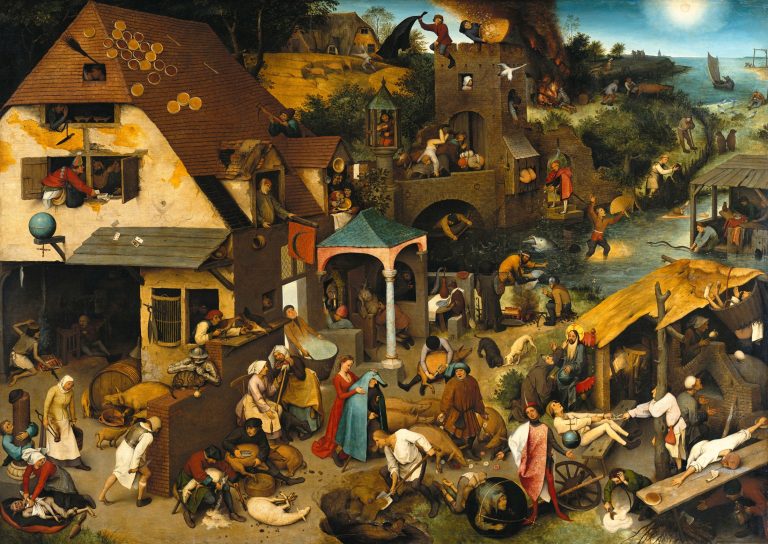
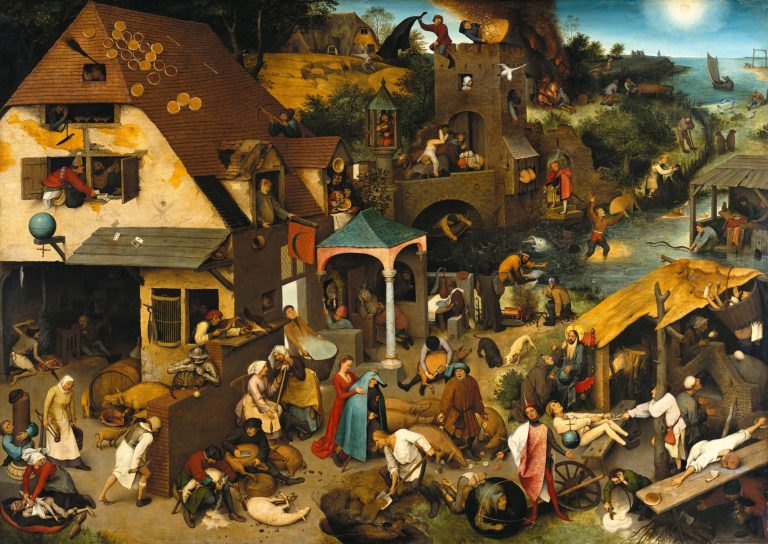
1559 · Oil on oak panel · Gemäldegalerie, Berlin
Save articles to your collection
Log in or create a free account, and this article will be waiting in your Private Collection.
Log in or sign up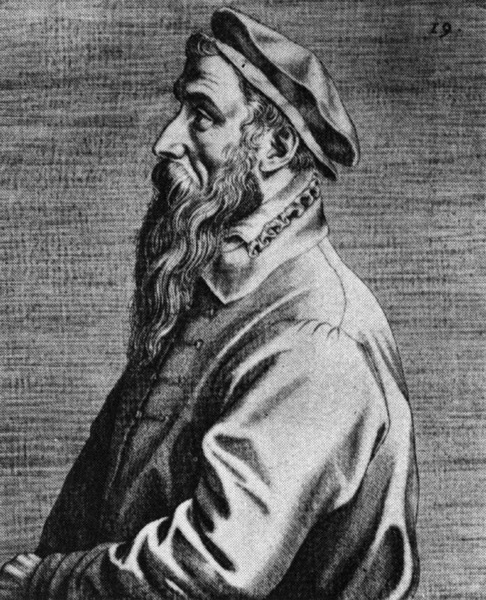 Explore the artistPieter Bruegel the Elder →
A man puts his head against a wall. A woman lowers a blue cloak over her husband. The roof of a house carries a supply of round tarts, while a globe hangs with its cross pointing the wrong way. At first, Pieter Bruegel the Elder’s Netherlandish Proverbs resembles a busy village scene. Then almost every ordinary action begins to look impossible.
Bruegel painted the work in 1559. The original, in Berlin’s Gemäldegalerie, is an oil painting on an oak panel measuring 117.2 × 163.8 centimetres. It is also known as The Dutch Proverbs, The Blue Cloak and The World Upside Down.
The panel brings together more than a hundred proverbial expressions. The total varies with the way overlapping sayings are counted. The museum’s detailed presentation identifies more than 120, but a precise total is less useful than understanding the method: a familiar turn of language becomes an actual thing somebody is doing.
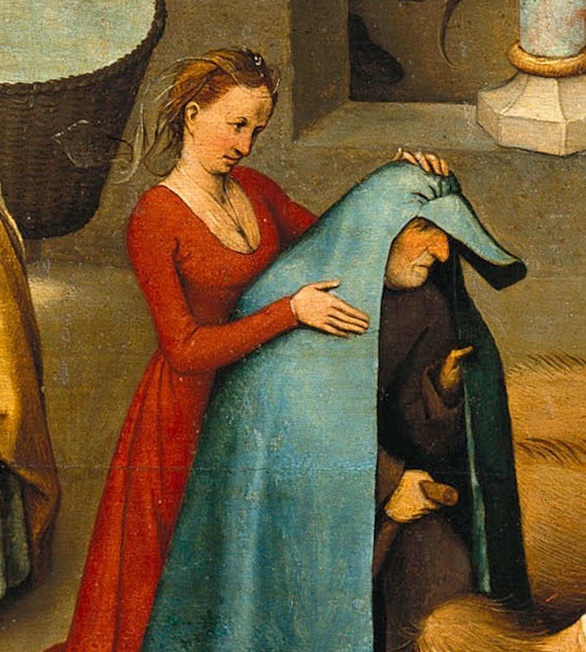
The woman in red supplies one of the strongest blocks of colour in the foreground. She raises a blue cloak over an older man, who bends beneath it. The fabric is bright enough to hold our attention amid the many neighbouring incidents.
The museum explains the cloak as an emblem of deception, particularly an unfaithful wife deceiving her husband. That meaning would have been more readily understood by the painting’s first audience than by many viewers today.
Its placement changes the whole scene. What initially resembles a helpful domestic gesture becomes an act of concealment. The husband receives something, yet does not benefit from knowing what the gesture means. The viewer is placed in the uncomfortable position of understanding more than he does.
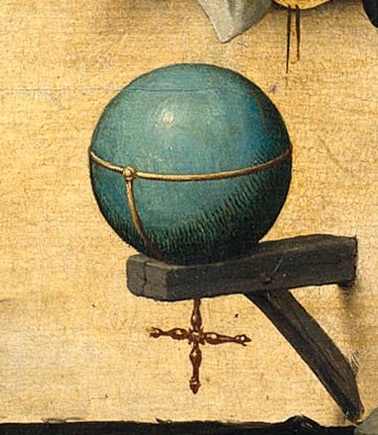
On the left-hand building, a small blue globe sits above a cross instead of beneath it. The inversion is easy to overlook because the people and their actions are larger and more colourful.
This detail supplies the work’s alternative title, The World Upside Down. It expands the subject beyond a collection of unrelated jokes. The village has become an image of disordered behaviour.
Notice the difference in scale. A tiny object announces the state of an entire world. Bruegel does not need a giant allegorical figure labelled Folly. He lets an apparently minor fixture explain the much larger human performance around it.
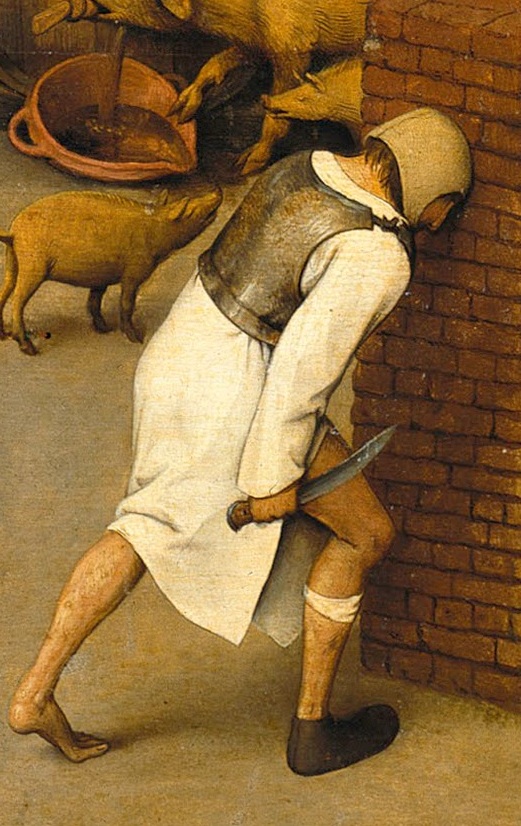
At the front of the left-hand house, a man bends into the brickwork. His body makes the action legible before we know the saying. His legs push forward while the solid wall offers no corresponding movement.
The familiar expression about hitting one’s head against a wall describes futile persistence. Here, an abstract frustration acquires weight, awkward posture and a hard surface.
That translation from phrase to body is a principal pleasure of the painting. We can recognise a mistake without being told a long story about the person making it. The action supplies the argument, while its absurd physical form makes the moral easier to remember.
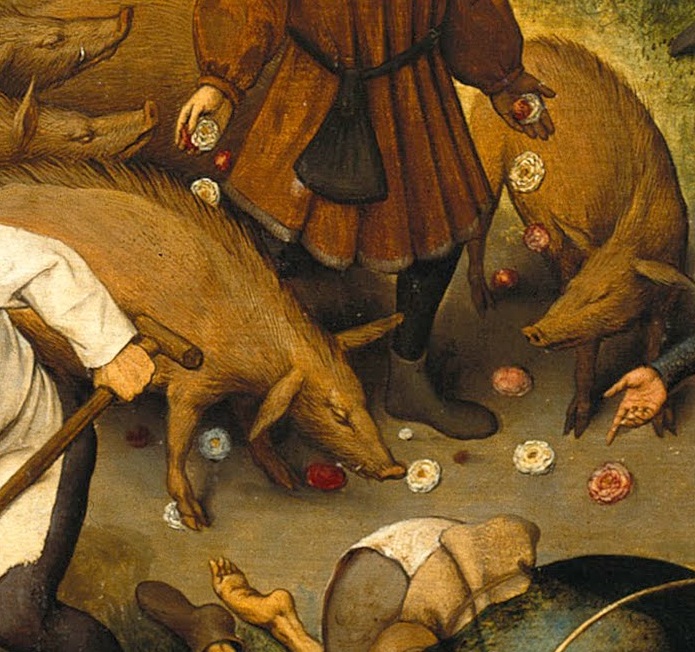
The figure scattering flowers stands close to the pigs. In the historical expression, these are roses cast before swine, comparable to the English phrase about pearls. The gift reaches an audience unable to appreciate its value.
The exchange is deliberately uneven. The human hand gives; the animals continue with their own interests. The humour comes from the confidence that effort alone will produce an appropriate response.
Bruegel sets this beside other small exchanges rather than isolating it as a moral poster. Our attention is always being offered somewhere else to go. We may even experience the same difficulty as the flower giver: how do we decide where to spend our care in a world this crowded?
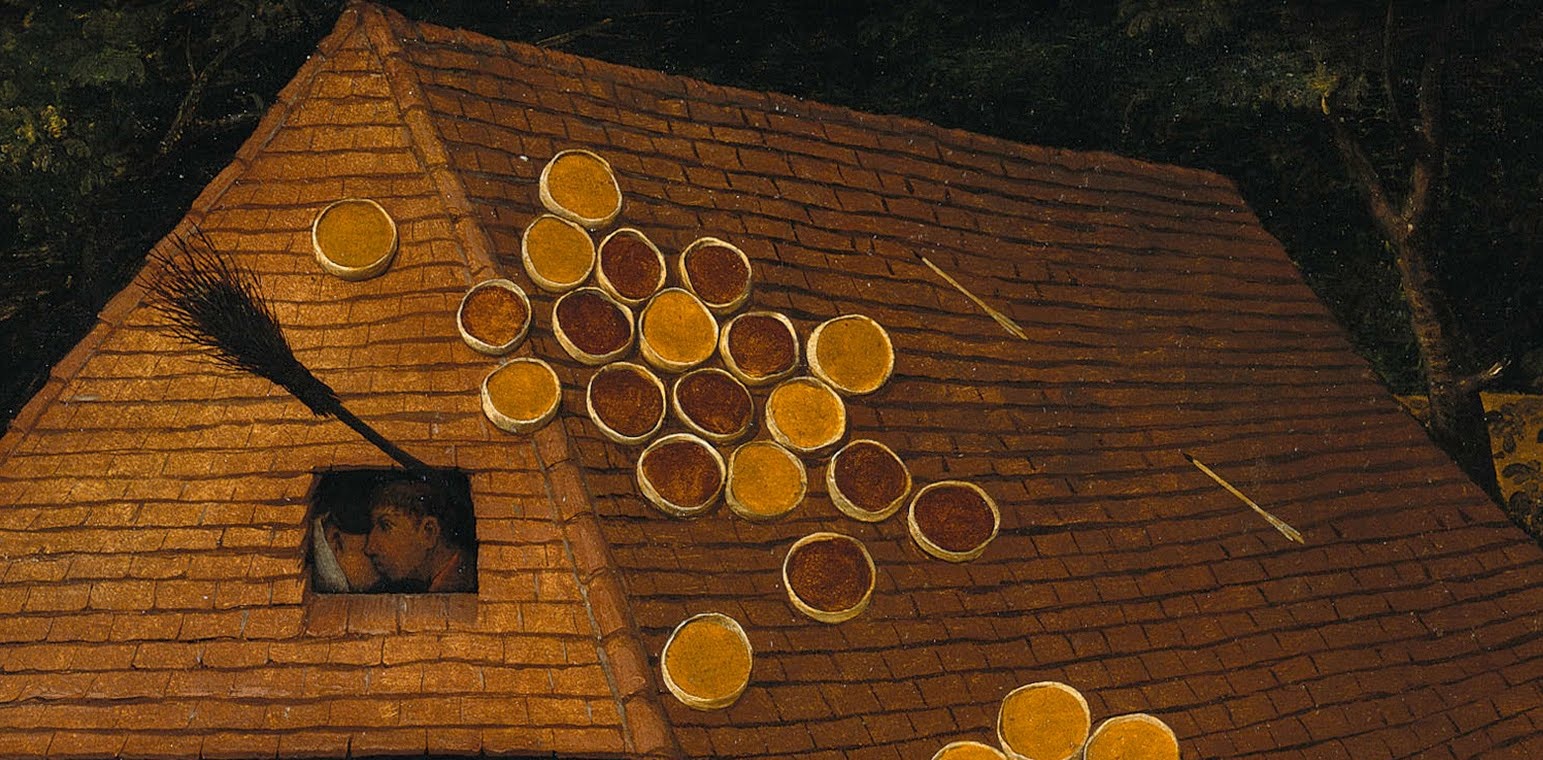
Round golden tarts climb over the roof of the large house. They are arranged where we expect tiles, their warmer circles standing out against the red-brown structure beneath them.
The museum connects this saying with abundance and the deceptive promise of a fool’s paradise. From a distance, the roof almost passes as architecture. Close looking reveals a fantasy of food where practical shelter ought to be.
It is a particularly efficient visual joke because the circular shapes remain persuasive enough to belong to the picture. Bruegel does not abruptly abandon the village’s materials and lighting. He makes the irrational fit into the same visible world as everything else.
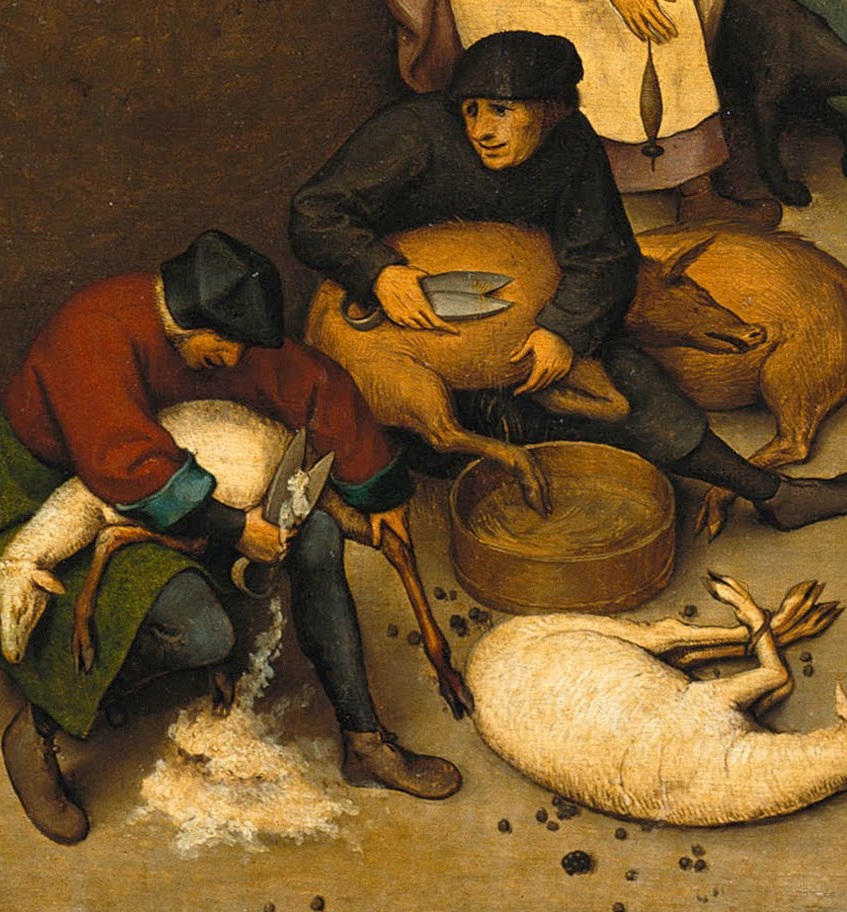
Two workers bend over animals near the bottom of the panel. One has a sheep; the other works on a pig. Their paired postures create an immediate comparison.
The museum identifies the saying as one person shearing sheep while another shears pigs: similar-looking labour can bring very unequal results. Wool can be obtained from one animal, while the other offers little reward for the same operation.
The bodies make the imbalance tangible. Heads turn down, arms bend, attention is absorbed by the task. The comparison does not require a person in authority to enter and explain who is wiser. We can see the difference by considering what each task is likely to yield.
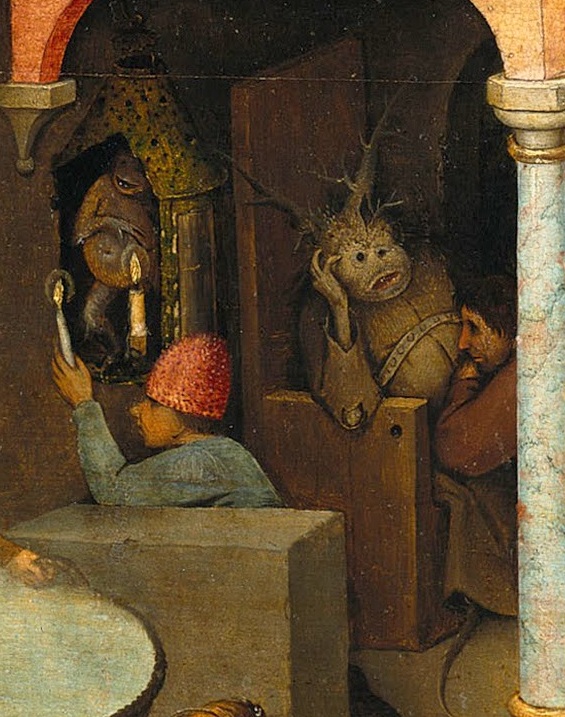
Inside the small open structure, a religious figure attends an enthroned image. The action is stranger than devotion alone: a pale beard is being attached.
The Gemäldegalerie reads this as deceit appearing under a show of piety. Including religious dress among the village’s follies prevents the scene from becoming a simple joke about supposedly ignorant peasants.
The little architectural canopy makes the action look ceremonious. Its columns and roof lend authority to a gesture that the proverb exposes. The contrast between setting and behaviour is as important as the comic act itself.
After examining these details, step back to the full composition. The road, water, bridge and buildings carry the eye into the distance. Colour links incidents that have no shared plot. Red and blue appear repeatedly, giving the apparently scattered actions a visual structure.
There is no narrator standing outside the confusion to rescue its inhabitants. Each person remains absorbed in a small activity. We can move from one folly to the next more easily than any figure in the painting seems able to recognise the larger pattern.
That is why the picture rewards repeated looking without requiring every proverbial phrase to be solved. Its deeper subject is the relation between local certainty and general confusion. Almost everyone appears to know what they are doing. The village as a whole gives us reason to doubt it.
For a different Bruegel world built from many simultaneous activities, explore The Hunters in the Snow. The people there are smaller within a winter landscape, while this panel makes human conduct the landscape’s principal event.
Pieter Bruegel the Elder painted the Berlin panel in 1559.
It belongs to the Gemäldegalerie, Staatliche Museen zu Berlin, inventory number 1720.
More than a hundred. Counts differ because an incident can illustrate more than one expression; the museum’s detailed presentation discusses more than 120.
The original discussed here is by the Elder. His son and later workshops produced versions of the popular subject, which should be identified separately.
Faithful public-domain reproduction of Netherlandish Proverbs, via Wikimedia Commons. Detail images are crops of the same historical painting; no reconstruction or upscaling.
Enjoyed this story?
Save articles to your collection
Log in or create a free account, and this article will be waiting in your Private Collection.
Log in or sign up
Man Writing a Letter
Gabriel Metsu, c. 1664
The gallery list
Every painting is already 50% off. Join the list and we will send you an extra $15 code, plus first access to new collections.
No spam. Unsubscribe anytime. · Privacy Policy
Welcome
Your $15 code is on its way. Explore the gallery while you wait.