Loading cart…
No products in the cart.

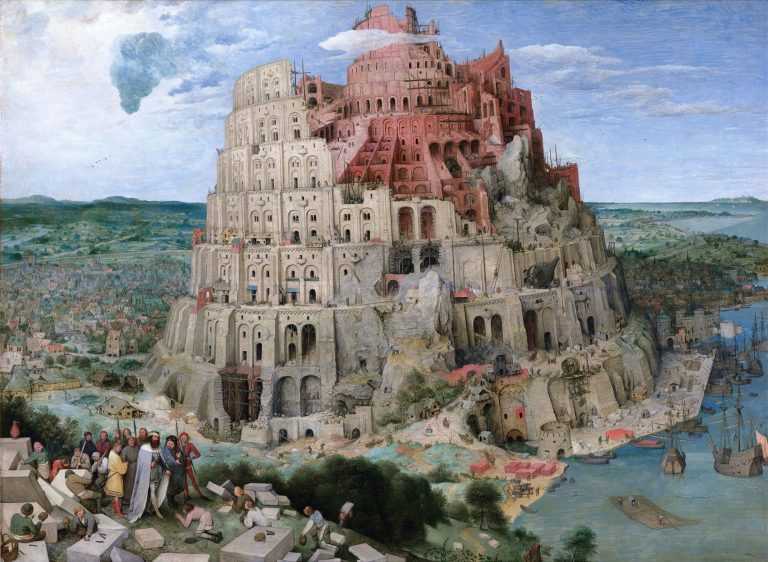
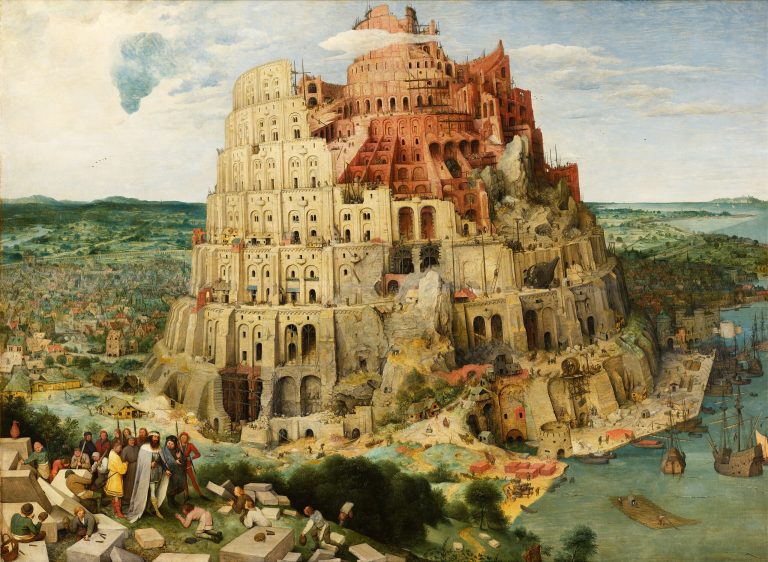
1563 · Oil on oak panel · Kunsthistorisches Museum, Vienna
Save articles to your collection
Log in or create a free account, and this article will be waiting in your Private Collection.
Log in or sign up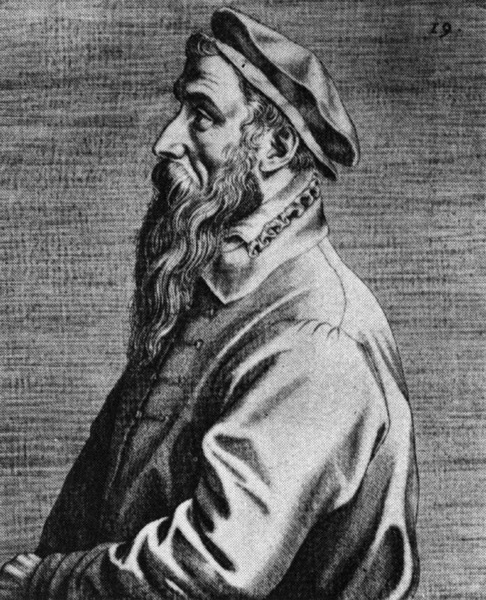 Explore the artistPieter Bruegel the Elder →
The tower is so large that the surrounding houses resemble fragments of a model. Ships crowd the water below it. Roads and workshops gather around its base. Near the foreground, a ruler and his attendants are barely more than a small knot of people.
Pieter Bruegel the Elder painted this Tower of Babel in 1563. It is the large Vienna version, now in the Kunsthistorisches Museum, an oil painting on oak measuring 114.4 × 155.5 centimetres. It is distinct from his smaller, darker tower in Rotterdam.
From a distance the building looks like one colossal achievement. Closer inspection reveals scaffolds, workmen, exposed rock, unfinished openings and layers that do not settle into a reassuring whole. The fascination lies in that change of scale: an impressive monument becomes a collection of unstable decisions.
In Genesis 11, people sharing one language build a city and a tower to establish their name and prevent their dispersal. God confuses their language, they lose the ability to understand one another, and the building project stops as they scatter.
The biblical account does not describe a dramatic collapse of the tower. It also does not name Nimrod as the ruler of this particular undertaking. His association with Babel belongs to the wider interpretive tradition, and the richly dressed foreground ruler is usually identified with him.
Bruegel gives us a building site rather than an illustrated conversation. We cannot hear the languages becoming confused. Instead, the painting asks us to consider the relationship between an immense common ambition and the many individual operations needed to achieve it.
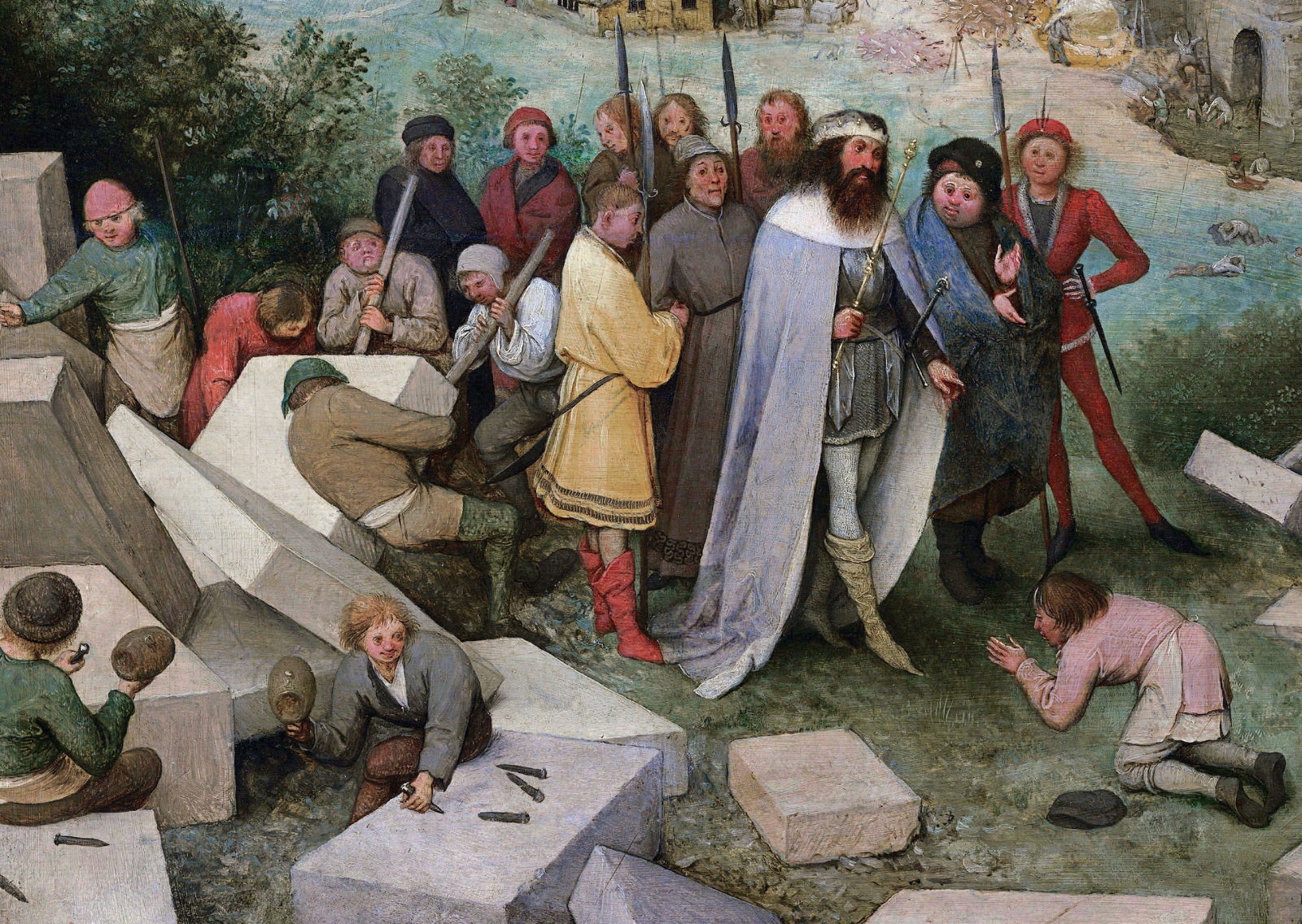
The ruler’s pale cloak and upright posture separate him from the workers around the stone blocks. Figures bend or kneel before him. Other bodies remain occupied with the practical business of shaping material.
The contrast is larger than a difference of costume. One person can survey a project and receive deference without personally carrying its physical burden. The people closest to the stone must negotiate its weight, dimensions and resistance.
Seen beside the tower, even the ruler’s authority becomes small. The project may bear a powerful person’s ambition, but its sheer size threatens to exceed any individual’s ability to comprehend it.
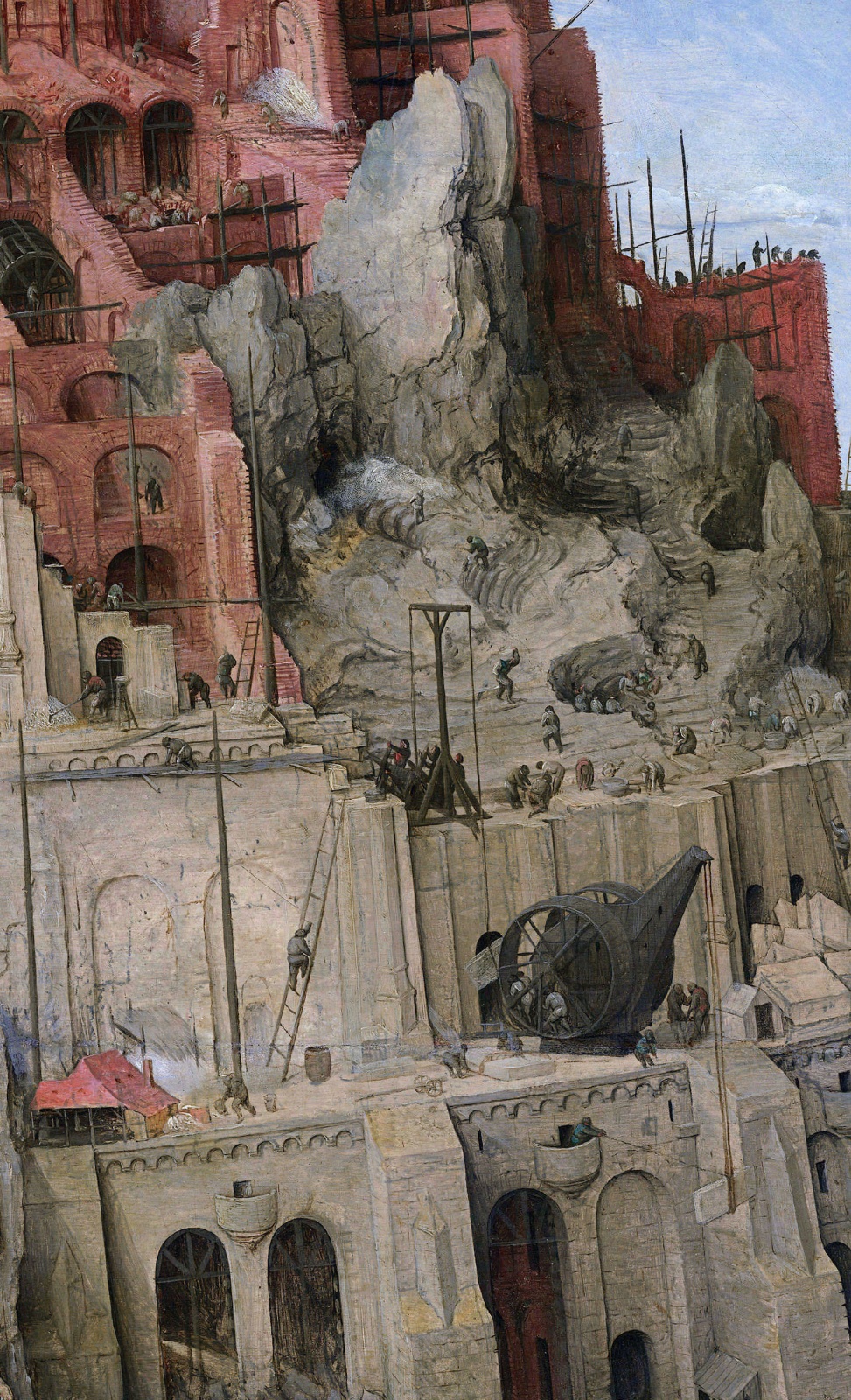
On the exposed side, the tower does not read as a neat stack of finished rooms. Pale rock interrupts the structure. Built openings and irregular natural surfaces meet without a clean boundary.
This makes the tower seem less like an object placed on the landscape than an attempt to consume and reorganise it. A mountain has become part of the construction site.
The architecture mixes familiar forms in an impossible accumulation. The museum notes its combination of ancient and Romanesque elements. Repeated arches give it something of an antique monument’s authority, while the unfinished core prevents that authority from feeling secure.
Calling it an exact reconstruction of the biblical tower would miss the invention. Bruegel is making an imagined structure intelligible through things his audience could recognise.
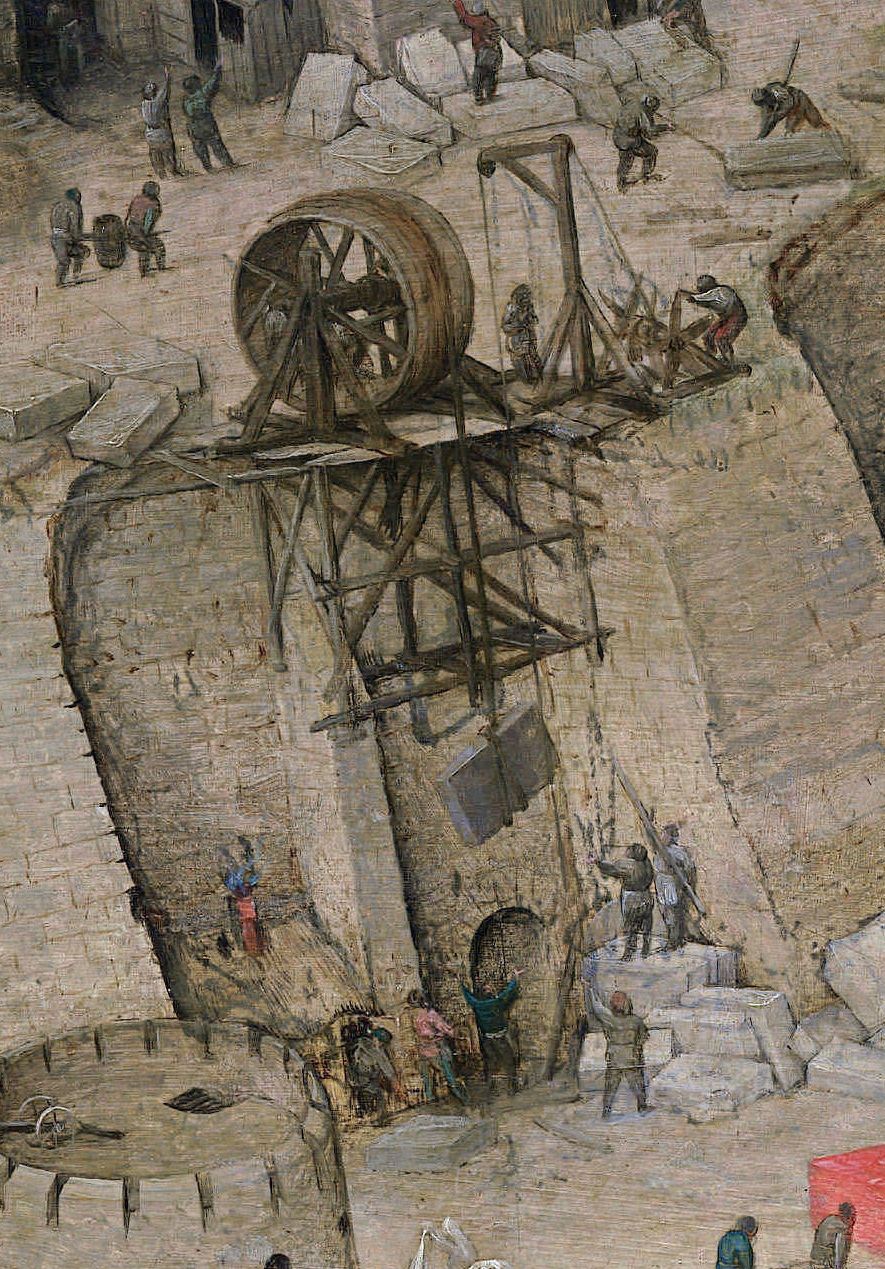
The lifting apparatus near the base provides a different measure of scale. Its wheel, framework and suspended working space belong to a practical world of effort. A load does not rise simply because a ruler orders a tower into existence.
The device is tiny beside the finished-looking arcades above it, but the building could not proceed without operations of this kind. Bruegel makes the means of construction visible alongside the desired result.
There is pleasure in this precision. We can admire the observation of a mechanism even while recognising that the larger undertaking is doomed in the story. Technical intelligence and collective folly are allowed to occupy the same image.
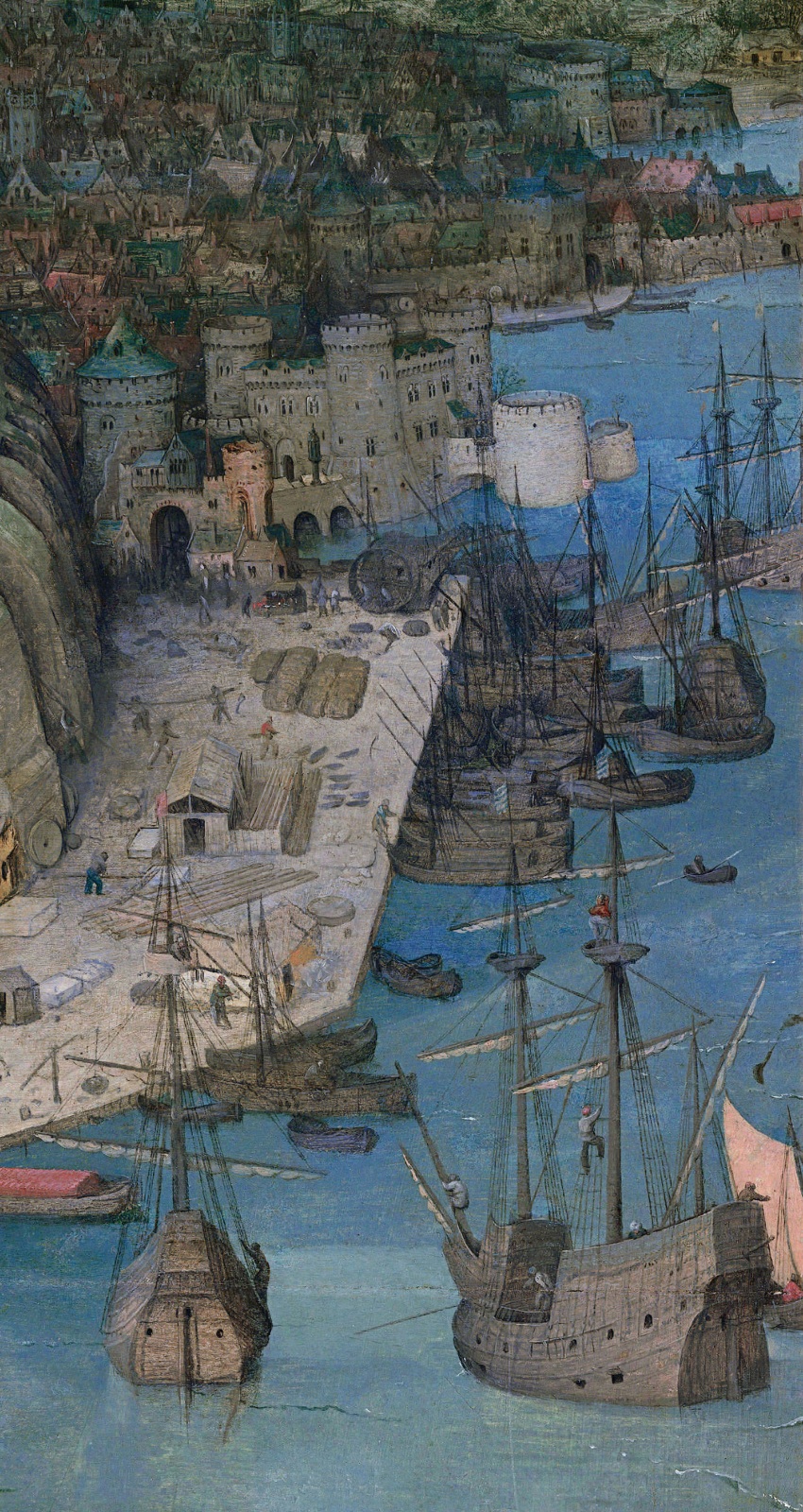
Boats gather beside the tower’s water-facing edge. Masts make a second forest of thin verticals, answering the scaffolds on the structure itself.
The shoreline suggests the movement of supplies, people and goods. The tower is not isolated in a desert. It occupies a connected world with a town, transport and a working waterfront.
The surrounding city also provides a comparison for the monster it supports. Ordinary buildings can be grasped at a glance. The tower demands repeated looking, continually producing another arch, platform or unfinished passage.
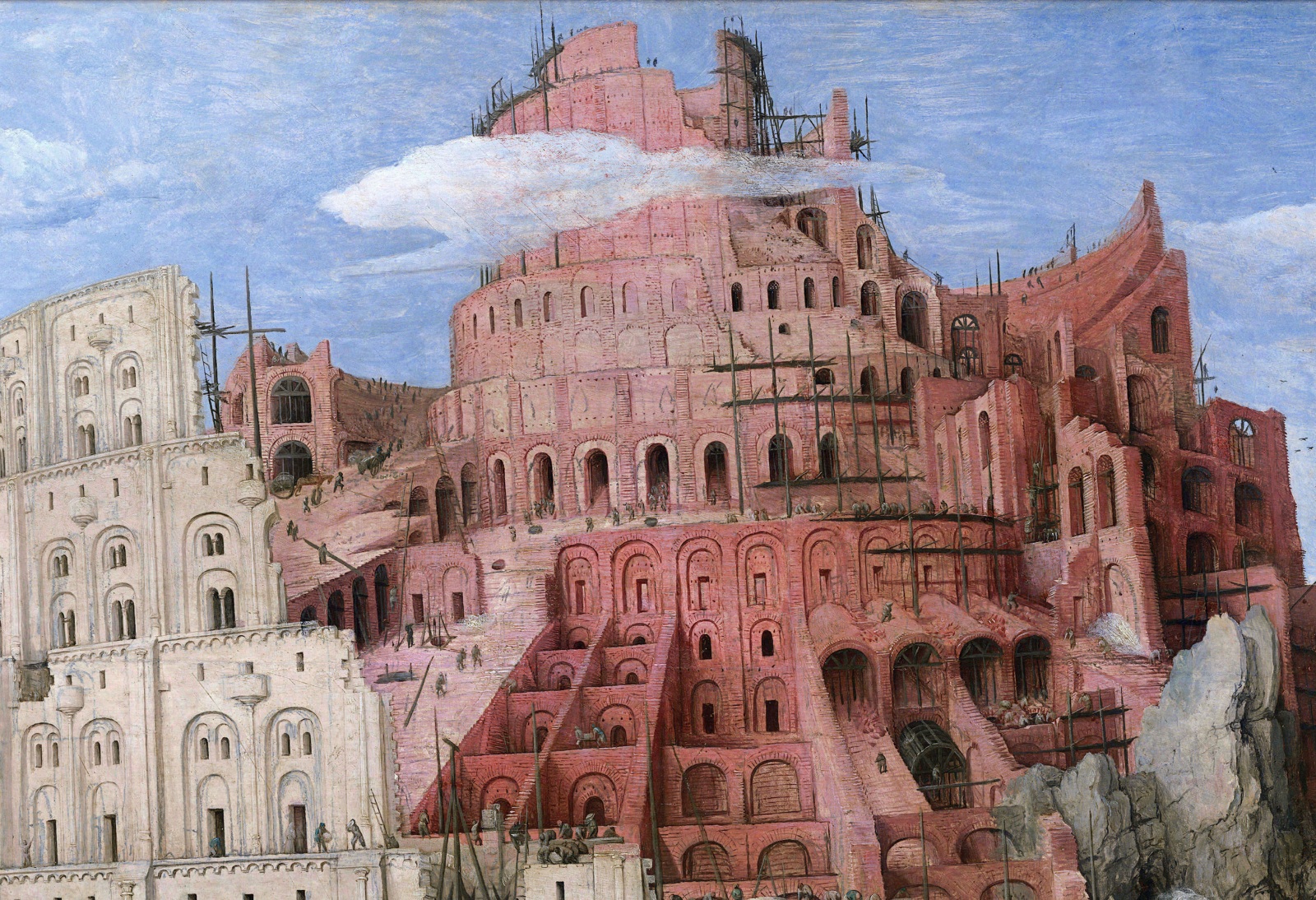
At the summit, open walls and scaffolds deny the clean silhouette of a completed monument. The building reaches the clouds while remaining visibly in progress.
Its pale lower exterior and redder upper sections do not create a simple, uniform object. Different materials and stages of work appear together. The eye climbs, but does not arrive at a stable conclusion.
That incompletion is essential. A finished tower would turn the story into a report about something already achieved. This one holds us inside an ambition still demanding labour, material and agreement from the people beneath it.
The tower can be read as an image of pride, but that word alone is too quick for the experience of looking. Bruegel gives us reasons to admire the very thing the biblical story warns against.
The labour is ingenious. The scale is astonishing. The city is intricately organised. Yet none of those achievements guarantees that the shared purpose is wise or sustainable.
The picture’s force comes from keeping both responses available. We are impressed before we become doubtful, then find more to admire in the details that deepen the doubt.
Bruegel’s Netherlandish Proverbs similarly builds a large world from many small actions. In that village, people pursue private follies. At Babel, their effort is gathered into one overwhelming project.
The 1563 painting discussed here is in the Kunsthistorisches Museum, Vienna, inventory GG 1026.
Yes. The smaller surviving version is in Museum Boijmans Van Beuningen, Rotterdam. It is a different painting, not a detail cut from this one.
Genesis 11 describes the confusion of language, dispersal of the builders and abandonment of the project, rather than a collapse.
He is traditionally identified as Nimrod, although Genesis 11 itself does not name the tower’s ruler.
Faithful public-domain reproduction of The Tower of Babel, via Wikimedia Commons. Detail images are crops of the same historical painting; no reconstruction or upscaling.
Enjoyed this story?
Save articles to your collection
Log in or create a free account, and this article will be waiting in your Private Collection.
Log in or sign up
Man Writing a Letter
Gabriel Metsu, c. 1664
The gallery list
Every painting is already 50% off. Join the list and we will send you an extra $15 code, plus first access to new collections.
No spam. Unsubscribe anytime. · Privacy Policy
Welcome
Your $15 code is on its way. Explore the gallery while you wait.