Loading cart…
No products in the cart.

About 1598 · Oil on canvas · Uffizi, Florence
Save articles to your collection
Log in or create a free account, and this article will be waiting in your Private Collection.
Log in or sign up Explore the artistCaravaggio →
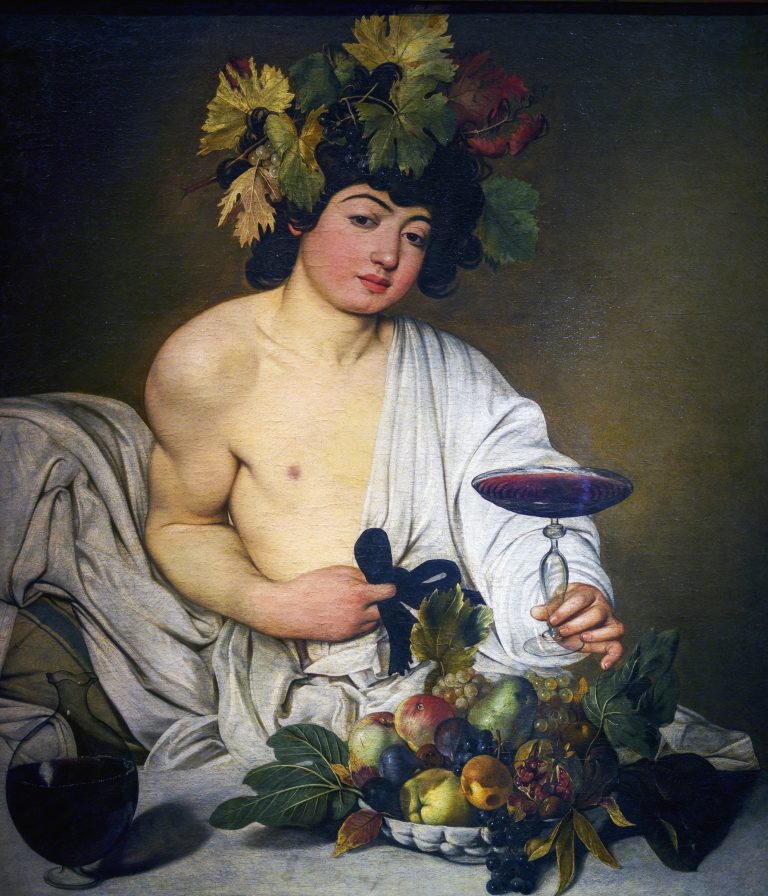
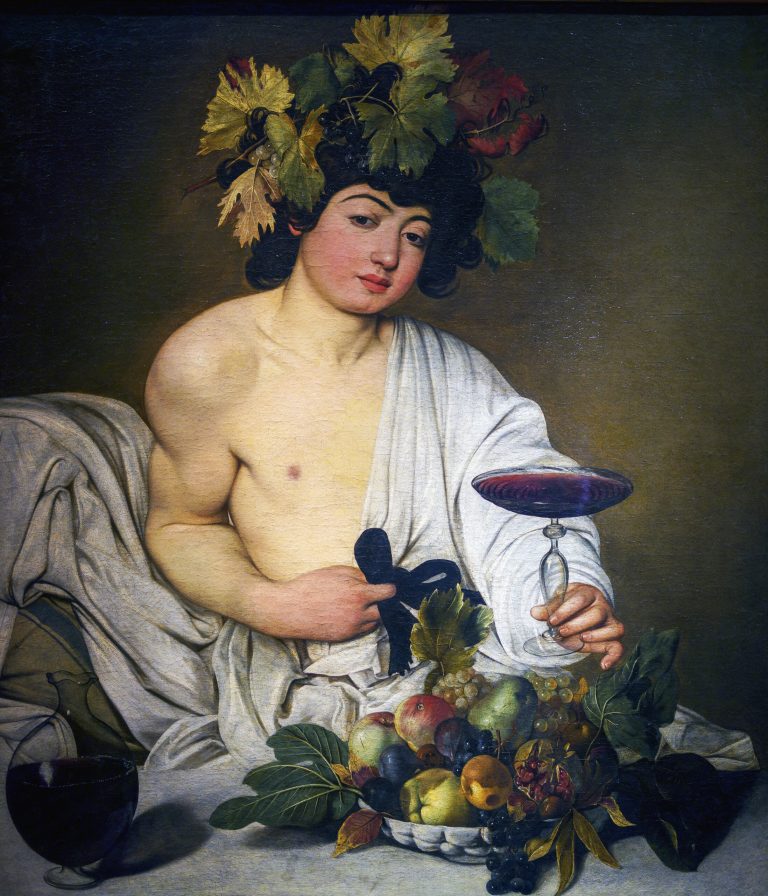
Bacchus looks outward and offers a shallow glass of wine. One shoulder is bare, white cloth gathers around the body, and a wreath of vine leaves and grapes sits over dark curls.
Caravaggio's Bacchus, now in the Uffizi in Florence, turns a classical god into a presence that feels close enough to share a table. The glass addresses the viewer. The fruit and carafe make the invitation materially convincing.
The Uffizi currently dates the painting to about 1598. Earlier publications often place it slightly earlier in the 1590s. It belongs to Caravaggio's early Roman work, before the more expansive religious scenes for which he became famous.
Bacchus is the Roman name associated with the god of wine, known in Greek tradition as Dionysus. Vines, grapes and wine help establish the subject here without a crowd of mythological attendants.
The figure's appearance is both elevated and ordinary. The wreath identifies a god, while the slightly tilted head, bare skin and relaxed pose can suggest a young person dressed for the part.
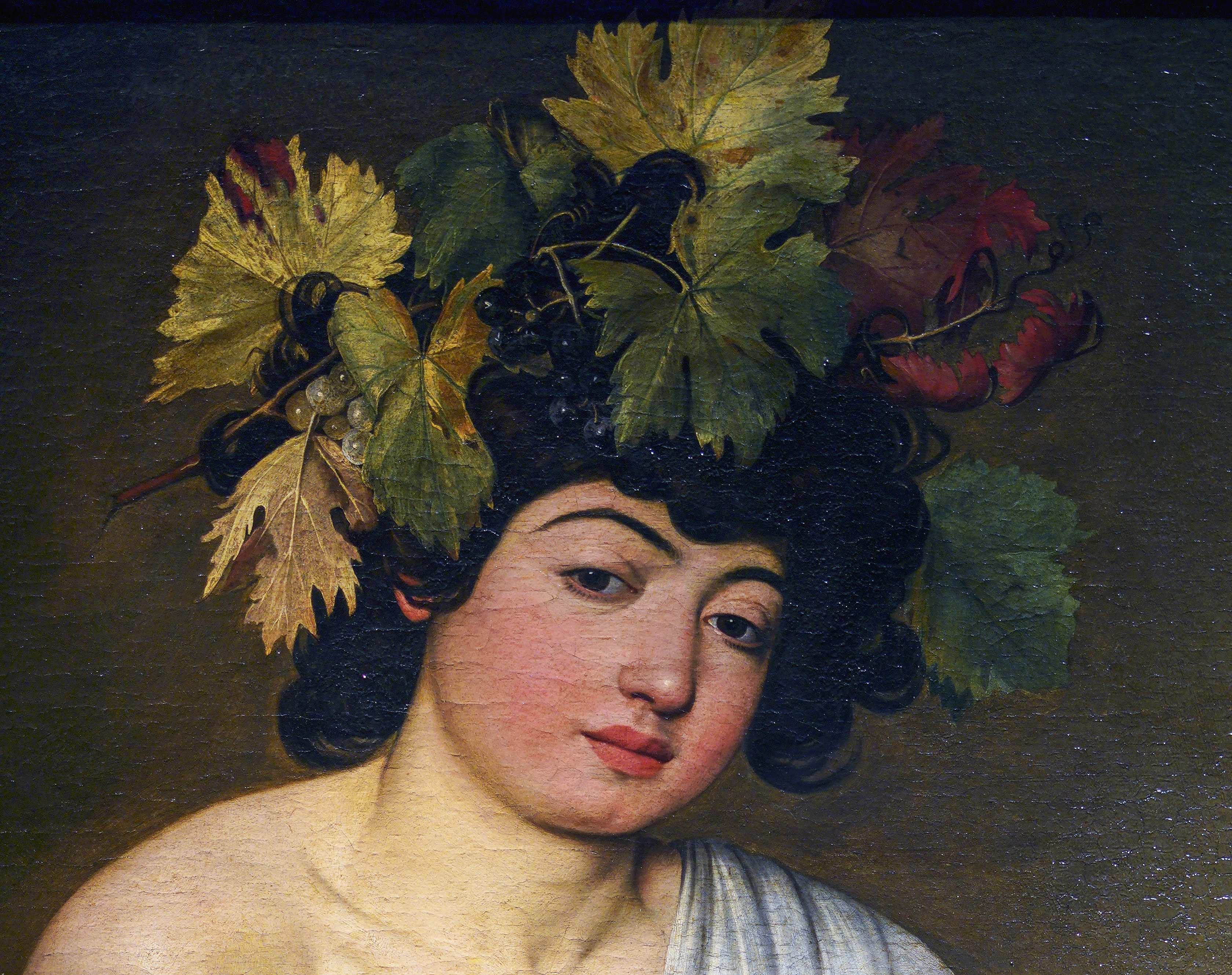
The Uffizi discusses the painting's relationship with classical models, including portraits of Antinous. Caravaggio does not simply reproduce a sculpture, however. Warm flesh, a coloured mouth and an outward gaze give the figure a different kind of immediacy.
The identity of the person who modelled for the painting is not established by looking at the face. Confidently naming a sitter requires evidence beyond resemblance and repetition.
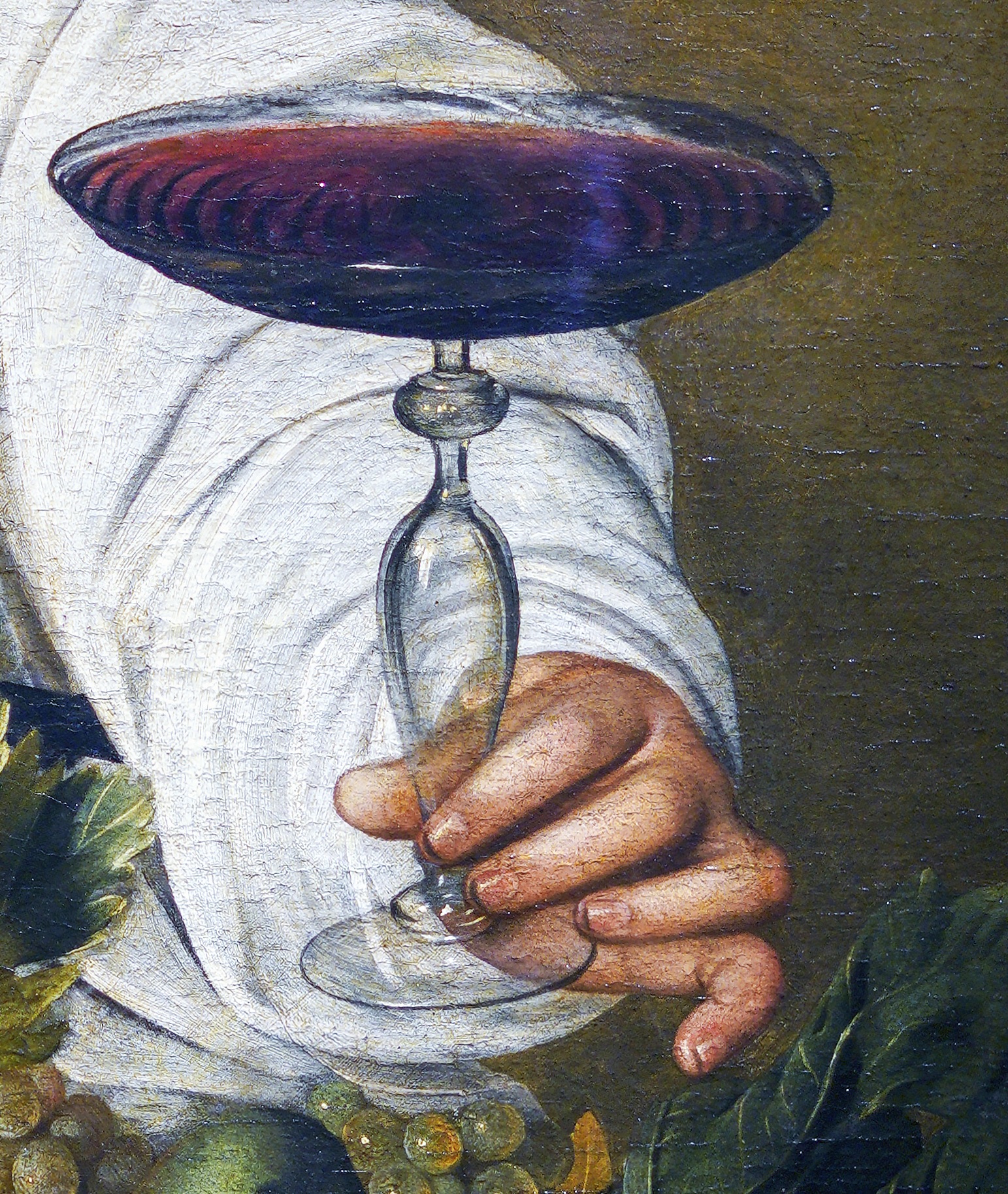
The hand holds the wineglass by its stem. Fingers curve around a narrow support beneath a broad, shallow bowl. Wine occupies a surface much wider than the small area being gripped.
That imbalance makes the object feel fragile. A slight movement would disturb the contents. The figure's relative stillness becomes part of the invitation.
Glass also permits Caravaggio to show several kinds of seeing at once. The rim reflects light, the stem remains partly transparent, and the wine creates a darker coloured field. A simple contour would not describe all those conditions.
The object is offered toward the viewer rather than raised in an exuberant toast. Bacchus does not need to leave his seat for the picture to reach into our imagined space.
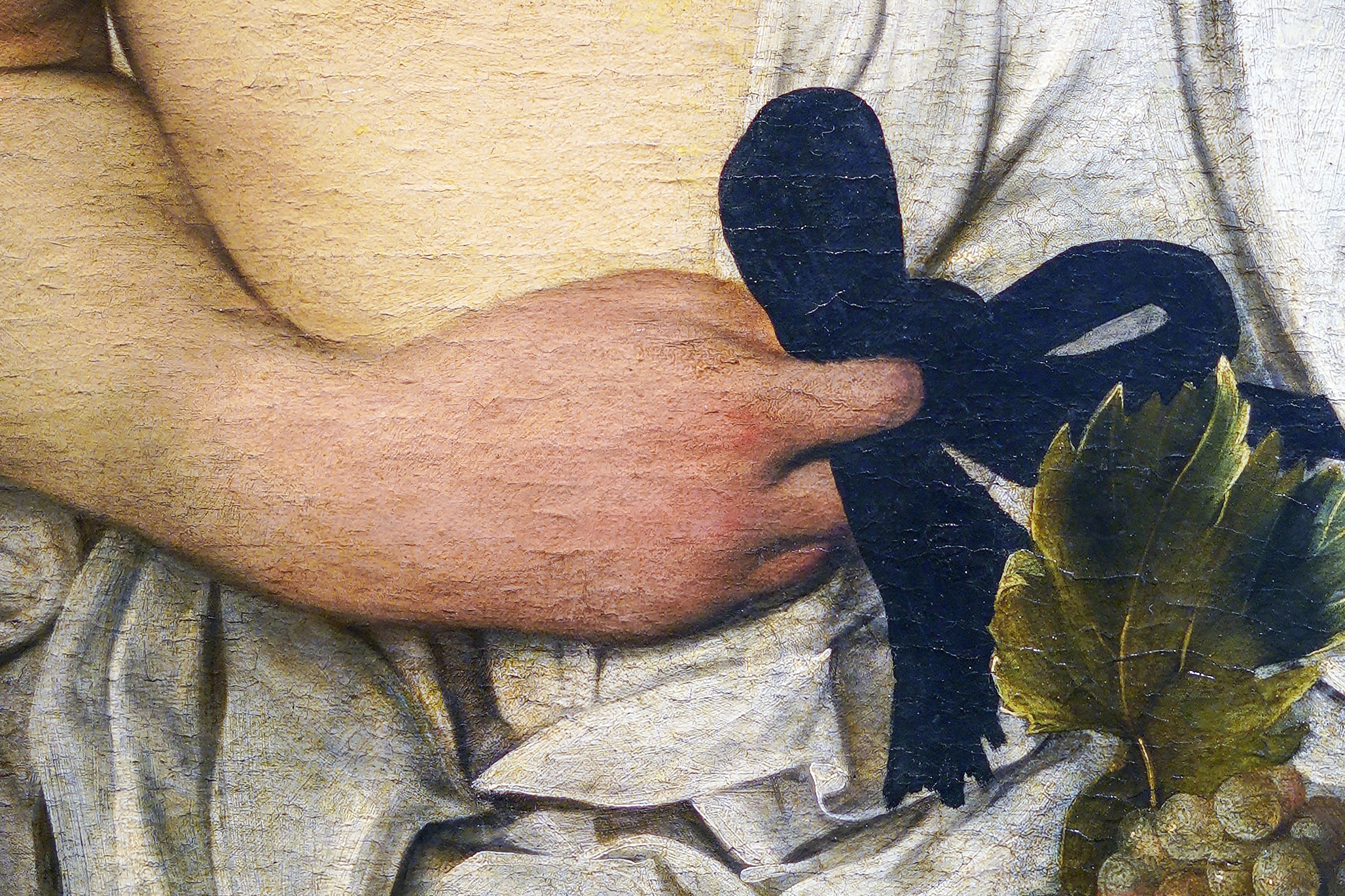
The other hand gathers a dark ribbon near the body. Its loops make rounded shapes against the broad folds of white fabric.
The contrast is both tonal and tactile. The ribbon looks smooth and concentrated; the cloth spreads into larger passages of light and shadow. The hand joins them without making the pose rigid.
The gesture has contributed to sensual readings of the painting. That is a response supported by the relaxed body and drapery, but the image does not dictate one private intention for the figure. It can sustain ambiguity without requiring an invented narrative about the sitter.
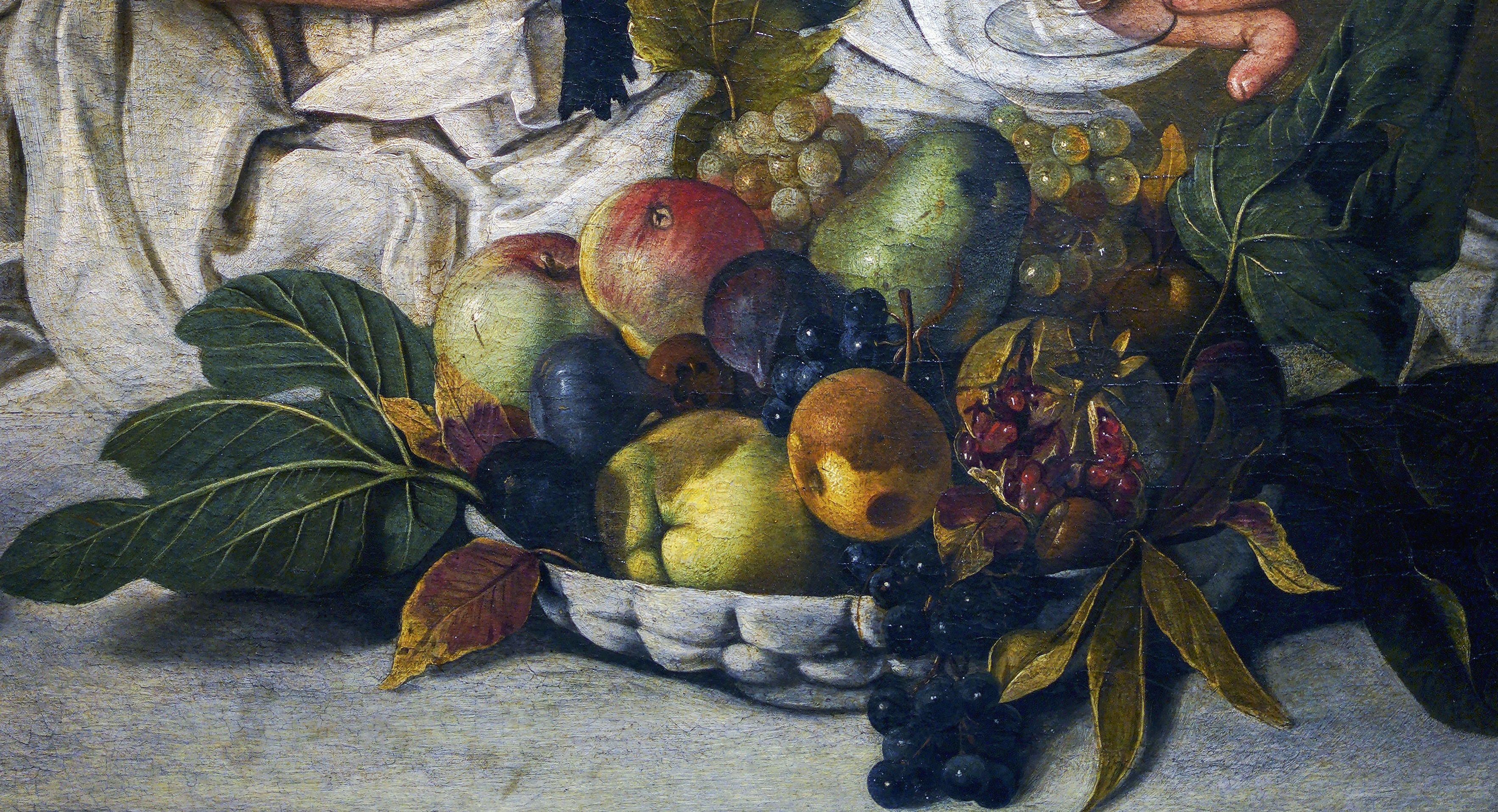
The foreground bowl holds grapes, other fruit and leaves in different conditions. Some skins are marked; some leaves bend or darken. The arrangement is abundant without making every surface flawless.
Those differences reward the same attention as the figure's face. A viewer can move from the invitation in the glass to the changing material world on the table.
Fruit's capacity to ripen and spoil has encouraged readings involving the passage of time. The association is reasonable, but it should not flatten every blemish into an individually decoded symbol. Caravaggio also uses imperfect fruit to make things look particular.
The Uffizi presents several interpretations of the offered wine and still life, including conviviality, friendship and a restrained enjoyment of life. Their coexistence is more useful than pretending a single meaning has been conclusively established.
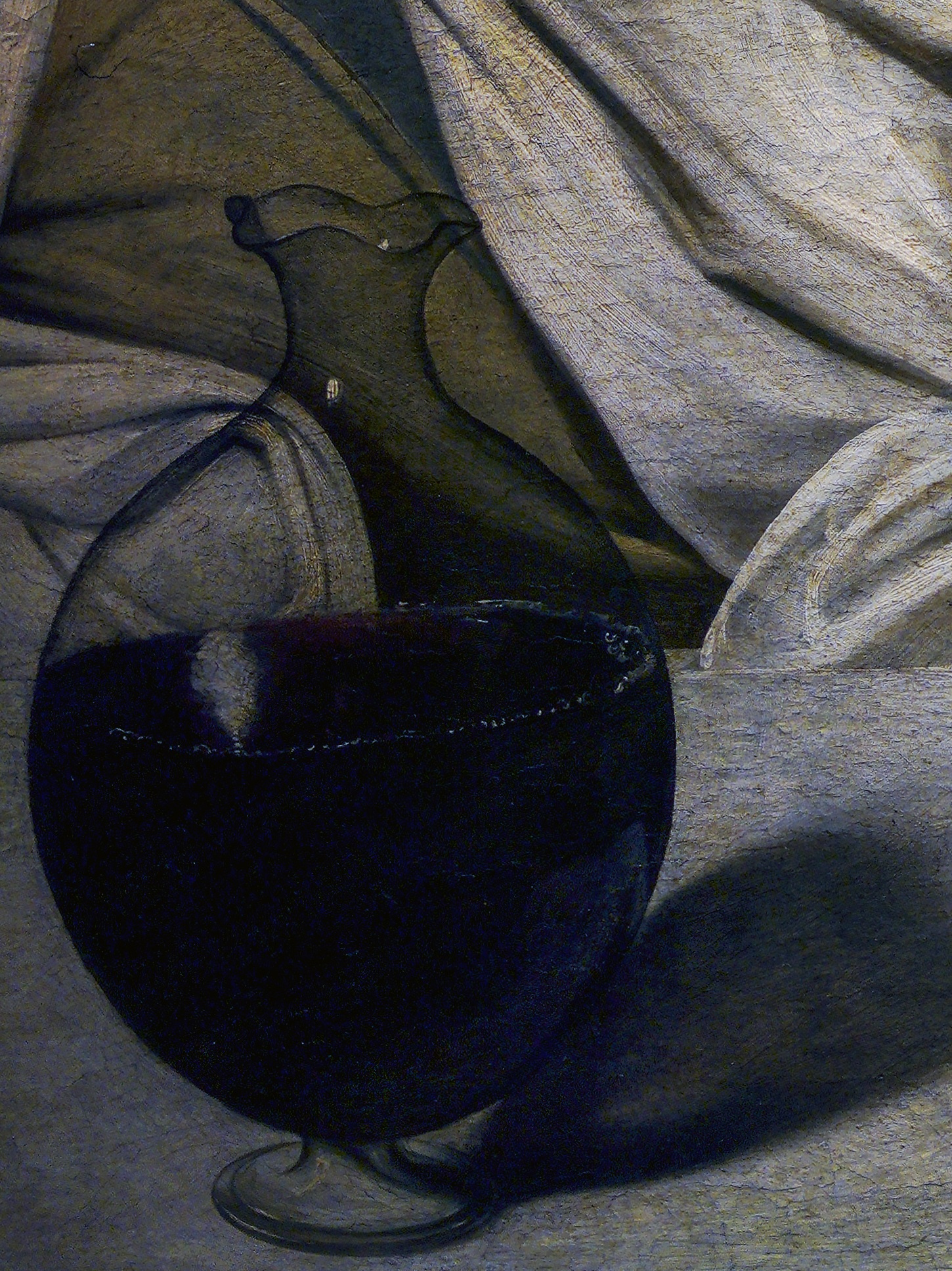
The carafe stands near the left edge. Its dark liquid and reflective glass create a concentrated shape beside the broad white fabric.
Its placement balances the offered wineglass on the other side of the figure. One container remains on the table; the other is held outward. The relationship helps the scene feel arranged for an encounter rather than merely assembled from unrelated objects.
Very small reflected shapes are sometimes discussed in accounts of this painting. A reproduced dark patch should not be treated as secure evidence for a miniature portrait unless the claim is supported by technical research. The carafe's visible reflective quality is already important without that additional certainty.
The Uffizi places Bacchus within a group of early, relatively light half-length subjects. The background here does not swallow most of the body. Skin, cloth and fruit remain broadly visible.
This matters if Caravaggio is remembered only through strong darkness and sudden illumination. His work includes different ways of making a figure and a still life persuasive.
A comparison with The Supper at Emmaus shows a continuity as well as a difference. In both paintings, a hand or object approaches the viewer's space, and food remains materially specific. The larger religious scene gives those devices another narrative purpose.
The Uffizi records its rediscovery in the museum's storerooms in 1913 and its attribution to Caravaggio by Roberto Longhi. Its present fame should not make that history invisible.
A work can be physically present in a collection without holding the status it later acquires. Recognition involves research, attribution and renewed looking, not simply the survival of a canvas.
The painting's own encounter remains simpler than that later history. A figure looks outward. A glass is offered. The viewer is left to consider whether the invitation promises friendship, pleasure, a passing experience or something less easily settled.
It is in the Uffizi, Florence, inventory 1890 no.5312. The canvas measures 95 by 85 centimetres.
The Uffizi dates it to about 1598. Earlier sources sometimes use a slightly earlier date within the 1590s.
A shallow glass of wine held toward the viewer. Grapes, vine leaves and the nearby carafe reinforce his identity as the god of wine.
No. Bacchus in the Uffizi is a different painting from the work known as Young Sick Bacchus in the Galleria Borghese.
Painting photographs: Commonists / Wikimedia Commons, CC BY-SA4.0. Images have been resized and cropped; these image derivatives retain that licence. The historical painting itself is public domain.
Caravaggio, Bacchus, about1598, Uffizi, Florence. Photograph by Commonists, Wikimedia Commons, CC BY-SA4.0: https://creativecommons.org/licenses/by-sa/4.0/. Resized full image and cropped details are shared under the same licence. The underlying painting is public domain.
Enjoyed this story?
Save articles to your collection
Log in or create a free account, and this article will be waiting in your Private Collection.
Log in or sign up
Man Writing a Letter
Gabriel Metsu, c. 1664
The gallery list
Every painting is already 50% off. Join the list and we will send you an extra $15 code, plus first access to new collections.
No spam. Unsubscribe anytime. · Privacy Policy
Welcome
Your $15 code is on its way. Explore the gallery while you wait.