Loading cart…
No products in the cart.

The Trojan War in Paintings · Part 1 of 3
The Trojan War begins with a wedding, an apple and a beauty contest, and it is the most painted story in Western art. Before Achilles ever picks up a spear, three goddesses undress on a mountain and a shepherd chooses one of them. This is the first part of the war told through the paintings we make by hand: the apple, the choice, and the face that a thousand ships were launched for.
Everything starts at a party. Peleus, a mortal king, married Thetis, a sea goddess, and every god was invited except one. Eris, the goddess of discord, came anyway and rolled a golden apple across the floor with three words on it: for the fairest. Three goddesses reached for it, Hera, Athena and Aphrodite, and Zeus, who was not a fool, refused to choose between his wife, his daughter and the goddess of love. He sent them to a shepherd on Mount Ida.

Hendrick de Clerck, a Flemish painter working for the archdukes in Brussels, gives the wedding the full Olympian crowd, and if you look at the right-hand side you can find the trouble arriving. Painters liked the scene because it let them put every god in one picture. Homer does not tell it; he assumes you know. The Iliad starts nine years into the war, and the whole apple business is background that the poet mentions once, in a single line about Paris, "who insulted the goddesses when they came to his sheepfold".
He praised the one who offered him a grievous lust.
Homer, Iliad, translated for this article, Book 24
The shepherd was Paris, a prince of Troy who had been left on the mountain as a baby because of a prophecy that he would destroy the city, and had been raised by herdsmen. Hermes brought the three goddesses to him and each made an offer. Hera offered power, Athena offered victory in war, Aphrodite offered the most beautiful woman in the world. He gave the apple to Aphrodite. The most beautiful woman in the world was already married to a Greek king.
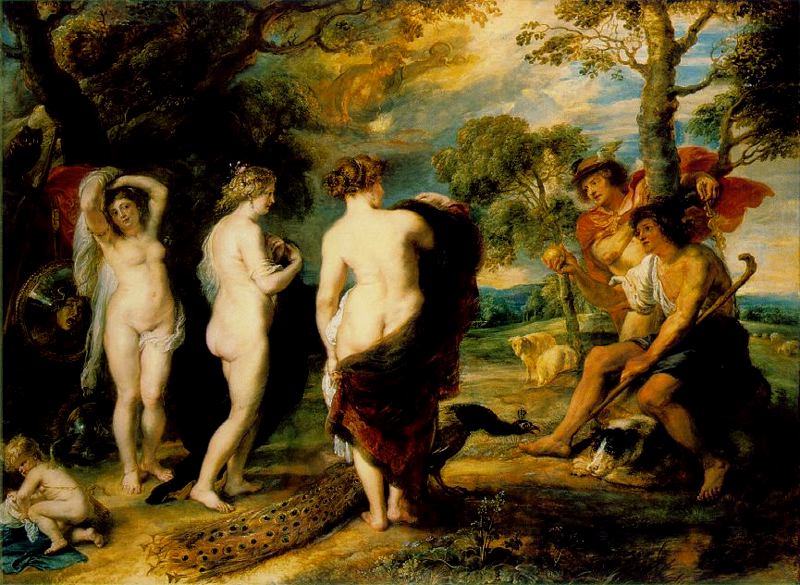
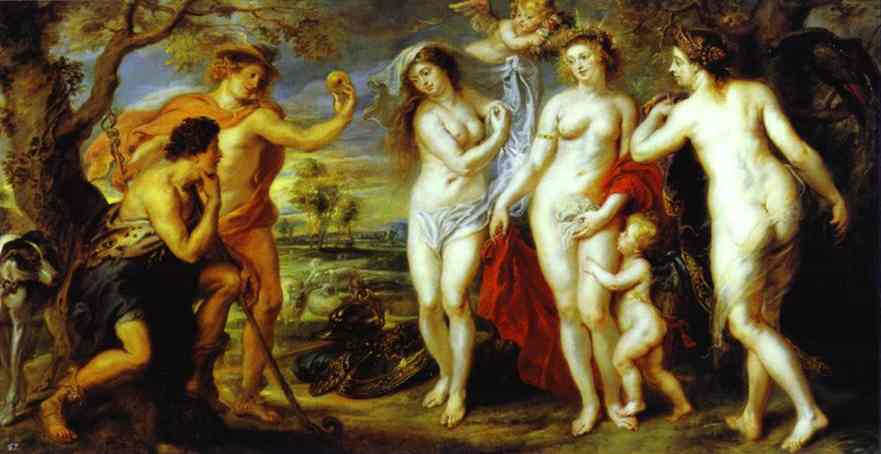
No scene in mythology has been painted more often, for a reason that is not hard to guess: it is three nude women being judged by a man, with a classical excuse. But the good painters made something of it. Rubens, who painted it at least four times, treats it as a debate, with each goddess making her case in a different pose, and gives Paris the face of a man who knows he is about to make a mistake. In his other version the goddesses are seen from the side and Paris is almost in shadow.
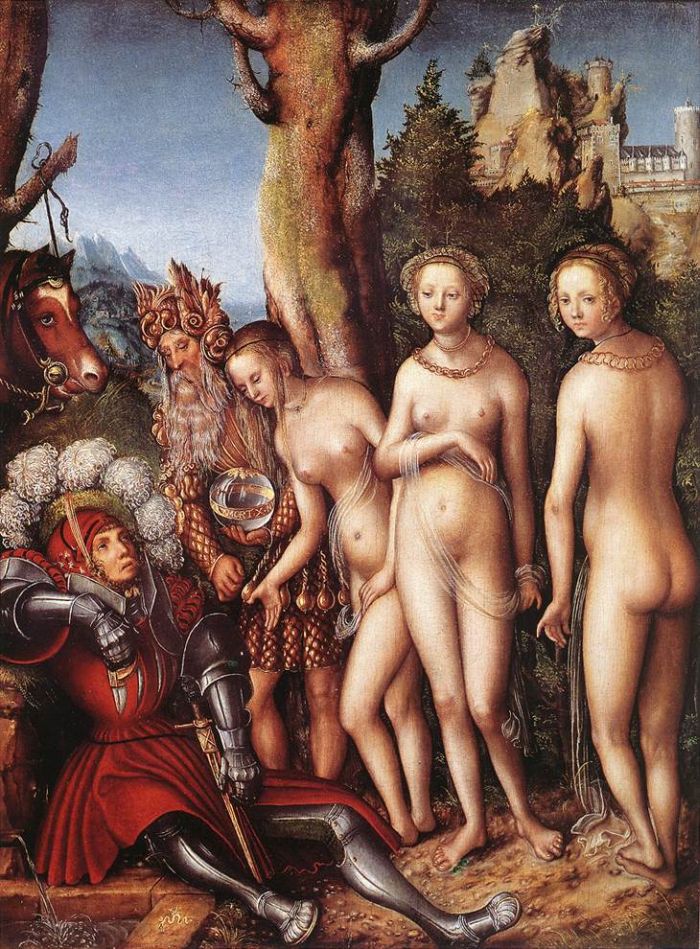
Lucas Cranach painted it more than a dozen times for the Saxon court, and his versions are the strangest: Paris is a German knight in full armour, asleep or dozing under a tree, and the three goddesses are thin, pale Cranach nudes in transparent veils and enormous hats. Hermes is an old man with a beard. The apple is a glass ball. The whole scene looks like a dream, which is probably how Cranach meant it.
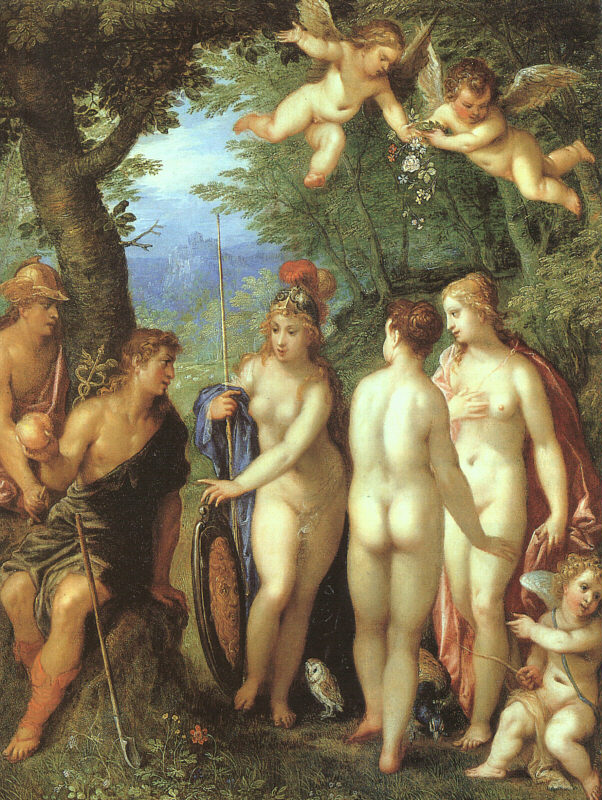
Joachim Wtewael, in Utrecht, made it a Mannerist fantasy with twisting bodies and a picnic of gods in the sky; Frans Floris and Hans von Aachen filled the scene with flesh for their courtly buyers; Hendrick van Balen made it small and jewel-like. The Victorians tried to be serious about it: Etty painted it as a colour exercise in the manner of Titian, and Watts, decades later, painted it as a tall, quiet canvas with all the noise taken out.
 The Judgment of Paris
 The Judgment of Paris
 The Judgment of Paris
 The Judgement of Paris
 The Judgement of Paris
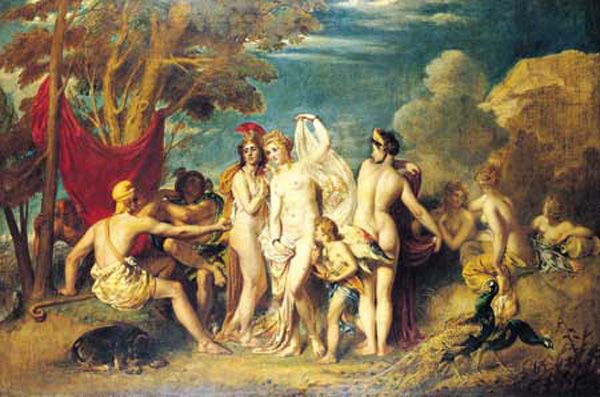 The Judgement of Paris
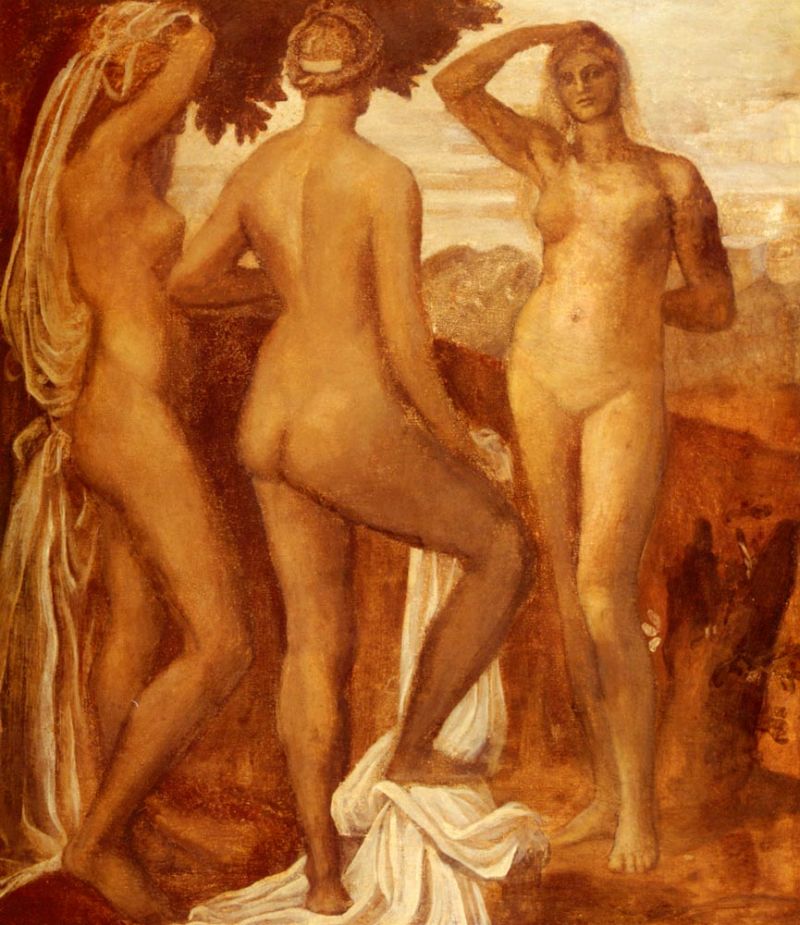 The Judgement of Paris
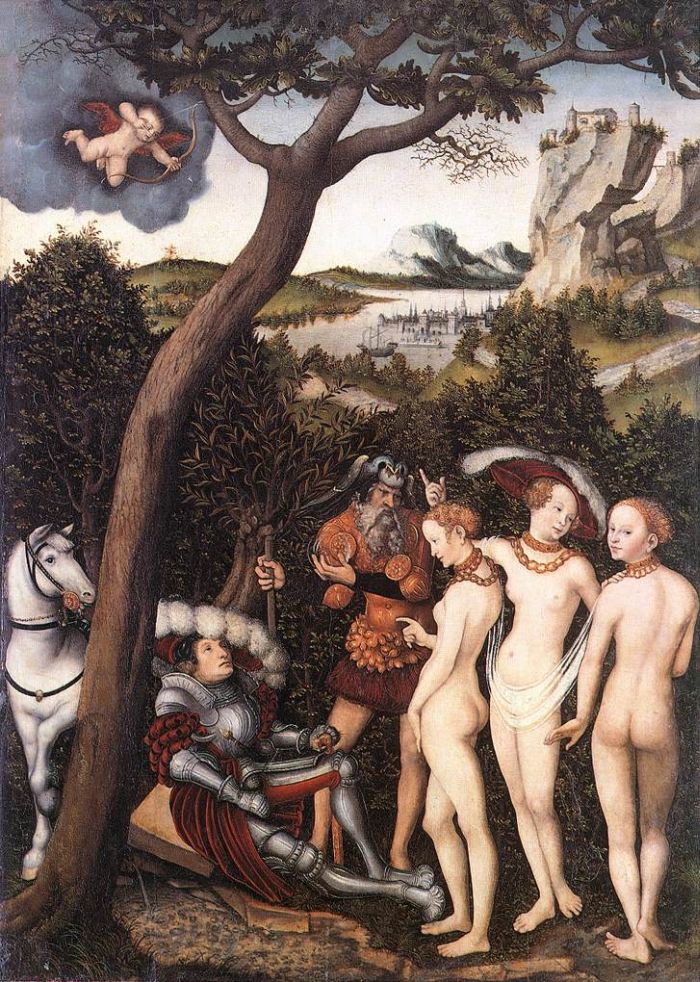 The Judgment of Paris
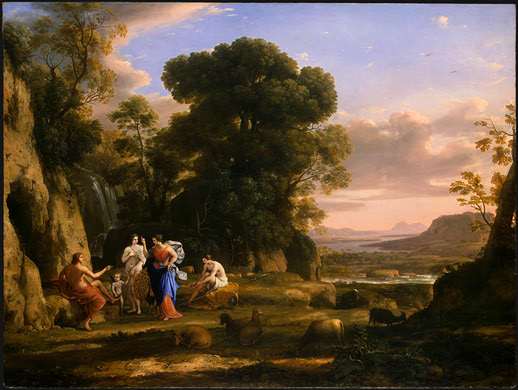
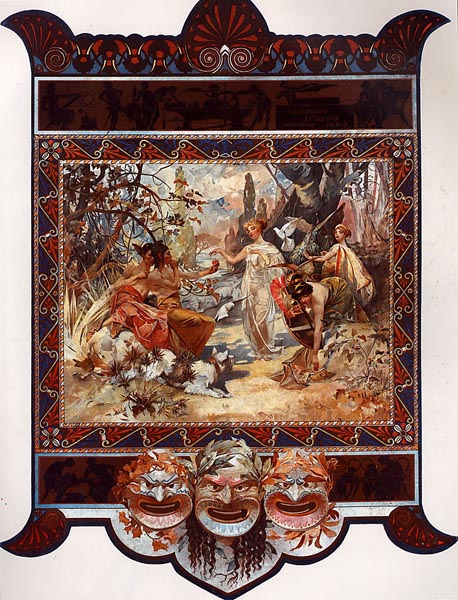
Claude Lorrain, who did not much care about bodies, put the whole contest in the corner of an enormous landscape, and Alphonse Mucha, in 1895, turned it into a calendar. Between them the subject has been used for four hundred years to paint the nude, the landscape, the court and the poster. Nobody has ever painted it as what it is in the story, which is the worst decision in literature.
Before Helen there was Oenone. Paris, as a shepherd, had loved a nymph of Mount Ida, and Claude Lorrain painted them in the landscape he loved best, a river valley with the sea beyond, Paris carving her name into a tree. Ovid gave Oenone a letter in his Heroides, written after Paris has sailed for Greece, in which she reminds him of the tree and tells him the name is still growing.
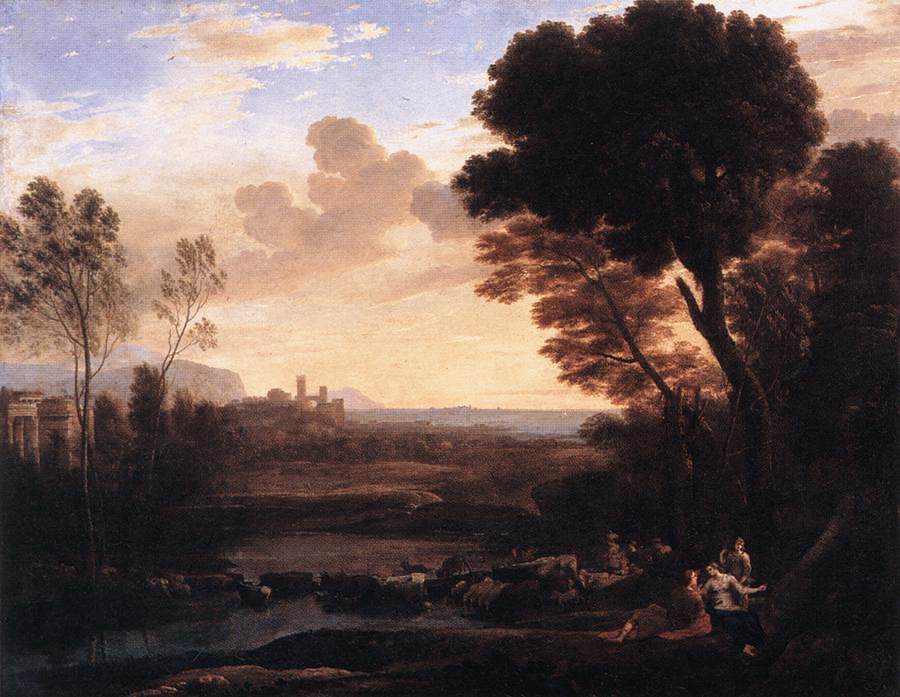
Donato Creti, in Bologna, painted the moment Mercury arrives with the message from Zeus, and made it a nocturne: the god descending in the dark to a shepherd who has no idea what he is being handed. It is the last quiet moment in the story.

Helen was the daughter of Zeus and Leda, the wife of Menelaus, king of Sparta, and the most beautiful woman alive. Aphrodite had promised her, and Aphrodite delivered: Paris sailed to Sparta as a guest, and left with the host's wife. Whether Helen went willingly is the question the whole tradition argues about, and the painters take sides.

Benjamin West has Venus lead Helen to Paris by the hand, with Cupid doing the pushing: the goddess made her do it. Jacques-Louis David, twelve years later, paints the two of them alone in a bedroom in Troy, Paris with his lyre and Helen leaning on him, in the calmest painting he ever made. It was commissioned by the Comte d'Artois, the king's brother, and it is about pleasure, not blame. David finished it a year before the Revolution.
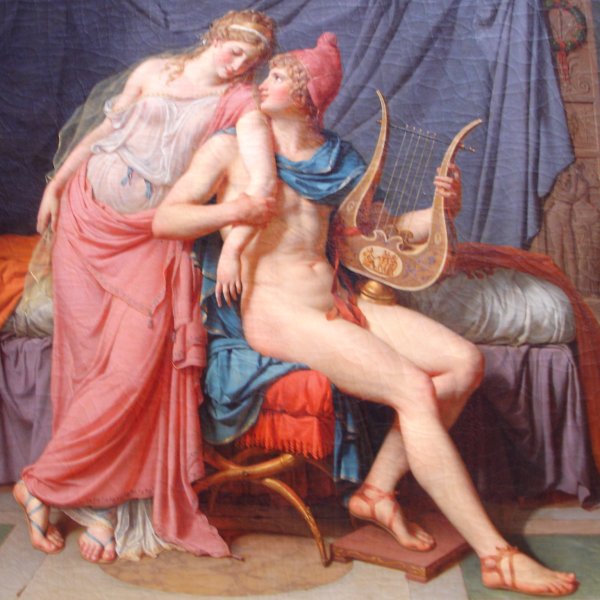
Homer is subtler than either. In Book 3 Helen comes up onto the wall of Troy to watch the Greeks, and the old men of the city, who have every reason to hate her, look at her and say this:
No one could blame the Trojans and the Greeks for suffering so long for a woman like this. She is terribly like the immortal goddesses to look at.
Homer, Iliad, translated for this article, Book 3
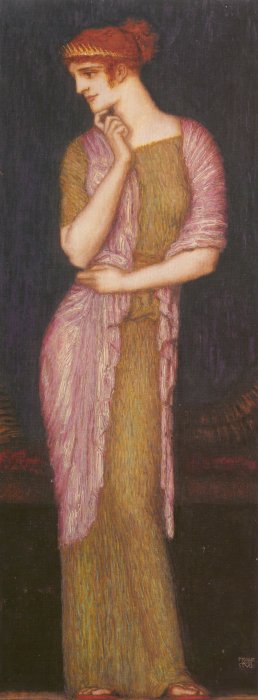
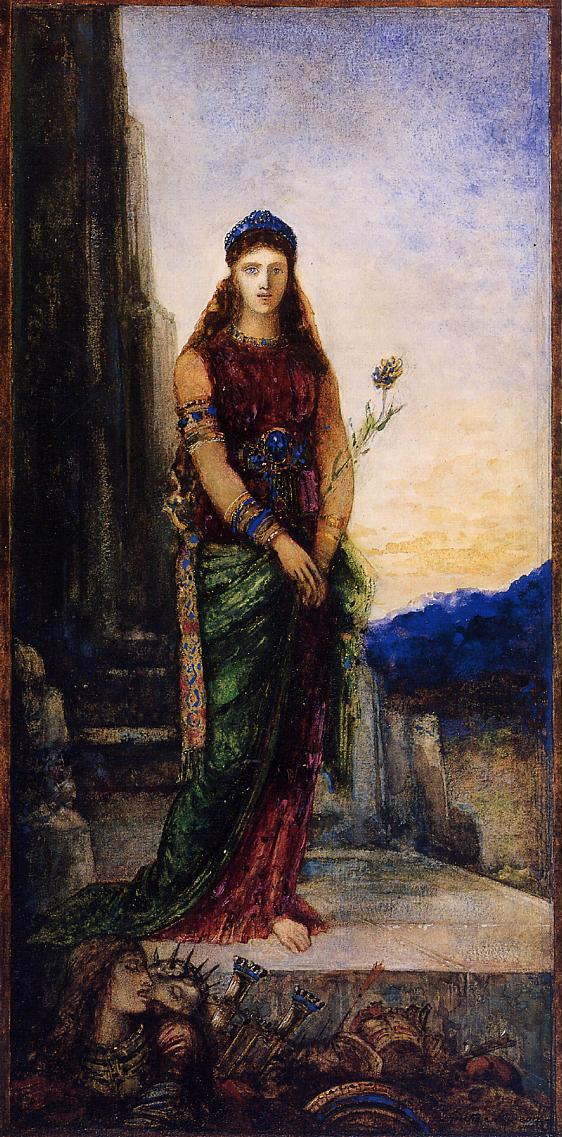
Gustave Moreau painted her on that wall, a tall pale figure in a jewelled dress standing above the smoke, expressionless. Moreau made several versions and she is always the same: not a woman but a fact, like the weather, that men die under. Franz von Stuck, in the 1920s, painted her as a single column of a figure in a dark dress, the last of the Symbolist Helens.
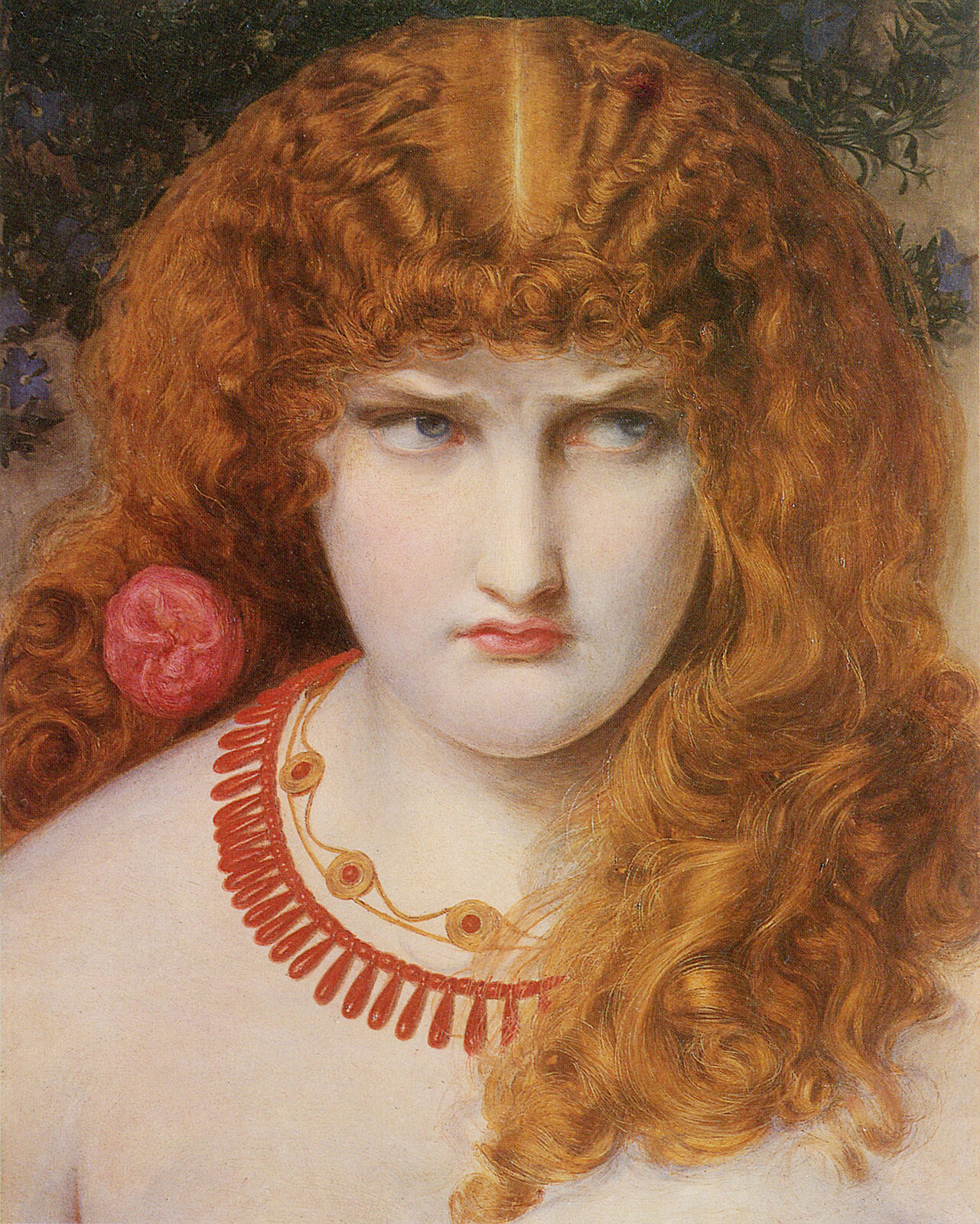
The Pre-Raphaelites took the opposite view. Frederick Sandys painted her in 1867 as a head and shoulders, close enough to touch: a fall of red hair, a jewelled collar, and a mouth turned down in a sulk that is halfway to a snarl. There is no Paris and no city. Sandys, who used a Romani model called Keomi Gray for his most dangerous women, does not think she was innocent, and he does not think it matters. It is the face people mean when they say the face that launched a thousand ships, and it belongs to someone who would have done it again.
The next part follows the man the war was really about. Achilles was a baby on a centaur's back when the apple was thrown, and by the time Helen stood on the wall he was the best soldier in the world, sitting in his tent, refusing to fight.

Dates for the smaller works follow the catalogue attributions on our product pages; where a museum gives a range, the range is used.