Loading cart…
No products in the cart.

The Trojan War in Paintings · Part 3 of 3
Homer never tells the end of the war. The Iliad stops at Hector's funeral; the horse, the sack and the burning city come from later poets, above all Virgil, whose Aeneas tells the story to Dido at a dinner. Painters did not mind where it came from. The fall of Troy is the great catastrophe picture, a city on fire at night, and this last part follows it from the quarrel over Achilles' armour to the ships sailing away.
Achilles died as his mother said he would, with an arrow in the heel, shot by Paris. The armour Hephaestus made for him was to go to the best of the remaining Greeks, and two men claimed it: Ajax, the strongest, and Odysseus, the cleverest. The Greeks voted for Odysseus. Ajax went mad with rage, slaughtered a flock of sheep believing they were the generals, and killed himself when he saw what he had done.
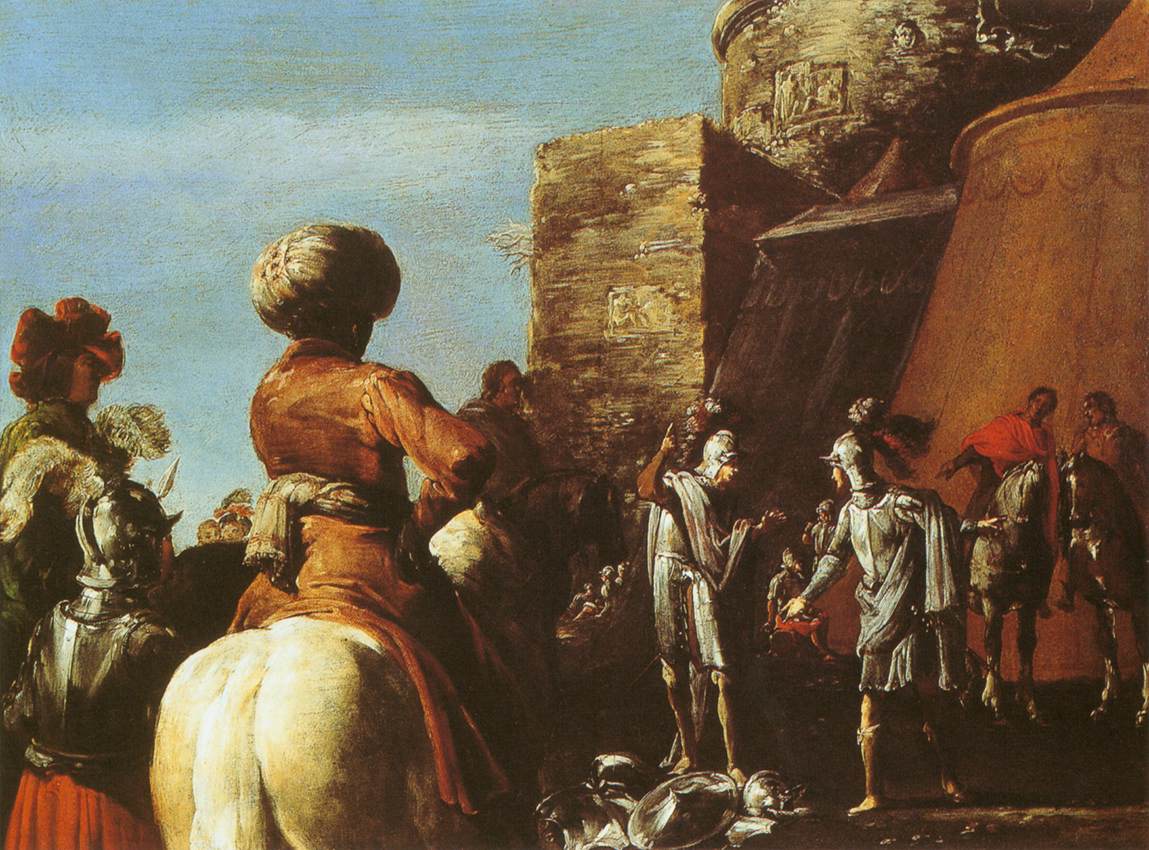
Leonaert Bramer, who painted everything by torchlight, shows the argument in front of the assembled army. It is the moment the war stops being about strength. Odysseus wins the armour and, shortly afterwards, thinks of the horse.
The idea was simple and insane: build a hollow wooden horse, hide the best men inside it, burn the camp, sail the fleet out of sight, and leave one man behind to tell the Trojans it was an offering to Athena. The Trojans argued. The priest Laocoön threw a spear at it and said the line everyone remembers.
Whatever it is, I fear the Greeks even when they bring gifts.
Virgil, Aeneid, Book 2, translated for this article
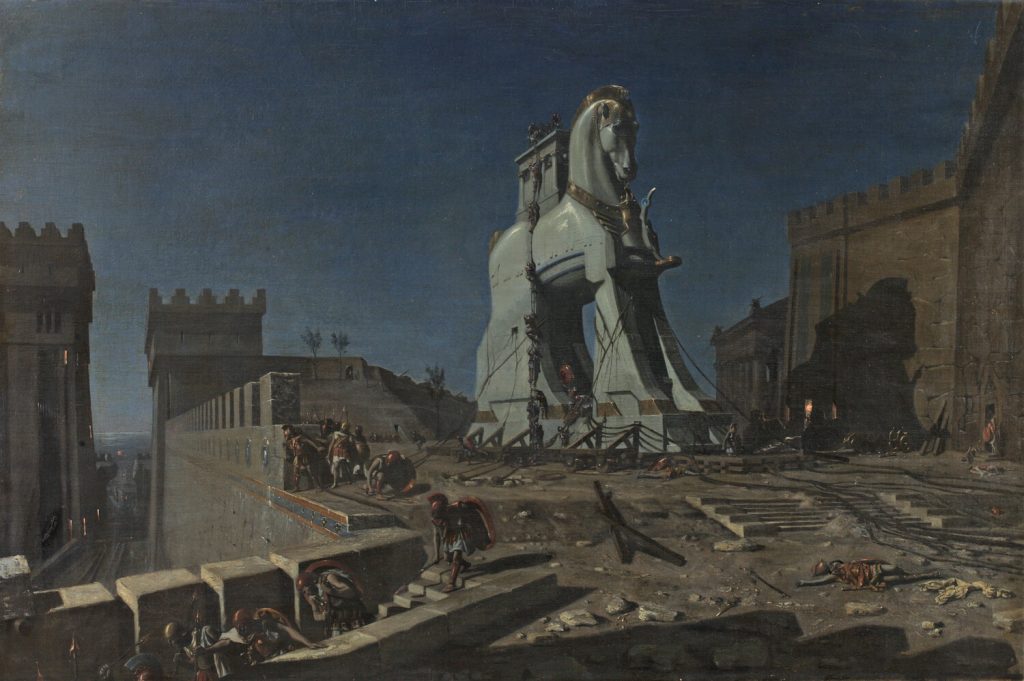
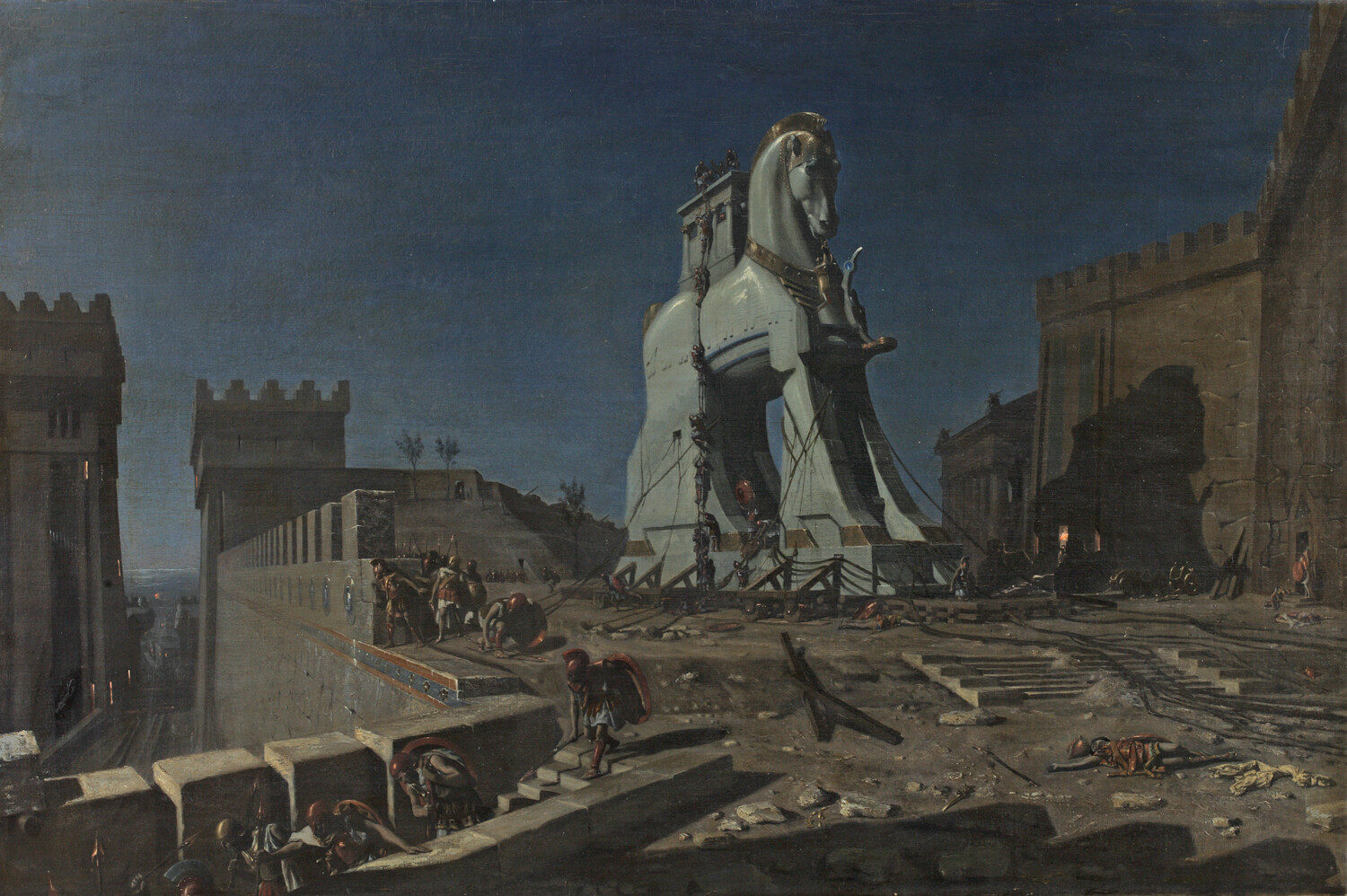
Two sea serpents came out of the water and killed Laocoön and his sons, which settled the argument. The horse that everyone pictures at this moment is Henri-Paul Motte's: a colossal thing of dark timber and bronze standing at the gate at dusk, with the Trojans gathered beneath it like ants and nothing happening yet. Motte, a pupil of Gérôme, painted it in 1874 with the polish of an archaeologist, and it has been in every schoolbook since. It is the horse before the night.
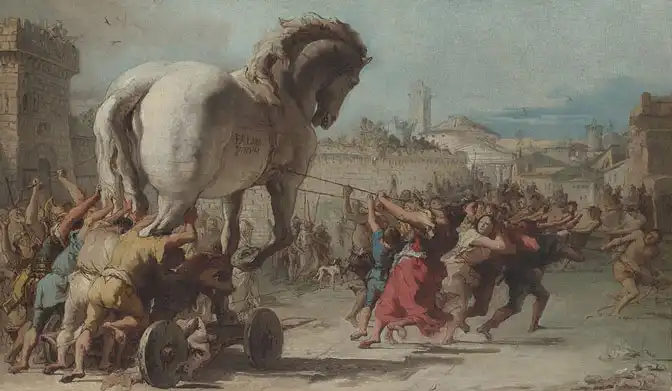
The Trojans knocked down part of their own wall to get the horse in. Giovanni Domenico Tiepolo, the son of the great Giambattista, painted the procession in the 1770s, in the pale, ironic manner he used for everything late in life: the enormous horse, the tiny cheerful crowd, and a sky that already looks like smoke.
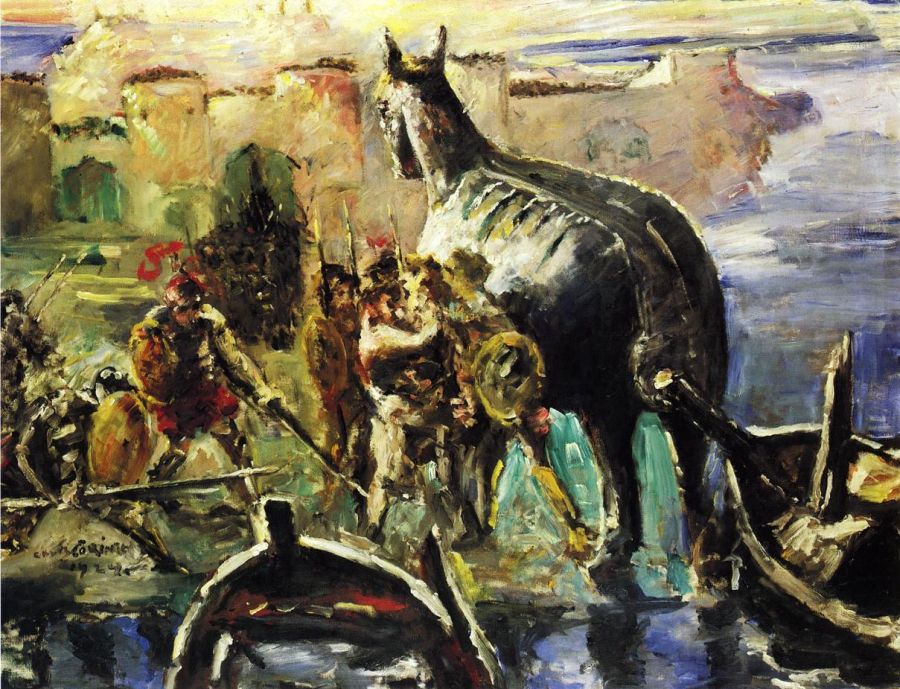
Lovis Corinth painted it in 1924, the year before he died, after a stroke had left his hand shaking and turned his brushwork into a storm. His horse is a lurching brown mass in front of a wall of towers, and the Trojans hauling it look like a mob at a fire. It is the same scene as Tiepolo's, seen from the other end of a century that had just had a war.
The men came out of the horse at night, opened the gates, and the fleet, which had only sailed round the headland, came back. What followed is the sack of Troy: Priam killed at his own altar, Hector's son thrown from the walls, Cassandra dragged from the temple, the women divided among the victors, and the city burned. Painters from the sixteenth century on made it the great night picture, because a burning city is the one subject in which darkness and light fight on equal terms.

Adam Elsheimer, a German working in Rome, painted it on a copper plate the size of a book, and it taught a generation, Rembrandt included, how to paint fire at night. Kerstiaen de Keuninck, in Antwerp, made the same subject a vast Flemish panorama, with the horse still standing in the square, the towers alight, and the whole population running for the gates.
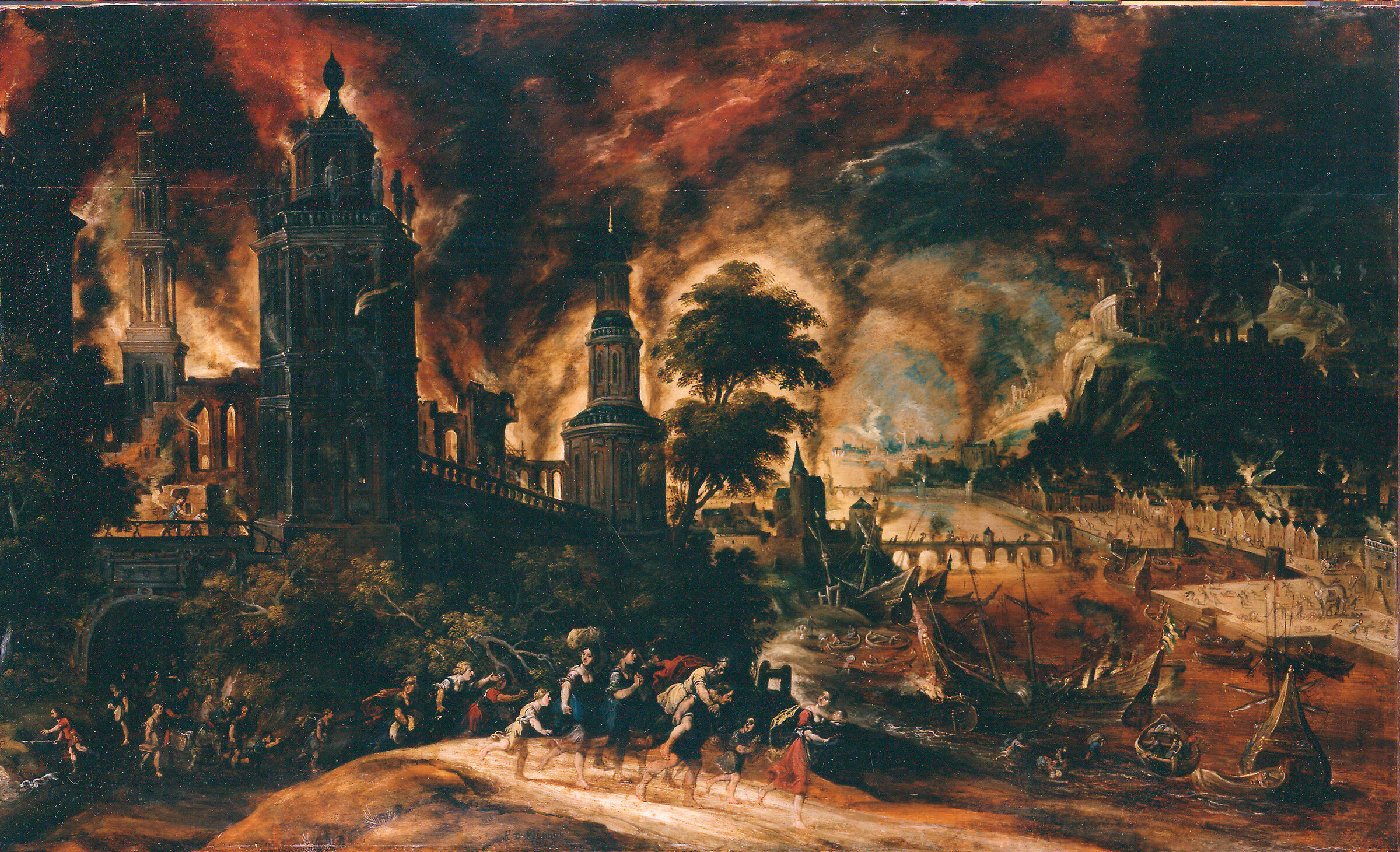
Out of that crowd comes one family. Aeneas, a Trojan prince, carries his old father Anchises on his back, holds his small son by the hand, and loses his wife in the dark. Virgil made him the founder of Rome, and the escape became one of the most painted moments in the whole story, because it is the one act of decency in a night of atrocity.


The war was over and the going home began, and that is where the story turns into the Odyssey. Menelaus took Helen back to Sparta and, according to Homer, they grew old together. Agamemnon sailed home to Mycenae and was murdered in his bath by his wife, who had not forgiven him for Iphigenia; Leighton painted his daughter Electra at his tomb, all in black, waiting for the brother who will avenge him. And Odysseus, the man who thought of the horse, took ten years to get back.

His ten years are their own three-part story on this site: the cyclops, Circe, the Sirens, Calypso, and the dog who knew him when he came home. The apple that Eris rolled across the floor at a wedding took twenty years and two poems to stop rolling.
Homer and Virgil are quoted in our own prose translations. The events after Hector's funeral are not in the Iliad; the sources for each episode are named in the text.