Loading cart…
No products in the cart.

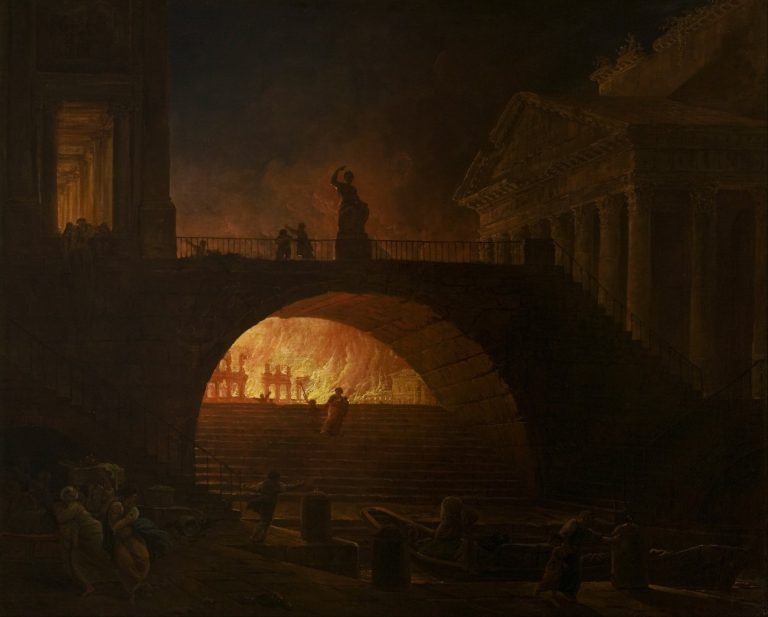
c. 1771 · Oil on canvas · Musée d'art moderne André-Malraux (MuMa), Le Havre, France
Save articles to your collection
Log in or create a free account, and this article will be waiting in your Private Collection.
Log in or sign upRome is burning. Through the great dark arch of a bridge, a wall of orange flame rises behind ruined arcades and temples, so bright it seems to light the whole painting from behind. In the foreground, everything is in shadow: a monumental staircase, temple fronts, a bridge with an iron railing and a statue standing on it. People flee in every direction, small and dark against the enormous architecture.
The French painter Hubert Robert painted this scene around 1771. It shows the Great Fire of Rome of AD 64, one of the most famous disasters of the ancient world. But Robert is less interested in the history than in the spectacle: the contrast between fragile human figures, colossal stone buildings and a fire that dwarfs them both.
The fire broke out in July of AD 64, during the reign of the emperor Nero, in the shops around the Circus Maximus. Driven by the wind, it burned for about six days, died down, then flared up again. According to the Roman historian Tacitus, only four of the city's fourteen districts escaped untouched; three were completely destroyed.
Rumours quickly spread that Nero had wanted the fire, to clear space for his new palace, the Golden House. Tacitus reports a story that the emperor sang of the fall of Troy while Rome burned, which later became the famous legend of Nero playing the fiddle. To deflect the blame, Nero accused the Christians of Rome, who were persecuted and executed. The fire became one of the great images of a civilisation at the edge of destruction.
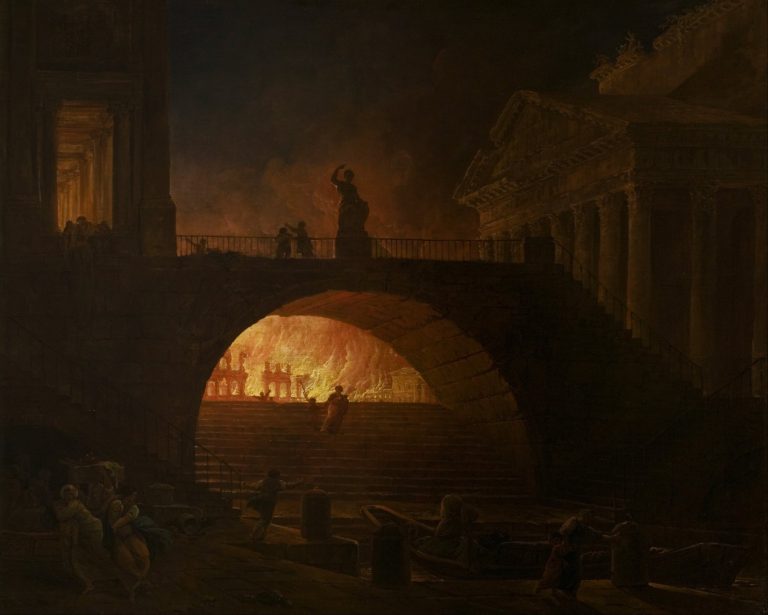
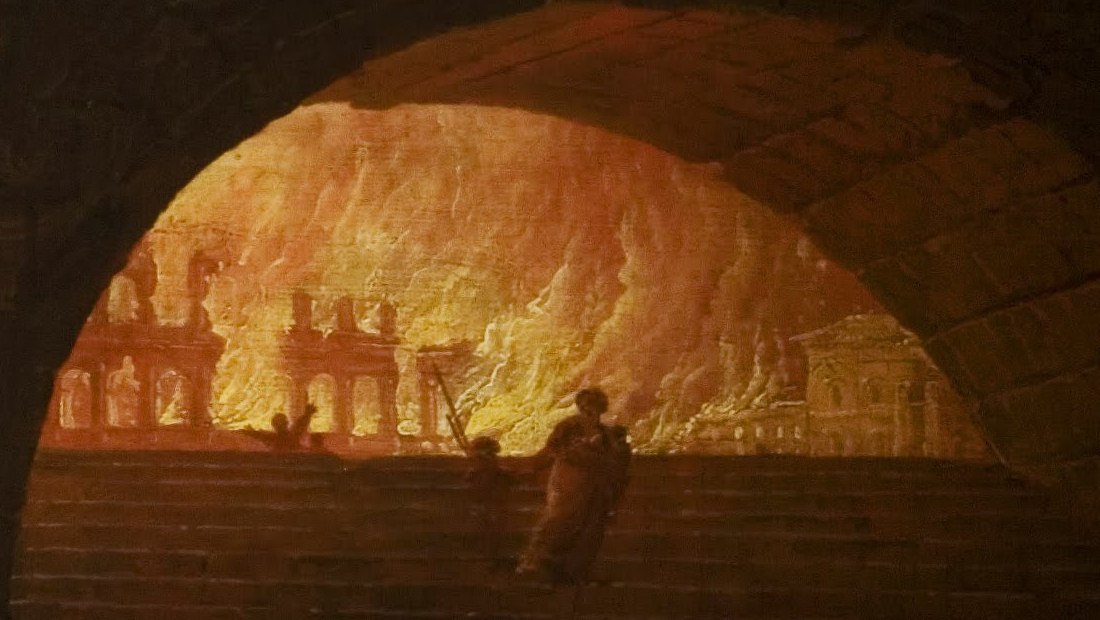
Robert builds the whole painting around a single effect of backlighting. The fire is not in front of us but behind the buildings, and we see it framed by the black opening of a vast arch, like a stage set lit from the back. Everything in front of it is reduced to silhouette.
The effect does two things at once. It unifies a crowded composition, because everything is lit by the same glow. And it makes the fire seem even bigger than it is: we only see a fragment of it, and imagine the rest.
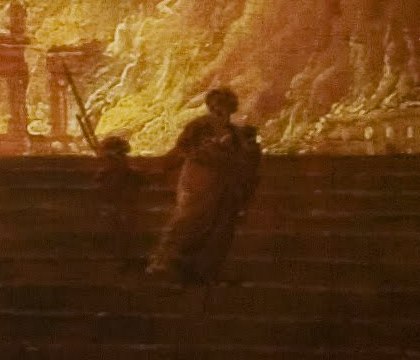
At the very centre, inside the arch, a woman walks down the steps holding a child by the hand. She is tiny against the fire, and she is the emotional heart of the picture.
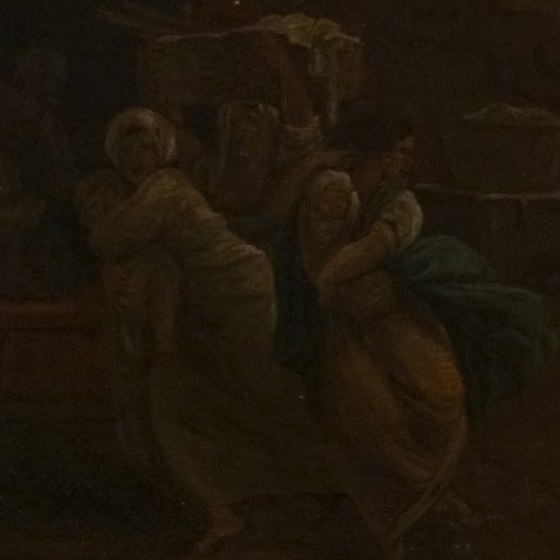
Look closely at the people escaping, and you will notice that Robert shows almost only women: carrying bundles, clutching children, looking back at the flames. The MuMa in Le Havre, which owns the painting, points out that this choice adds to the drama and draws the viewer's sympathy. Women and children in flight were, for an eighteenth-century audience, the most moving image of a city's catastrophe.
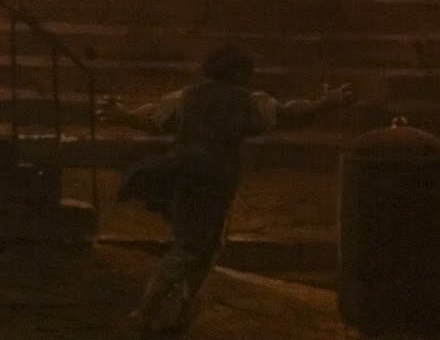
None of them is a hero, and none is named. Robert does not paint Nero, or soldiers, or firefighters. The real protagonists are the city and the fire.
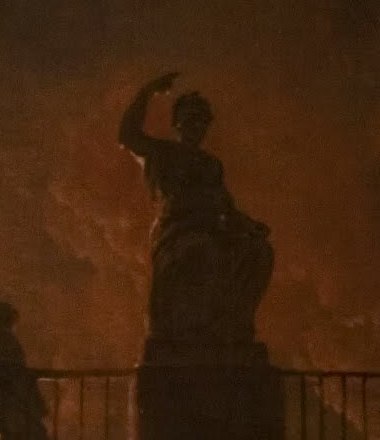
Right above the arch, on the parapet of the bridge, stands a classical statue with one arm raised above its head, black against the glowing smoke. It sits directly above the woman with her child on the stairs below, so the two figures line up in the centre of the painting.
What you can see, and what is interpretation: the statue, its raised arm and its position above the mother and child are all clearly painted. The MuMa reads the pairing as a symbol: the ancient world and the modern one, or the divine and the human, side by side in the moment of disaster. That is an interpretation, not something Robert wrote down, but the careful alignment makes it hard to see as an accident.
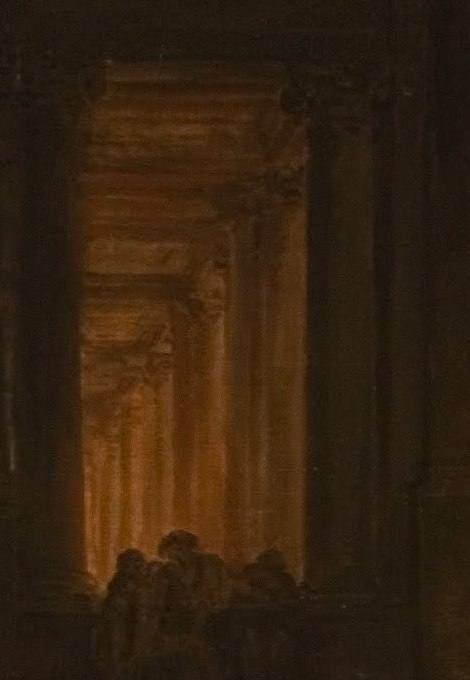
No. Robert was not painting an accurate view of the city in AD 64. He combines real and invented architecture into an ideal ancient Rome: temple fronts with triangular pediments, rows of columns, great arches and stairways, all on a scale far larger than life. This kind of imaginary architectural view was called a capriccio, and Robert was one of its masters.
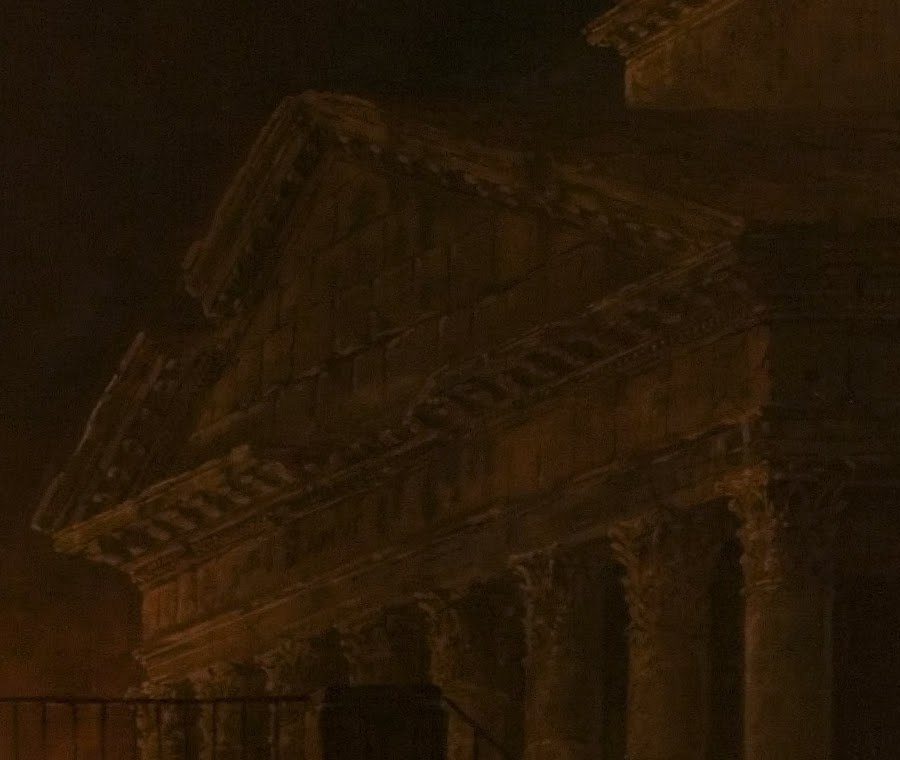
He had learned it in Rome itself, where he lived from 1754 to 1765. There he met the view painter Giovanni Paolo Panini and, above all, the printmaker Giovanni Battista Piranesi, whose dramatic etchings of Roman ruins taught him to make buildings feel gigantic and heavy with time. In The Fire of Rome, the architecture is so vast that the people seem like insects. That feeling of being overwhelmed was exactly what the eighteenth century called the sublime.
Hubert Robert was born in Paris in 1733 and died there in 1808. After his years in Rome he returned to Paris and made his debut at the Salon of 1767, where his paintings of ruins delighted the public and the critic Denis Diderot. His love of crumbling monuments earned him the nickname "Robert des Ruines", Robert of the Ruins.
He had an unusually varied career. He designed gardens, including the Bath of Apollo grove at Versailles, painted views of Paris being demolished and rebuilt, and was involved in planning the Louvre as a public museum, which he painted many times, sometimes imagining it in ruins. During the Revolution he was imprisoned in 1793 and 1794, and kept painting in his cell. The Fire of Rome brings together everything he loved: architecture, light and the drama of time and destruction.
More views of the Louvre by Hubert Robert appear in our guide to gallery wall ideas.
The painting is in the MuMa, the Musée d'art moderne André Malraux, in Le Havre, France, which bought it for the city. It is oil on canvas, 75.5 by 93 centimetres, and dates from around 1771.
We paint The Fire of Rome by hand in oil on canvas, at the original size or the size that suits your wall, with the glow of the flames and the deep shadows of the architecture built up in layers. See the hand-painted reproduction. Browse all our oil painting reproductions on canvas.
Thomas Cole imagined the rise and fall of a whole civilisation in The Course of Empire.
Enjoyed this story?
Save articles to your collection
Log in or create a free account, and this article will be waiting in your Private Collection.
Log in or sign upWhat can be seen in the painting, what is documented, and what is interpretation are kept separate throughout this article. Some online sources date the painting 1785; the owning museum dates it about 1771.

Man Writing a Letter
Gabriel Metsu, c. 1664
The gallery list
Every painting is already 50% off. Join the list and we will send you an extra $15 code, plus first access to new collections.
No spam. Unsubscribe anytime. · Privacy Policy
Welcome
Your $15 code is on its way. Explore the gallery while you wait.