Loading cart…
No products in the cart.

Art Guides · Interiors
Save articles to your collection
Log in or create a free account, and this article will be waiting in your Private Collection.
Log in or sign upA gallery wall is a group of pictures hung together so that they read as one: a single, larger work of art made from many. Done well, it looks collected over a lifetime. Done badly, it looks like a noticeboard. Here are ten gallery wall ideas, from the grand picture galleries of the seventeenth century to the stairs in your hallway, and a step-by-step guide to hanging one that looks curated, not crowded.
Every layout below is shown with real paintings from our collection, and each painting links to its hand-painted reproduction. For ideas on a single statement painting, see our guide to living room decor ideas.

The gallery wall is not a modern invention. In the seventeenth century, the great collectors of Europe hung their paintings frame to frame, from the floor to the ceiling, and had artists paint the result. David Teniers the Younger was court painter to Archduke Leopold Wilhelm, governor of the Spanish Netherlands, and the keeper of his famous collection, and he painted the Archduke's gallery in Brussels several times.
Look at how the walls work. The biggest pictures sit at eye level and in the centre; smaller ones fill the gaps above and below; the edges of the whole arrangement form clean straight lines. It is the same principle as a good gallery wall today: many pictures, one shape.
See Archduke Leopold Wilhelm in his Gallery as a hand-painted reproduction
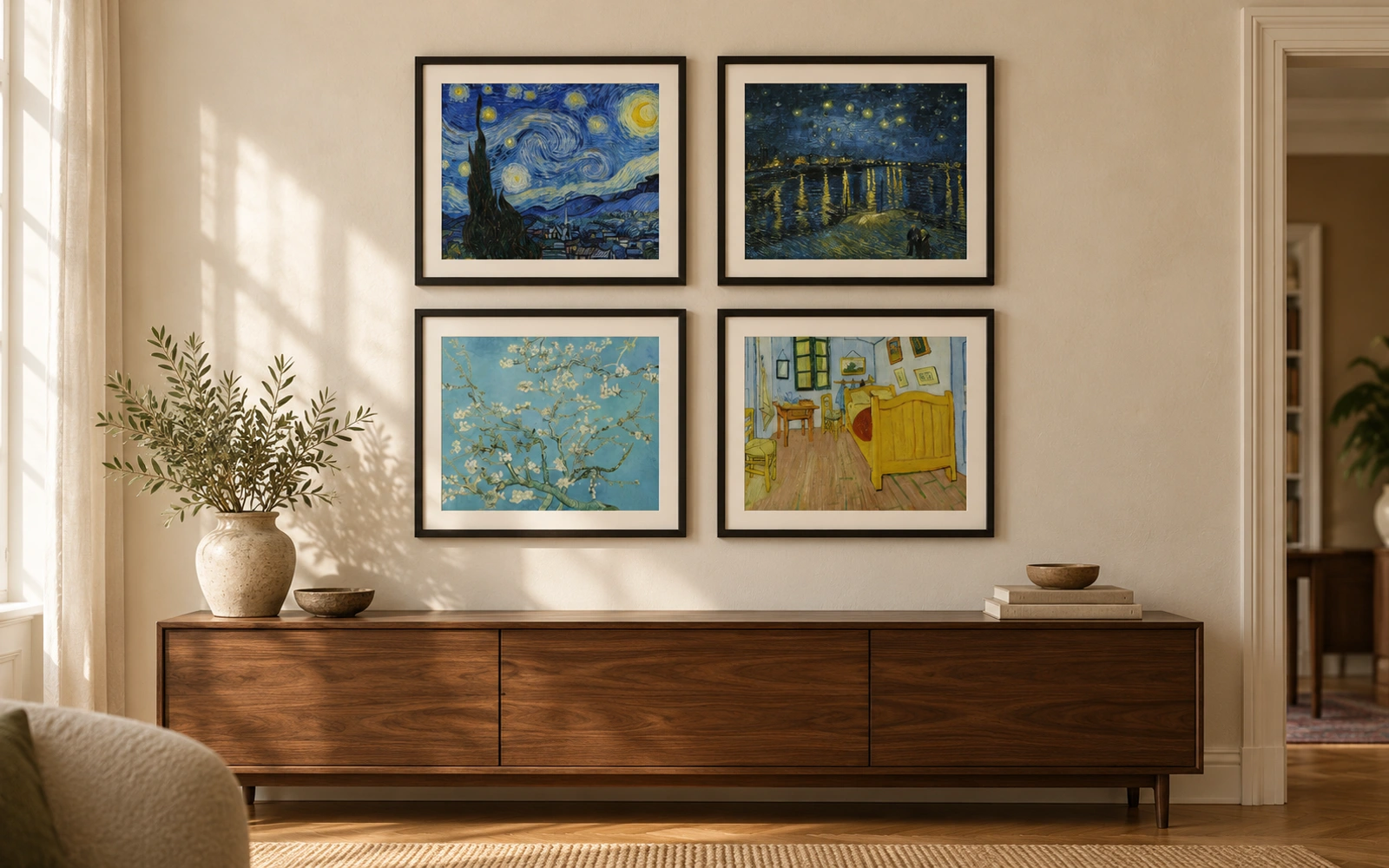
The simplest gallery wall is a grid: paintings of the same size, in the same frames, hung in straight rows and columns with exactly the same gap between them. It is calm, architectural and almost impossible to get wrong, which makes it ideal for modern living rooms, dining rooms and offices.
A grid works best when the pictures share something, such as one artist, one subject or one palette, because the identical frames already do the work of holding them together. Four, six or nine works are the classic numbers.
Paintings shown: The Starry Night, Starry Night Over the Rhône, Almond Blossom, The Bedroom in Arles
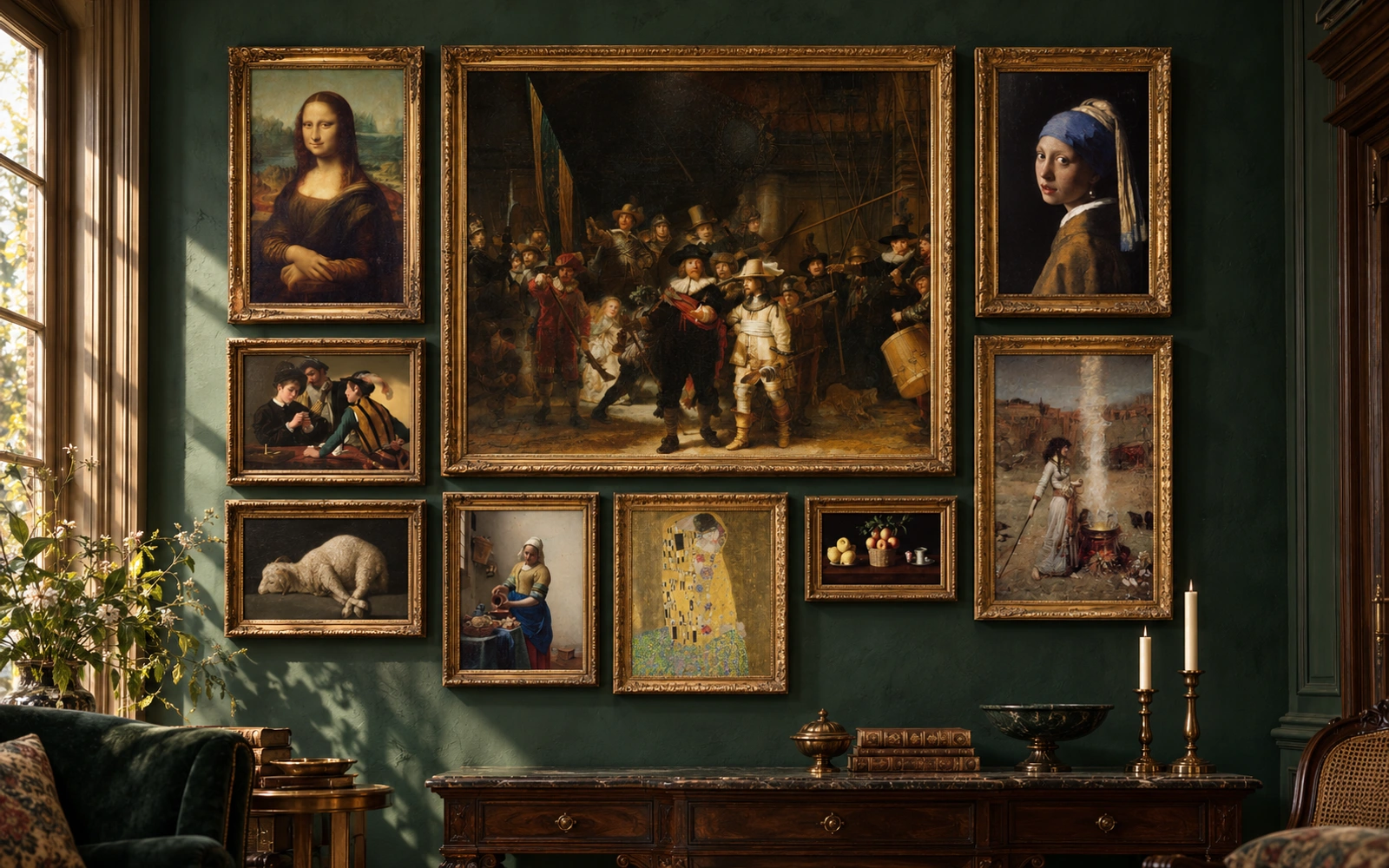
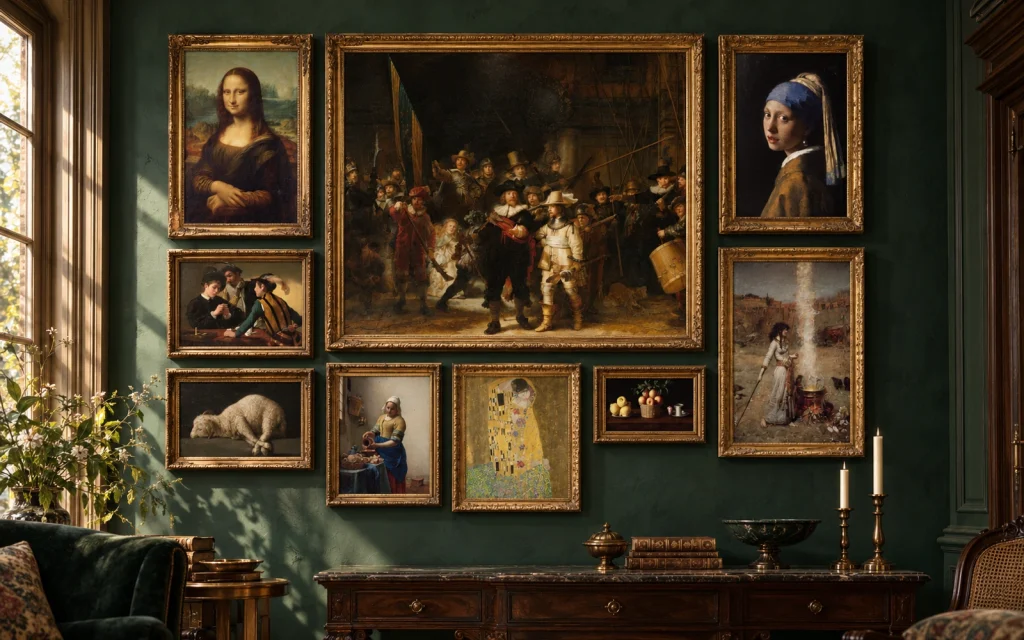
Salon style takes its name from the Paris Salon, the great annual exhibition where hundreds of paintings were hung frame to frame up to the ceiling. In a home it means mixing sizes, shapes and frames in one dense, generous arrangement, the look of a collector's room rather than a showroom.
The secret is that it is less random than it looks. Start with one large anchor painting near the centre, keep the gaps between frames tight and even, and line up the outside edges so the whole group forms a rectangle. Inside that rectangle, you can mix portraits, landscapes and still lifes freely.
Paintings shown include The Night Watch, Mona Lisa, Girl with a Pearl Earring, The Kiss and The Cardsharps

In this second view of the Archduke's gallery, the paintings are arranged symmetrically around a central doorway, with pairs of similar size on each side. Symmetry is the easiest way to make a gallery wall feel formal and finished.
You can do the same around a door, a window, a fireplace or a mirror. Pick a centre, then hang pictures in matching pairs on each side: same size, same height, same distance from the middle. The paintings themselves can be completely different; it is the frames and spacing that create the order.
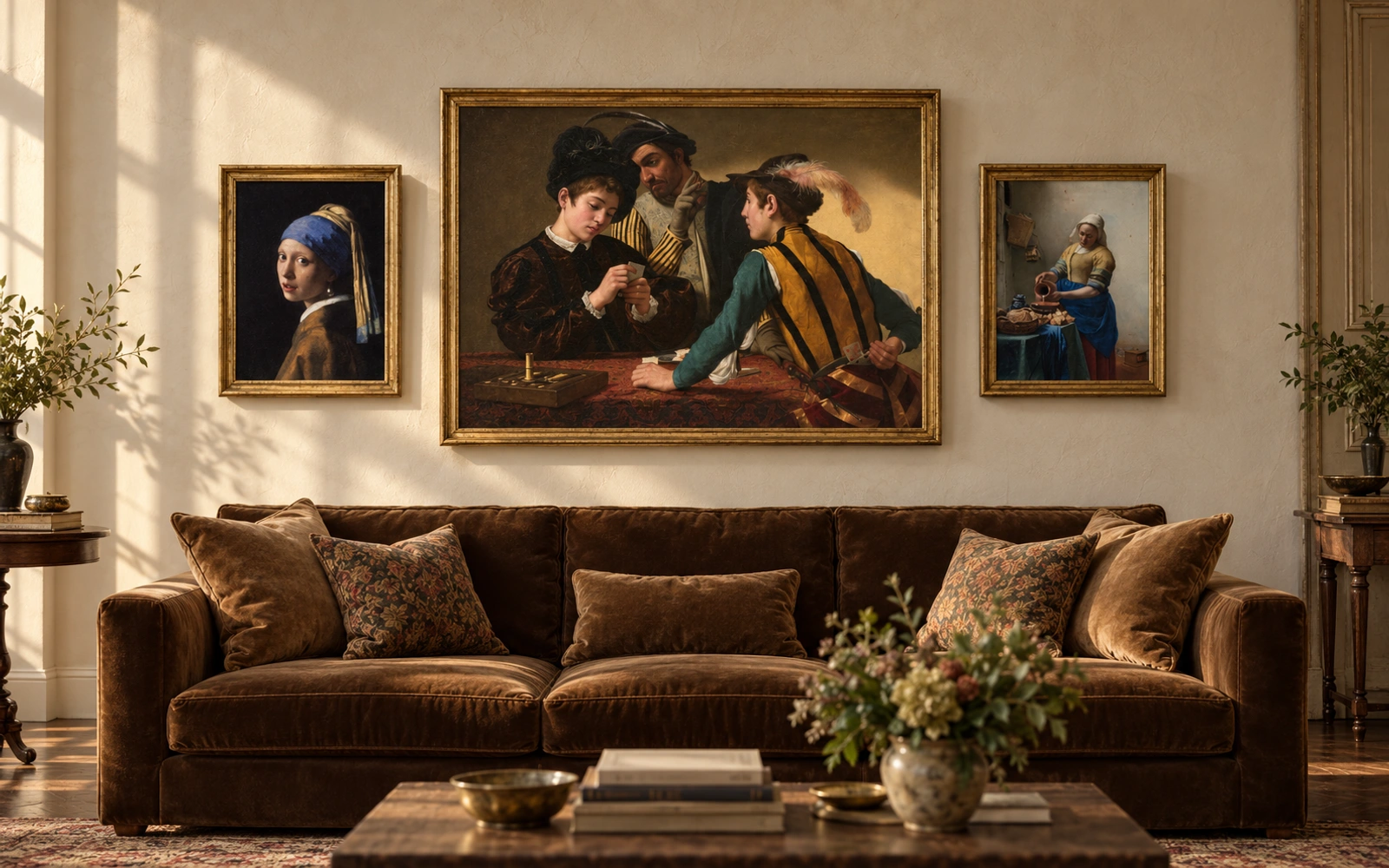
The wall above the sofa is the most popular place for a gallery wall in a living room. The rule is to treat the whole group as one picture: together, the paintings should span about two-thirds of the sofa's width, and the bottom edge of the lowest frame should sit about 20 to 25 cm (8 to 10 inches) above the back of the sofa.
A three-piece arrangement, one larger painting flanked by two smaller ones of the same size, is the easiest version and looks good over almost any sofa. For a longer sofa, add a second row of small pictures above or below the side pieces.
Paintings shown: The Cardsharps, Girl with a Pearl Earring, The Milkmaid
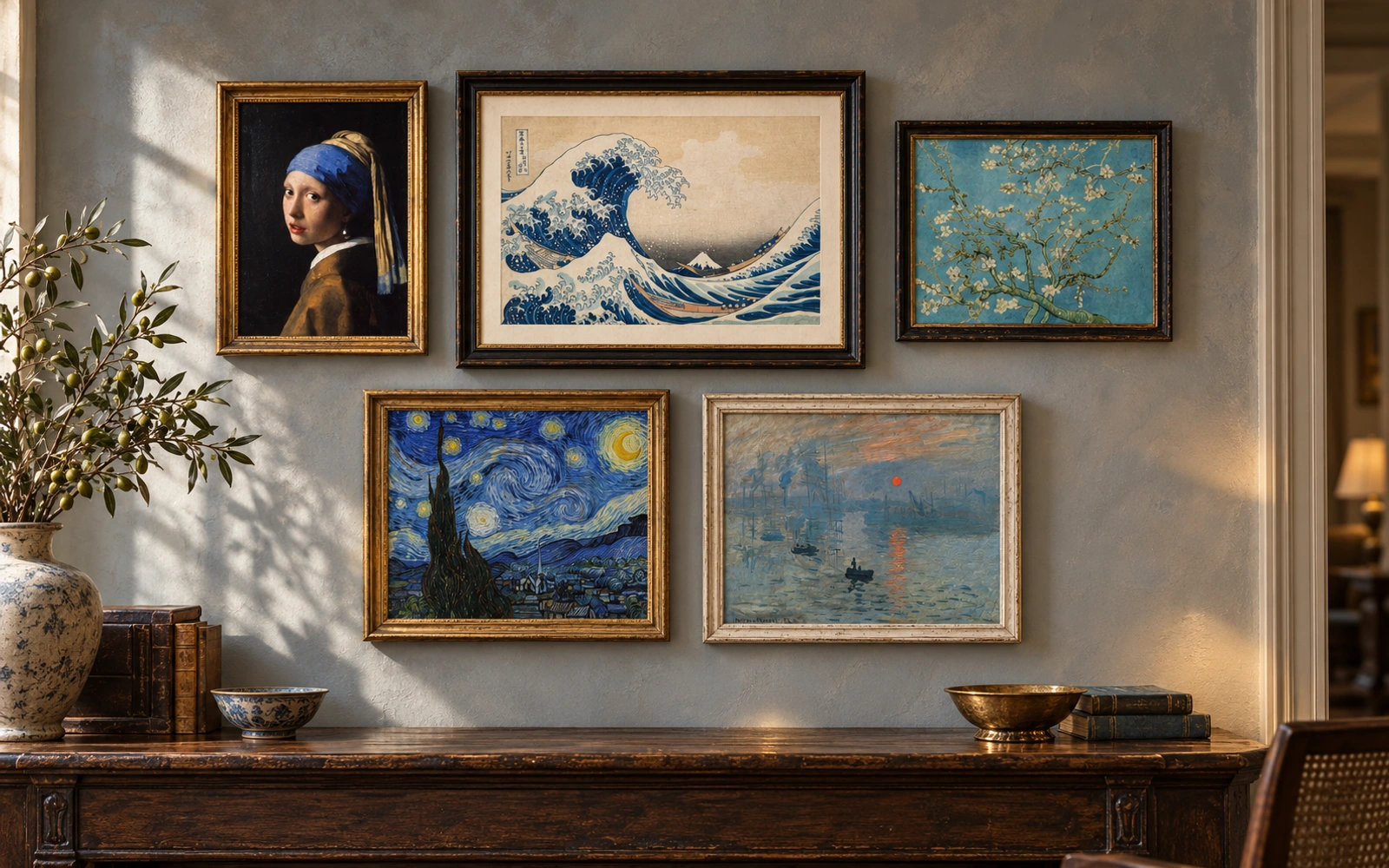
What makes a gallery wall look curated rather than random is a common thread. It can be a colour, like the blues above, running from Hokusai's wave to Vermeer's turban and Monet's harbour. It can be one artist, a single period, or one subject: portraits, landscapes, flowers, the sea.
Once you have a thread, you can be relaxed about everything else. Mixed frames and mixed sizes stop looking chaotic when the pictures clearly belong together.
Paintings shown: The Great Wave off Kanagawa, Girl with a Pearl Earring, Almond Blossom, The Starry Night, Impression, Sunrise

Zoffany painted this view of the Tribuna, the most famous room of the Uffizi in Florence, for Queen Charlotte of Britain in the 1770s. Its walls are red, and the gold frames glow against them. Strong wall colours, such as deep red, forest green and navy, are the traditional backdrop for paintings in museums for exactly this reason.
If your gallery wall is full of old masters in gilded frames, a dark or saturated wall will make it look richer and more unified. Paint just the wall behind the arrangement if you do not want to commit the whole room.
See The Tribuna of the Uffizi as a hand-painted reproduction
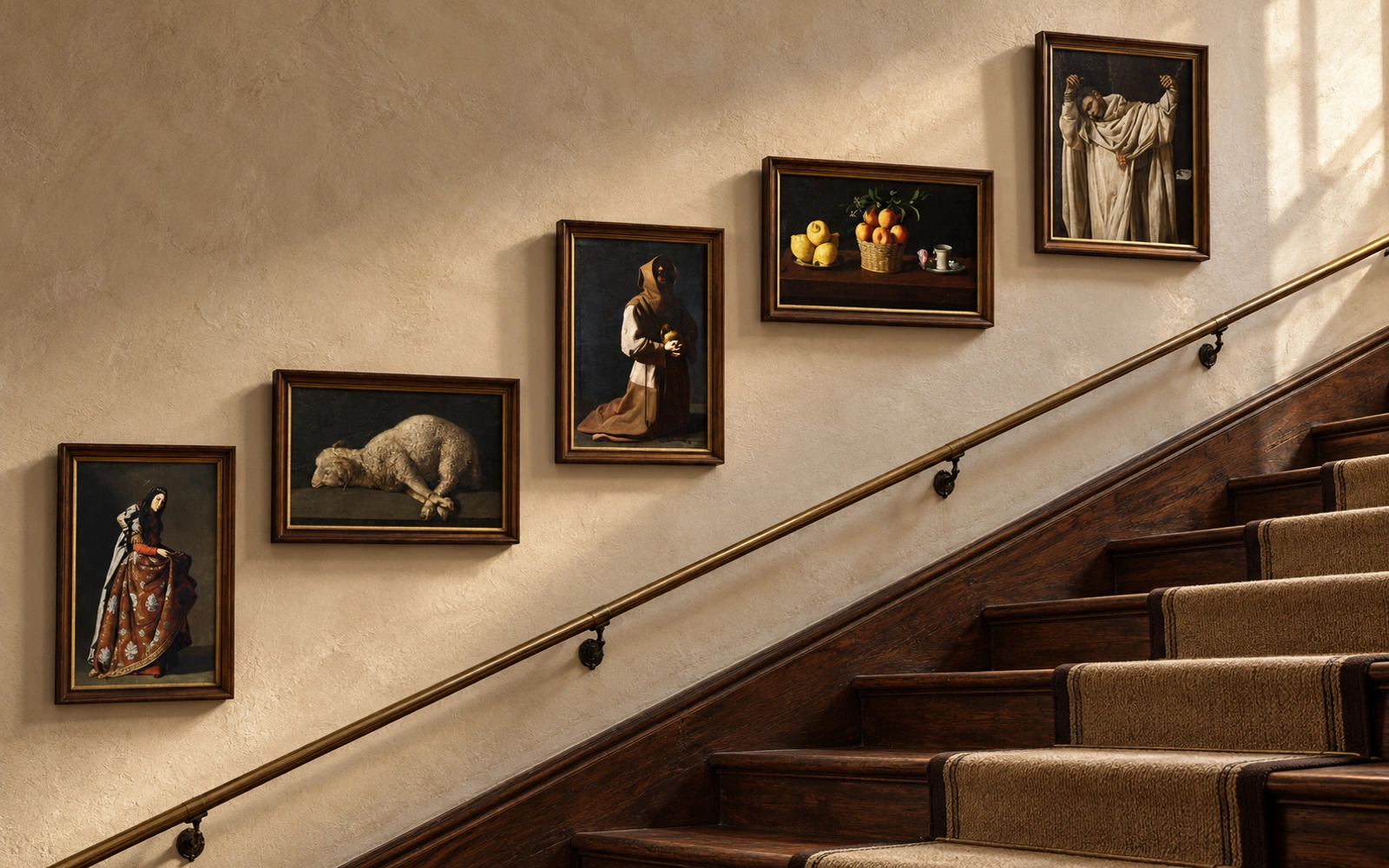
A staircase is one of the best places for a gallery wall, because people pass it every day at a slow walking pace, and it is usually an awkward wall to decorate any other way.
The trick is to follow the angle of the stairs. Imagine a line running parallel to the handrail, about 145 to 150 cm above the steps, and hang each picture with its centre on that line. Keep the gaps between frames equal, and use the same frame finish throughout, so the eye travels smoothly up the stairs.
Paintings shown: Saint Casilda, Agnus Dei, Saint Francis in Meditation, Still Life with Lemons, Oranges and a Rose, Saint Serapion
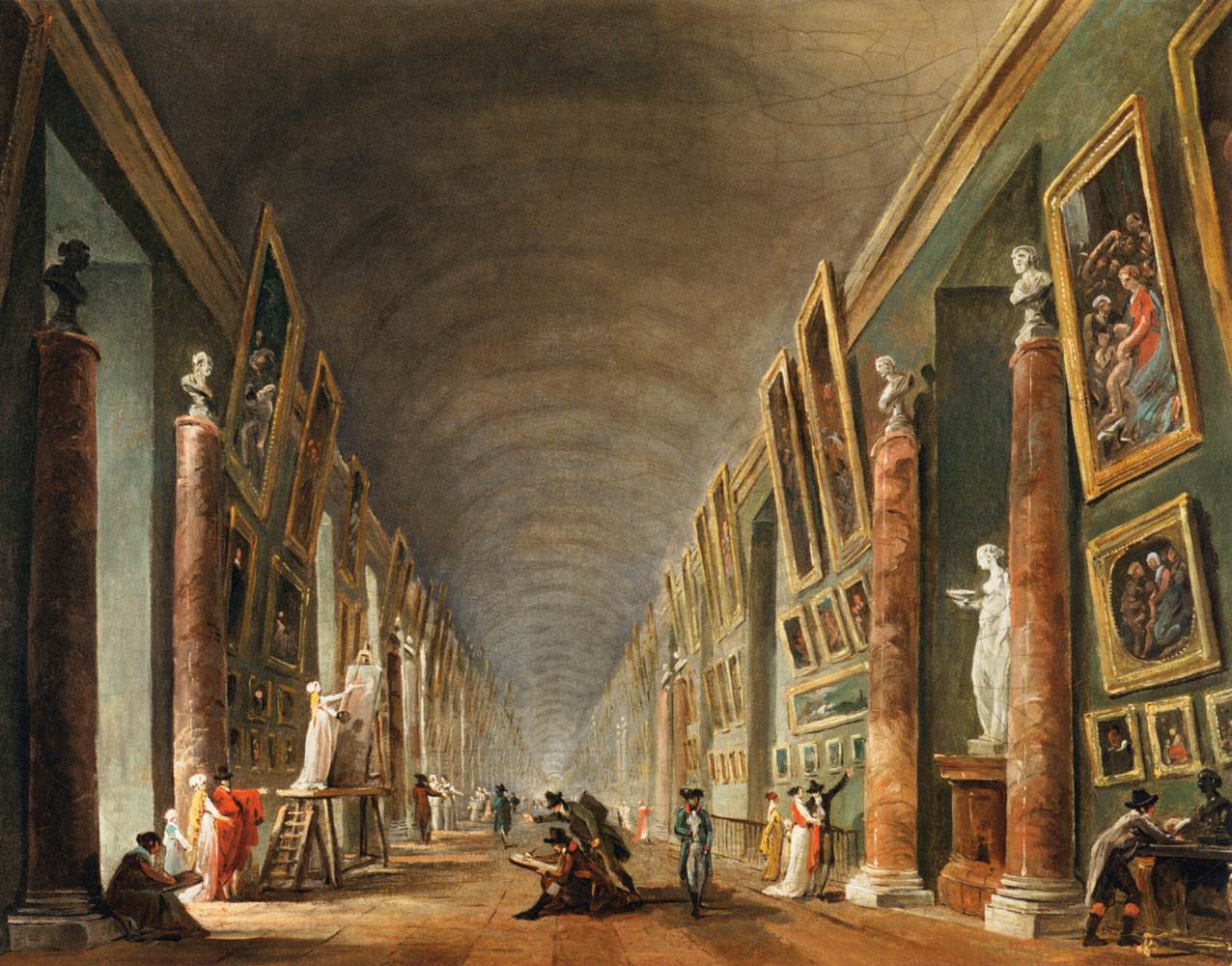
A long corridor is a gallery waiting to happen. Hubert Robert, one of the painters involved in planning the Louvre as a museum in the 1790s, painted its Grande Galerie many times: a long, narrow room with paintings marching along both walls towards a distant point.
At home, hang hallway pictures in a single line at eye level, with the centres at the same height, and keep the spacing regular. Smaller works suit a hallway well, because people see them from close up.

Not every picture has to hang. In Alma-Tadema's imagined Roman gallery, paintings sit on easels and lean against the furniture as well as covering the walls. Doing the same at home adds depth and makes the arrangement easy to change.
Lean a painting on a mantelpiece or a picture ledge, stand a small one on an easel on a side table, or let one large canvas rest on a console in front of a gallery wall. Layering at different depths is what makes a collection look lived with.
See A Collection of Pictures at the Time of Augustus as a hand-painted reproduction
How far apart should pictures be on a gallery wall? About 5 to 8 cm (2 to 3 inches) between frames. Closer than that looks cramped; much wider and the pictures stop reading as one group.
How high should a gallery wall be hung? Treat the group as one picture and put its centre about 145 to 152 cm (57 to 60 inches) from the floor. Above a sofa or sideboard, start the lowest frames 20 to 25 cm above the furniture.
Do the frames on a gallery wall have to match? No. Matching frames give a calm, modern look, as in a grid. Mixed frames look collected, as in salon style, but they need a common thread, such as colour or subject, to hold together.
How many pictures do you need for a gallery wall? As few as three can make a gallery wall above a sofa. Grids usually use four, six or nine, and salon-style walls can grow to fifteen or more.
What are good art gallery wall ideas for a small room? Use smaller frames with plenty of breathing space, keep to one colour or one frame finish, and consider a vertical column of pictures, which draws the eye up and makes the ceiling feel higher.
Enjoyed this story?
Save articles to your collection
Log in or create a free account, and this article will be waiting in your Private Collection.
Log in or sign upImages marked "Illustration" are layout examples made with photographs of ByMuseum hand-painted reproductions. They show arrangements, not real rooms.

Man Writing a Letter
Gabriel Metsu, c. 1664
The gallery list
Every painting is already 50% off. Join the list and we will send you an extra $15 code, plus first access to new collections.
No spam. Unsubscribe anytime. · Privacy Policy
Welcome
Your $15 code is on its way. Explore the gallery while you wait.