Loading cart…
No products in the cart.

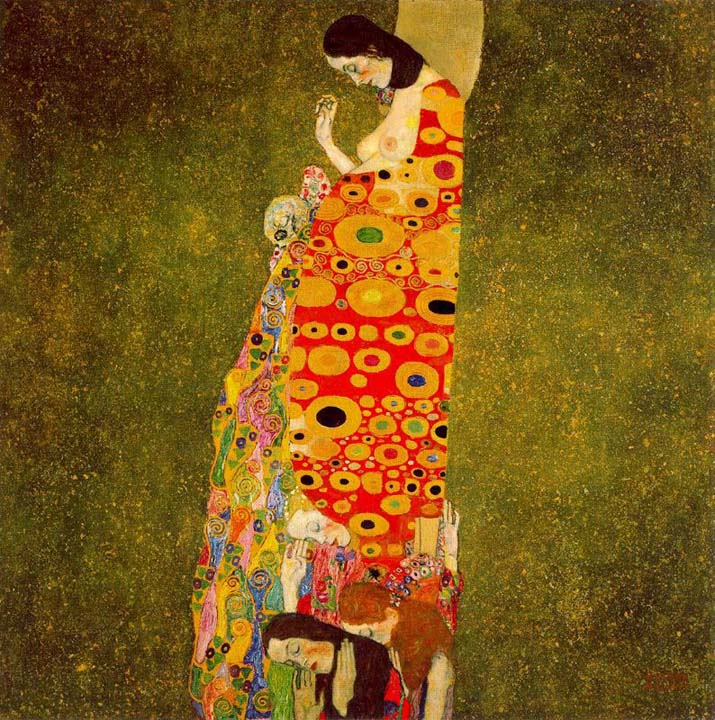
1907-1908 · Oil, gold, and platinum on canvas · Museum of Modern Art, New York, United States
Save articles to your collection
Log in or create a free account, and this article will be waiting in your Private Collection.
Log in or sign upGustav Klimt painted Hope II between 1907 and 1908, during the peak of his so-called Golden Period, a phase in which he incorporated actual gold and platinum leaf into his canvases. The work followed an earlier composition, Hope I, painted in 1903, which had caused considerable controversy in Vienna due to its frank depiction of a nude pregnant woman. For Hope II, Klimt chose a more restrained approach by clothing the central figure in an elaborate decorative robe, though the subject matter remained equally charged with symbolic weight. The painting was acquired by Margaret Stonborough-Wittgenstein, a prominent Viennese patron, shortly after its completion, and it eventually found its way into the collection of the Museum of Modern Art in New York, where it remains one of the most studied works from the Viennese Secession movement. The historical context surrounding this painting is deeply tied to the cultural anxieties of fin-de-siecle Vienna. Klimt was operating within a society simultaneously fascinated by and fearful of the feminine body, reproduction, and mortality. His earlier version of the same theme had been rejected for public exhibition because of its perceived obscenity. Hope II, while more ornamented and less anatomically explicit, continued to interrogate the same themes. The timing of its creation, coinciding with Klimt's work on other allegorical canvases such as the Beethoven Frieze and the University ceiling paintings, situates it within a broader project of representing universal human experience through the lens of symbolism and decorative abstraction.
The formal composition of Hope II is structured as a near-perfect square, a format Klimt used deliberately to create a sense of self-contained completeness. The pregnant central figure dominates the upper two-thirds of the canvas, her body wrapped in a robe of interlocking geometric and organic patterns rendered in gold, silver, and deep jewel tones. This decorative treatment of the surface flattens the figure against a similarly ornamented background, creating the characteristic tension between depth and flatness that defines Klimt's mature style. The three smaller faces clustered at the base of the composition introduce a narrative complexity, suggesting sleeping or praying figures who seem to be part of a communal ritual around the central woman. Klimt applied gold and platinum leaf directly to the canvas surface, a technique inspired by his early career as a decorative muralist and by his study of Byzantine mosaics during a visit to Ravenna in 1903. The contrast between the rigid geometry of the robe and the soft organic curves of the woman's bowed head creates a visual dialogue between the artificial and the natural. The color palette, dominated by warm golds and cooler blues and greens at the base, reinforces a movement from earthly life downward toward something darker and more uncertain. Every element of the surface is activated with pattern, leaving no area of visual rest, which creates an almost hypnotic density characteristic of Art Nouveau at its most elaborate.
The central meaning of Hope II revolves around the intersection of life, birth, and death as inseparable human experiences. The pregnant woman represents the promise of new life, but the bowed head and the three sleeping or mourning figures at her feet introduce an undercurrent of sorrow and vulnerability. Klimt was deeply interested in the cyclical nature of existence, and this painting functions as a meditation on what it means to carry life within oneself while remaining mortal and subject to loss. The title itself, Hope, is both sincere and ironic, pointing toward expectation while simultaneously acknowledging that all hope exists in the shadow of its possible failure. The symbolic layering in this painting also engages with themes of community and shared suffering. The smaller figures at the base are not passive observers but appear to be participating in a kind of collective mourning or prayer, suggesting that the experience of pregnancy and potential loss is never solely individual but is embedded in a wider human community. Klimt was influenced by the Symbolist poets and philosophers of his era, particularly by ideas drawn from Schopenhauer and Nietzsche regarding the will, suffering, and transcendence. Hope II can therefore be read as a visual argument that beauty and sorrow are not opposites but are woven together in the fabric of human life, much as the ornamental patterns of the robe weave together rigidity and fluidity into a single unified surface.
Enjoyed this story?
Save articles to your collection
Log in or create a free account, and this article will be waiting in your Private Collection.
Log in or sign up