Loading cart…
No products in the cart.

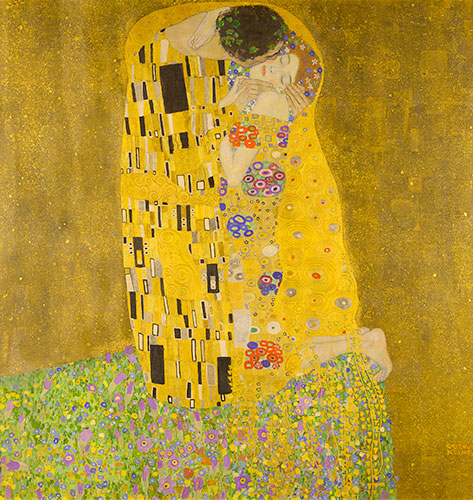
1907-1908 · Oil and gold leaf on canvas · Osterreichische Galerie Belvedere, Vienna, Austria
Save articles to your collection
Log in or create a free account, and this article will be waiting in your Private Collection.
Log in or sign upGustav Klimt created The Kiss during a period of intense creative productivity that coincided with his growing rejection of academic convention and his embrace of decorative surface as a primary expressive tool. The painting belongs to what scholars describe as his Golden Phase, a period lasting roughly from 1899 to 1910 during which he incorporated gold and silver leaf into his canvases in a manner influenced by his study of Byzantine mosaics, particularly those he observed during visits to Ravenna, Italy. Klimt exhibited The Kiss at the Vienna Kunstschau in 1908, where it was immediately purchased by the Austrian government, an unusual and significant act of institutional endorsement that reflected the painting's immediate popular appeal. The work has remained in Austria ever since and is now held at the Osterreichische Galerie Belvedere in Vienna, where it draws a substantial portion of the museum's annual visitors. The identities of the figures depicted have been debated for over a century, with many scholars suggesting that Klimt incorporated his own likeness into the male figure, though the artist never confirmed this. The painting was produced at a time of enormous cultural ferment in Vienna, when the city was at the center of revolutionary developments in art, architecture, philosophy, and psychology.
The Kiss is composed as an almost perfectly square canvas in which two figures kneel together at the edge of a flower-covered bluff, enveloped in a single billowing golden robe that merges their bodies into a single undulating form. The male figure bends over the female, whose face is turned outward and downward with eyes closed, her expression one of surrender and calm. Their robes are decorated with contrasting patterns: the male robe bears bold rectangular and geometric forms in black and white, while the female robe features softer circular floral motifs in pinks and greens, a distinction that encodes gender difference within the decorative surface itself. The background is a shimmering field of gold leaf that eliminates spatial depth entirely, placing the figures in a timeless, non-specific realm. Klimt built the surface through a combination of oil paint, gold leaf, and intricate ornamental detail that rewards close inspection and blurs the boundary between painting and applied art. The flowers beneath the figures and the golden aura surrounding them lend the scene the quality of a sacred image, drawing on both Byzantine religious art and the secular Symbolist tradition.
The Kiss occupies a central place in the cultural imagination as an image of romantic love elevated to a state of transcendence. The merging of the two figures into a single golden form suggests a unity of self that dissolves individual identity in the experience of love, a theme consistent with Symbolist ideas about the transformative power of intense emotion. The floral meadow on which the figures kneel and the golden field behind them remove the scene from the social world entirely, placing it in a space that is both natural and supernatural. The painting also reflects fin-de-siecle anxieties about gender, sexuality, and power: the female figure, though cradled and embraced, faces outward and downward in a posture that some scholars read as ambiguous between ecstasy and submission. Since its first exhibition, The Kiss has been reproduced on an extraordinary range of commercial and decorative objects, from posters and scarves to ceramics and jewelry, and it remains one of the most widely circulated painted images in European popular culture. Its combination of sensory richness, emotional directness, and formal innovation ensures its continued relevance to audiences worldwide.
Enjoyed this story?
Save articles to your collection
Log in or create a free account, and this article will be waiting in your Private Collection.
Log in or sign up