Loading cart…
No products in the cart.

1830 · Oil on canvas · Musée du Louvre, Paris
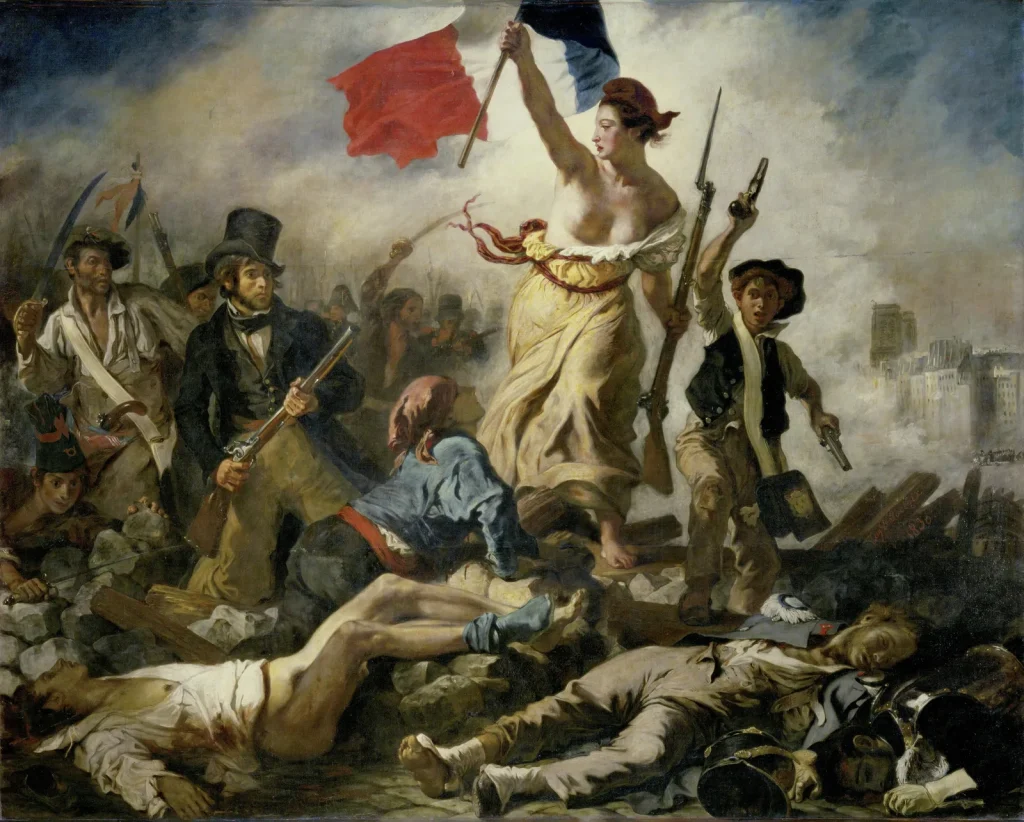
In July 1830 King Charles X of France issued a set of ordinances that dissolved the newly elected chamber, muzzled the press and cut the electorate to a fraction of its size. Paris rose. For three days, 27, 28 and 29 July, students, workers, shopkeepers and former soldiers built barricades from paving stones and furniture and fought the royal troops street by street. The king fled. His cousin Louis-Philippe took the throne as a constitutional monarch.
The French call those days les Trois Glorieuses, the Three Glorious Days. Delacroix's full title is Le 28 Juillet. La Liberté guidant le peuple: the 28th of July, the middle day, when the fighting was heaviest and the outcome still unclear.
Delacroix did not fight. He was thirty-two and watched from a distance. In October he wrote to his brother that he had started a modern subject, a barricade, and that if he had not fought for his country, he would at least paint for her. The painting was finished by the end of the year.
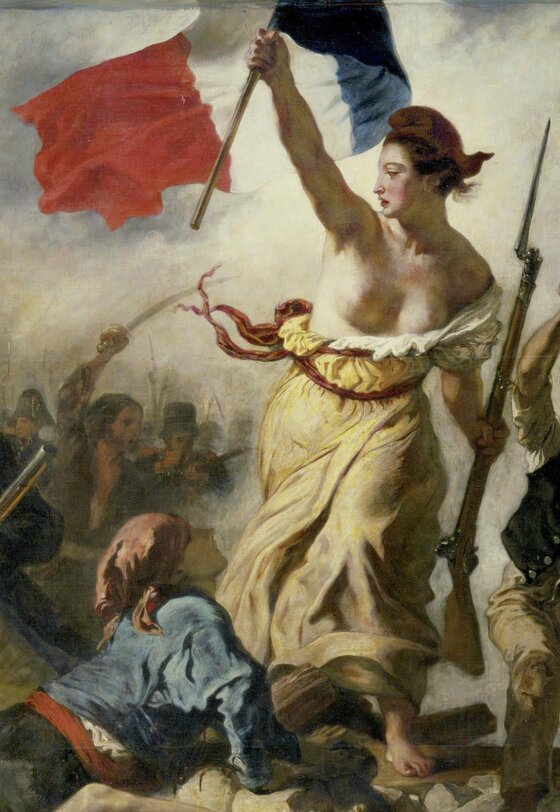
The woman at the centre is not a real Parisian. She is an allegory, Liberty, the way earlier centuries had painted Justice or Victory. Delacroix gives her the signs: the red Phrygian cap worn by freed slaves in Rome and by the revolutionaries of 1789, the tricolour flag, and bare breasts, which in the language of allegory mean she is a goddess rather than a woman of the streets.
Then he does something the old allegories never did. He gives her hair under her arm, dirty feet, a musket with a fixed bayonet held like someone who knows how to use it, and a face turned back toward the crowd. She is not floating above the battle. She is climbing the barricade, and she is looking to see whether anyone is following.
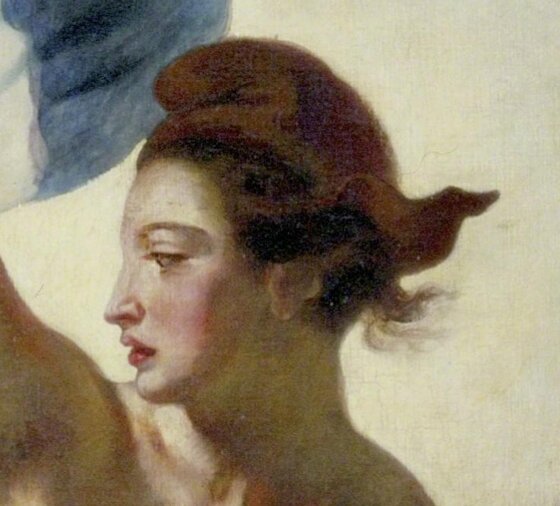
This mixture is what shocked the first viewers. A critic complained that she was dirty and looked like a fishwife. That was the point. Delacroix wanted an ideal you could believe had been on the barricade.
She is also the ancestor of Marianne, the personification of the French Republic. Her face was on the 100-franc note in the 1980s and 1990s, and versions of her stand in every town hall in France.
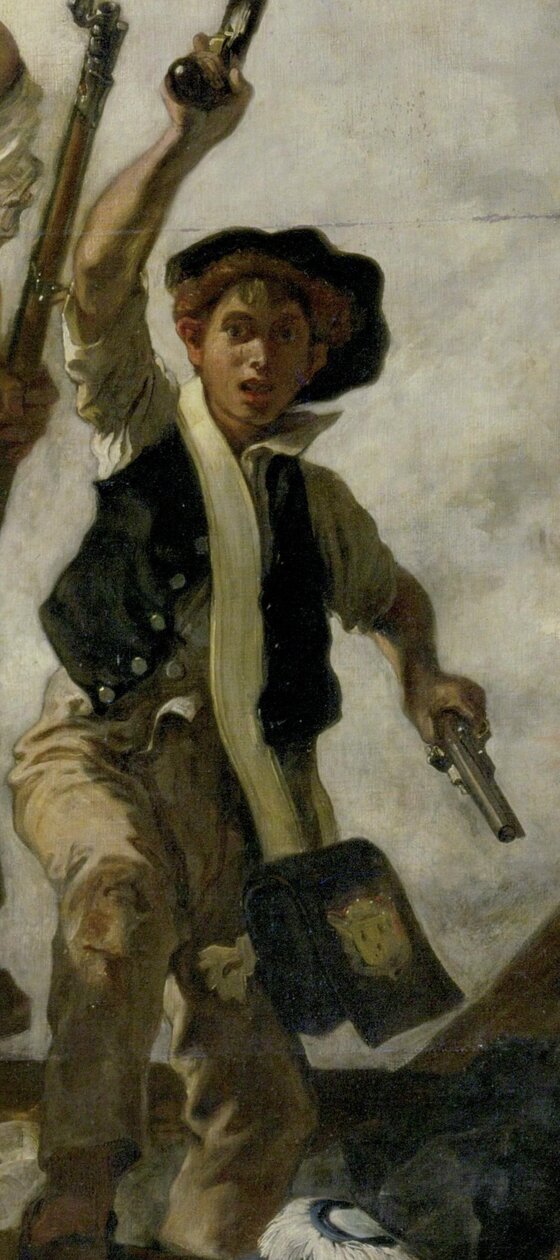
To Liberty's right a boy runs forward with a pistol in each hand. He wears a velvet beret and a cartridge pouch that is far too big for him. His mouth is open. He is the only figure who seems to be enjoying himself.
Street children did fight in July 1830, and Delacroix's boy became the most famous of them. Thirty years later Victor Hugo put a boy like him in Les Misérables, on the barricade of 1832, and named him Gavroche. Readers have called this figure Gavroche ever since, though the painting came first.
He matters compositionally as well. Liberty's flag rises to the top of the canvas; the boy's raised pistol echoes it lower down. Together they make the right-hand edge of the pyramid that organises the whole picture.
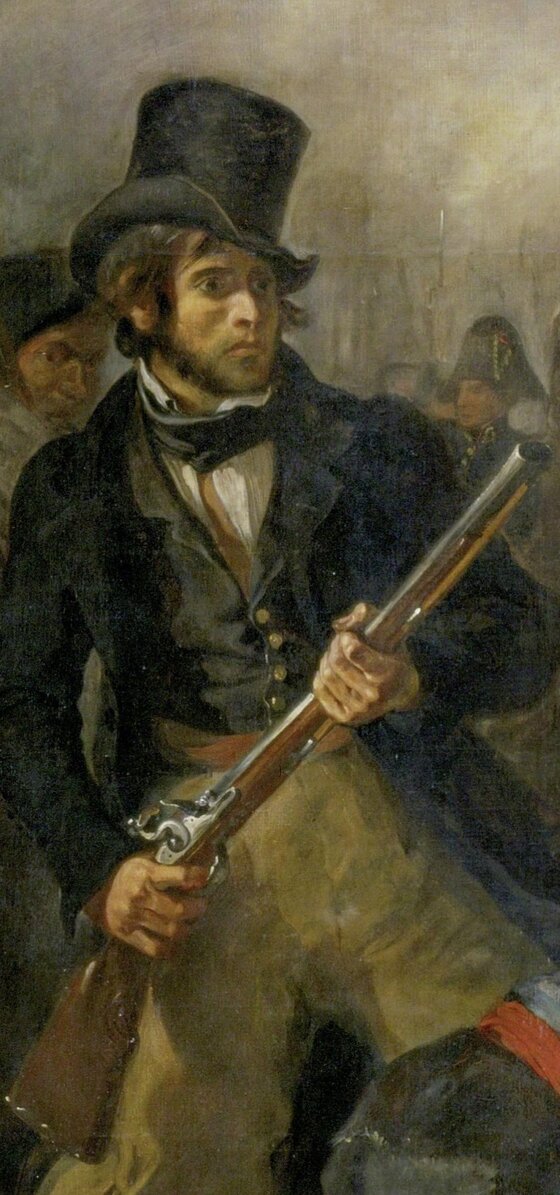
On Liberty's left stands a man in a black coat and top hat, holding a double-barrelled hunting gun. He is a bourgeois, a man of property, and he is fighting next to a worker in a shirt and beret who holds a sabre. That pairing is the political message of the picture: in July 1830 the middle class and the working class fought together.
For a long time he was said to be Delacroix's self-portrait. Most scholars now doubt it; the face does not match his known portraits, and Delacroix, as he admitted, was not on the barricades. Names proposed instead include the painter's friend Frédéric Villot and the republican Étienne Arago. Nobody knows.
The worker beside him and the wounded man at Liberty's feet, looking up at her in a blue jacket and red scarf, complete the crowd. Behind them, in the smoke, the mass of the people is suggested by a few heads, a cavalry sabre and the glint of bayonets.
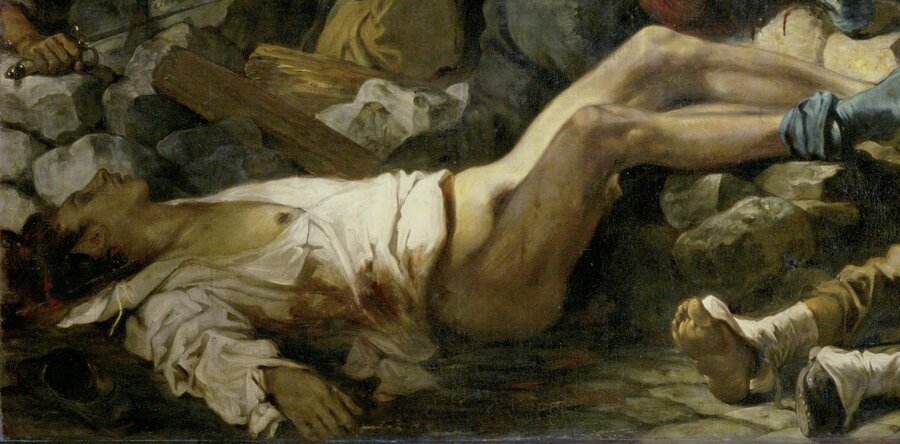
Liberty walks over corpses. On the left lies a young man in a nightshirt, one sock on, stripped of his trousers by looters. On the right lie two of the king's soldiers, a Swiss guard in his blue coat and a cuirassier with his helmet beside him. Delacroix gives both sides the same treatment: they are simply dead.
The foreground borrows openly from Géricault's Raft of the Medusa, painted eleven years earlier, where the front of the picture is also given to the fallen. Delacroix had posed for the Raft as a young man and never forgot it. His pyramid of bodies rising from the dead to a figure holding something aloft is Géricault's design, rebuilt for a street in Paris.
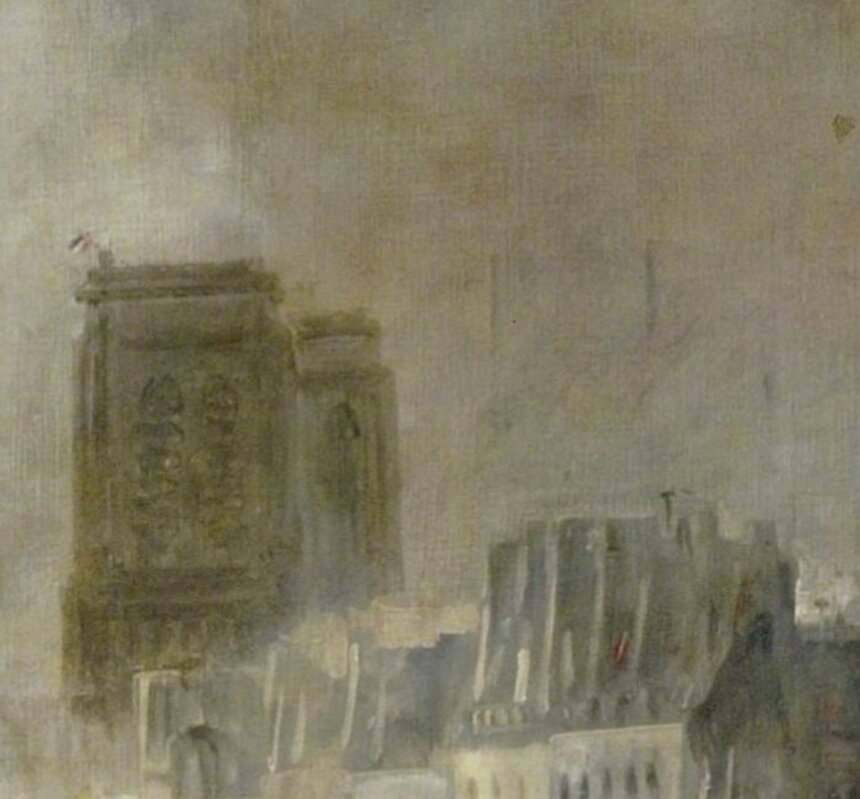
The only landmark in the painting is on the far right: the twin towers of Notre-Dame, seen from across the river, with a small tricolour flying from one of them. On 28 July rebels did climb the cathedral and hang the flag there, and the city saw it. It was the sign that the centre of Paris had fallen.
The geography is not exact. Delacroix has turned the view so that the cathedral sits where he needs it, at the edge of the smoke, small and far away. The flag on the tower rhymes with the flag in Liberty's hand. The whole city is claimed.
The obvious meaning is the one in the title. Liberty leads the people, and the people are everyone: the bourgeois with the hunting gun, the worker with the sabre, the boy from the gutter, the wounded man and the dead. The painting argues that the revolution of 1830 belonged to all of them.
The less obvious meaning is in the way Delacroix painted it. Government-approved history paintings of the time were smooth, clear and calm. This one is rough, loud and hazy with smoke. The brushwork is fast; the colour is built around the three colours of the flag, red, white and blue, scattered through the crowd in a sash, a shirt, a jacket. Form serves feeling. That is Romanticism, and this is its manifesto.
And there is a warning in it. Liberty looks back at the crowd rather than ahead. The people are following, but they have to keep following. The picture is not a celebration of a revolution already won. It is a picture of a revolution in the act of being decided, with corpses at its feet.
Delacroix showed it at the Salon of 1831. The new government of Louis-Philippe bought it for 3,000 francs, hung it briefly in the Musée du Luxembourg, and then took it down. A king who owed his throne to a street revolt did not want a picture that glorified street revolts. It went back to Delacroix's studio and stayed out of sight for years.
It was shown again after the revolution of 1848, at the Exposition Universelle of 1855, and entered the Luxembourg permanently in 1863, the year of Delacroix's death. It moved to the Louvre in 1874 and has been there since.
In 2013 a visitor wrote on it with a marker at the Louvre-Lens outpost; the ink was removed within hours. In 2023 and 2024 the Louvre gave the painting a six-month restoration, removing eight layers of yellowed varnish. The blues and whites came back, the smoke turned from brown to grey, and the picture now looks closer to what the Salon saw in 1831.
The original is in the Louvre, Paris, in the Denon wing, in the same red rooms as The Raft of the Medusa. It is oil on canvas and measures 260 by 325 centimetres. The figures are life size, and Liberty's foot is at the height of your eyes.
It has left France only once, for Tokyo in 1999, and is unlikely to travel again. If you want the image at home, our hand-painted reproduction of Liberty Leading the People is painted in oil on canvas from the original composition, with the restored colours.
Ferdinand Victor Eugène Delacroix was born near Paris in 1798 and died in Paris in 1863. He trained with Guérin alongside Géricault, made his name at the Salon of 1822, and spent forty years as the leader of French Romanticism and the great rival of the classicist Ingres.
His subjects were literature, history, the East after a journey to Morocco in 1832, animals fighting, and religion. His colour and his brush influenced almost everyone who came after him, from Manet and the Impressionists to Cézanne and Van Gogh, who copied him repeatedly.
Browse all of our Eugène Delacroix reproductions, including The Death of Sardanapalus, Women of Algiers and the lion hunts.
This is a painting that fills a room, and it is usually chosen for a room where people gather: a hallway, a library, an office, a place with an argument in it. It reads well at any size because the design is so clear, one bright figure and one flag against smoke.
A dark frame holds the smoke; a gilt frame, which is how the Louvre shows it, makes the tricolour sing. Give it width. The picture is wider than it is tall and the dead need the whole foreground.
Look at Liberty's face last. Everyone else in the picture is looking forward. She is looking back, at you.
Visible details, documented facts and interpretation are kept separate throughout this article. Identifications of the man in the top hat are reported as proposals, not facts.