Loading cart…
No products in the cart.

1818 to 1819 · Oil on canvas · Musée du Louvre, Paris
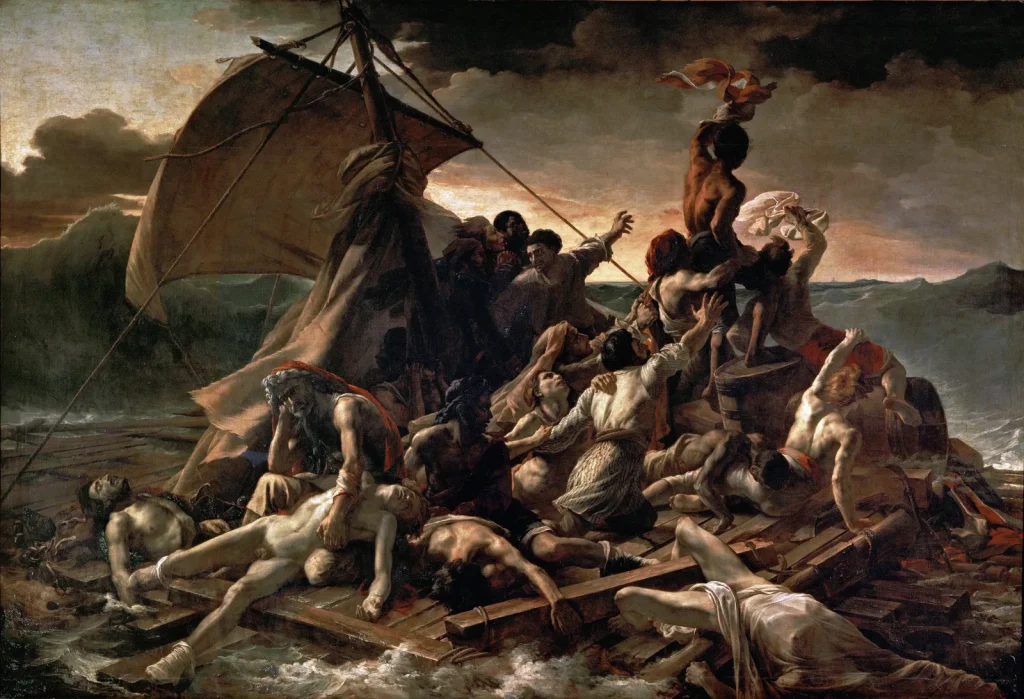
On 2 July 1816 the French frigate Méduse ran aground on the Arguin Bank off the coast of West Africa, on its way to Senegal. It was carrying around 400 people. The captain, Hugues Duroy de Chaumareys, was a royalist who had been given the command for his loyalty to the restored monarchy rather than his seamanship; he had barely been to sea in twenty years.
There were not enough lifeboats. The officers and the governor took them. Around 147 sailors, soldiers and passengers were put on a raft about twenty metres long, built from the ship's masts and lashed to the boats to be towed to shore. Within hours the tow ropes were cut, or slipped, and the raft was abandoned.
It drifted for thirteen days. There was almost no food or water. The first night, men were washed off or crushed. Then came fighting, then murder, then the eating of the dead. When the brig Argus found the raft on 17 July, fifteen people were alive. Five of them died soon after.
Two survivors, the surgeon Henri Savigny and the engineer Alexandre Corréard, published their account in 1817. It became a scandal for the Bourbon government, which had appointed the captain and tried to bury the story. That is the event Géricault chose to paint, at life size, for the Paris Salon.
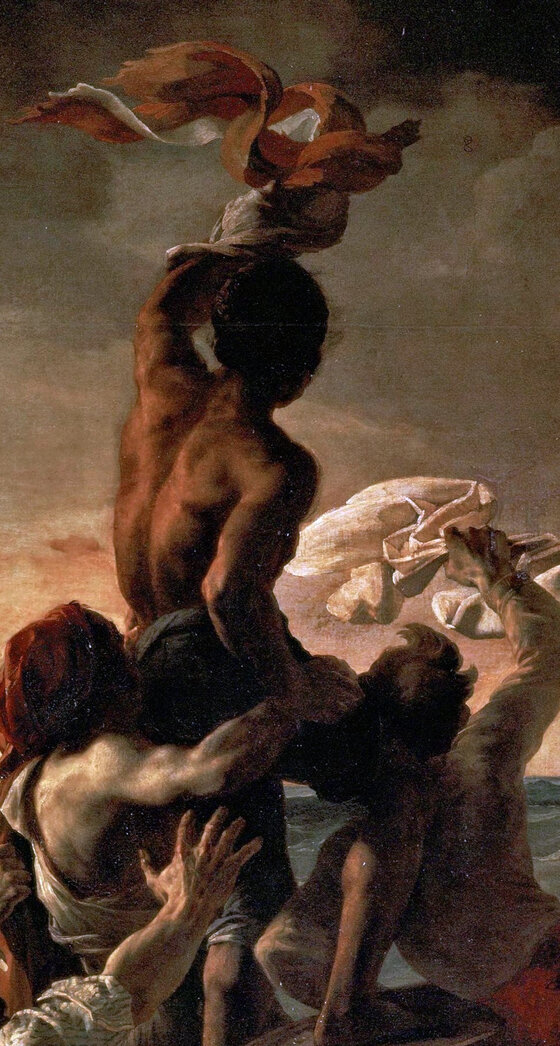
Géricault could have painted the mutiny, the cannibalism or the rescue. He painted none of them. He chose the moment when the survivors first sight the Argus on the horizon, hours before it reaches them. In the finished painting the ship is a speck on the right, barely a few brushstrokes wide. Most viewers do not find it without help.
That choice sets the emotional temperature of the whole picture. It is not a scene of horror, though horror is everywhere in it. It is a scene of hope that may come to nothing. Every living body strains toward the top right corner, toward the man on the barrel, and beyond him toward a ship that has not yet seen them.
The man waving the cloth was modelled by Joseph, a professional model of Haitian birth who worked in Paris studios. Placing a Black man at the summit of the composition, as the figure who reaches furthest toward salvation, was a deliberate decision. Géricault had strong abolitionist sympathies and planned, but never made, a large painting on the slave trade.
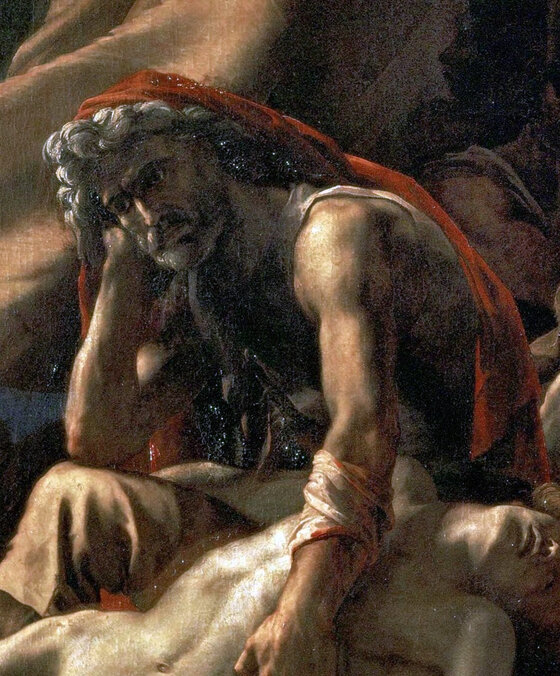
On the left of the raft, an older man sits with a red cloth over his head and a dead youth across his lap. He is the only living figure in the painting who does not look toward the horizon. His hand rests on the body. His face is turned away from hope.
Géricault took the pose from images of Ugolino, the count in Dante's Inferno who was locked in a tower with his sons and watched them starve. It is a quiet quotation, but it tells you what the painter thought the raft was: a hell in which the living had to decide what to do with the dead.
This is the figure most people remember after the first shock wears off. The pyramid of bodies reaching upward is the painting's argument. The old man is its doubt.
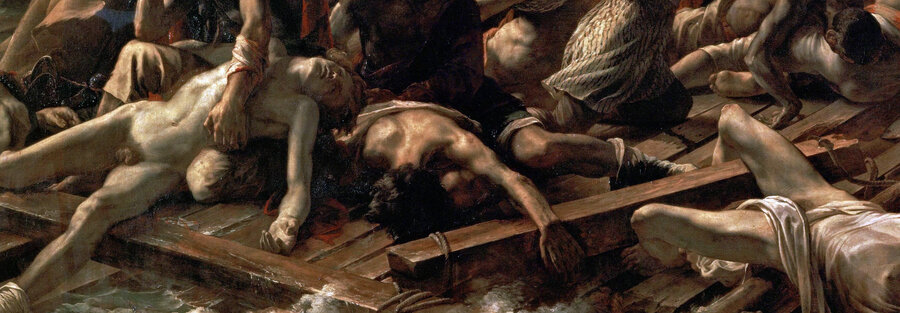
The nearest figures to us are corpses. One lies face up with an arm trailing in the sea. Another, half covered by a sheet, has slipped off the planks and only the legs remain on board. A third lies face down at the centre, his arm stretched toward the viewer.
These bodies are painted with an accuracy that unsettled the Salon audience, and there is a reason for it. Géricault rented a studio near the Beaujon hospital and drew the dying and the dead. He brought severed limbs and heads back to the studio and painted them as they decayed. He wanted to know what dead flesh looked like, and the painting shows that he found out.
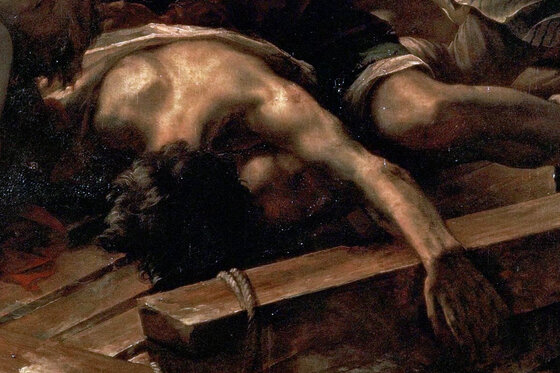
The face-down figure at the front has a story of its own. The model, by long tradition, was the twenty-year-old Eugène Delacroix, Géricault's friend and admirer, who would go on to paint Liberty Leading the People a decade later. Delacroix later said that when he first saw the finished Raft he ran from the studio like a madman.
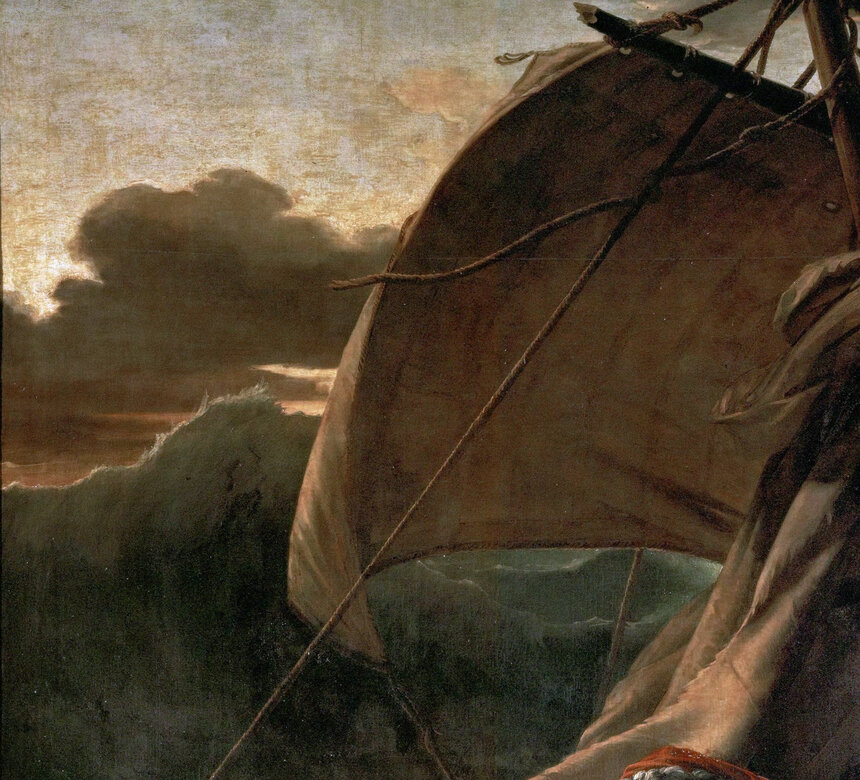
Look at the left side of the painting. A wave is rising behind the raft, and the sail is full. The wind is blowing from the left, which means it is blowing the raft away from the ship on the right. The survivors are signalling toward rescue while the weather carries them in the other direction.
Géricault built the picture on two pyramids. The first is the mast and its ropes, leaning left, made of wood and canvas and weather. The second is the pile of human bodies, leaning right, made of hope. The two pull against each other, and the tension between them is what keeps a picture of this size from collapsing into a heap.
The sky is dark, the sea is dark, and the light falls from the upper left across the bodies. Much of the darkness is not what Géricault intended. He used bitumen, a tarry brown pigment that never fully dries, and over two centuries it has blackened and cracked. The painting we see is gloomier than the one shown in 1819.
At the Salon of 1819 the painting was listed simply as Scène de naufrage, "Shipwreck Scene". Nobody was fooled. Everyone in Paris knew which shipwreck, and everyone knew that the captain had been appointed by the government, that the officers had saved themselves, and that the survivors' book had been suppressed.
So the first meaning is political. This is a painting about a state that abandoned its people. The raft is France under the restored Bourbons, cut loose and left to drift. Critics on the right attacked it; critics on the left praised it for exactly that reason.
The second meaning is bigger than 1816. Géricault painted an anonymous group of ordinary men, not a king or a saint or a general, on the scale that history painting had always reserved for heroes. The figures are life size. Their suffering is given the dignity of the grand style. This is the moment when Romanticism took over the largest canvases in France, and the moment when the subject of great painting became the human being in extremity.
The third meaning is the one you feel standing in front of it: the ship is tiny and may not turn. Géricault refuses to tell us whether these people will be saved. We know from history that fifteen were. The painting does not know.
Géricault was twenty-seven when he began. He interviewed Corréard and Savigny, had the ship's carpenter build him a scale model of the raft, shaved his head to keep himself from going out, and worked on the canvas for about eighteen months across 1818 and 1819.
At the Salon of 1819 it won a gold medal but the state did not buy it. Géricault took it to London in 1820, where it was shown at William Bullock's Egyptian Hall in Piccadilly and drew around 40,000 paying visitors, then to Dublin. The English trip was more successful than the French one.
Géricault died in January 1824, aged thirty-two, after a series of riding accidents. The painting was bought for the Louvre at the sale of his studio the same year. It has been there ever since, and because of its size and fragility it does not travel.
The original is in the Louvre, Paris, in the Denon wing among the large French Romantic paintings. It is oil on canvas and measures 491 by 716 centimetres, roughly five metres high and seven wide. The figures are life size or larger, and the raft's front edge sits at the viewer's feet.
The size is part of the meaning, and it is the one thing no reproduction can give you. What a reproduction can give you is the composition, the light and the faces. Our hand-painted reproduction of The Raft of the Medusa is painted in oil on canvas from the original, in sizes up to a full wall.
Jean-Louis André Théodore Géricault was born in Rouen in 1791 and died in Paris in 1824. He came from a wealthy family, trained briefly with Carle Vernet and Pierre-Narcisse Guérin, and learned most of what mattered by copying in the Louvre and by riding. Horses fill his early work.
The Raft is his only monumental painting. After it he made lithographs in London, a series of portraits of patients in a Paris asylum that are among the most humane pictures of the century, and a great many studies for paintings he never finished. He is the founder of French Romanticism in painting, and Delacroix was his heir.
Browse all of our Théodore Géricault reproductions, including the oil study for the Raft and the horse paintings.
This is not a gentle painting, and it is not for every room. But it is one of the great images of human endurance, and people who choose it tend to choose it for that reason: it shows people at the edge, still reaching.
It reads best large and in a wide format, where the two pyramids have room to pull against each other. Dark wood or a plain black frame suits the sea and sky. Because the painting is so dark, hang it where it gets daylight or a dedicated picture light.
Find the ship first. Then find the old man who is not looking at it. Everything the painting has to say lies between those two.
Visible details, documented facts and interpretation are kept separate throughout this article. Traditions about the models (Delacroix, Joseph) are reported as traditions.