Loading cart…
No products in the cart.

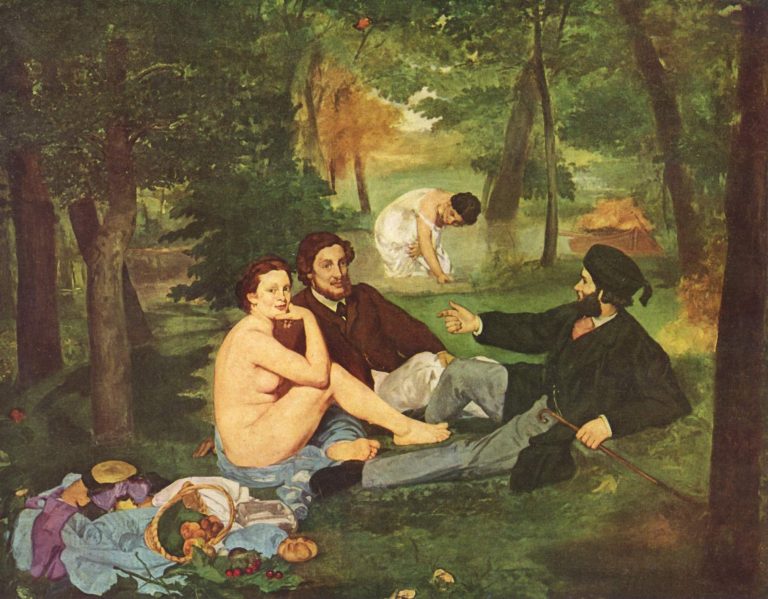
1863 · Oil on canvas · Musée d’Orsay, Paris
Save articles to your collection
Log in or create a free account, and this article will be waiting in your Private Collection.
Log in or sign up Explore the artistÉdouard Manet paintings →
Collection reference: Musée d’Orsay, Paris.
Two clothed men sit in a wooded setting beside a nude woman. She turns towards us while they appear absorbed in their own exchange. Behind them, another woman bends near the water. Clothes, fruit and a basket gather in the foreground.
Édouard Manet’s Luncheon on the Grass, or Le Déjeuner sur l’herbe, is dated 1863. It was rejected by the official Salon and shown that year at the Salon des Refusés. The painting belongs to the Musée d’Orsay in Paris.
Its notoriety can make the image seem easy to explain: a nude among modern men caused a scandal. But the unsettled space, borrowed poses and insistent foreground gaze make it more complex than a provocative subject alone.
The setting suggests a gathering outdoors, yet the figures do not combine into a fully explained event. The men are dressed for contemporary life. The foreground woman is undressed, while the distant woman wears a pale garment and occupies a separate area near the stream.
The picnic objects help make the scene recognisably ordinary. They also make the missing explanation more conspicuous. The painting supplies enough evidence for us to recognise a social encounter, but not enough to settle its circumstances.
That ambiguity is part of the experience of looking. We can describe where the people sit and what they wear without claiming to know exactly why they are together or what they have said.
The Musée d’Orsay relates the controversy to the contemporary setting of the nude and to Manet’s handling of paint. Without a clearly mythological role, the woman appeared to belong to the same modern world as the men.
The strong contrasts and compressed depth challenged expectations of polished illusion. Viewers could object to what was represented and to how insistently the painting exposed its construction.
The Salon des Refusés made rejected works publicly visible in 1863. Manet’s canvas became a central example in arguments over what modern painting could show and how a finished picture should look.
Manet drew on established artistic models. The arrangement of the seated figures relates to Marcantonio Raimondi’s engraving after Raphael’s Judgement of Paris. The contrast between nude women and clothed men also recalls the Pastoral Concert associated with Titian.
Those references make the picture more than a rejection of tradition. Manet uses the authority of older art while shifting its figures into an uncomfortable contemporary encounter. A familiar compositional pattern no longer comes with a reassuring mythological explanation.
The painting therefore asks a difficult question about convention. If a nude is acceptable in an inherited pastoral or mythological scene, what changes when the surrounding men appear to belong to modern Paris?
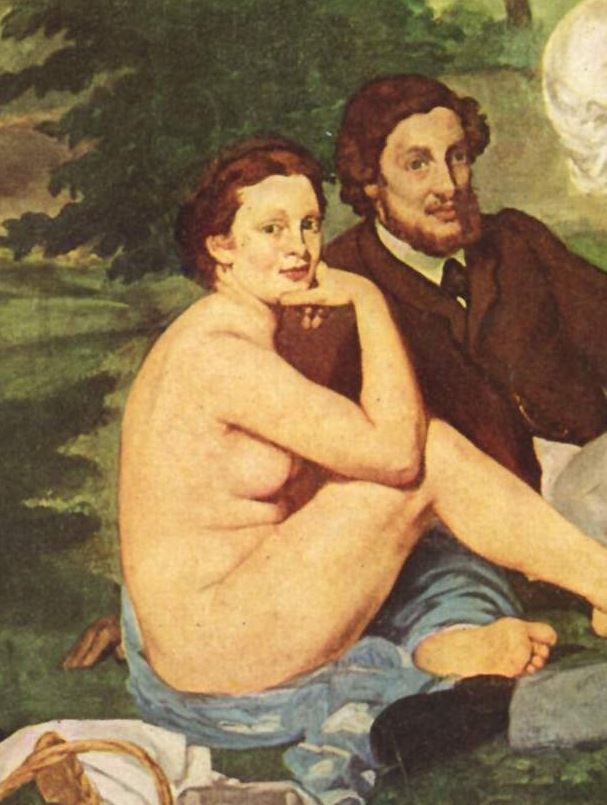
The foreground woman’s face is turned outward. The men’s gestures establish a conversation, but her attention seems to pass beyond them. She makes our position before the canvas difficult to ignore.
Her body is strongly lit against the wooded surroundings. Abrupt changes between light and dark limit the soft modelling that a Salon audience might have expected. The figure can appear strikingly present and comparatively flat at the same time.
The effect is not merely a matter of nudity. Her gaze and the manner of painting give the encounter a particular directness. She seems aware of a viewer whose relation to the gathering remains undefined.
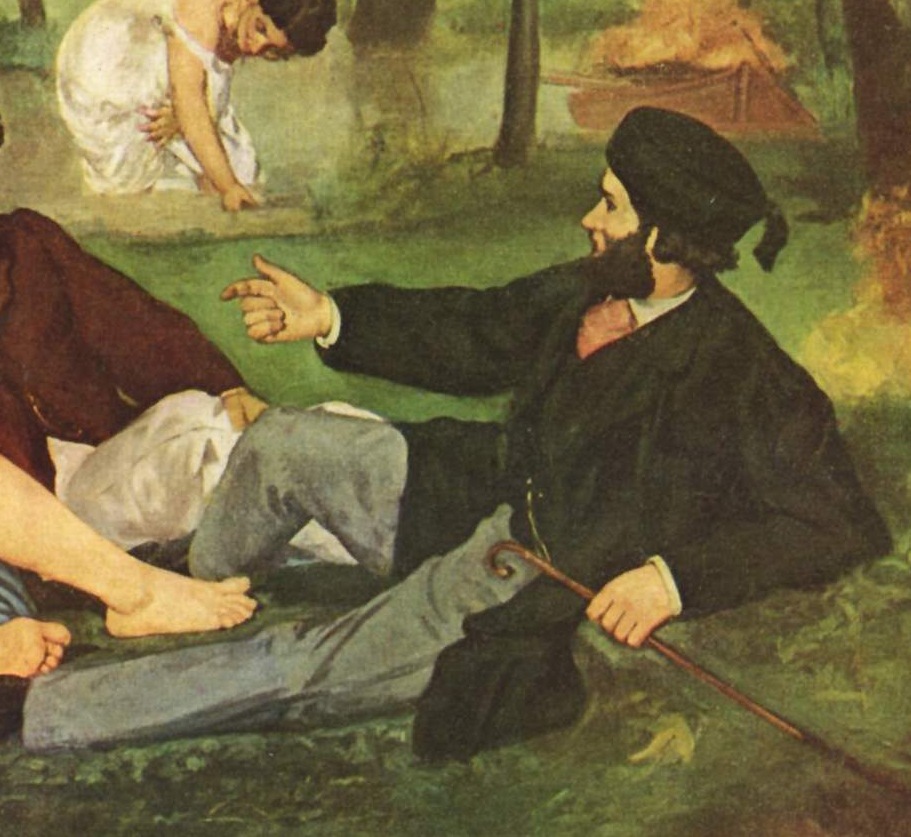
One man extends his hand in a gesture that suggests speech. The other appears to listen or consider. Their clothes and the arrangement of their limbs make them substantial foreground forms, but the content of their exchange is unavailable to us.
Their gestures create a closed circuit of attention that the woman does not fully join. This difference prevents the group from resolving into one shared action. The picture contains several directions of looking and several degrees of awareness.
The close arrangement also compresses the space. Bodies overlap without making the whole wooded setting easy to measure. We can follow individual limbs while remaining uncertain about how comfortably the gathering could occupy the place as a complete, continuous scene.
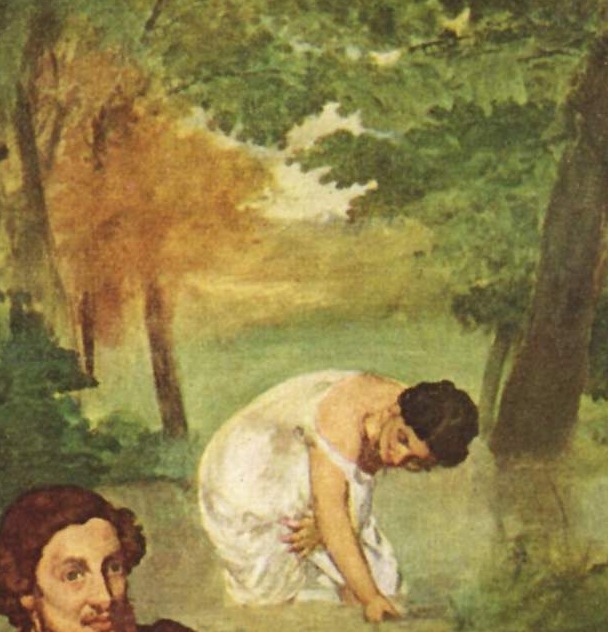
The woman near the water introduces a second scale. Her body is smaller, but its relation to the foreground figures and the stream can feel unexpectedly close. The recession is not as effortless as a conventional landscape might promise.
Trees and foliage supply the setting, yet they do not dissolve every inconsistency into a single deep vista. The landscape can feel like a constructed stage for the figures rather than an uninterrupted space we could enter.
That quality contributes to the painting’s tension. It makes us aware of pictorial decisions just when the subject seems to invite a straightforward account of a picnic outdoors.
The foreground group and the bather do not simply divide into two neat stages of depth. The pale fabric near the stream catches our attention while the darker vegetation should be carrying it farther away. The result can feel closer to overlapping pictorial zones than to one effortless walk into the woods.
This is why the bather deserves her own look. Treating her as a minor background accessory misses one of the places where the painting makes its constructed space most apparent.
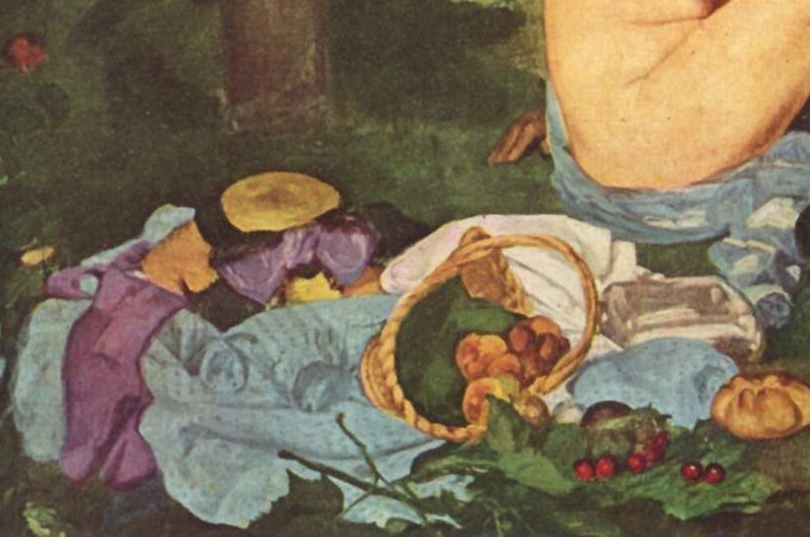
The lower-left corner brings objects unusually close: a tipped basket, fruit, fabric and leaves. Their arrangement anchors the gathering in material things, as if the people had only recently unpacked or settled down.
The colours and textures offer another route through the picture. Instead of following the figures’ gazes, the eye can travel across cloth, rounded fruit and the irregular edges of the basket.
These objects also make a boundary between us and the group. Before reaching the seated figures, we encounter the belongings spread on the ground. The painting gives the foreground a physical density that contrasts with the more uncertain distance behind.
Manet and Claude Monet are different artists. Monet later made his own Luncheon on the Grass, but the 1863 composition of the nude woman with two clothed men is Manet’s.
The distinction is especially useful in an Impressionism guide. Manet was an important colleague and example for the Impressionists, but he did not exhibit in their eight group shows. His relationship with the movement is close without being identical to Monet’s.
Compare Olympia, painted in the same year. Its reclining woman also returns the viewer’s gaze within a modern setting. Together, the works show Manet using familiar artistic forms to make the circumstances of looking newly unsettled.
Édouard Manet painted the canvas discussed here. Claude Monet later created a different work with a related title.
The familiar French title is Le Déjeuner sur l’herbe. It was shown at the Salon des Refusés in 1863 under the title Le Bain.
A contemporary nude among clothed men challenged accepted conventions, while strong contrasts and compressed space departed from polished Salon expectations.
The group relates to Raimondi’s engraving after Raphael’s Judgement of Paris, and the subject recalls Titian’s Pastoral Concert.
It belongs to the Musée d’Orsay in Paris. The museum records its dimensions as 207 by 265 centimetres.
It helped open the way for modern painting and was important to the Impressionists. Manet himself never participated in their eight group exhibitions.
Detail images are crops of the historical painting, with no painted forms added.
Continue with our guide to ten famous Impressionist paintings.
Enjoyed this story?
Save articles to your collection
Log in or create a free account, and this article will be waiting in your Private Collection.
Log in or sign up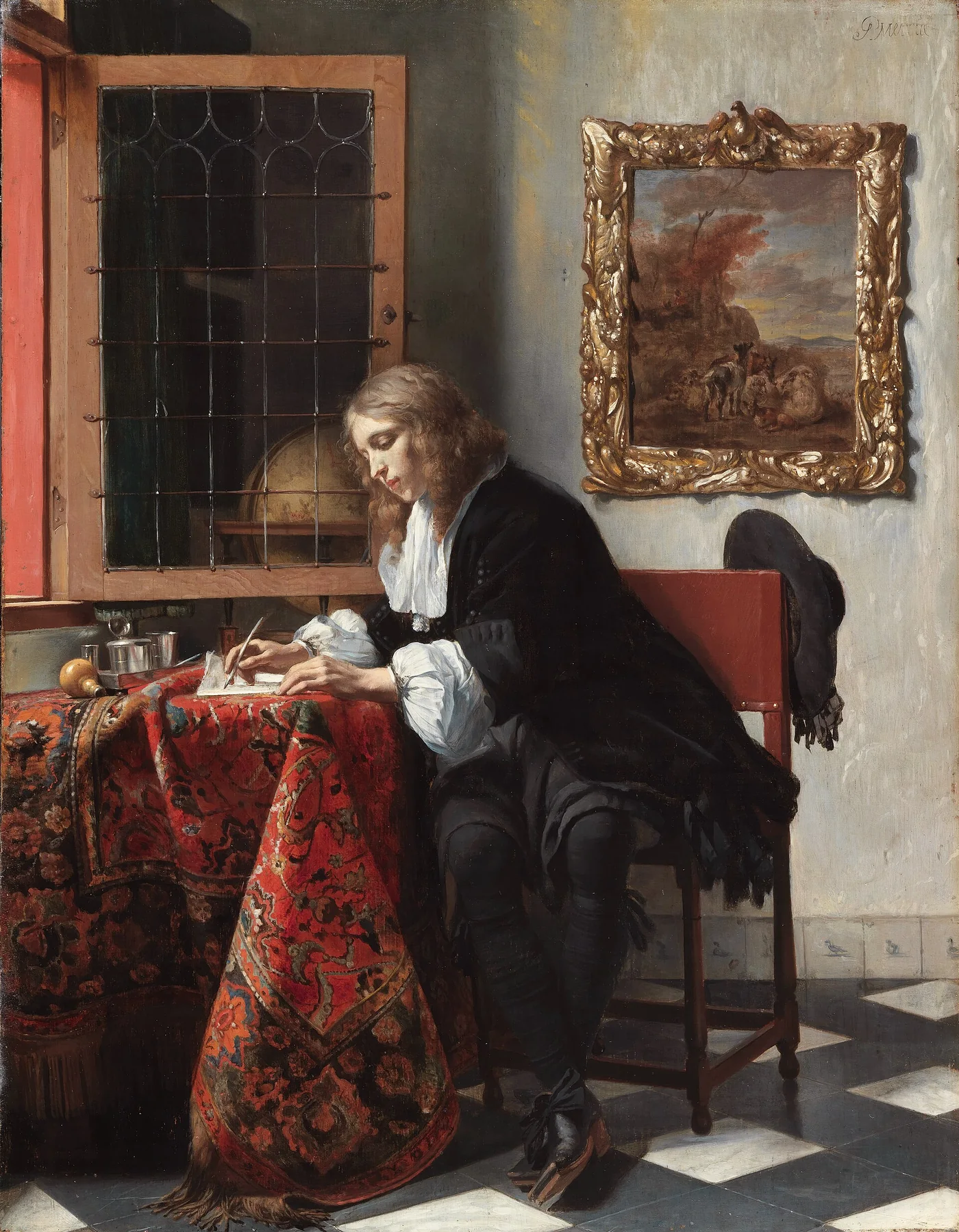
Man Writing a Letter
Gabriel Metsu, c. 1664
The gallery list
Every painting is already 50% off. Join the list and we will send you an extra $15 code, plus first access to new collections.
No spam. Unsubscribe anytime. · Privacy Policy
Welcome
Your $15 code is on its way. Explore the gallery while you wait.