Loading cart…
No products in the cart.

1886 · Oil on canvas · Lady Lever Art Gallery, Port Sunlight, United Kingdom

Millais painted Bubbles in 1886, using his grandson William James as the model for the central figure. The boy, dressed in a velvet suit of the kind associated with the aesthetic fashion of the 1880s, is depicted kneeling on a low step and gazing upward at a soap bubble he has just blown through a clay pipe. The painting was originally titled A Child World and was sold by Millais to the dealer William Agnew, who in turn sold the reproduction rights to the London Illustrated News. It subsequently came to the attention of Thomas Barrett of A. and F. Pears, the soap manufacturing company, who purchased the painting and the rights to use it in advertising for their flagship product, Pears Soap. Millais gave his consent to the commercial use, a decision that generated considerable controversy in artistic circles, where it was seen by some as a compromise of the integrity of fine art for commercial ends. The debate about the Pears Soap advertisement touched on broader Victorian anxieties about the relationship between high culture and commercial enterprise, and it made Millais a figure of discussion well beyond the usual audience for exhibition painting. Despite the controversy, the painting itself was recognized as a work of high technical achievement, and its sentimentality, carefully judged and never descending into mere saccharine, reflected a deliberate shift in the later career of Millais toward subjects with broader popular appeal. The original canvas passed through several hands after the Pears Soap use and is now held at the Lady Lever Art Gallery in Port Sunlight, where it continues to attract visitors drawn by both its art-historical interest and its cultural familiarity.
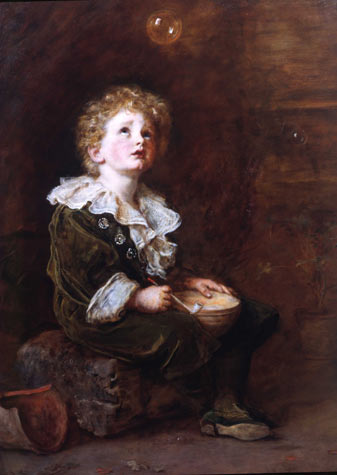
The technique of Bubbles represents the mature style of Millais at a significant remove from the tight, botanical precision of his Pre-Raphaelite years, though it retains many of the qualities that defined his approach throughout his career. The handling of light in this painting is particularly accomplished. The figure of the boy is illuminated from a source to the left that falls across the velvet of his suit and picks out the copper and gold tones of his curling hair with a warmth that is clearly calculated to invite affection from the viewer. The background, a shallow domestic setting with a low shelf and a partially visible ceramic vessel, is rendered in the softer, broader brushwork of Millais in his later period, where forms are suggested rather than enumerated and atmosphere is prioritized over individual detail. The soap bubble itself, floating in the upper portion of the composition, is painted with real delicacy, its iridescent surface capturing a tiny reflected highlight that gives it a fragile, convincing transparency. The upward gaze of the boy creates a strong vertical axis in an otherwise quiet composition, drawing the eye from the kneeling figure at the lower register up through the frame of the bubble and into the empty space above, a spatial gesture that gives the image its characteristic sense of transient wonder. The expression on the face of the child is one of genuine, unselfconscious absorption, free from the posed quality that weakens much Victorian child portraiture. Millais was a painter of faces with remarkable ability to capture a specific psychological state, and the look of this boy, wholly given over to the moment of watching, is among his most persuasive achievements in that regard. This is a painting that rewards close looking, and a hand-painted oil reproduction available through ByMuseum allows you to experience that looking every day.
The thematic core of Bubbles is the classical motif of the soap bubble as an emblem of transience, a tradition known by its Latin name, Homo Bulla, meaning man is a bubble, which carried significant weight in European art from the sixteenth century onward. Painters working in the tradition of vanitas imagery, which meditated on the brevity of life and the futility of material attachment, frequently employed the soap bubble as a symbol of the ease with which beauty and life dissolve. Millais, painting in the 1880s, was unlikely to have been unaware of this tradition, and the presence of the bubble in a painting of a child, who is himself a symbol of life at its earliest and most vulnerable stage, gives the image a quiet undercurrent of melancholy that prevents it from being merely a pleasing genre scene. The choice of a boy dressed in aesthetic fashions, with a pipe and a bowl of soapy water, places the activity of bubble-blowing in the register of cultivated play, a leisure activity that speaks to a comfortable domestic world, yet the bubble the child watches so intently will burst in a moment, leaving nothing behind. This tension between the beauty of the present and the certainty of its passing is one of the most durable themes in Western painting, and Millais brings it into the Victorian drawing room with directness and warmth. The commercial history of the image adds an additional layer of meaning: the subsequent use of Bubbles in advertising transformed a meditation on impermanence into a vehicle for consumer aspiration, and that transformation itself became a document of the cultural tensions of the late nineteenth century. Owning a hand-painted oil reproduction of Bubbles is an opportunity to reclaim the painting from its commercial afterlife and to engage with it as the considered work of pictorial art that it has always been.