Loading cart…
No products in the cart.

1856 · Oil on canvas · Birmingham Museum and Art Gallery, Birmingham, United Kingdom

Millais began preparatory work on The Blind Girl around 1854 and completed the painting in 1856, undertaking a significant part of the outdoor work at Winchelsea in East Sussex. The painting depicts two young girls, the older of whom is blind, resting on a common during what appears to be the passing of a storm. The older girl holds a small concertina and wears around her neck a sign identifying her as a blind beggar, a reminder that traveling musicians with visual impairments were a recognizable feature of Victorian rural and semi-urban life. The younger girl has turned to look at the double rainbow appearing in the sky behind them, but the older girl faces forward, her eyes closed or sightless, entirely unable to perceive the spectacular natural display that surrounds her. Millais brought to the landscape the same disciplined naturalism he had applied in Ophelia, painting the wet grass, the distant town of Winchelsea, and the luminous post-storm sky with close attention to observed conditions. The model for the blind girl was a young woman from the local area, and accounts suggest Millais worked with considerable care to ensure the posture and expression conveyed the particular stillness of someone who navigates the world without sight. The work was exhibited at the Royal Academy in 1856 to significant critical and public attention. John Ruskin praised it warmly. The painting was acquired by the Birmingham Museum and Art Gallery, where it remains a central treasure of the collection. Its combination of social observation, natural splendor, and emotional depth gave it immediate resonance with Victorian audiences attuned to questions of suffering, beauty, and spiritual consolation.
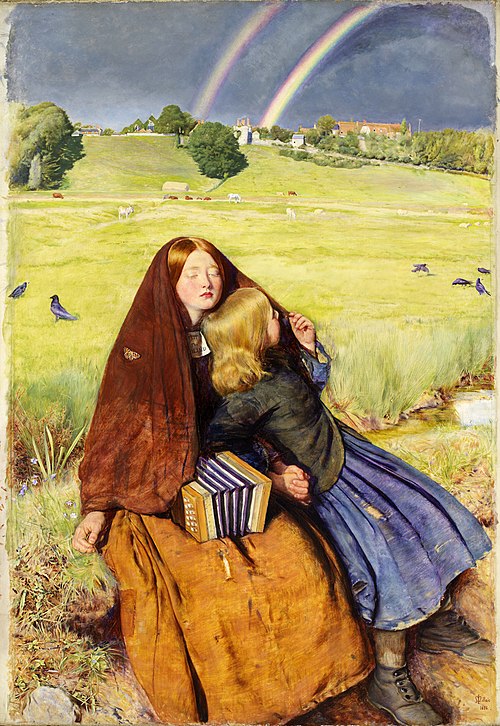
The compositional strategy of The Blind Girl is built on a structural irony that is immediately legible and endlessly resonant. The entire upper register of the painting is devoted to one of the most spectacular natural phenomena visible in the landscape, a vivid double rainbow arching over a rain-cleared sky above the rooftops of Winchelsea, yet the central figure of the composition is constitutionally unable to see any of it. Millais positions the girls in the lower half of the canvas, close to the picture plane, and elevates the sky so that it occupies a generous portion of the surface area, making the viewer acutely aware of the beauty that surrounds and exceeds the perception of the central figure. The handling of the wet grass in the foreground is extraordinarily precise. Individual blades can be distinguished, and the quality of light after rainfall, that particular luminosity when the sun re-emerges on saturated ground, is captured with the faithfulness that defines Millais at the height of his Pre-Raphaelite commitment. The face of the blind girl is turned slightly upward, and a butterfly has landed on her shawl, a detail painted with the same care as every other element in the scene. Her expression is not one of obvious anguish but rather of a settled, almost contemplative calm, which makes the surrounding grandeur simultaneously more beautiful and more poignant. The smaller girl looks back at the rainbow, providing the viewer with a surrogate gaze, a figure within the painting who does what the viewer is doing and sees what the blind girl cannot. This internal commentary on seeing and not-seeing gives the composition an unusual self-awareness. You can own this as a hand-painted oil reproduction through ByMuseum, available in multiple custom sizes.
The symbolic architecture of The Blind Girl operates on several levels simultaneously, and the painting rewards each level of attention equally. At its most immediate, it is a scene of social observation: two child beggars resting on common land, dependent on charitable recognition from strangers, their poverty marked literally by the label around the neck of the older girl. Millais was working in a tradition of Victorian social realism that took seriously the lives of those on the margins of prosperity, and The Blind Girl participates in that tradition without condescension or sentimentality. At a deeper level, the painting engages with ideas about perception, consciousness, and the relationship between the outer world and inner life. The blind girl cannot see the rainbow, but she is surrounded by other sensory information: the smell of the wet earth, the warmth of returning sunlight, the sound of whatever small movements the landscape makes around her. The butterfly on her shawl, traditionally a symbol of the soul in Christian iconography, suggests a spiritual dimension to her experience that transcends physical sight. Some scholars have read the painting as a meditation on faith, the idea that there are forms of knowing and being that do not depend on empirical visual evidence. The rainbow itself, a traditional symbol of divine promise drawn from the story of Noah in the Bible, reinforces this reading by placing the visible sign of a covenant precisely where it cannot be received by the person who most might need consolation. The cultural legacy of The Blind Girl is substantial. It is widely reproduced in discussions of Victorian painting, social history, and disability studies, and it continues to be cited as one of the most emotionally intelligent images produced in nineteenth-century Britain. To bring a hand-painted oil reproduction of this work into your home is to live daily with a painting that asks profound questions about what it means to be present in the world.