Loading cart…
No products in the cart.

1860 · Oil on canvas · Lady Lever Art Gallery, Port Sunlight, United Kingdom

John Everett Millais completed The Black Brunswicker in 1860, exhibiting it at the Royal Academy to considerable public enthusiasm. The painting draws upon the historical moment preceding the Battle of Waterloo in 1815, focusing on a soldier belonging to the Black Brunswickers, a German volunteer corps that fought alongside the British forces against Napoleon. Millais was deeply interested in the emotional and human dimensions of historical conflict, and this work reflects his ongoing commitment to narrative painting that combined precise detail with accessible sentiment. The figures were painted using live models, with the soldier rendered by a man named Frederick Walker and the young woman by Kate Perugini, who was the daughter of Charles Dickens. The use of identifiable and well-regarded models added a layer of contemporary resonance to the historical subject matter. The painting was produced during a transitional phase in Millais's career, as he moved gradually away from the strict doctrines of the Pre-Raphaelite Brotherhood toward a broader Victorian narrative style. Despite this shift, the work retains characteristic Pre-Raphaelite attention to surface detail, particularly in the rendering of costume and fabric. The elaborately decorated uniform of the soldier, the soft muslin of the young woman's dress, and the detailed interior setting all demonstrate a dedication to pictorial accuracy that Millais had developed throughout the 1850s. The canvas was acquired by Lord Lever and eventually came to form part of the celebrated collection at the Lady Lever Art Gallery in Port Sunlight, where it remains one of the most visited works.
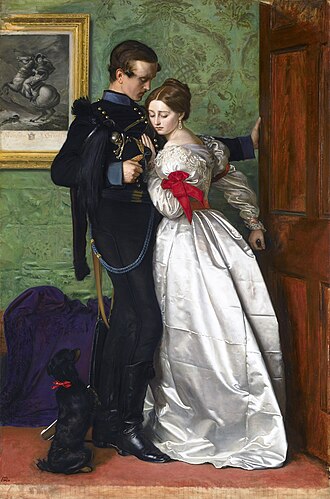
The composition of The Black Brunswicker is structured around a central tension between movement and stillness. The soldier leans forward with purposeful energy, his body angled toward the door as if already in motion toward the battlefield, while the young woman presses her hand gently against his chest in a gesture that is simultaneously tender and restraining. This physical dynamic creates a visual dialogue between duty and love, between the external world of war and the interior world of private feeling. Millais arranges the figures so that their bodies form a unified diagonal line, guiding the eye from the upper left corner, where the door stands slightly ajar, down toward the lower right where their hands meet. The handling of light in this painting is particularly refined. A soft, diffuse illumination falls across the interior, highlighting the white of the young woman's dress and the polished buttons of the soldier's uniform. Millais employs a restrained palette of black, white, and warm neutral tones that reinforces the emotional gravity of the scene without resorting to melodramatic color. A small framed portrait of Napoleon Bonaparte visible on the wall behind the couple functions as a quiet but pointed compositional element, reminding the viewer of the historical forces that have created this farewell. Every surface, from the wood of the door to the lace trim of the dress, is rendered with precise observational care.
The thematic core of The Black Brunswicker rests on the universal human experience of separation and sacrifice. By situating a deeply personal moment within a well-known historical conflict, Millais invites viewers to consider the private cost of public warfare. The soldiers of the Black Brunswickers were volunteers motivated by patriotism following the occupation of their homeland, and this context gives the farewell scene a weight that extends beyond simple romantic sentiment. The young woman in the painting is not merely a grieving beloved but a figure who represents the civilian population left behind while others march toward an uncertain fate. Her gesture of restraint, pressing against the soldier's chest, carries within it both affection and an awareness that she cannot truly stop what is about to happen. The inclusion of the portrait of Napoleon on the wall deepens the interpretive possibilities of the painting considerably. Napoleon serves as the unseen antagonist, the historical force whose ambitions have set the events of this moment into motion. By placing his image in the domestic interior, Millais suggests that the reach of political power extends even into the most private spaces of human life. The painting was created in 1860, during a period when British audiences were reflecting on the legacy of the Napoleonic Wars with a mixture of nostalgia and pride, and Millais calibrated his image to resonate with that collective memory. The work ultimately affirms the significance of ordinary human bonds against the backdrop of extraordinary historical circumstances.