Loading cart…
No products in the cart.

1509 to 1511 · Fresco · Apostolic Palace, Vatican City
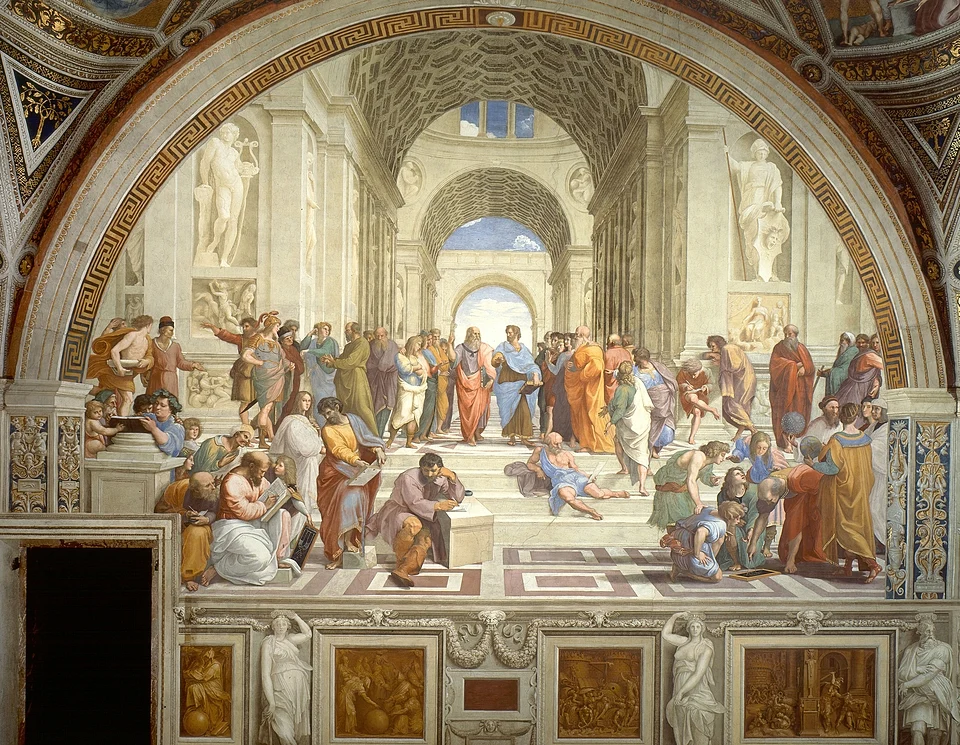
When Pope Julius II decided to renovate and redecorate his private apartments in the Vatican Palace, he assembled a group of leading artists for the task. Among them was the young Raphael, barely twenty-five years old and newly arrived in Rome, yet already recognized as a painter of exceptional promise. The commission to paint the Stanza della Segnatura, the room that would house the papal library, called for a unified decorative program reflecting the four branches of human knowledge: theology, philosophy, law, and the arts. The fresco now known as The School of Athens was assigned to the wall representing philosophy, and Raphael conceived it as an imaginary gathering of the greatest intellectual figures of the ancient world. The work was completed between 1509 and 1511, and it immediately established Raphael as one of the defining painters of his generation. The project gave him both the physical space and the institutional support to develop his ideas about pictorial composition, spatial depth, and the relationship between individual figures and monumental architectural settings. The commission was among the most prestigious of the entire Renaissance period, placing Raphael in direct proximity to papal power and giving his work an audience that extended across the entire Catholic world. The fresco survives today in remarkable condition and remains in its original location in the Vatican, forming part of the suite of rooms open to visitors as the Raphael Rooms.
The composition of The School of Athens is organized around a deep architectural space that recedes toward a central vanishing point positioned between the two principal figures of Plato and Aristotle. Raphael constructed this space using a sequence of barrel-vaulted arches inspired by the grand Roman buildings he studied during his years in the city, and the effect is one of almost theatrical spaciousness. More than fifty individual figures are distributed across the foreground and middle ground of the image, each identifiable by gesture, attribute, or pose. Plato, modeled on the likeness of Leonardo da Vinci, points upward toward the realm of ideal forms, while Aristotle extends his hand outward toward the observable world, and this contrast in gesture summarizes an entire philosophical debate with elegant economy. In the foreground, the solitary figure of Heraclitus, modeled on Michelangelo and added after Raphael had seen early sections of the Sistine Chapel ceiling, leans over a block of stone in brooding isolation. The spatial clarity and the psychological variety of the individual figures demonstrate a compositional intelligence that sets this work apart from anything produced before it. The fresco rewards extended study, offering new figures and new relationships each time the eye moves across its surface. Those who wish to bring this extraordinary image into their own space can own this as a hand-painted oil reproduction, crafted with full attention to the depth and tonal richness of the original fresco.
The School of Athens carries a meaning that operates on several levels simultaneously. At the most immediate level it is a celebration of classical learning, presenting the intellectual heritage of ancient Greece as a living tradition relevant to the humanist culture of Renaissance Rome. By bringing together figures from different centuries and different schools of thought into a single imagined space, Raphael proposed that the pursuit of knowledge is a unified and continuous human endeavor rather than a series of isolated individual achievements. The fresco also functions as a statement about the role of the papacy as a guardian of human learning, placing this celebration of philosophy in the private apartments of the pope and thereby linking spiritual and intellectual authority. The inclusion of contemporary figures among the ancient philosophers, including portraits of Leonardo, Michelangelo, and Raphael himself in the guise of the painter Apelles near the right edge, suggests that the Renaissance present is continuous with the ancient past, that the project of human understanding begun in Athens is being carried forward in Rome. The lasting impact of this image on Western culture has been immense. It has served as a model for group portraiture, for the representation of intellectual community, and for the idea that art can give visual form to the deepest aspirations of a civilization. It remains one of the most reproduced images in the history of art, and owning it as a hand-painted oil reproduction allows collectors to engage with its visual complexity in a direct and personal way.