Loading cart…
No products in the cart.

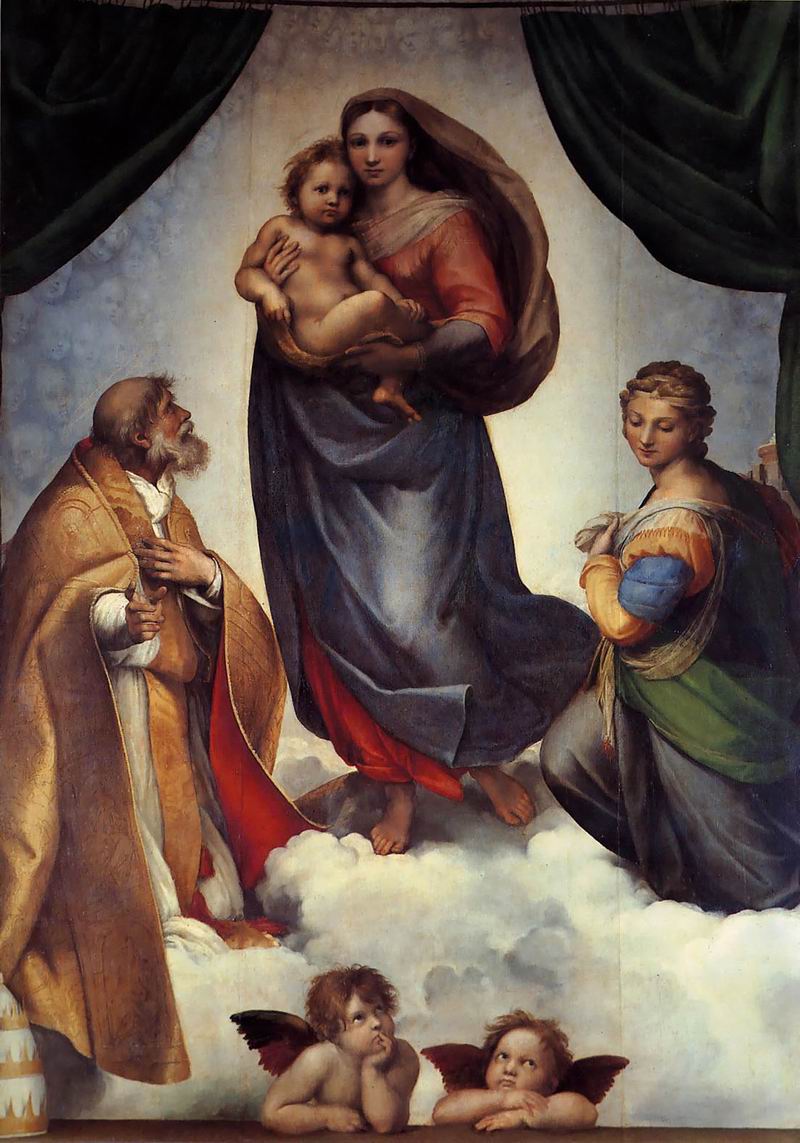
1512 · Oil on canvas · Gemaldegalerie Alte Meister, Dresden, Germany
Save articles to your collection
Log in or create a free account, and this article will be waiting in your Private Collection.
Log in or sign upThe Sistine Madonna was commissioned by Pope Julius II for the monastery church of San Sisto in Piacenza, a city in northern Italy that had recently come under direct papal control. The work was intended as an altarpiece and was delivered to the church around 1512, where it remained for more than two centuries. The commission was part of a broader program through which the papacy used works of art to assert its spiritual and political authority in newly acquired territories. Raphael received the commission at a moment when his reputation in Rome was at its height, following the completion of the first of the Stanza frescoes, and the resulting painting reflects both the confidence of an artist at the peak of his powers and the specific devotional requirements of the commission. The painting remained in Piacenza until 1754, when Augustus III, Elector of Saxony and King of Poland, purchased it from the monks of San Sisto for the Dresden picture gallery. The negotiations were lengthy and the price substantial, reflecting the extraordinary reputation the work had acquired over the preceding centuries. Since its arrival in Dresden, the Sistine Madonna has remained one of the prize possessions of the Gemaldegalerie Alte Meister, surviving damage during the Second World War and a period of confiscation by Soviet forces before being returned to Dresden in 1955. The two small winged angels at the bottom of the composition, often reproduced independently, have become among the most recognized details in the history of Western art.
Raphael organized the composition of the Sistine Madonna around a single central axis that runs from the parted green curtain at the top of the image down through the figure of the Virgin and the Christ Child to the two contemplative angels resting at the bottom edge of the picture. This vertical axis creates a sense of celestial descent, as though the Virgin is moving downward from a heavenly realm into the space of the viewer. The figures of Saint Sixtus on the left and Saint Barbara on the right flank the central group in poses that open outward rather than closing inward, drawing the viewer into the composition rather than containing it. The Christ Child at the center of the image is depicted with an unusual directness of gaze, looking outward at the viewer with an expression that combines the vulnerability of infancy with a quality of gravity that suggests awareness of a larger destiny. The technique in this painting demonstrates the full maturity of the approach of Raphael to oil painting. The modeling of the flesh of the Virgin and the Christ Child is achieved through extremely delicate transitions of warm and cool tone, while the clouds surrounding the figures are rendered with a luminous softness that gives the entire scene an atmospheric quality unlike anything in his earlier work. Collectors seeking to experience the warmth and luminosity of this composition at home can own this as a hand-painted oil reproduction, allowing its gentle light and careful figure work to be appreciated in a personal setting.
The Sistine Madonna holds a place in the devotional and cultural life of the Western world that is difficult to overstate. As a devotional image, it presents the Virgin Mary in a mode that is simultaneously approachable and awe-inspiring. She does not sit enthroned in the traditional manner of earlier Madonna images but instead walks forward through cloud and air, carrying the Child toward the viewer with an expression of tender seriousness. This sense of movement and immediacy was innovative for its time and gave the image an emotional directness that made it exceptionally effective as an object of devotion. The inclusion of Saint Sixtus, the patron of the commissioning family and of the church, connects the heavenly vision to a specific earthly community, while Saint Barbara, associated with a peaceful death, adds a layer of protective meaning appropriate for a liturgical setting. The two small angels at the base of the composition, looking upward with expressions of dreamy curiosity, have acquired a cultural life entirely their own in the centuries since the painting was completed. They appear today on postcards, posters, and decorative objects around the world, often entirely separated from the larger work of which they form a small part. This phenomenon speaks to the extraordinary quality of psychological observation that Raphael brought even to the minor details of his compositions. Owning this painting as a hand-painted oil reproduction allows collectors to appreciate the full context of those celebrated angels and the magnificent devotional image of which they are part.
Enjoyed this story?
Save articles to your collection
Log in or create a free account, and this article will be waiting in your Private Collection.
Log in or sign up