Loading cart…
No products in the cart.

Today, the name Raphael carries a weight that extends far beyond the walls of any single museum. Reproductions of his compositions appear in galleries, private collections, and homes across every continent. His figures are studied in art schools from Rome…
Today, the name Raphael carries a weight that extends far beyond the walls of any single museum. Reproductions of his compositions appear in galleries, private collections, and homes across every continent. His figures are studied in art schools from Rome to Tokyo. His approach to harmony, idealized beauty, and compositional clarity has shaped the visual vocabulary of Western painting for more than five centuries. The frescoes he created for the Vatican remain among the most visited works of art in the world, drawing millions of visitors each year who stand in quiet admiration before images that were conceived by a young Italian painter who never reached his fortieth birthday. His influence passed through the Baroque period, resurfaced in Neoclassicism, and became a defining touchstone for the academic painting traditions of the nineteenth century. Even movements that rejected his aesthetic, such as the Pre-Raphaelites, defined themselves specifically in opposition to the values he represented, which is itself a testament to the central position he has long occupied in the history of art. To understand the legacy of Raphael is to understand how one vision of beauty can organize an entire cultural tradition.
Raffaello Sanzio da Urbino was born on April 6, 1483, in the refined court city of Urbino, where his father Giovanni Santi worked as a painter in service to the Duke. This early environment gave the young Raphael direct exposure to humanist thought, courtly culture, and the emerging ideals of the Renaissance. After the death of his father, Raphael entered the workshop of Pietro Perugino, one of the leading painters of Umbria, and absorbed the graceful spatial arrangements and luminous figure types that would remain characteristic of his work. His move to Florence around 1504 brought him into contact with the works of Leonardo da Vinci and Michelangelo, and his capacity to observe, absorb, and synthesize the innovations of others became the foundation of his extraordinary artistic development. Pope Julius II summoned him to Rome in 1508 to decorate the papal apartments known as the Stanze di Raffaello, and it was here that Raphael produced the works that would define his reputation for all time. In the final years of his life he also served as architect of Saint Peter Basilica and as a pioneering figure in the documentation of ancient Roman monuments. He died on his thirty-seventh birthday, leaving an unfinished legacy that his contemporaries and all subsequent generations have continued to mourn.
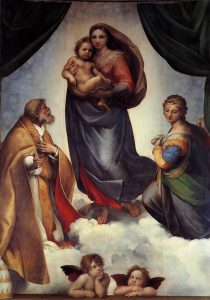
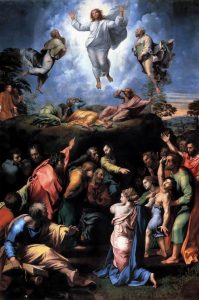
The technique of Raphael is defined above all by a pursuit of serene perfection that never tips into coldness. His figures possess a fullness and warmth that derives partly from his careful study of Leonardo da Vinci's sfumato technique, which he adapted into a softer and more lucid idiom. Rather than dissolving forms into atmospheric shadow as Leonardo did, Raphael preferred a clear, warm light that defines anatomy with gentle precision while still allowing transitions between light and shadow to feel organic and alive. His preparatory process was extraordinarily rigorous. He produced large numbers of drawings, often working through poses and groupings through many iterations before arriving at the final composition. These drawings reveal a mind constantly in search of balance, rhythm, and a feeling of effortless grace that required immense effort to achieve. His handling of paint, whether in fresco or in panel and canvas works, demonstrates a consistency of touch and a control of glazing that gives his surfaces a luminous depth. Color in his work tends toward a harmonious chord of warm reds, cool blues, and soft ochres that reinforce the emotional and spiritual tone of each composition.
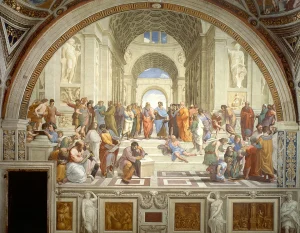
Composition is perhaps the area in which the style of Raphael is most immediately recognizable and most analytically rich. He organized figures into pyramidal groupings inherited from Leonardo but opened those groupings outward to include the viewer and to suggest a broader spatial world beyond the picture plane. In his large fresco cycles, he arranged dozens of figures into coherent dramatic scenes without allowing the image to feel crowded or confused. Each figure has a clear role, a legible gesture, and a face that communicates a specific psychological state. The architectural settings he devised, often inspired by the classical buildings and ruins he studied in Rome, provide frameworks of measured geometry that anchor the figures and give the eye a sense of rational order within which the human drama unfolds. This balance between intellectual structure and human warmth is the defining quality of his visual language, and it is what has made his work so consistently compelling across so many different cultural contexts and historical periods.
Each card links to its own article with full analysis and reproduction details.
 #1
#1
 #2
#2
 #3
#3
A print can reproduce colors. What it cannot reproduce is texture, depth, and the physical presence of oil paint on canvas. Raphael technique depends on these.
At ByMuseum, every reproduction is painted by hand using oil on canvas. There is no inkjet, no digital print. The brushwork is real. The result looks like a painting because it is one.