Loading cart…
No products in the cart.

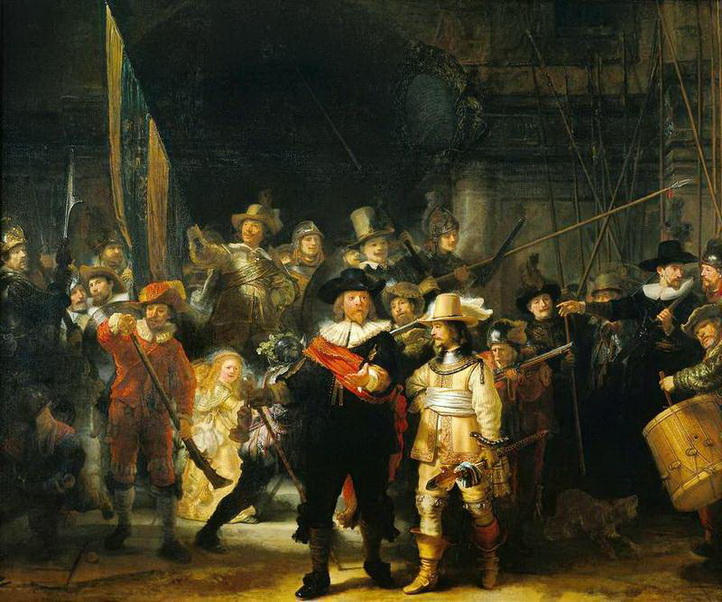
1642 · Oil on canvas · Rijksmuseum, Amsterdam, Netherlands
Save articles to your collection
Log in or create a free account, and this article will be waiting in your Private Collection.
Log in or sign upRembrandt van Rijn painted The Night Watch in 1642 on a commission from the Amsterdam civic militia company of Captain Frans Banninck Cocq. The painting was intended to hang in the Kloveniersdoelen, the meeting hall of the musketeer militia, alongside other large group portraits commissioned around the same time from different painters. The militia system in seventeenth-century Dutch cities was a civic institution made up of prosperous citizens who served a defensive and ceremonial function, and commissioning a group portrait was a prestigious and expensive undertaking. Each of the identifiable figures in the painting contributed to the cost of the commission, with those placed more prominently paying more. The painting was trimmed on all four sides, most significantly on the left, when it was moved to Amsterdam City Hall in 1715, and the missing portion, which would have included two additional figures on the left edge, is known only through a small copy made before the trimming. The current popular title, The Night Watch, was given to the painting in the late eighteenth century based on the mistaken impression that the scene takes place at night, when in fact it depicts a daytime scene darkened by accumulated varnish.
Rembrandt broke significantly from the conventions of Dutch group portraiture in The Night Watch by organizing the composition around dramatic movement and action rather than the static, row-by-row arrangement typical of the genre. Captain Frans Banninck Cocq, dressed in black with a red sash, strides forward at the center of the composition, accompanied by his lieutenant Willem van Ruytenburch in yellow. The company of musketeers behind them is rendered in a compressed, overlapping arrangement that creates a sense of forward momentum and crowd energy. Rembrandt used his characteristic chiaroscuro lighting to dramatic effect, bathing certain figures in brilliant light while others recede into deep shadow, creating a visual hierarchy that guides the viewer eye through the complex scene. A small girl in a golden dress appears in the middle ground, her identity and symbolic function still debated by scholars. A dog barking in the foreground, a drummer at the right edge, and various figures loading or carrying weapons all contribute to the sense of animated preparation. The scale of the painting, at over four meters wide, is essential to its effect, and even a hand-painted oil reproduction benefits from being produced at a generous size to convey the dynamism of the original.
The Night Watch is significant not only as a painting but as a document of civic identity and social aspiration in the Dutch Golden Age. The militia companies it depicts were important institutions of middle-class self-governance in Dutch cities, and commissioning a large group portrait was an act of collective self-presentation. By choosing to represent the company in motion rather than posed, Rembrandt elevated the subject from a formal record to a celebration of civic energy and purposeful action. The painting has also been interpreted as a meditation on light and darkness, visibility and concealment, which were recurring concerns in Rembrandt artistic practice. The mysterious girl in gold, who carries the claw of a chicken at her belt, the symbol of the Kloveniersdoelen, may function as an allegorical figure representing the company or its values. Over the centuries, the painting suffered damage from a knife attack in 1975 and an acid attack in 1990, both of which were repaired, adding a layer of vulnerability and resilience to its cultural narrative. It remains the centerpiece of the Rijksmuseum and one of the most visited paintings in the world.
Enjoyed this story?
Save articles to your collection
Log in or create a free account, and this article will be waiting in your Private Collection.
Log in or sign up