Loading cart…
No products in the cart.

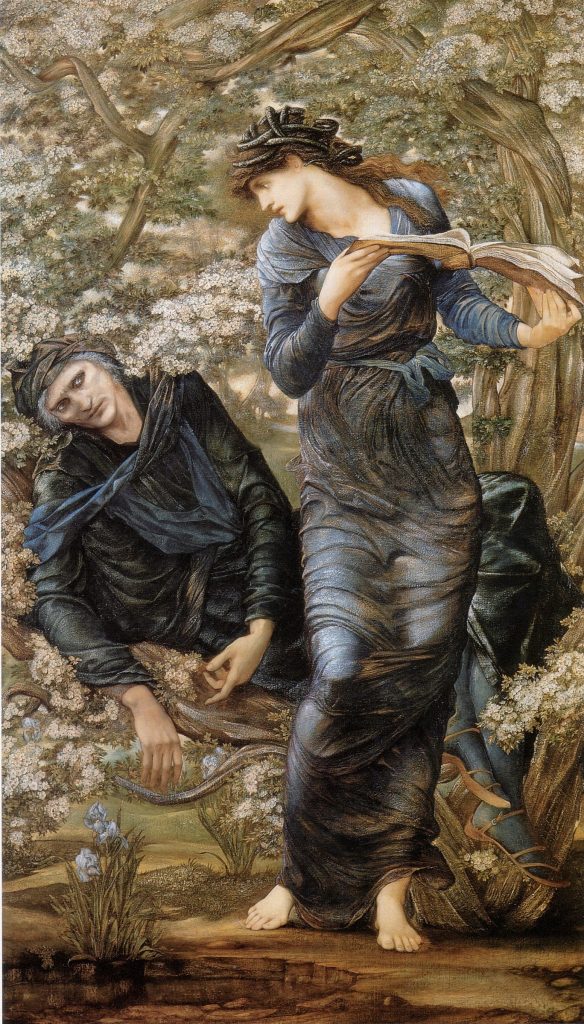
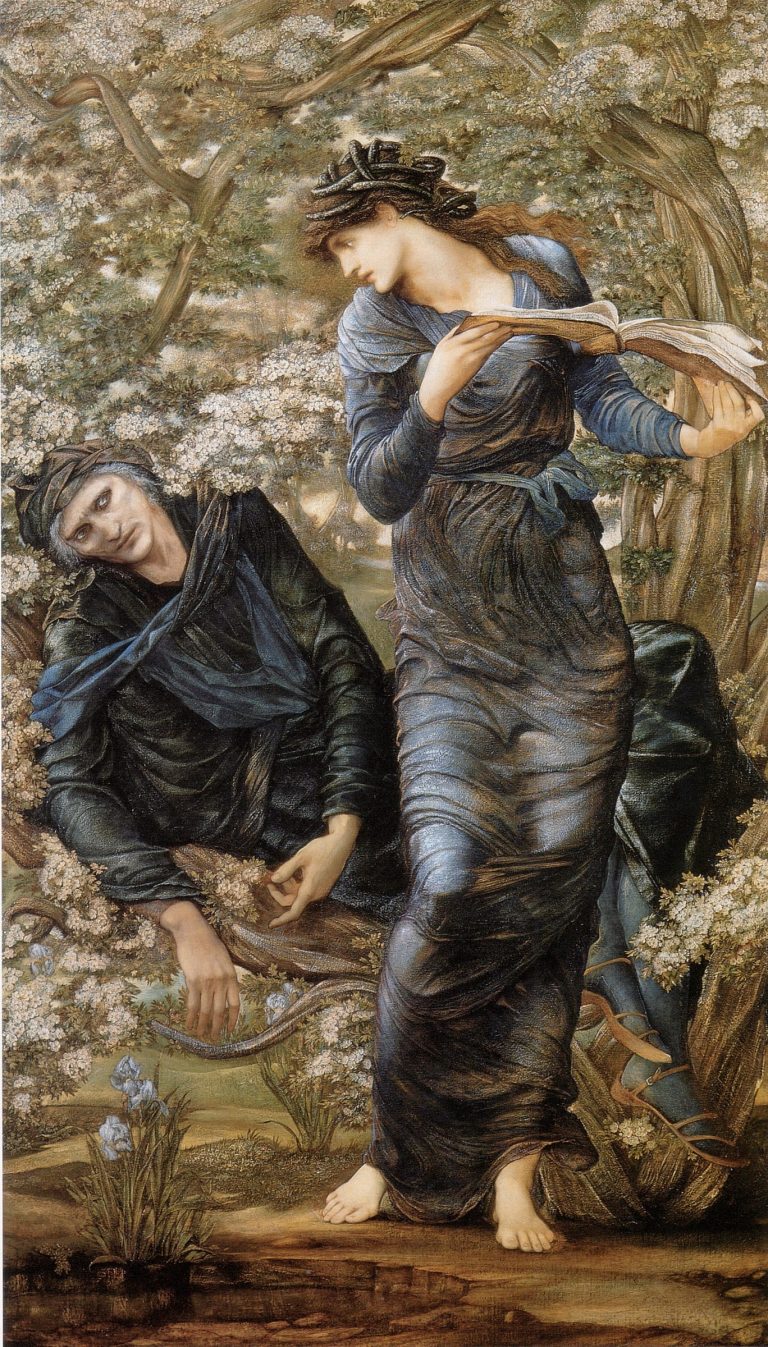
1872 to 1877 · Oil on canvas · Lady Lever Art Gallery, Port Sunlight
Save articles to your collection
Log in or create a free account, and this article will be waiting in your Private Collection.
Log in or sign up Explore the artistEdward Burne-Jones paintings →
Nimue stands among flowering branches with a book held across her chest. Merlin is lower down, caught inside the same tree. Her body turns toward him, but the book keeps the two figures apart. The branches appear beautiful until we notice what they are doing to the man among them.
Edward Burne-Jones’s The Beguiling of Merlin turns an Arthurian story into a close encounter between knowledge and vulnerability. The large oil painting was developed in the 1870s and shown at the first Grosvenor Gallery exhibition in 1877. It belongs to the Lady Lever Art Gallery at Port Sunlight.
There is no flash of light to mark the spell. Leaves, hands, folded cloth and a tilted head carry the action. Enchantment looks almost indistinguishable from the arrangement of the painting itself.
The story concerns the enchantress Nimue, also known in Arthurian retellings as Vivien or by related names. She learns magic from Merlin and uses his knowledge to confine him. Burne-Jones shows the reversal of their relationship: the teacher is held, while the pupil controls the open book.
The Lady Lever collection record identifies the scene with Merlin’s entrapment in a hawthorn tree. Arthurian versions differ over the form and circumstances of his imprisonment, so the painting should not be made to illustrate every variant at once.
Here the trap is visible. Branches cross and surround Merlin’s body. Nimue has room to stand. The difference in their freedom is more telling than any imagined words they might exchange.
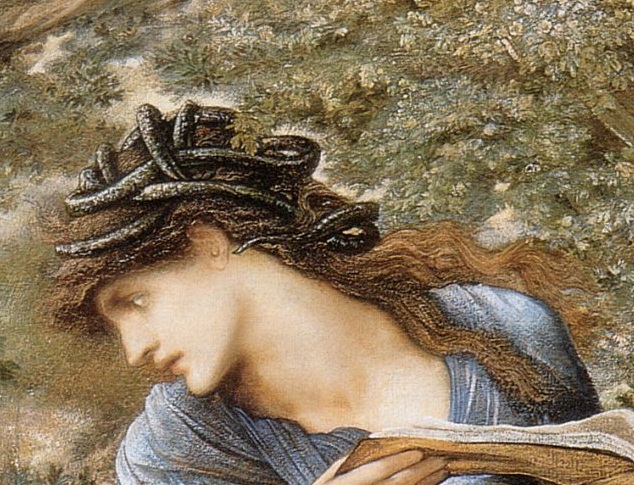
Her head turns sharply toward the left. A dark coiled headdress makes a hard, irregular shape above the soft curve of her neck. The face is pale, and the eyes appear directed down toward Merlin rather than outward to the viewer.
This sideways turn prevents her from becoming a simple upright emblem of triumph. Her attention remains tied to the person beside her. We cannot tell from the expression alone whether she feels satisfaction, caution, reluctance or something less easily named.
The headdress can suggest serpentine forms, but resemblance is not proof that Burne-Jones has inserted a separate Medusa story. Its immediate effect is to make the head difficult to separate from the curling, twisting growth around it. Nimue seems both a figure in the garden and a continuation of its shapes.
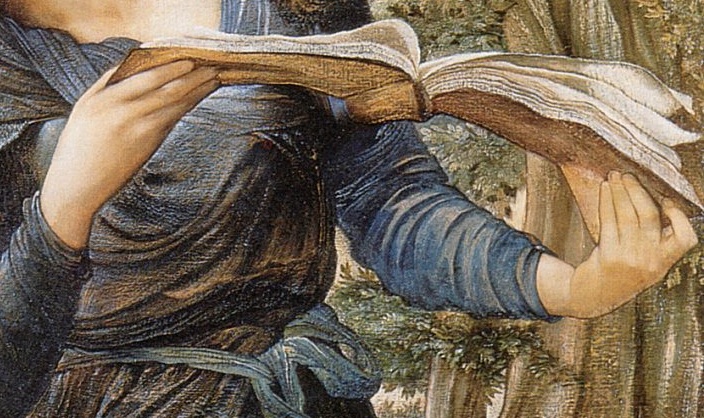
One hand supports the book near the binding; the other holds its outer edge. The long open shape reaches across her chest and out toward the right. It is not a small accessory dangling at her side. Burne-Jones places it between the head that looks toward Merlin and the body that remains upright.
The gesture has a practical clarity. She can hold the pages open, keep them at reading height and turn her attention away without putting them down. What has been learned remains physically in her possession.
Merlin’s knowledge has become portable. It can leave him and continue to operate in another person’s hands. This gives the spell a disturbing logic: the object associated with instruction is also the means by which the instructor loses his freedom.
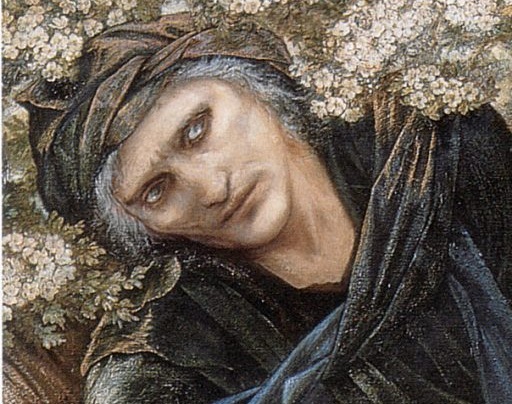
His head tilts at an uncomfortable angle. A cloth wraps around the hair, the eyes turn upward and the face seems to press through the surrounding foliage. He does not look asleep. The open eyes make his confinement feel conscious.
Compare the direction of the two heads. Nimue bends her attention toward him from above, while his gaze rises from a body that cannot follow it. Their eyes help to connect them across the space, but their postures prevent an equal exchange.
The scene can evoke betrayal or desire, yet the painting does not supply a single reliable emotional diagnosis. Merlin’s predicament is unmistakable; the exact mixture of recognition, longing and alarm in his face is harder to fix. Burne-Jones leaves the viewer looking for an answer where the image keeps giving us ambiguity.
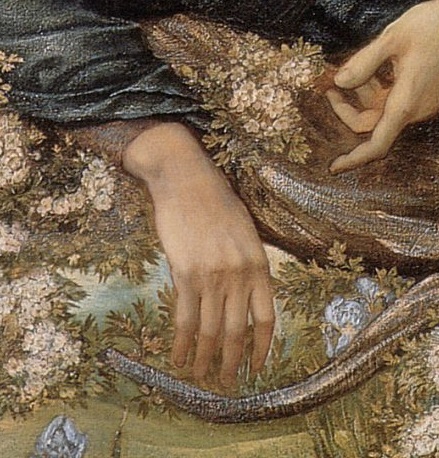
Lower down, a hand hangs beside the flowering branches. Its fingers have little of the active separation visible in Nimue’s hands. They do not grasp the book or tear the tree apart. Their downward movement gives Merlin’s body a sense of weight.
This is one of the details that changes the tree from a decorative setting into a constraint. A branch runs beneath the hand and across the figure’s space. Leaves and blossoms continue their delicate growth around a limb that cannot usefully act.
The contrast is quiet. Burne-Jones does not need shackles when a hand and a branch can show the limit of movement. The same flowering structure that rewards close looking also makes escape difficult to imagine.
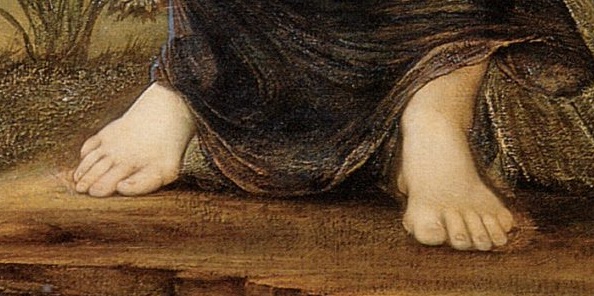
Nimue’s feet emerge below the long blue garment. They rest on the exposed ground at the base of the tree, surrounded by roots and low growth. The dress has wrapped itself into such dense folds that the uncovered feet become a sudden reminder of a human body inside it.
They also make her position different from Merlin’s. She occupies the ground; he occupies the tree. Her feet can support a change of stance, while his limbs are caught in the branches. The painting distributes freedom through ordinary bodily details rather than a written explanation of magical rules.
Across the full composition, the lower strip of earth remains narrow. Neither figure appears to inhabit an open landscape. Even the person who controls the spell is held within a tightly enclosed pictorial world.
Hawthorn blossoms fill much of the space around the figures. They make pale clusters against the grey-green leaves and darker branches. In the foreground, upright flowers answer the elongated shapes of Nimue’s dress and the tree behind her.
A quick glance can make this feel like a luxuriant garden painting. A longer one reveals how little empty air there is. The flowers do not simply surround a drama taking place elsewhere. They are part of the structure through which we experience it.
The beauty makes the confinement harder to dismiss. There is no clear border where an attractive world gives way to a frightening one. Burne-Jones asks us to look at both at once: blossom can remain blossom while belonging to a trap.
The work is generally dated across the years 1872 to 1877; scholarly accounts also describe the main painting campaign as 1873 to 1877. Its first Grosvenor Gallery showing in 1877 is the useful fixed point. The canvas is approximately 187 by 111 centimetres, large enough for the two figures to have a strong physical presence.
The Smarthistory discussion places the work within Burne-Jones’s late Victorian art and the interest in Arthurian subjects. A related head study catalogued by Christie’s identifies Maria Zambaco as the model for Nimue. A model’s identity can inform a work’s history without becoming a key that explains every gesture in the finished painting.
The complete canvas should also be distinguished from those studies. A close study of Nimue’s head cannot show the relation between the book, Merlin’s body, the tree and her grounded feet. The full composition gives those separate details their force.
She is Nimue, the enchantress associated with Merlin’s confinement. Related Arthurian retellings use the name Vivien. The painting focuses on her use of knowledge learned from Merlin.
The original belongs to the Lady Lever Art Gallery in Port Sunlight, part of National Museums Liverpool.
The subject is his magical entrapment. His open eyes and upward gaze are important visible details; the painting does not show a corpse or a death scene.
The title points to enchantment and deception. The reversal of power between the two figures is expressed through the open book and Merlin’s confinement among the branches.
Compare Nimue’s book with the tools in Sandys’s Morgan le Fay and the objects on Medea’s table. All three pictures make magical power visible through things a person can hold or use.
Continue through our guide to 20 famous witch paintings, explore the hand-painted Beguiling of Merlin reproduction, or browse the Magic and Witchcraft collection.
Collection records supply catalogue facts; interpretive possibilities are identified in the text. Full images and detail crops reproduce the historical painting without reconstruction. Collection ownership does not guarantee current display.
Enjoyed this story?
Save articles to your collection
Log in or create a free account, and this article will be waiting in your Private Collection.
Log in or sign up
Man Writing a Letter
Gabriel Metsu, c. 1664
The gallery list
Every painting is already 50% off. Join the list and we will send you an extra $15 code, plus first access to new collections.
No spam. Unsubscribe anytime. · Privacy Policy
Welcome
Your $15 code is on its way. Explore the gallery while you wait.