Loading cart…
No products in the cart.

1831 · Etching; painted versions exist · The Metropolitan Museum of Art, New York (1831 etching)
Save articles to your collection
Log in or create a free account, and this article will be waiting in your Private Collection.
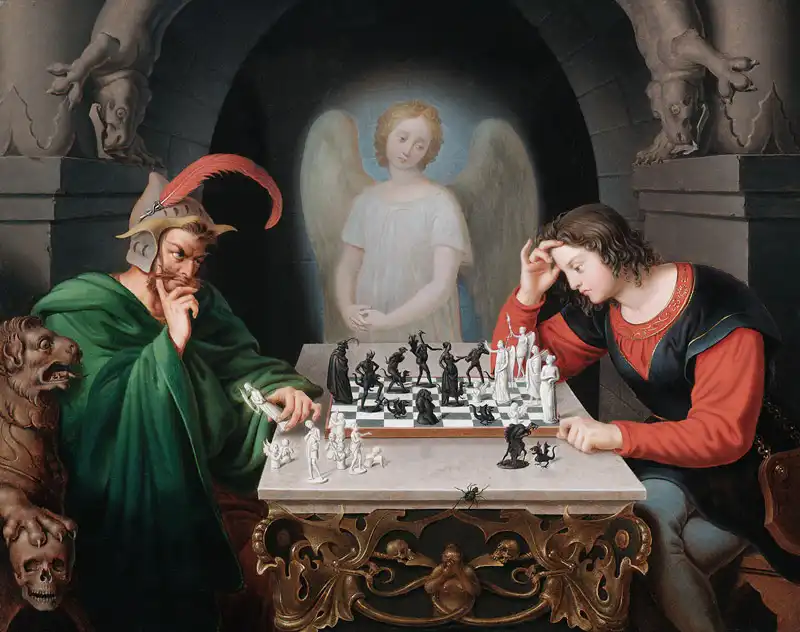
Log in or sign upA young man leans over a chessboard, his forehead pressed against one hand. Across from him sits a figure in a feathered helmet and green cloak. The opponent looks human at first, but the animals, skulls and grotesque faces gathered around him identify the darker side of the game. This is the Devil, and the stake is the young man's soul.
Behind the board, an angel stands in a pool of pale light. The angel does not touch the pieces or interrupt the match. It watches while the young man searches for a move.
Friedrich August Moritz Retzsch called the composition Die Schachspieler, or The Chess Players. The image became famous through an etching published in Leipzig in 1831, then through painted versions and copies. Later audiences supplied more dramatic names, including Satan Playing Chess, The Devil's Checkmate and Morphy's Game.
The documented title is Die Schachspieler, printed in German, French and English as The Chess Players. The Metropolitan Museum of Art holds the 1831 publication, a book of etchings credited to Retzsch with Carl Borromäus von Miltitz as editor and Ernst Fleischer as publisher.
This distinction matters. “Checkmate” is a later nickname, not the title under which the image first appeared. Calling it The Devil's Checkmate makes the ending sound settled before anyone examines the board. Retzsch's title names only the players and leaves the position open.
It is also difficult to name one oil painting as the single original. The print is securely documented in 1831, while painted versions and copies circulated afterward. Sotheby's notes that it is uncertain whether the composition began as a painting or an etching. The image on this page represents the familiar coloured version of the design.
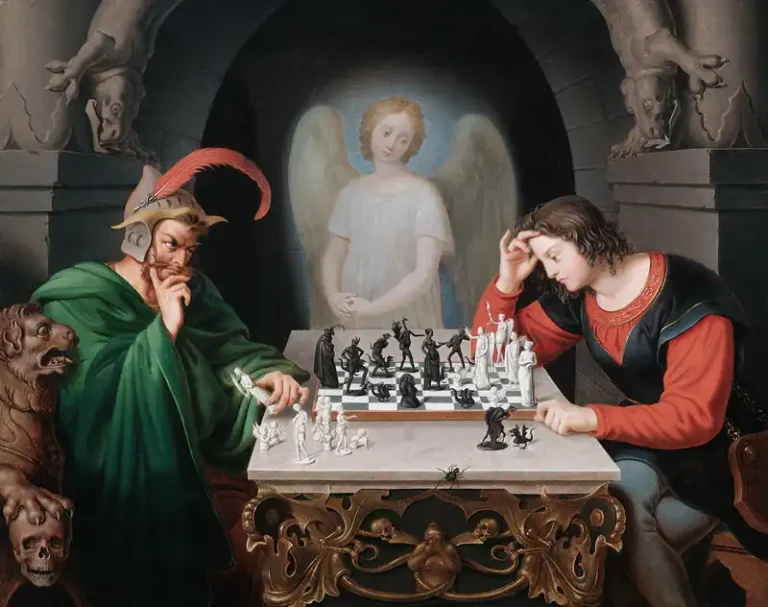
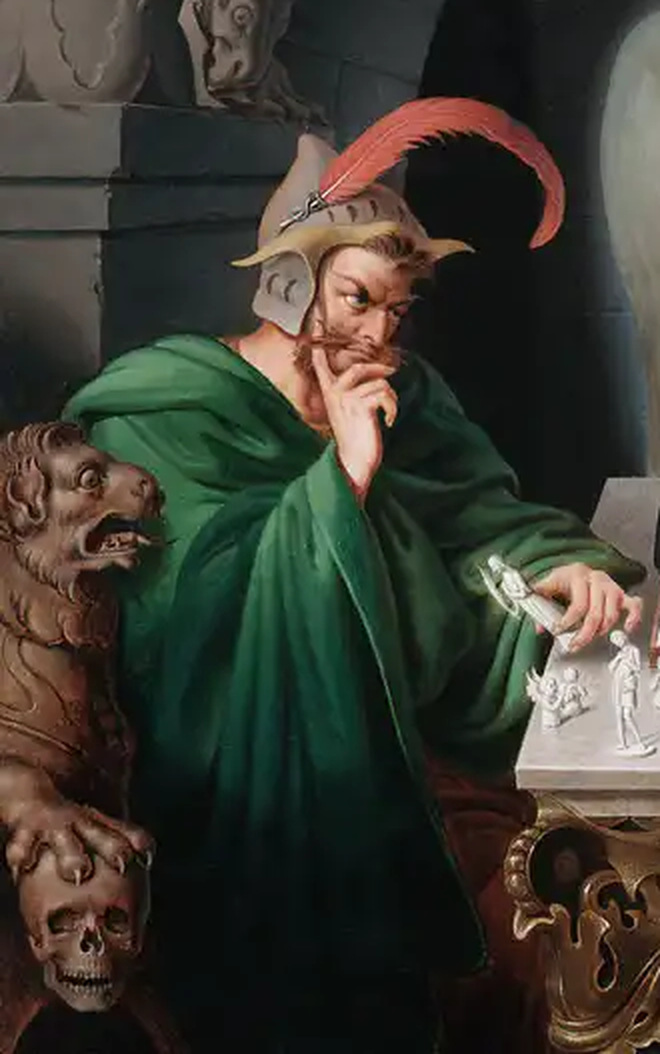
The opponent wears a theatrical helmet and a heavy green cloak, but Retzsch surrounds him with signs that make his identity clear. A snarling animal presses close to his side. Beneath it lies a skull. Grotesque stone creatures crouch above the scene, and dark figures advance across his half of the board.
The British Museum catalogues nineteenth-century images derived from Retzsch's design under the description “Satan playing at chess with man for his soul.” A Metropolitan Museum study likewise describes the composition as a game played by the Devil for the soul of his opponent.
He does not attack the young man with force. He thinks, waits and plays by turns. That is what makes the scene unsettling. Temptation appears as an intelligent opponent who has persuaded the young man to take a seat.
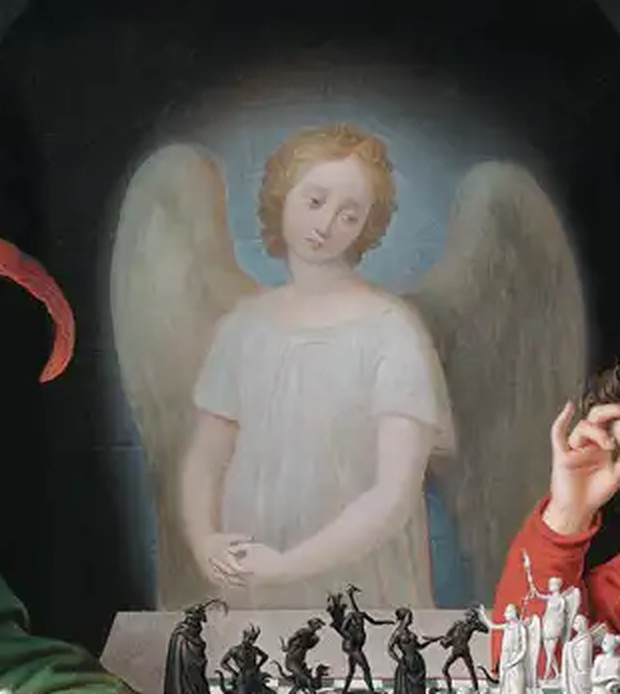
The angel occupies the centre of the image but remains behind the board. Its pale clothing and wings separate it from the dark arch, creating the brightest vertical shape in the composition. The young man does not look back.
The angel can be read as a guardian, conscience or promise of help, but Retzsch does not show it choosing a move. The decision remains with the player. The image therefore sets up a moral drama in which guidance is present without removing human responsibility.
The contrast is carefully arranged. The Devil leans toward the pieces and holds one in his hand. The angel keeps its hands together. One side acts through temptation and calculation. The other waits to be noticed.
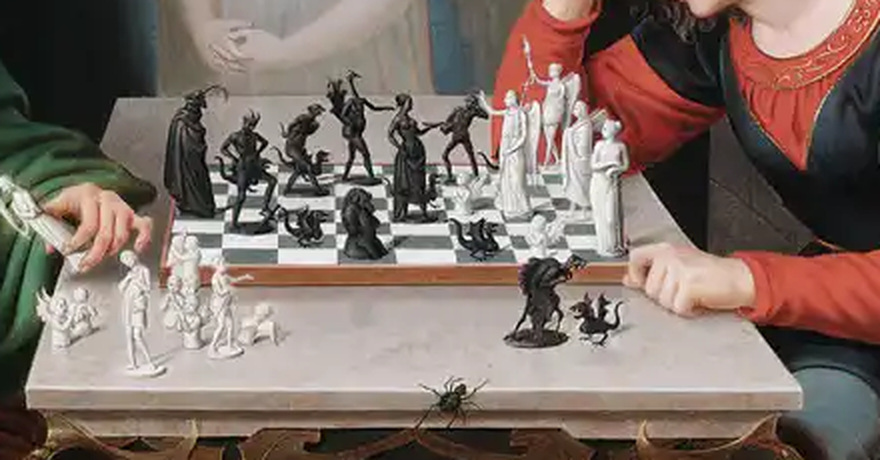
The pieces are miniature figures rather than an ordinary chess set. On the young man's side, white forms include prayerful or angelic figures. On the Devil's side, dark warriors and distorted bodies move across the board. The Metropolitan Museum's discussion of the work describes them as virtues and vices.
This changes the meaning of every capture. The game is not simply intellect against intellect. It is a model of moral life, with habits, choices and temptations represented as pieces that can be protected, sacrificed or lost.
A captured group of white figures stands near the Devil's hand. Their presence helps create the feeling that the young man is in serious danger. Yet the image never supplies a clear, universally agreed chess position. Different prints, paintings and later copies also vary in detail.
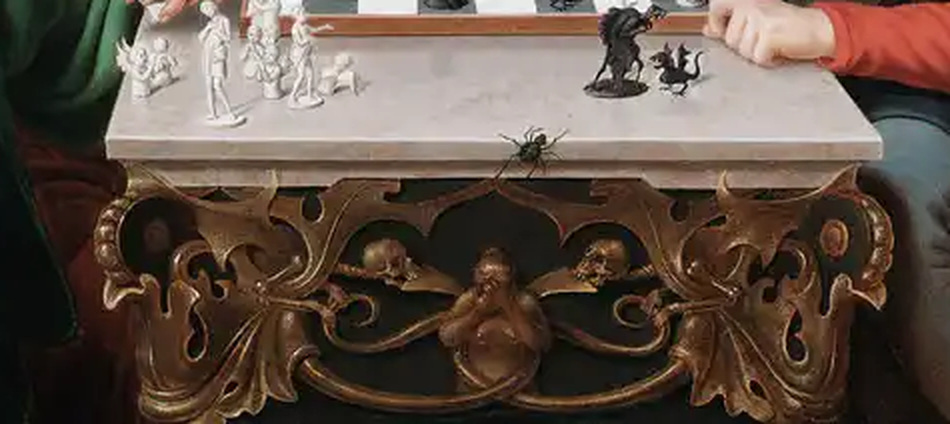
The board rests on an elaborate chest or coffin-like table. A small skull appears beneath the centre, while a crouching creature occupies the carved opening below. The Metropolitan Museum study specifically notes that the game takes place on a board resting on a coffin.
The object turns the contest into a memento mori, a reminder that life ends. Chess already reduces conflict to a limited board governed by time, position and consequence. Placing that board over a coffin makes the final limit visible.
The young man is trying to save more than a king. He is playing above the place where every human game eventually stops.
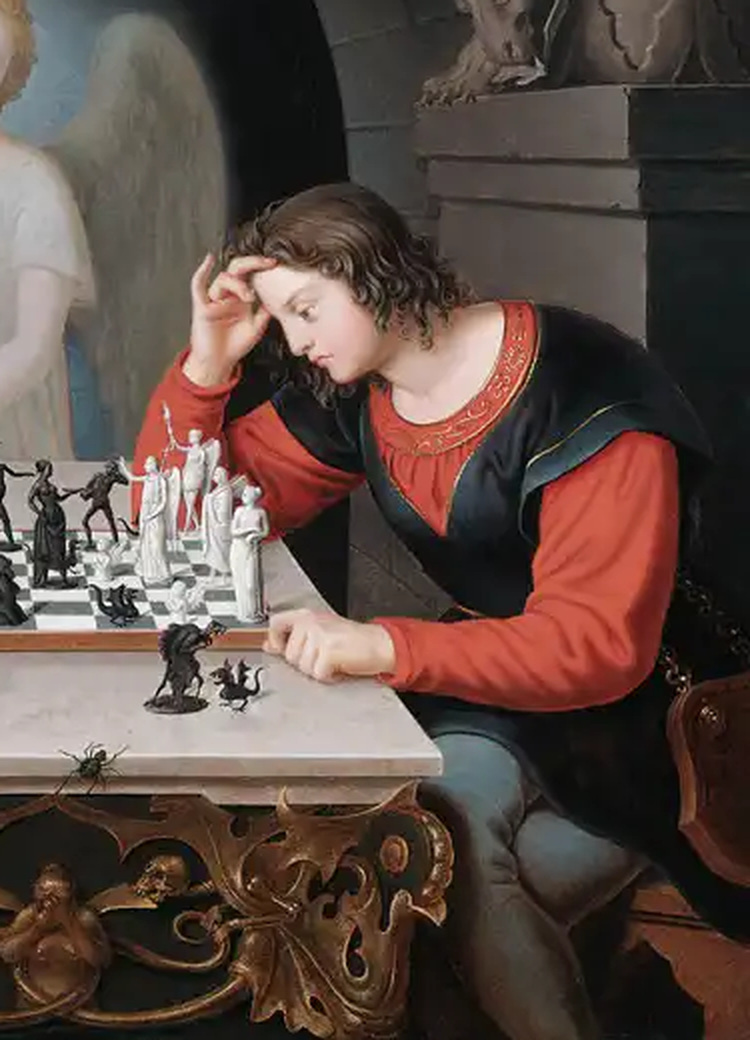
The painting has often been described as a checkmate, but the visual evidence is less certain. The pieces are symbolic figures, some squares are obscured, and different versions of the composition do not always preserve the same details. Even in 1888, readers debating the Morphy story questioned whether the positions could be read clearly enough from an engraving.
That uncertainty may be part of the design. The young man has not surrendered. He continues to study the board while the angel remains behind him. The emotional question is whether despair has arrived before the game is actually over.
What you can see, and what is interpretation: the young man appears endangered, the Devil has captured white pieces, and the game continues. A precise forced win for either side cannot be proved from every surviving version of the image.
The most famous story attached to the image says that American chess master Paul Morphy examined the board while visiting a private home. Other viewers believed the young man had lost. Morphy supposedly studied the position and announced that he could take the young man's side and win. In modern retellings, this becomes the dramatic line: “The king has one more move.”
The story is powerful, but it is not securely documented as an event from Morphy's lifetime. The earliest known printed version appeared in the Columbia Chess Chronicle on 18 August 1888, four years after Morphy died. Letters followed immediately. One reader objected that his engraving did not show the pieces clearly enough to reconstruct the game, while others proposed positions that might support the anecdote.
Sotheby's repeats the traditional account and explains why it endured: it changes an image of apparent defeat into a symbol of strategic hope. Yet a later story, printed after the supposed witness could no longer confirm it, should be treated as a legend rather than a verified quotation from Morphy.
The legend survives because it expresses what viewers want the angel to mean. The young man may feel lost, but help is still present, and the board may contain a possibility he has not yet seen.
Friedrich August Moritz Retzsch was born in Dresden in 1779 and became known as a painter, printmaker and illustrator. His outline illustrations for literary works, especially Goethe's Faust, circulated widely across Europe.
The Chess Players is often connected with Faust because it shows a man in a contest with a devil-like figure. The relationship is thematic rather than literal. Sotheby's notes that the composition was not included among Retzsch's twenty-six engravings for the 1818 Cotta edition of Faust.
Retzsch's strength was narrative clarity. He could arrange a complicated moral idea so that it could be understood at a glance: temptation on the left, anxiety on the right, silent help in the centre, and the human soul represented by a game whose rules invite endless analysis.
The Metropolitan Museum of Art in New York holds the documented 1831 publication of the etchings, measuring 28 by 36.3 centimetres overall. It is not currently on view. Painted versions and many later copies exist in private and institutional collections, which is one reason the composition appears in different colours and with varying details.
The safest way to describe the work is as Retzsch's composition, first securely documented through the Leipzig publication of 1831. The familiar oil versions preserve and expand that design, but the history of which painted version came first remains uncertain.
We recreate The Chess Players by hand in oil on canvas, preserving the young man's tense expression, the luminous angel and the symbolic figures on the board. See the hand-painted oil reproduction.
Enjoyed this story?
Save articles to your collection
Log in or create a free account, and this article will be waiting in your Private Collection.
Log in or sign upVisible details, documented history and later legend are kept separate throughout this article.